Kēres (singular Kēr, Κήρ)
First Appearance
The Keres belong to the first dark generation of the world, the brood of Night. In Hesiod's Theogony (211–225) murky **Nyx** (Night), lying with none, brings forth a train of grim powers — hateful Moros (Doom), and "black Ker," and Thanatos (Death) and Hypnos (Sleep) and the tribe of Dreams; then Blame and Misery, the Hesperides, the Moirai (Fates), and "the ruthlessly punishing Keres" who pursue the transgressions of men and gods and never cease from their dread anger until they have paid out punishment to the wrongdoer. So the Dooms are sisters of Death and Sleep, born of Night herself, with no father. Homer already knows them as a terror of the battlefield: on the Shield of Achilles (Iliad 18.535–538) "deadly Ker" moves among the fighters, clutching now a man freshly wounded and still alive, now one dragged dead by the feet through the slaughter, and the robe about her shoulders is red with the blood of men.
— Hesiod, Theogony 211–225; Homer, Iliad 18.535–538
Who They Are
The Keres (KAIR-eez; singular Ker, KAIR) are the female death-spirits of Greek myth — the dark powers of violent, cruel, and untimely death. Where the gentle brother Thanatos is death itself, the quiet closing of a life, the Keres are death in its most dreadful forms: the slaughter of the battlefield, the carnage of war, the wasting of plague and disease, the doom that comes bloody and before its time. Hesiod names them among the children of Nyx, Night, born with no father alongside Death, Sleep, Doom, and the Fates — so they are among the oldest and darkest beings in the world, kindred to all the shadowed powers that attend the end of mortal life.
In the oldest poetry a kēr is not a named goddess so much as a thing that happens to you: the particular deadly end allotted to each person — your doom, the specific death that is coming for you. Homer speaks constantly of the "doom of death" (kēr thanatoio) hovering over a warrior, catching one man and passing another by; and in a famous passage he tells how Achilles carries "two kēres," a twofold doom, between which he must choose — a long life without glory at home, or a short and glorious death at Troy. From this it is a short step to the Keres as persons: dreadful winged female spirits who haunt the field of battle, described with unforgettable horror in the poetry of war.
For the Greeks pictured them vividly and terribly. In the pseudo-Hesiodic Shield of Heracles a swarm of Keres fights over the dying — dark-robed, gnashing their white teeth, grim and bloody and glaring, each longing to drink dark blood; the moment a man falls wounded or newly slain they sink their great claws into him, his soul goes down to Hades, and they drink their fill before casting the body aside and rushing back into the slaughter for another. They are the vultures of the battlefield made into goddesses — the spirits of the ugly, greedy, blood-drinking death that war deals out. It is important, though, to keep them distinct from the Moirai, the Fates: the Fates spin and measure out the length of a life, but the Ker is the death at the end of it, the dark shape of how and when a life is cut off.
Mythology
Daughters of Night, sisters of Death
The Keres come, like so many of the world's dark powers, from Nyx — Night — who in Hesiod's Theogony (211–225) brings forth her whole shadowed brood alone, lying with no partner. In a single terrible catalogue she bears hateful Moros (Doom), and "black Ker," and Thanatos (Death) and Hypnos (Sleep) and the tribe of Dreams; then Blame and Misery and the Hesperides; then the Moirai (the Fates) and "the Keres, ruthless in vengeance," followed by Nemesis, Deceit, Old Age, and Strife. So the Dooms are sisters to Death and Sleep themselves, and to the Fates — the whole family of powers that attend the ending of mortal life, all children of the primal dark. (Note that Hesiod names both a singular "black Ker" at line 211 and the plural "Keres" at line 217; the Greek slides easily between the one Doom and the many, and both are counted among the offspring of Night.)
In that same passage (Theogony 217–222) Hesiod gives the Keres a moral edge, naming them close beside the Fates as powers who "pursue the transgressions of men and of gods, and never cease from their dread anger until they have paid out evil punishment to whoever has done wrong." Here the Dooms shade toward avengers — the death that overtakes the guilty as their deserts. But this punishing aspect never wholly separates them from their first and plainest meaning, which is simply death itself in its violent, dreadful form.
The doom that comes for each person
In the oldest Greek usage a kēr is intensely personal: it is your death — the particular deadly end allotted to you, the specific way and hour in which your life will be cut off. Homer's battle-poetry is full of this: the "doom of death," kēr thanatoio, hovers close over the fighters, and a man either escapes his kēr for a time or it fastens on him and he falls. It is in this sense that the most famous of all passages about the Keres is spoken. In the Iliad (9.410–416) Achilles tells the embassy that his goddess-mother Thetis has revealed to him that he carries "two kēres" — a twofold doom — toward the day of his death: if he stays and fights at Troy his homecoming is lost but his glory will be undying, and if he sails home his glory is lost but a long life remains to him. Here the kēr is not a monster but a destiny, a mode of death; Achilles' tragedy is that he knows both of his dooms and must choose which one will take him. This is the quiet, inward face of the Keres — the death that belongs to each person, shaped to that one life.
The spirits on the field of battle
But the Keres are also persons, and in the poetry of war they are among the most frightening figures the Greeks ever imagined. On the Shield of Achilles (Iliad 18.535–538), amid the figures of Strife and Tumult, moves "deadly Ker" (kēr oloē): she holds now a man freshly wounded and still living, now one yet unhurt, and now drags a dead man by the feet through the press of battle, and the robe about her shoulders is soaked red with the blood of men. The same dreadful image, almost word for word, stands on the shield of Heracles in the pseudo-Hesiodic Shield of Heracles (248–257), but there the one Doom has become a swarm. The Keres, "dark, gnashing their white teeth, grim-eyed, fierce, bloody, and terrifying," fight one another over the men who are falling, for every one of them longs to drink dark blood; and the instant they seize a man who has dropped wounded or newly slain, one of them flings her great claws about him, his soul goes down to chill Hades, and when they have glutted their hearts with human blood they throw the body down behind them and rush back into the roar of battle after another. This is the Keres at their most vivid: the greedy, blood-lapping spirits of a soldier's death, dragging off the slain, part goddess and part carrion-bird, the very shape of the ugliness of killing.
The Keres and the Fates — a needful distinction
Because they are born together and both have to do with the ending of life, the Keres are easily confused with the Moirai, the Fates — but the Greeks drew a real line between them. The Moirai spin and measure: they allot the thread of a life, its length and its portion, the lot a person is born to. The Keres are the death at the end of the thread — not the measuring of the span but the dark, concrete event of its cutting-off, the manner and the moment of dying, and above all a death that is violent or untimely. A Moira apportions; a Ker strikes. The two stand side by side at the edge of every life — the one deciding how long, the other how it ends — and the poets sometimes name them in the same breath, but the Ker keeps always its particular colour: it is death as a dreadful thing that seizes, not fate as a thread that is spun.
The Keres as plague and the evils of the jar
Beyond the battlefield the Keres were understood more widely as the spirits of every violent and wasting death — above all the diseases and plagues that carry mortals off. Hesiod connects them with this in the myth of Pandora's jar (Works and Days 90–104): once, he says, the tribes of men lived free of toil and of the hard diseases that bring the Dooms upon them — until the woman lifted the lid of the great jar and scattered its griefs abroad, so that now "of themselves diseases come upon men, some by day and some by night, bringing evils to mortals in silence." In this tradition the countless evils loosed from the jar are kin to the Keres: the invisible death-bringing spirits of sickness and misfortune let loose into the world, flitting everywhere among men and striking without warning. It is the Keres in their least martial and most dreadful everyday guise — not the clawed terror of the battlefield, but the silent doom that comes with fever and pestilence.
Weighed in the balance
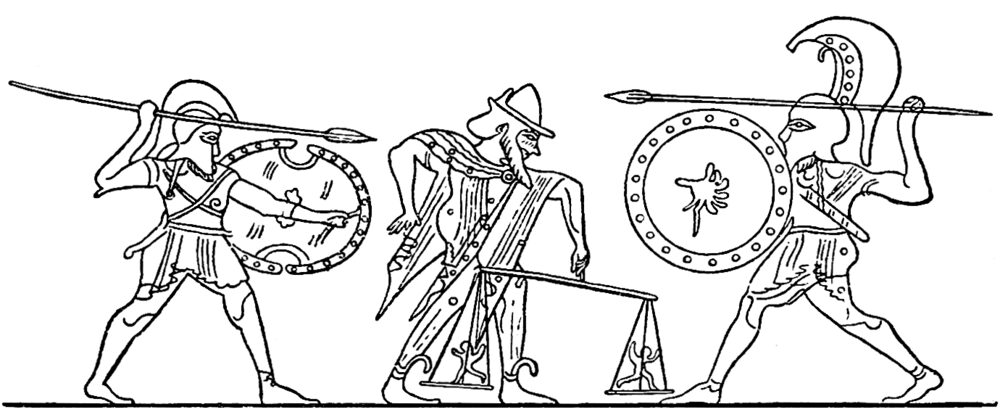
One further image belongs to them, though the sources sometimes blur the kēr with doom and fate in general. Homer twice shows Zeus taking up his golden scales and setting in them "two kēres of death" — two dooms — to see which of two heroes must die: so at the fatal duel the kēr of Hector sinks down heavy toward Hades while that of Achilles rises (Iliad 22.209–213; compare 8.69–74, where the dooms of the Achaeans and Trojans are weighed). The "weighing of the kēres" (kērostasia) makes the Doom a thing that can be set in a balance — the measurable weight of a man's death — and it became a favourite subject of vase-painters, who sometimes show two small winged figures, the kēres themselves, in the pans of the divine scales. Whether the weighed thing is pictured as the spirit or as the fate, the point is the same: the moment of a hero's death is settled, and the heavier doom draws him down.
Worship — Ancient
Powers to be driven off, not courted
The Keres had no bright public cult of their own — no temples, no priesthood, no joyful festival. One does not build a shrine to the spirits of violent death and invite them in. What the Greeks did instead was to ward them off: the Keres belong to the world of apotropaic ritual, the rites of riddance and protection, by which a household or a city tried to keep the death-spirits and the hungry dead outside its doors. Their "worship," such as it was, is really a worship of keeping-away.
"Out, Keres!" — the Anthesteria
The clearest trace of them in Athenian cult comes at the Anthesteria, the ancient three-day festival of Dionysos and the new wine kept in the spring month of Anthesterion. The last day, the Chytroi ("Pots"), had a darker colour than the drinking of the days before: it was a day of the dead, when the spirits of the departed were thought to rise and wander among the living, and offerings of cooked grains and seeds were set out for them. At the festival's close the Athenians drove these spirits back out of their homes with a proverbial cry — "Out of doors, Keres! The Anthesteria is over!" (thyraze Kēres, ouk eti Anthestēria). Houses were protected during the festival by smearing the doors with pitch and by chewing leaves of buckthorn (rhamnos), both thought to repel the death-spirits. (Ancient readers already debated whether the cry banished the Kēres, the death-spirits, or the Kares, Carian slaves given a holiday — but the ritual sense, a dismissal of the thronging dead at a festival of the dead, points to the Keres.) This is the Keres as the Greeks mostly met them in practice: unwelcome guests of the household, to be fed if need be and then firmly sent away.
Kin to the daimones of the dead
More broadly, the line between the Keres and the restless spirits of the dead was never sharp in popular belief. Both were invisible, death-dealing, and apt to crowd about the living and bring harm; and the same protective instinct — the pitch on the door, the warding plant, the words of dismissal — was used against both. In this the Keres are less a cult than a fear woven through daily life: the sense that violent death and the hungry dead hover at the edge of every house, and must be kept at the threshold.
Worship — Modern
Acknowledged, not invited
In the modern revival of Greek religion the Keres keep the place the ancients gave them — powers acknowledged rather than courted. A devotee does not pray to the Dooms for favour; one honours them, if at all, with the gravity owed to the reality of death, and especially of hard, violent, or untimely death. They sit most naturally within rites for the dead and within the protective, apotropaic side of practice: the warding of a home, the marking of the threshold, the quiet dismissal of what should not linger. Where the ancients smeared the door with pitch and chewed buckthorn and cried the Keres out at the Anthesteria, a modern household might keep some small gesture of riddance at a festival of the dead — a cleansing, a boundary drawn, a formal sending-away — in the same spirit.
The Dooms in imagination and language
Far more than through cult, the Keres survive as an idea. They are the Greek face of the truth that death is not always gentle — that alongside the quiet sleep of Thanatos there is the bloody, greedy, untimely death of the battlefield and the plague-house, with its own dark spirits. Their picture — dark-robed, white-toothed, bloody-clawed, dragging the slain and lapping their blood — remains one of the most powerful images of war's horror in all of early poetry, and it stands behind every later vision of death-spirits, valkyrie-like gatherers of the slain, and the carrion-figures that haunt the imagination of the battlefield. And in the distinction the Greeks drew — between the Fate that measures a life and the Doom that ends it — the Keres still mark something true: that how a life is cut off is its own matter, and its own dread.
Epithets & Cult Titles
- Κὴρ μέλαινα (Kēr melaina) — "black Doom" — Hesiod's own phrase for the death-spirit (Theogony 211), where "black Ker" is born of Night alongside Doom (Moros), Death (Thanatos), and Sleep (Hypnos). The darkness is both their colour — they are dark-robed — and their nature, for they belong to the night and the grave
- Κὴρ ὀλοή (Kēr oloē) — "deadly / destroying Doom" — The Iliad's phrase for the single death-spirit who walks the battlefield on the Shield of Achilles (Iliad 18.535), dragging the dead through the carnage with her robe soaked in men's blood — the Doom as a ruining, death-dealing power
- κὴρ θανάτοιο (kēr thanatoio) — "the doom of death" — A formula that runs all through Homeric battle-poetry: the "doom of death" that hangs over a warrior, that he escapes or that catches him. In this everyday epic use the kēr is the moment and manner of a man's dying, hovering close in the fight and fastening on him when his hour comes
Sources & Variants
- Hesiod, Theogony 211–225 (Nyx bears, fatherless, the whole brood of the dark: Moros, black Ker, Thanatos, Hypnos, the Dreams, and the Keres who punish the transgressions of men and gods)
- Hesiod, Works and Days 90–104 (the evils and diseases loosed from Pandora's jar; the diseases 'that bring the Keres upon men,' now coming of themselves in silence)
- Homer, Iliad 18.535–538 (the Shield of Achilles: 'deadly Ker,' robe red with blood, dragging the dead and clutching the dying through the carnage)
- Homer, Iliad 9.410–416 (Achilles' 'two kēres' — the twofold doom between which he must choose, long life without glory or early death with undying fame)
- Homer, Iliad 22.209–213 (Zeus weighs the two kēres of death for Hector and Achilles; Hector's doom sinks down toward Hades); cf. 8.69–74 (the weighing of the dooms of Achaeans and Trojans)
- Pseudo-Hesiod, Shield of Heracles (Aspis) 248–257 (the swarm of dark Keres on Heracles' shield, gnashing white teeth, glaring and bloody, fighting over the dying, each longing to drink dark blood, flinging their great claws about the fallen and dragging the souls down to Hades)
- Scholia and lexica on the Anthesteria; the proverb 'thyraze Kēres, ouk eti Anthestēria' ('Out of doors, Keres! The Anthesteria is over') — the dismissal of the death-spirits at the festival's close, with pitch-smeared doors and buckthorn as apotropaic guards
Gallery