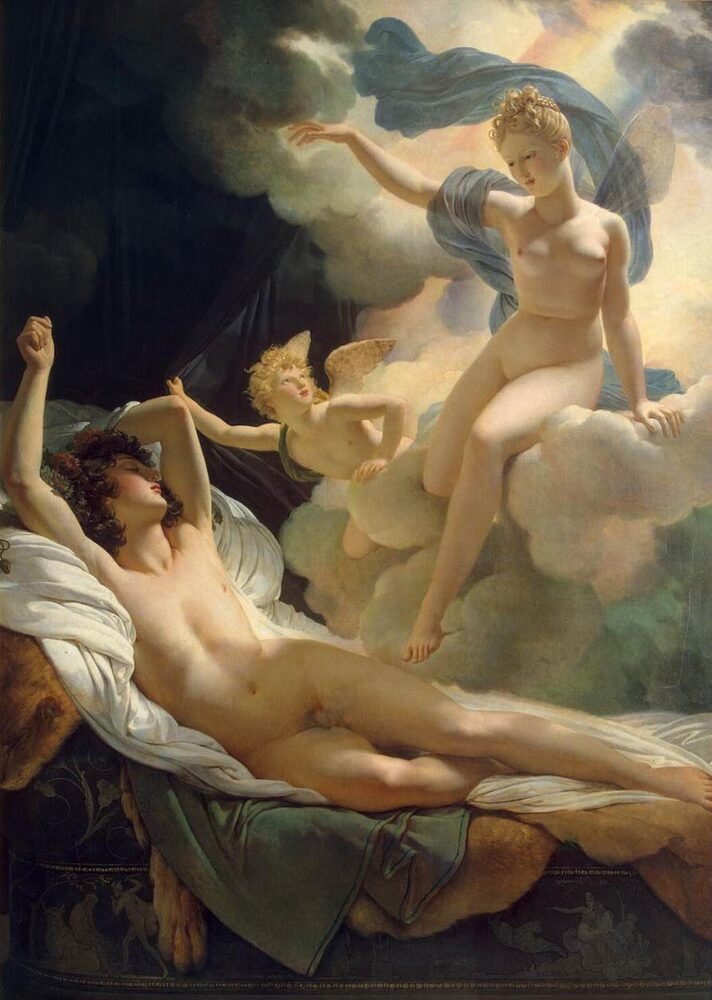
Oneiroi / the Dream-spirits (with Morpheus)
First Appearance
The Dreams enter Greek poetry as a nameless multitude, children of the primal dark. In Hesiod's Theogony (211–212) Night (Nyx) brings forth her grim brood without a father — "Doom and black Fate and Death," and "Sleep (Hypnos), and she bore the tribe of Dreams (phŷla Oneirōn)" — so that dreams are, from the first, the offspring of Night and the kin of Sleep and Death. Homer gives them their most famous image in the Odyssey (19.560–569), where Penelope tells of the two gates through which dreams come to mortals: a gate of sawn Horn, through which pass the dreams that come true, and a gate of gleaming Ivory, through which come the dreams that deceive and whose words find no fulfilment. The individual dream-gods with names — Morpheus and his brothers — belong not to this early Greek stratum at all, but to the Roman poet Ovid, centuries later.
— Hesiod, Theogony 211–212 (Nyx/Night bears the tribe of Dreams); Homer, Odyssey 19.560–569 (the gates of Horn and Ivory)
Who They Are
The Oneiroi (oh-NY-roy; singular oneiros, "a dream") are the dream-spirits of Greek myth — the shapes and visions that come to mortals in sleep, personified as a tribe of winged powers born of Night. In the oldest Greek sources they are not individuals with names and stories but a swarm, a phŷlon or "tribe" of Dreams, counted among the dark children whom Nyx (Night) brought forth alone, the sisters and brothers of Sleep, Death, Doom, and the other powers of the night (Hesiod, Theogony 211–212). To the Greek mind a dream was a thing sent and a thing that arrived — it "stood over" the sleeper's head, spoke, and departed — and so dreams were naturally imagined as living messengers, spirits who fly up out of the dark to settle on a dreaming mind and then are gone by morning.
Two great images shaped how the Greeks pictured the realm of dreams. The first is Homer's: the two gates through which dreams pass to mortals, a gate of Horn for the dreams that come true and a gate of Ivory for the dreams that lie (Odyssey 19.560–569) — a distinction between the true vision and the empty one that runs through all later thinking about dreams. The second is the dim geography of the dream-world itself, the land of dreams (dēmos oneirōn) that the Odyssey sets out at the edge of the world, past the streams of Ocean and the gates of the Sun, near the borders of the dead (Odyssey 24.11–12). The Oneiroi dwell there in the dark and fly out to visit sleepers.
The named dream-gods that modern readers know best — Morpheus the shaper of human forms, Phobetor (or Ikelos) who becomes beasts, and Phantasos who becomes lifeless things — are a different and later layer, and honesty about the sources requires saying so plainly. They are the literary invention of the Roman poet Ovid, who in the Metamorphoses (11.592–649) gave Sleep a thousand sons and singled out three with names and offices. The Greeks personified Dreams as a tribe; it was Ovid who gave three of them faces. This page keeps the two layers distinct — the Greek Oneiroi of Hesiod and Homer first, and Ovid's Morpheus and his brothers named for what they are: a brilliant Roman elaboration, not an ancient Greek cult.
Mythology
The children of Night
In the earliest Greek account the Oneiroi are the offspring of Nyx (Night), born of her alone without a father, in the same dark birth that produced Hypnos (Sleep) and Thanatos (Death). Hesiod lists them simply as a group — "the tribe of Dreams" (phŷla Oneirōn) — set among Night's other children: Doom, black Fate, Death, Sleep, Blame, Woe, the Hesperides, the Moirai, Nemesis, and the rest (Theogony 211–225). This placing tells us how the Greeks understood dreams: not as private tricks of the mind but as powers of the night, kin to sleep and death, come up from the same primordial darkness. The tragic poets kept this parentage and gave it a vivid epithet — Euripides calls on "the mother of black-winged dreams" (Hecuba 70–71), picturing the Oneiroi as dark-feathered spirits that fly up out of Night. There is no father in the Greek tradition and no single mother but Night; the Dreams are hers, a countless brood rather than a family of named gods.
The land of dreams and the gates of Horn and Ivory
Homer gives the Oneiroi their lasting geography and their most famous law. In the Odyssey the dream-world lies at the very edge of things: when Hermes leads the souls of the dead, they pass "beyond the streams of Ocean and the White Rock, past the gates of the Sun and the land of dreams (dēmos oneirōn)" on their way to the meadow of asphodel (Odyssey 24.11–12). The Dreams dwell out there in the half-light, on the frontier of the living and the dead. And in the Odyssey's most quoted passage on dreams, Penelope — uncertain whether to trust a hopeful dream of Odysseus's return — sets out the two gates through which dreams reach mortals (19.560–569): "Two gates there are for shadowy dreams, and one is fashioned of horn and one of ivory. The dreams that pass through the sawn ivory deceive, bearing words that go unfulfilled; but those that come forth through the polished horn bring true things to pass, when any mortal sees them." The Greek ear caught a pun in it — keras ("horn") chimes with krainō ("to fulfil"), and elephas ("ivory") with elephairomai ("to deceive") — so that the very words for the gates carry their meaning. The distinction between the true dream and the empty one, figured as these two gates, became one of the most enduring images the Greeks ever made.
The named dream-gods: Morpheus, Phobetor, Phantasos (a Roman naming)
The dream-gods with names and distinct powers are the invention of the Roman poet Ovid, and are nowhere found in the early Greek sources — this must be said clearly, because the names are now so famous that they are often mistaken for ancient Greek gods. In the Metamorphoses (11.592–649) Ovid describes the cave of Somnus (Sleep, the Roman Hypnos), through which the stream of forgetfulness (Lethe) murmurs and before whose door the poppies grow, and gives Sleep "a thousand sons," the Somnia (Dreams). Of these he singles out three as the most skilful at counterfeiting:
- Morpheus (from Greek morphē, "form, shape") is "the artist and mimic of human forms" — he can take on any person's face, gait, voice, and very dress, and so appear in a dream as a known man or woman. He imitates only people.
- Ikelos — "whom the gods call Ikelos, but mortal men call Phobetor" (from phobos, "fear") — becomes beast and bird and the long serpent; his are the dreams of animals and of terror.
- Phantasos (from phainō, "to appear") takes the shapes of lifeless things — earth, rock, running water, timber, "and whatever lacks a soul."
So Ovid divides the whole content of dreams three ways — people, beasts, and inanimate things — and gives each a dream-god. It is an elegant poetic system, and a late one. The Greek Oneiroi were a faceless multitude; it was Ovid who gave three of them names and specialities, and Morpheus — "the Shaper" — who caught the imagination of every later age.
Morpheus and the dream of Ceyx (Ovid — the one story)
Ovid built his dream-gods for a single purpose: the tragic tale of Ceyx and Alcyone (Metamorphoses 11), the only narrative in which a named dream-god acts. When King Ceyx drowns at sea, the goddess Juno (the Roman Hera), unwilling that his widow Alcyone keep praying to a dead man, sends her messenger Iris down to the cave of Sleep with an order: that a dream be sent to Alcyone to tell her the truth. Sleep rouses Morpheus, the one most gifted at wearing a human shape, and Morpheus flies to Alcyone's bedside in the form of her drowned husband — naked, dripping, deathly pale — and standing over her in sleep speaks with Ceyx's own voice to tell her that he is dead and bid her mourn. She wakes weeping, goes to the shore, finds his body borne in on the waves, and the two are at last transformed into the halcyon birds. It is a Roman story, and the dream in it does exactly what the Greek Oneiroi were always imagined doing — standing over the sleeper's head and speaking — but now through a god with a name and a particular art.
True dreams and false — and the ivory gate in the Aeneid
The Homeric contrast of the two gates was taken up, and pointedly used, by the Roman poet Virgil. At the close of the great descent to the underworld in the Aeneid (6.893–898) he describes the "twin gates of Sleep," one of horn by which true shades pass up to the living, one of gleaming ivory "through which the spirits send false dreams to the world above" — and then, famously and puzzlingly, sends his hero Aeneas back up to the daylight through the ivory gate, the gate of false dreams. Scholars have argued ever since about what Virgil meant by it (that the vision came before midnight? that the whole prophecy is somehow to be doubted? that Aeneas is not a true shade?), but the image itself is borrowed straight from Homer's Penelope. Both the Greek original and the Roman reworking turn on the same unease: that not every dream can be trusted, that the night sends true visions and lying ones through gates that look alike, and that the dreamer cannot always tell which gate a dream has come by.
The kin of the Dreams: Sleep, Night, and the house of dreams
The Oneiroi were never worshipped or imagined apart from their family. They are the children of Nyx (Night) and the close kin of Hypnos (Sleep), in whose house or beside whose cave they dwell — in the Greek sources as Night's own brood, in Ovid's Roman reworking as the thousand sons of Sleep himself. Through Sleep they are bound to his twin Thanatos (Death), so that the Greek night holds Sleep, Death, and Dreams together as a single company of dark powers. A dream, in this way of seeing, is not a thing the mind makes but a thing that comes — up out of the land of dreams at the world's edge, in through the gate of horn or the gate of ivory, to stand over the sleeper and speak, and then to fly back into the night from which it came.
Worship — Ancient
Powers heeded rather than worshipped
The Oneiroi had almost no cult of their own. There were no temples of the Dreams, no priesthood, no festival; they were powers that the Greeks heeded rather than ones they petitioned at an altar. What devotion they received came through their kin and through the practice of attending to dreams as messages from the gods. A dream that "stood over" a sleeper and gave a command or a warning was treated as a genuine divine communication, to be reported, interpreted, and obeyed — and so the real "worship" of the Oneiroi lay in taking dreams seriously, giving thanks for a true one, and guarding against the false.
Incubation: sleeping for a dream
The nearest thing to a cult of dreams was incubation (enkoimēsis, "lying down to sleep"), the rite of sleeping within a sacred precinct in the hope that a god would send a healing or answering dream. This belonged above all to Asklepios, the healing god: at his great sanctuary of Epidaurus the sick slept in the holy hall (the abaton) and waited for the god to appear in a dream and cure them or prescribe a remedy, and the walls were hung with tablets recording the dreams and the cures. It belonged too to the oracular hero Amphiaraos at Oropos, where (Pausanias 1.34.5) an enquirer purified himself, sacrificed a ram, spread its fleece on the ground, and slept upon it to receive the answer in a dream. In these places the dream was the oracle, and the Oneiroi — though rarely named — were its bearers.
The reading of dreams
Because dreams might come true or deceive, the Greeks developed a whole art of dream-interpretation (oneirokritikē). Its great surviving monument is the Oneirocritica of Artemidorus of Daldis (second century AD), a vast handbook sorting dreams by type and reading their meanings, which carefully distinguishes the significant, prophetic dream (the kind that comes through Homer's gate of horn) from the empty dream born of the day's cares or the body's state. The distinction the poets drew between true and false dreams thus became the working principle of a practical science: the task of the skilled interpreter was, in effect, to tell which gate a dream had come through.
Worship — Modern
Morpheus in the language of sleep
Of all the dream-spirits it is Morpheus who survived most vividly, chiefly through a single phrase: to fall asleep is to pass "into the arms of Morpheus." Though his name and office were Ovid's late invention rather than ancient Greek cult, Morpheus became the common literary personification of sleep and dreaming from the Middle Ages onward, and the phrase is still current in English. His name also lives in science: the sedative drug morphine, isolated in the early nineteenth century and named by its discoverer for Morpheus because it brings sleep and dreams, carries the dream-god's name into every pharmacy. The Greek root morphē, "shape," which gave Morpheus his name as the shaper of dream-forms, runs on as well — in "morph," "metamorphosis," "amorphous," and the rest.
The two gates, still standing
Homer's image of the gates of horn and ivory has never left Western literature. It is quoted or echoed wherever a writer wants to ask whether a dream or a vision can be trusted — in Virgil, in Plato, in the poets of every later age who send a true dream through the horn and a lying one through the ivory. The phrase "gates of horn and ivory" is still used for the difference between the true intimation and the deceiving one, and the passage is among the most commented-on in all of Homer.
The dream-spirits in modern imagination
For modern readers the Oneiroi reach their widest audience through fantasy and fiction, where "Morpheus" has become a standard name for a lord of dreams — most famously as the central figure of a celebrated modern comics series, and borrowed again for the dream-waking guide of a well-known film. In Hellenic polytheist practice, where it exists, the Dreams are honoured lightly and always alongside Hypnos (Sleep) and Nyx (Night) — a candle or an offering before sleep, a prayer for true dreams and against the dreams that deceive and terrify, and the old, serious habit of treating a vivid dream as something that may have been sent, and worth attending to in the morning.
Epithets & Cult Titles
- Ὄνειροι (Oneiroi) — "Dreams" — The group-name itself: the dream-spirits, the tribe of Dreams whom Night brought forth. To name "the Oneiroi" is to speak of dreams as living powers that come and go from a sleeper, each one a shape sent to the mind in the dark
- melanopteryges (μελανοπτέρυγες) — "black-winged" — The dreams called "black-winged" children of Night by the tragic poets; Euripides invokes "the mother of black-winged dreams" (Hecuba 70–71). The image is of dark-feathered spirits flying up out of the night to settle on a sleeper
- Morpheus (Μορφεύς) — "the Shaper, the Fashioner" — From morphē (μορφή), "form, shape" — the dream-god who takes on human forms, mimicking a person's face, voice, walk and dress so perfectly that the sleeper thinks a known man or woman stands before them. His name and office are the invention of the Roman poet Ovid (Metamorphoses 11.635)
- Ikelos / Phobetor (Ἴκελος / Φοβήτωρ) — "the Like-one" / "the Frightener" — The second named dream-god, whom (says Ovid) "the gods call Ikelos, and mortals Phobetor" — Ikelos from eikelos (εἴκελος), "resembling," and Phobetor from phobos (φόβος), "fear." He takes the shapes of beast and bird and long serpent, and so brings the dreams of terror. Ovid's naming (Metamorphoses 11.638–640)
- Phantasos (Φάντασος) — "the Apparition" — The third named dream-god, from phainō / phantasia (φαίνω, φαντασία), "to appear / appearance." Where Morpheus becomes people and Phobetor becomes beasts, Phantasos becomes the inanimate things of a dream — earth, rock, running water, timber. Ovid's naming (Metamorphoses 11.641–643)
Sources & Variants
- Hesiod, Theogony 211–212 (Nyx/Night, without a father, bears Hypnos/Sleep and 'the tribe of Dreams' — phŷla Oneirōn — among her dark children)
- Homer, Odyssey 19.560–569 (Penelope on the two gates of dreams: the gate of Horn for dreams that come true, the gate of Ivory for dreams that deceive)
- Homer, Odyssey 24.11–12 (the souls of the dead pass the streams of Ocean, the White Rock, the gates of the Sun, and the 'land of dreams,' dēmos oneirōn)
- Euripides, Hecuba 70–71 (invocation of Earth/Night as 'the mother of black-winged dreams' — the Oneiroi as dark-winged children of Night)
- Ovid, Metamorphoses 11.592–649 (the cave of Somnus/Sleep; his thousand sons the Somnia; the three named dream-gods — Morpheus the mimic of human forms, Ikelos/Phobetor who becomes beasts, Phantasos who becomes lifeless things; Morpheus sent in Ceyx's shape to Alcyone) — Roman, and the source that first NAMES the dream-gods
- Virgil, Aeneid 6.893–898 (the twin gates of Sleep, of horn and ivory, through the ivory of which false dreams are sent — and by which Aeneas departs) — Roman
- Hyginus, Fabulae preface (the Somnia/Dreams reckoned children of Sleep, or of Night and Erebus) — Roman
- Pausanias, Description of Greece 1.34.5 (incubation at the dream-oracle of Amphiaraos at Oropos: the ram's fleece and the answering dream); 2.27 (the incubation-cures of Asklepios at Epidaurus)
- Artemidorus of Daldis, Oneirocritica (the ancient art of dream-interpretation, distinguishing the true, prophetic dream from the empty one) — 2nd century AD
Gallery