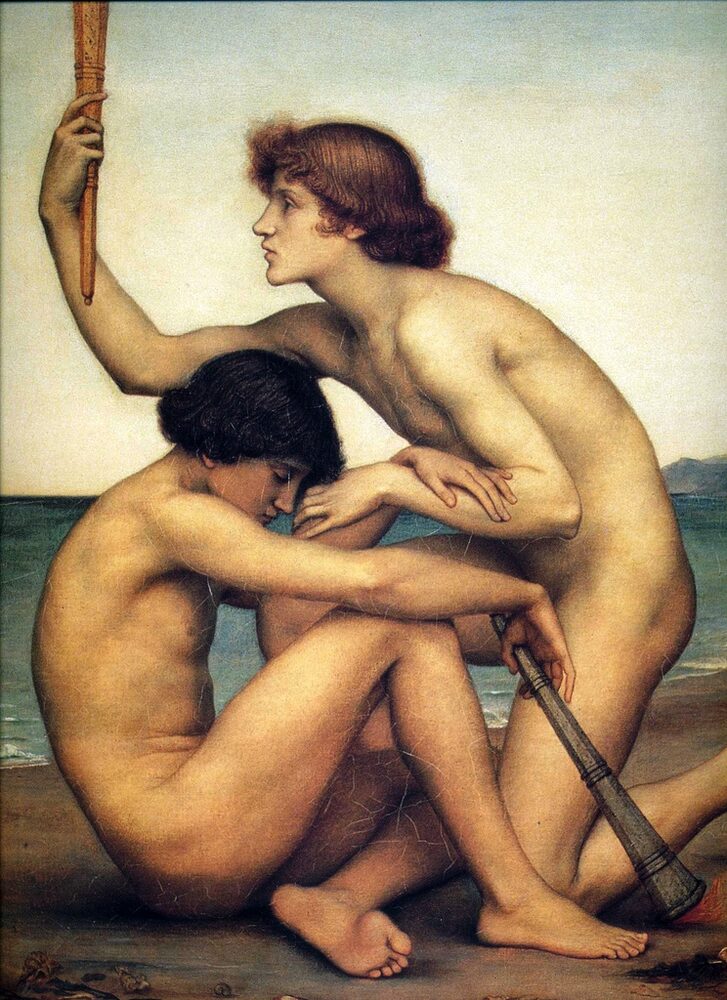
Phōsphoros / Hesperos
First Appearance
The pair enter Greek poetry at the birth of the stars themselves. Hesiod tells how Dawn (Eos) lay with the Titan Astraeus, the "star-father," and bore first the Winds — Zephyros, Boreas, and Notos — "and after these Erigeneia [the Early-born, Eos] bore the Dawn-bringer, Eosphoros, and the shining stars with which the heaven is crowned" (Theogony 378–382). The Morning Star is thus a child of the Dawn, brother of the winds and of all the stars of the sky; and Hesperos, the Evening Star, is of the same celestial kin.
— Hesiod, Theogony 378–382
Who They Are
Phosphorus and Hesperus (FOSS-for-us and HESS-per-us) are the Morning Star and the Evening Star — the one bright wandering light that goes up in the east before the sun, and the one that hangs low in the west after sunset. To the early Greeks these were two radiant children of the sky: Phosphoros (also called Eosphoros, "Dawn-bringer"), who rises ahead of his mother Eos, the Dawn, to herald the coming day; and Hesperos, the gentle, beautiful star of evening that leads out the whole host of stars as the light fails. Both are sons of the Dawn and of the Titan Astraeus, the star-father, and so brothers of the Winds and of all the other stars (Hesiod, Theogony 378–382).
They are gathered here on a single page because, in the end, they are a single thing. The Morning Star and the Evening Star are not two bodies but one — the planet we call Venus, the brightest wanderer of the sky, which the Greeks came in time to recognise as one star wearing two names and two offices, rising before dawn for part of the year and setting after dusk for another. That recognition — that Phosphoros and Hesperos are the same — became one of the most famous facts the ancients handed down, and much later a favourite example of the philosophers, who used "the Morning Star is the Evening Star" to show how one thing may be known under two names.
So their story is double: two beautiful star-figures of myth, brothers born of the Dawn, each keeping one hinge of the day — and behind them a single brilliant planet, the first light seen at dusk and the last at dawn.
Mythology
The children of the Dawn and the Star-father
In the oldest telling the stars are born, like everything else, into a family. Hesiod relates how Eos, the Dawn, mother of the morning, lay with the Titan Astraeus — whose name means "starry," the father of the stars — and bore to him first the great Winds, and then the lights of the sky: "after these Erigeneia bore the Dawn-bringer, Eosphoros, and the gleaming stars with which the heaven is crowned" (Theogony 378–382). The Morning Star is therefore the eldest and brightest of the Dawn's star-children, named for the very office he keeps — to bring the dawn. Hesperos, the Evening Star, belongs to the same lineage of the sky, a shining son of Astraeus and Eos and brother of the winds and the stars. (Eos had another radiant son, Phaethon, "the shining one," born later to her and the hunter Cephalus, Theogony 986–991; some ancient writers blurred this gleaming child of the Dawn with the morning star, but the star proper is Eosphoros.)
Phosphoros, the Morning Star — herald of the Dawn
The Morning Star's whole character is in his name. As Eosphoros ("Dawn-bringer") and Phosphoros ("Light-bringer") he is the star that climbs the eastern sky just before the sun, the first announcement of day while the world is still dark. Homer sets him at exactly that hour: in the funeral night of Patroclus, the pyre burns down "at the hour when the Morning Star (Heosphoros) goes forth to herald light over the earth, and after him Dawn in her saffron robe spreads over the sea" (Iliad 23.226–227). He goes before his own mother, running ahead of Eos's chariot to open the gates of the morning — the torch-bearer of the day, carrying light up out of the night. Later poets pictured him as a winged youth bearing a torch, leading the Dawn's horses up the sky.
Hesperos, the Evening Star — fairest of all the stars
His evening counterpart is a quieter, lovelier figure. Homer gives Hesperos the most beautiful of all descriptions of a star: the gleam of Achilles' spear-point, he says, shone "like the Evening Star (Hesperos) that is set in heaven, the fairest star of all" (Iliad 22.317–318). Hesperos is the star of dusk, the first light to appear as the sky darkens, and he leads out after him the whole host of the other stars, as a herdsman leads his flock. And where the Morning Star opens the day, the Evening Star closes it and gathers its creatures home — a note Sappho caught in a famous fragment: "Hesperos, you bring home all that the shining Dawn scattered abroad; you bring the sheep, you bring the goat, you bring the child back to its mother" (Sappho fr. 104a). He is the star of homecoming, of rest, of the fold at nightfall — placid, beautiful, and kind.
One star, two names: the single wanderer
The deepest truth of the pair is that they are one. The brilliant light that rises before dawn for part of the year and the brilliant light that lingers after sunset for another part are the same celestial body — the planet Venus, the brightest of the five wanderers (planētes, "wanderers") the Greeks counted in the sky. In the earliest poetry Phosphoros and Hesperos are treated as two; but Greek observers came in time to know them for a single star, and antiquity credited this discovery to the early philosophers (it is assigned variously to Pythagoras and to Parmenides). The later naturalists state it plainly: the planet of the morning and the planet of the evening are one and the same, called by the Romans Lucifer when it goes before the sun and Vesper when it follows it down (as Pliny sets out, Natural History 2.36–37). This identity — "the Morning Star is the Evening Star" — became one of the most celebrated facts of ancient astronomy, and long afterward a favourite example among philosophers of how a single thing can be truly known under two different names. The planet is also the star of Aphrodite, the goddess of love, whose brightness and beauty the Greeks felt fitted the goddess, so that Venus's star and the goddess of desire were linked.
Hesperos and the Hesperides; the later lines (a Roman note)
Because Hesperos is the star of the west and of evening, later tradition made him the father of the Hesperides, the "daughters of Evening," the nymphs who guard the golden apples in the far western garden at the edge of the world (in Diodorus Siculus 4.27 they are the daughters of Atlas and Hesperis, and so granddaughters of Hesperos through their mother). In Roman poetry the Evening Star — as Lucifer, confusingly keeping the morning-name — is made the father of mortal kings: of Ceyx, the gentle king of Trachis, and of Daedalion, in Ovid's telling (Metamorphoses 11.271–345), where Lucifer grieves for his transformed children. These paternities belong to the later and Roman strands of the myth rather than to the early Greek sources, where Phosphoros and Hesperos are above all the two faces of the bright star, the children of the Dawn who keep the morning and the evening of the world.
Worship — Ancient
Stars honoured at the hinges of the day
Phosphorus and Hesperus had no great temples or civic festivals of the kind the Olympians enjoyed; they belonged to the sky and to the eye rather than to the altar. Their honour lived in the two turning-points of the day they governed — the first light before dawn and the first star of dusk — moments naturally marked by the lifting of a lamp, the pouring of a libation, or a glance of recognition at the bright wanderer low on the horizon. As the star of Aphrodite, the evening light shared in the atmosphere of the goddess of love; and as the herald of the sun, the morning star was greeted by those who rose before dawn.
In poetry and song
Their truest cult was poetic. From Homer and Hesiod to Sappho and the later lyric poets, the two stars were among the most beloved images in Greek verse — the Morning Star as the herald of light and labour, the Evening Star as the bringer of rest and homecoming and the companion of lovers and weddings (Hesperos presided over the evening, the hour of the marriage-feast). To name the fairest of stars, a Greek poet reached for Hesperos; to mark the edge of night, for Eosphoros.
Worship — Modern
The star anyone can find
Of all the figures of Greek myth, Phosphorus and Hesperus are among the easiest to honour, because they are still plainly in the sky: the brilliant "star" low in the west after sunset, or low in the east before dawn, is the planet Venus — the very light the Greeks called Hesperos and Phosphoros. A modern devotee can keep them exactly where the ancients did, at the two hinges of the day: a word, a lifted lamp, or a poured libation at the first evening star or the last morning one. They sit well as patrons of thresholds and turning-points — of beginnings (the dawn-bringer) and of homecoming and rest (the gatherer of evening).
Two names, one light
Their deepest gift to later thought is the lesson of their single identity: one bright body, known by two names and two offices, morning and evening. The pair became a standing example in philosophy of how a thing may be met under different names and still be one — a quiet reminder, drawn from the oldest skywatching, that the herald of the day and the star of homecoming are, after all, the same light.
Epithets & Cult Titles
- Eōsphoros / Heōsphoros (Ἑωσφόρος) — Dawn-bringer — the oldest Greek name for the Morning Star, the form Hesiod and Homer use; the star that goes up before the sun to herald the light over the earth
- Phōsphoros (Φωσφόρος) — Light-bringer / Light-bearer — the common later name for the same morning star, carrier of the coming day; the direct source of the Latin Lucifer
- Hesperos (Ἕσπερος) — The Evening Star — 'the fairest star set in the sky' (Homer, Iliad 22.317–318), the star of dusk that gathers the day's scattered things home
- Lucifer / Vesper — The Latin names of the two stars — Lucifer ('light-bearer') for the morning, Vesper ('evening') for the dusk; used here only to note the Roman line of the names, not to lead with them
Sources & Variants
- Hesiod, Theogony 378–382 (Eos bears to Astraeus the Winds and then Eosphoros, the Dawn-bringer, and the shining stars of heaven)
- Hesiod, Theogony 986–991 (Eos bears to Cephalus the radiant Phaethon — Eos's other 'shining' son, sometimes confused with the morning star)
- Homer, Iliad 23.226–227 (the Morning Star, Heosphoros, goes forth to herald light over the earth, with Dawn behind him)
- Homer, Iliad 22.317–318 (the gleam of Achilles' spear like Hesperos, 'the fairest star set in heaven')
- Sappho, fragment 104a (Hesperos brings home all that the Dawn scattered — the sheep, the goat, the child to its mother)
- Diodorus Siculus, Bibliotheca 4.27 (the Hesperides as daughters of Atlas and Hesperis, hence granddaughters of Hesperos)
- Pliny the Elder, Natural History 2.36–37 (the one planet called Lucifer when it precedes the sun and Vesper when it follows it — the Morning and Evening Star are one) — Roman
- Ovid, Metamorphoses 11.271–345 (Lucifer the Morning Star as father of Ceyx and Daedalion) — Roman
Gallery