Anemoi / the Winds
First Appearance
The named winds first appear in Hesiod's Theogony (378–380), where Eos (Dawn) bears to Astraeus ("Starry") the strong-blowing winds Zephyrus, Boreas, and Notus — the three well-born winds, "a god-descended race." Later in the same poem (869–880) Hesiod carefully sets these apart from the other, lawless winds that blow at random from the monster Typhoeus and bring only disaster to sailors; the good winds are of divine birth, the bad ones are not. In Homer the winds are already living powers who must be prayed to and fed: in the Iliad (23.192–230) Achilles begs Boreas and Zephyrus to come and set alight the pyre of Patroclus, and Iris carries the message to them as they feast together in the house of Zephyrus; and in the Odyssey (10.1–75) Aeolus, keeper of the winds, ties all the contrary winds up in a leather bag for Odysseus.
— Hesiod, Theogony 378–380 and 869–880; Homer, Iliad 23.192–230 and Odyssey 10.1–75
Who They Are
The Anemoi (uh-NEM-oy), in Greek the Ἄνεμοι, "the Winds," are the four wind-gods of Greek myth, one for each quarter of the sky — and like several of the oldest Greek powers they are at once natural forces and persons, the wind you feel on your face and a god you can pray to, feast, or anger. There are four of them in the classic reckoning, named for the direction they blow from: Boreas the North Wind, Notus the South Wind, Eurus the East Wind, and Zephyrus the West Wind. Between them they box the compass, and their moods are the weather itself — Boreas's killing winter cold, Notus's rotting late-summer rains, Eurus's ill-omened gusts, and gentle Zephyrus's breath of spring.
The best families of the winds are children of the dawn. Hesiod names their parents as Astraeus ("Starry," a Titan of the stars and of dusk) and Eos (the Dawn), so that the winds are literally born where the last stars meet the first light of morning — a lovely piece of cosmology that makes the winds the offspring of the turning sky. But Hesiod is careful, and so is this page: he counts only three of the winds — Zephyrus, Boreas, and Notus — as this well-born, "god-descended" race, and sets against them the other, lawless winds that blow at random and wreck ships, which are no children of Astraeus at all but gusts sprung from the storm-monster Typhoeus. Eurus, the fourth of the compass-winds, sits awkwardly between the lists, sometimes counted with his brothers and sometimes left out.
What makes the winds so alive in Greek story is that they must be handled. Sailors and farmers depended on them and feared them, and so the winds are among the powers the Greeks most often prayed and sacrificed to for practical help — a fair wind out, a calm to ride out a storm, the north wind to scatter an enemy's fleet. They are imagined as strong winged men, or as swift horses, and kept (in one strand of story) by a warden named Aeolus who bottles them up and lets them loose. This page holds all four together as a set, the four breaths of the turning year, and tells the stories the Greeks fixed to each: Boreas the ravisher who married an Athenian princess, Zephyrus the gentle wind with blood on his hands, and their brothers Notus and Eurus, the storm and the east.
Mythology
Boreas — the North Wind (cold, violent, winter)
(Content note: Boreas's central myth is an abduction — a god carrying off a young woman by force.) Boreas (Βορέας) is the North Wind, and of all the winds he is the strongest and the most violent: the cold blast out of the mountains of the north, the wind of winter and the storm, imagined as a great bearded, winged man of terrible strength, sometimes shown with two faces or with serpent-tails for feet. His home was set in Thrace, the cold country north of Greece, and from there he came roaring down. The Greeks pictured his force as a stallion's — Homer (Iliad 20.223–225) tells that Boreas, taking the form of a dark-maned horse, sired twelve marvellous foals on the mares of Erichthonius, so swift they could run over the standing corn without bending it and over the crests of the sea.
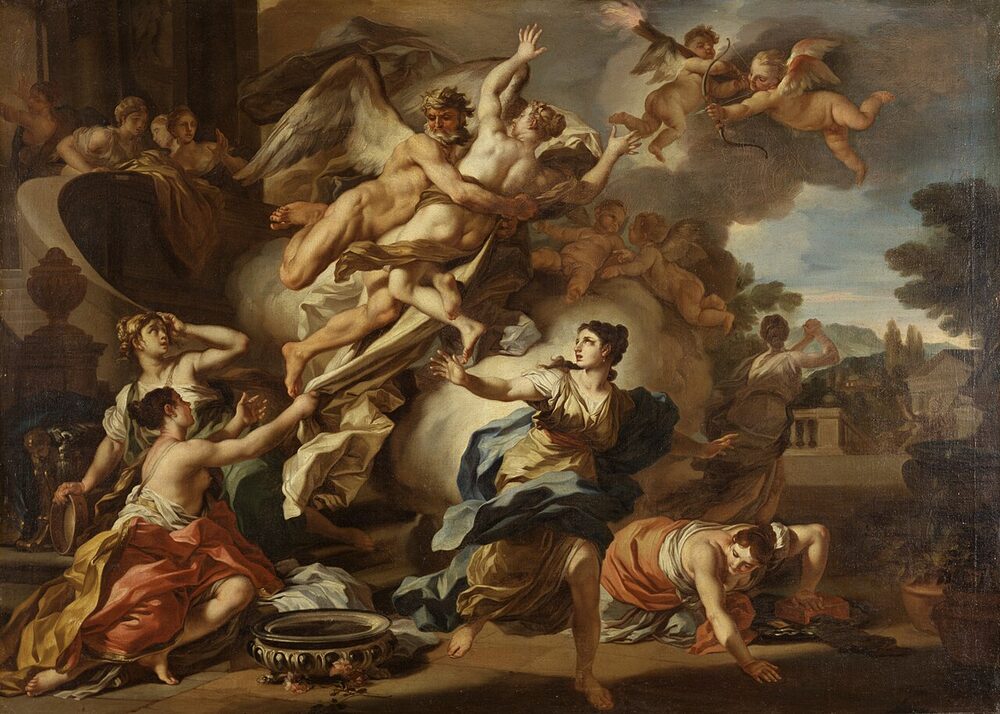
Boreas's great story is the carrying-off of Oreithyia (Ὠρείθυια), a princess of Athens, daughter of the early Athenian king Erechtheus. Boreas, the tale goes, loved her and wooed her gently at first; but the winds do not know how to be gentle for long, and when soft words failed he did what was in his nature — he swept down in a dark whirl of storm-cloud as she played by the river Ilissos and snatched her up into the sky, bearing her away to Thrace to be his wife. Their children were the winged brothers Zetes and Calaïs, the "Boreads," who sailed with the Argonauts and could fly. This marriage mattered enormously to Athens, because it made Boreas the city's son-in-law and kinsman — and the Athenians called on that kinship at their moment of greatest need. When the great fleet of Persia bore down on Greece, the Athenians (Herodotus 7.189) prayed to Boreas and to Oreithyia to help their kindred, and a tremendous north wind duly rose and wrecked hundreds of the Persian ships against the rocks of the coast. The Athenians gave Boreas the credit, and built him a shrine by the Ilissos where they said the abduction had happened. So the most violent of the winds was also, for one city, a friend in the family.
Notus — the South Wind (late-summer storms and blight)
Notus (Νότος) is the South Wind, the hot, wet, heavy wind out of the south, and where Boreas brings the clean cold of winter, Notus brings the sodden, spoiling weather of late summer and early autumn. He is the wind of the rains that come after the harvest, the bringer of the great storms of the season's turn — and, in the farmer's eye, the bringer of the blight and mildew that rot the standing crops and the stored grain in the muggy heat. Hesiod, who lived by his fields, names Notus among the three good winds born of Astraeus and Eos (Theogony 380), but the South Wind's gifts are dangerous ones: the rain that swells the river can also drown the field, and the warm damp breath that ripens can also rot. The Greek sailors feared him too, for the sudden autumn squalls out of the south that could catch a ship far from harbour. Of the four, Notus has the fewest stories of his own — he is above all a weather-power, the muggy, storm-laden south that every Mediterranean farmer and fisherman knew to watch for at the fading of the year; his name simply is the wind, and to say "Notus" was to say the season of storms had come.
Eurus — the East Wind (the odd one out)
Eurus (Εὖρος) is the East Wind — or, more exactly, the wind out of the east or southeast, for the Greeks did not always divide the quarters as we do. He is in a way the odd wind out of the four. Hesiod, in the passage that gives the winds their divine parentage, names only three — Zephyrus, Boreas, and Notus — as the well-born children of Astraeus and Eos (Theogony 378–380), and Eurus is not among them; the East Wind seems to have been added to fill out the compass to four quarters, and he never gained the clear divine pedigree his brothers have. He is the least storied of the winds, with no great myth of abduction or death attached to his name. In the reckoning of weather he was often counted an unlucky and unsettled wind, the quarter that brought changeable and stormy conditions; when the poets list all the winds breaking loose at once to make a great tempest — as when Homer and Virgil pile the four winds together to raise a storm at sea — Eurus is there in the roll-call, one of the four blasts that fall on the ship from every side. He completes the set: with Eurus in the east, the four winds together stand at the four corners of the sky, and the compass is whole.
Zephyrus — the West Wind (gentlest, herald of spring)
(Content note: Zephyrus's chief myth involves jealousy and a death — the killing, out of envy in love, of a young man.) Zephyrus (Ζέφυρος) is the West Wind, and he is by far the gentlest and best-loved of the four: the soft, warm breath out of the west that melts the last of the winter, that the Greeks felt as the herald of spring, the wind that coaxes the buds open and makes the meadows flower. He is the fertilising, life-bringing wind, and the poets gave him a fittingly happy household — in one tradition he is the husband of Iris, the rainbow, and in another of one of the Horai (the Seasons); he is even named as the father, by the harpy Podarge, of the two immortal horses Xanthus and Balius that drew the chariot of Achilles (Iliad 16.148–151), so that the swiftest horses in the world are foals of the West Wind.
But even the gentlest wind can turn deadly out of jealousy, and Zephyrus has one dark and famous story: the death of Hyacinthus (Ὑάκινθος). Hyacinthus was a beautiful young prince of Sparta, beloved of the god Apollo — and, in the version the poets tell, loved also by Zephyrus, who could not bear that the boy returned Apollo's love and not his own. One day Apollo and Hyacinthus were amusing themselves throwing the discus, and as Apollo made his cast, Zephyrus, in a fit of jealous spite, blew hard across its flight and drove the heavy disc astray, so that it swerved and struck Hyacinthus on the head and killed him. Apollo, grief-stricken, could not save the boy, but from his spilled blood he made grow the flower that bears his name, the hyacinth, its petals (the Greeks said) marked with the letters of a cry of woe. So the mildest of the winds carries this one bloody deed, a reminder that any wind, crossed in love, can kill; and Zephyrus stands as the double face of the west — the sweet breath of spring, and the gust that turned a game to a funeral.
The keeper of the winds — and a tangle of two Aeoluses
Over and beside the four wind-gods stands the figure of Aeolus (Αἴολος), the "keeper of the winds," who in one strand of story holds all the winds shut up under his hand and lets them out as he pleases. He is most famous from the Odyssey (10.1–75): Odysseus, sailing home, comes to the floating island of Aeolia, where Aeolus — a mortal favoured by the gods and set by Zeus as warden of the winds, "to still them or arouse them as he wills" — entertains him a month and, at parting, gives him a marvellous gift. Into a bag made of an ox-hide Aeolus has tied up all the stormy contrary winds, leaving only the gentle West Wind free to blow Odysseus home; and for nine days the ship runs straight for Ithaca. But on the tenth, with his homeland actually in sight, Odysseus falls asleep, and his crew — believing the bag holds treasure their captain is hiding from them — open it. All the winds burst out at once, the storm they raise blows the ship all the way back to Aeolia, and Aeolus, seeing that Odysseus has plainly come back cursed by the gods, drives him away and will help him no more.
It is worth being careful here, because the Greeks themselves used the name Aeolus for at least two different figures, and the sources sometimes blur them. There is Aeolus the warden of the winds, the son of Hippotes, the keeper on the floating island of the Odyssey — the one with the bag of winds. And there is, quite separately, Aeolus the ancestor-king, a son of Hellen, the founder-hero from whom the Aeolian branch of the Greek people (the Aeolians) took their name — a mortal king of Thessaly with nothing to do with the weather. Later writers, faced with two or three men of the same name, sometimes ran them together or made one the descendant of another, and it is from this muddle that the winds are sometimes said to be kept by "Aeolus" the king. For this encyclopedia the point to hold onto is simple: the four Anemoi — Boreas, Notus, Eurus, and Zephyrus — are the winds themselves, gods born of Astraeus and Eos; Aeolus is only their jailer, a separate figure (or figures) who holds their leash, and not one of the four.
Worship — Ancient
Winds you had to keep on your side
Few divine powers touched ancient life as directly and as daily as the winds, and few were prayed to more practically. A sailing world lived or died by them — a fair wind meant a swift, safe voyage and a foul one meant delay, wreck, or death — and a farming world watched them for the rain that fed the crops and the storms that flattened them. So the Anemoi were not distant sky-powers but gods you had real business with, to be coaxed, thanked, and appeased. The Greeks sacrificed to the winds to raise a favourable breeze, to lay a dangerous gale, and to turn the weather to their purpose, and this wind-cult was widespread across the Greek world.
The Athenians and Boreas
Athens had a special devotion to Boreas, and for a very Athenian reason: through his marriage to the princess Oreithyia the North Wind was reckoned a kinsman of the city, a son-in-law of the old king Erechtheus. The great moment of this cult was the Persian War. Herodotus (7.189) tells that when the Persian fleet threatened, the Athenians — obeying an oracle that told them to call on their "son-in-law" for aid — prayed and sacrificed to Boreas and Oreithyia to come to their help; a violent north wind then wrecked a large part of the Persian navy on the rocks near Cape Sepias, and the grateful Athenians afterward built Boreas a shrine on the banks of the river Ilissos, at the very spot where they said he had carried Oreithyia off. It is a rare and vivid case of a natural force being thanked, by name, for a military deliverance.
Altars, pits, and the priest of the Winds
Elsewhere the winds had their own altars and their own rites, some of them old and strange. Pausanias (2.12.1) describes a sanctuary at Titane in the territory of Sikyon where the Winds were worshipped with a nocturnal rite: once a year, on one night, a priest kept vigil and sacrificed to the winds, and performed secret ceremonies at four pits dug in the ground — one, we may guess, for each of the four quarters — to soothe the "fierceness of the blasts," chanting over them (the local story went) charms that the witch Medea had once used to lay the winds. The four pits are a lovely, concrete image of the four-fold winds made into cult. The Greeks also personified and honoured the winds in art and monument: at Athens the octagonal marble Tower of the Winds (the Horologion of Andronikos, first century BC) carries around its eight sides carved, flying figures of the eight winds, each labelled with his name — the classic four of the quarters among them — a public, civic image of the wind-gods watching over the city.
The winds and the dead
The winds had a place, too, at the edges of life and death. In Homer (Iliad 23.192–230) it is Boreas and Zephyrus who are begged to come and kindle the funeral pyre of Patroclus when it will not catch, and they come rushing over the sea to blow the flames up all night — the winds as servants of the last rites. And because the winds could carry things away unseen, they were sometimes imagined as bearing off the dead or the lost. This ancient sense of the winds as living, biddable powers — to be fed with sacrifice, called by name, and thanked or blamed for the turns of weather and fortune — is the heart of their worship.
Worship — Modern
The four winds in a modern practice
For a modern Hellenic polytheist the Anemoi make natural and welcome gods to honour, because they are so close and so constant: the wind is the one divine power a devotee feels physically, every day, without effort. A practitioner might keep the four winds as a set — Boreas, Notus, Eurus, and Zephyrus at the four quarters — and call on the appropriate wind for the appropriate season or need: Zephyrus in spring, as the ancients did, for new growth and gentle beginnings; Boreas for strength, for the clean hard cold of winter, or for the courage to face a storm; Notus and Eurus acknowledged as the powers of the warmer, wetter, more unsettled weather. Setting a small compass-marked shrine, or simply turning to face each quarter in turn, lets a devotee greet the winds where the ancients did — at the four corners of the sky.
Offerings and the sailor's prayer
The old forms of wind-worship transfer easily. A libation poured out to the open air — wine or water offered to the wind and carried away on it — is a fitting and ancient gift, and the winds were always among the powers a traveller or sailor prayed to for a safe and easy journey. Anyone who goes on the water, or who simply wants fair weather for a venture, stands in a very old tradition when they ask the winds for a favourable breeze and a calm sea, and thank them for it after. Incense, whose smoke the wind takes and disperses, is another natural offering to gods whose whole being is moving air. Because the winds are powers of weather and the turning year, marking the change of the seasons — the first warm west wind of spring, the first cold north wind of winter — is itself a way of honouring them.
The winds in language and imagination
Beyond devotion, the Anemoi survive everywhere in the language and imagery of the modern world. The gentlest of them lives on in the word "zephyr," still used in English for a soft, mild breeze — one of the few Greek wind-gods to become an ordinary word. The "four winds" are a fixed idea in our speech, scattered "to the four winds," and the wind-rose on old maps and compasses, with a face or a name at each point, descends directly from the ancient personified winds and from monuments like the Tower of the Winds. Meteorology still speaks, faintly, in their key: the whole idea of naming and characterising the winds by the quarter they blow from is the Greeks' idea. And the winds keep their old double nature in the imagination — the kindly breath that fills a sail and the killing gale that sinks it, the spring wind and the winter storm — the four moods of the moving air that the Greeks made into four gods, and set at the four corners of the sky.
Epithets & Cult Titles
- Βορέας (Boreas) — "the North Wind" — The cold, violent wind out of the north, bringer of winter; his name doubles as an epithet, for the wind itself is the god. The Athenians honoured him as a kinsman by marriage. (Roman: Aquilo.)
- Νότος (Notus) — "the South Wind" — The warm, wet wind out of the south, bringer of the late-summer storms and of the blight and mildew that rot the crops; his name is his title. (Roman: Auster.)
- Εὖρος (Eurus) — "the East Wind" — The wind out of the east or southeast, often counted as the unlucky and stormy quarter; the odd one out, whom Hesiod does not list among the three well-born winds. (Roman: Vulturnus.)
- Ζέφυρος (Zephyros) — "the West Wind" — The gentlest of the winds, the mild breath out of the west that heralds spring and makes things grow — though he has a darker side in the death of Hyacinthus. (Roman: Favonius.)
Sources & Variants
- Hesiod, Theogony 378–380 (Eos bears to Astraeus the winds Zephyrus, Boreas, and Notus — the three well-born winds of divine descent)
- Hesiod, Theogony 869–880 (the good winds distinguished from the lawless, ship-wrecking winds that blow at random from the monster Typhoeus)
- Homer, Iliad 23.192–230 (Achilles prays to Boreas and Zephyrus, feasting in the house of Zephyrus, to light the pyre of Patroclus; Iris carries the message)
- Homer, Iliad 20.223–225 (Boreas as a dark stallion sires twelve swift foals on the mares of Erichthonius)
- Homer, Iliad 16.148–151 (Zephyrus, by the harpy Podarge, father of Achilles's immortal horses Xanthus and Balius)
- Homer, Odyssey 10.1–75 (Aeolus, son of Hippotes, warden of the winds on his floating island, gives Odysseus the ox-hide bag of tied-up winds; the crew open it and are blown back)
- Herodotus 7.189 (the Athenians pray and sacrifice to their 'son-in-law' Boreas and to Oreithyia; the north wind wrecks the Persian fleet off Sepias; the shrine of Boreas on the Ilissos)
- Apollodorus, Bibliotheca 3.15.2 (Boreas carries off Oreithyia, daughter of Erechtheus, and fathers Zetes and Calaïs, the winged Boreads)
- Apollodorus, Bibliotheca 1.3.3, and Ovid, Metamorphoses 10.162–219 (Zephyrus, jealous of Apollo's love for Hyacinthus, blows the discus astray and kills the boy; the hyacinth springs from his blood) — Ovid a Roman retelling
- Pausanias, Description of Greece 2.12.1 (the sanctuary and nocturnal rite of the Winds at Titane near Sikyon, with sacrifice at four pits and the charms of Medea)
- Homer, Odyssey (Aeolus the wind-warden) distinguished from Aeolus son of Hellen, the eponymous ancestor of the Aeolians (Apollodorus, Bibliotheca 1.7.3) — two separate figures of the same name
- Varro and Vitruvius, on the octagonal Tower of the Winds (Horologion of Andronikos) at Athens, carved with the personified winds of the quarters — Roman-era witness to the wind-figures
Gallery