Astraia
First Appearance
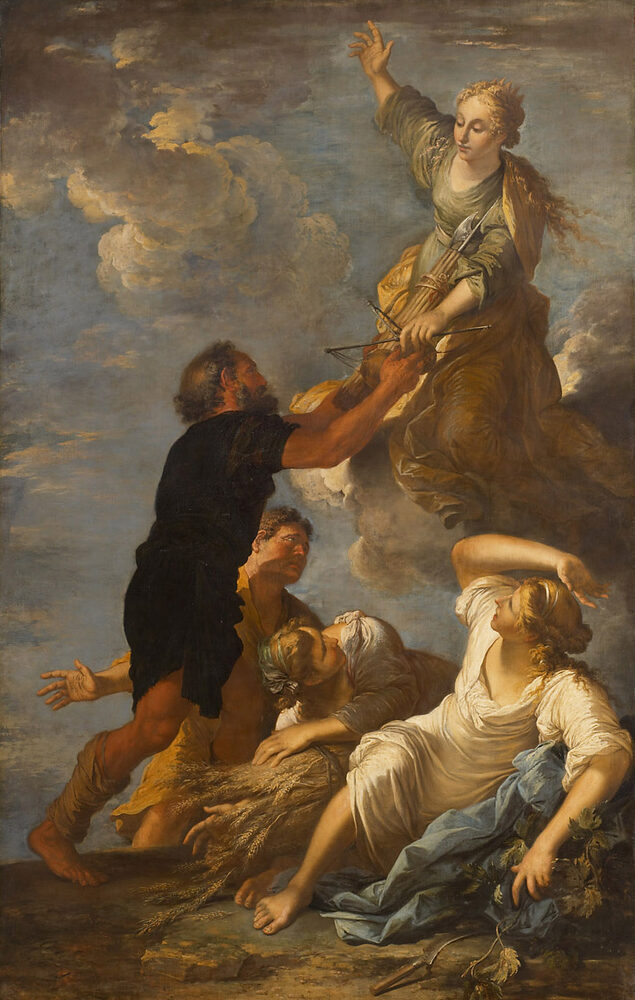
The pattern of Astraea's story is first set by Hesiod. In the Works and Days (197–201) he foretells that in the last and worst age of the world, the age of iron, Aidos (Shame) and Nemesis (Righteous Indignation) will wrap their fair flesh in white robes, forsake mankind, and go up from the wide-pathed earth to the company of the deathless gods, leaving only bitter grief behind. Her own tale is told fully by Aratus (Phaenomena 96–136): the Maiden (Parthenos), whom men call Dike (Justice), once lived openly among mortals in the first age and gathered them to right judgement in the open market-place; but as the generations grew worse — silver, then bronze — she drew back first to the mountains and then, when men forged the sword and ate the flesh of the plough-ox, she rose from the earth altogether and took her place in heaven as the constellation now called the Virgin, the Ear of grain gleaming in her hand.
— Hesiod, Works and Days 197–201 (the model: Aidos and Nemesis forsake the earth); Aratus, Phaenomena 96–136 (the Maiden / Justice withdraws to heaven as the constellation Virgo)
Who They Are
Astraea (a-STREE-uh), the "star-maiden," is the pure virgin goddess of justice and innocence who, the Greeks said, once dwelt openly among mortal men and was the last of the immortals to leave the earth when the world turned wicked. Her name is simply "the starry one" (from astron, "star"), and it holds her whole story in a single word: she ends as a star. When the golden race of men had given way through silver and bronze to the cruel age of iron — when oaths were broken, blood was shed, and men devoured one another — she alone of the deathless gods lingered longest; and when at last she too could bear it no more, she forsook the earth, rose into the sky, and was set among the constellations as the heavenly Maiden, with the scales of the balance shining beside her as the measure of the justice she carried away.
She stands very close to another goddess, and the two are not always to be told apart. That goddess is Dike (Justice), daughter of Zeus and Themis, the maiden who sits beside her father's throne and reports to him the wrongdoing of men. In the poem that tells Astraea's story most fully — the Phaenomena of Aratus — it is "the Maiden, whom some call Dike (Justice)" who lives among men and then withdraws to heaven, so that Astraea, the star-maiden, is in large part that same Justice seen in her ending: the catasterised (star-set) form of Dike, named for the stars she became. The Greeks could speak of her as Dike, as the Maiden (Parthenos), or as Astraea the starry one, and mean, more or less, the one goddess — the embodied righteousness of a better age.
Her parentage is told as fittingly as her name. The poet Aratus wonders whether she is the daughter of Astraeus, "who, men say, was of old the father of the stars" — the dusk-Titan of the starry sky — and the natural mother for a star-maiden born of that line is Eos, the Dawn, Astraeus's bride, from whose union the stars themselves were said to come. So the maiden of justice who becomes a star is made the child of the starry heaven and the dawn: a genealogy that is itself a small poem about who she is. (Where she is instead identified outright with Dike, her parents are given as Zeus and Themis — the older and more Panhellenic account, noted below.)
Mythology
The maiden who walked among men
In the beginning, the poets said, there was a golden race of mortals who lived without toil or war or law-court, for they did no wrong and needed none to judge them; and in that first and happy age the goddess of Justice walked openly among them. Aratus tells it most memorably (Phaenomena 100–114): the Maiden — "whom some call Dike, Justice" — was not yet withdrawn into the sky but moved freely in the midst of men and women, taking her seat in the market-places and the gates of the city, and there she would gather the people together and urge them, in a clear voice, to judgements that were true. She was no distant power then but a neighbour and a presence, the living conscience of a world still innocent, and men knew nothing yet of bitter strife or the clamour of the quarrel. This is the heart of Astraea: she is the memory of a time when right was so native to the earth that goodness itself had a face and a voice and walked abroad in daylight.
The declining ages
But the golden race passed away, and a lesser, silver race came after it — meaner of spirit, quicker to anger, slower to honour the gods. The Maiden did not yet abandon the earth, but she withdrew: no longer would she come down among them in the open, but she kept to the hills and the high mountains, and came to the cities only at evening, alone, to rebuke them for their crookedness, and would not stay. And when the silver race in turn gave way to the bronze — the first men to forge the sword, the first to taste the flesh of the labouring ox — then she could endure them no longer. Aratus marks the moment with horror (Phaenomena 129–136): these were the men who hammered out the dagger that robs the roads, and who killed and ate the plough-ox, their fellow-worker. At that the goddess of Justice, loathing the generation of such men, took wing and rose up into the sky. The decline is told as a falling-away through the metal ages, each worse than the last, and her retreat keeps exact pace with it — the measure of how far a world has fallen is how far its justice has drawn back from it.
The last of the immortals to leave the earth
The deepest note of her myth is that she was the last to go. Hesiod had drawn the pattern before Aratus: in the final age of iron, he says (Works and Days 197–201), Aidos (Shame) and Nemesis (Righteous Indignation) will veil their beauty in white robes and forsake the wide-pathed earth for Olympus, abandoning mankind to its griefs — the good powers leaving a world no longer worthy of them. Astraea is the fullest and most beloved form of that image: not merely one of the departing powers but the very last of the immortals to abide among men, holding on through age after worsening age until even she must rise and go. The Roman poet Ovid gives the line its most famous phrasing when he writes that, in the age of iron, when piety lay conquered, "Astraea, last of the immortals, forsook the blood-soaked earth" (Metamorphoses 1.149–150) — though this naming of her specifically as Astraea, and as the very last, belongs to the later Roman tradition rather than to the early Greek sources, which speak rather of the Maiden or of Dike. However she is named, the meaning the Greeks and Romans alike drew from her is the same: while justice yet lingers, the world is not wholly lost; the day she departs is the day a race has damned itself.
Astraea and Dike: one goddess, or two
A reader meets here a genuine tangle of the sources, and it is better named than hidden. The goddess of the withdrawal is, in the oldest and clearest telling (Aratus), the Maiden whom men call Dike — and Dike (Justice) is in Hesiod a well-defined goddess, daughter of Zeus and Themis, one of the three Horai (Seasons), who sits by her father and tells him of unjust men (Hesiod, Theogony 901–902; Works and Days 256–262). The name Astraea, "the star-maiden," comes to the fore chiefly in the later and Roman handling of the tale, as the proper name of the one who became the star — so that Astraea and Dike are in truth very nearly the same figure seen from two sides: Dike is Justice as she acts among men, Astraea is that same Justice named for her ending in the stars. This encyclopedia follows the choice of giving her a page of her own as Astraea the star-maiden, while keeping faith with the sources by saying plainly that where she is called Dike her father is Zeus and her mother Themis, and that the two names belong, in the end, to one idea: the righteousness of a better world.
Daughter of the starry heaven and the dawn
There is, besides the Dike-genealogy, an older and more fitting parentage for her precisely as the star-maiden. Aratus, pausing over her, will not swear to her descent but offers the loveliest guess: "whether she be the daughter of Astraeus, who, men say, was of old the father of the stars, or sprung of some other sire — untroubled be her course" (Phaenomena 98–99). Astraeus is the Titan of the starry dusk, and the bride with whom he begot the host of heaven was Eos, the Dawn (Hesiod, Theogony 378–382, where their children are the winds and the stars). To make the maiden who becomes a star the child of the star-father and the Dawn is to let her genealogy say what her name says — that she was starry from her begetting, and was only going home when she rose into the sky. It is this starlit descent, rather than the courtroom descent from Zeus and Themis, that her page here follows.
The star-maiden among the stars: Virgo and the Scales
So the story that began in the market-places of a golden age ends in the night sky, where anyone may still find her. She is the constellation the Greeks called simply Parthenos, the Maiden, and the Romans Virgo — a great reclining figure of the zodiac, in whose hand gleams the bright star the Greeks called Stachys and the Romans Spica, "the ear of grain," the sheaf that the goddess of a just and fruitful earth holds out even from heaven. And beside her, the Greeks set the Scales — the balance, which the Romans named Libra — the very instrument of fair judgement, placed next to the Maiden as the measure she carried with her when she left the earth, so that Justice and her balance still stand together in the sky above a world that let them go. To look up and name the Maiden and her Scales is to read, written in stars, the whole of Astraea's story: that right once lived among us, that it withdrew when we grew cruel, and that it waits, shining, overhead.
Worship — Ancient
A goddess of poetry and the sky, not the altar
Astraea had no cult in the way an Olympian did — no temple of her own, no priesthood, no festival on the calendar. She belonged to the poets and to the stargazers, and her "worship" was really the honouring of the thing she stood for: justice, the kept oath, the honest measure between neighbours. In this she is like the other personified powers of right — Dike, Nemesis, Aidos — whom the Greeks revered as living realities without always building them shrines. Where the goddess of Justice did receive cult, it was under the name of Dike or as one of the Horai (the Seasons — Eunomia Good-Order, Dike Justice, Eirene Peace), the daughters of Zeus and Themis who guarded the right ordering of the world; and in that form she was honoured beside Themis and the other guardians of law.
The hope of her return
One strand of her ancient memory is not only loss but longing. If the departure of the star-maiden marked the ruin of an age, then her return could stand for its renewal — the coming-again of a golden time of justice and peace. This hope found its most famous voice in the Roman poet Virgil, who sang that "now the Virgin returns, and the reign of Saturn comes again" (Eclogue 4.6) — foretelling the back-turning of the metal ages and the rebirth of the golden race, with the Maiden's homecoming as its sign. (This is a Roman development of the theme, later than the Greek sources, but it draws out what was always latent in the myth: that the goddess who left could come back, and that her coming would mean the mending of the world.)
Worship — Modern
The star-maiden and the scales of Justice
Astraea endures most visibly in two things everyone knows: the night sky and the image of Justice herself. Every star-chart and horoscope keeps her constellation alive as Virgo, the Maiden, with the bright star Spica — the ear of grain — in her hand, and the Scales of Libra at her side; so that the figure who left the earth is, in a quiet way, named aloud by millions who never heard her story. And the familiar image of blind Lady Justice, holding her balance, descends through the Roman Justitia from this same Greek root — the maiden-goddess of right judgement with her scales — so that Astraea, under other names, still stands over every court-house that keeps her emblem.
A patron of justice, innocence, and the better world to come
For a modern devotee, Astraea sits naturally as a patron of justice and honest dealing, of innocence kept in a hard world, and of the hope — never quite abandoned — that right can return to a place that has lost it. To honour her is to honour fair measure: to judge truly, to keep one's word, to deal straight with a neighbour, and so to keep a little of the golden age alive against the grain of the iron one. Her double image lends itself to reflection — the goddess who could not bear to stay, and the goddess whose return would mean the world made just again — and a thoughtful honouring of her holds both together: a clear-eyed grief at how far justice has withdrawn, and a steady work to call it back down out of the stars.
Epithets & Cult Titles
- Parthenos (Παρθένος) — The Maiden / the Virgin — the name under which Aratus sings of her, and the name of her constellation (Latin Virgo); she is the pure unwedded maiden of Justice, and 'the Maiden' is how the Greeks most often spoke of her in the sky
- Dikē (Δίκη) — Justice — the goddess with whom she is most closely identified; in Aratus it is Dike (Justice) who dwelt among men and then withdrew to the stars, and 'Astraea the star-maiden' is in large part the catasterised (star-set) form of that same Justice
- astron / the Starry Maid — The Star-Maiden — the plain sense of her name, marking her end: the immortal who, forsaking a wicked earth, was taken up and made a star among the heavenly signs
Sources & Variants
- Hesiod, Works and Days 197–201 (Aidos and Nemesis forsake the earth for Olympus in the iron age — the model for Astraea's departure)
- Hesiod, Works and Days 256–262 (Dike, maiden daughter of Zeus, sits by her father and reports the unjust dealings of men)
- Hesiod, Theogony 901–902 (Dike, Justice, born of Zeus and Themis, one of the Horai)
- Hesiod, Theogony 378–382 (Astraeus and Eos the parents of the stars and winds — the starlit line to which Aratus assigns the Maiden)
- Aratus, Phaenomena 96–136 (the Maiden / Dike dwells among men in the golden age, withdraws through the silver and bronze ages, and rises to heaven as the constellation Virgin holding the Ear of grain; the question whether she is daughter of Astraeus) — the central source
- Ovid, Metamorphoses 1.149–150 (Astraea, named and called the last of the immortals, forsakes the blood-soaked earth in the iron age) — later Roman retelling
- Virgil, Eclogue 4.6 ('now the Virgin returns, and the reign of Saturn comes again' — the hope of the star-maiden's return and a new golden age) — Roman
- Hyginus, Astronomica 2.25 (the constellation Virgo identified with Justice / the daughter of Astraeus and Aurora, among other accounts) — later Roman
Gallery