Orestēs
First Appearance
Orestes enters Greek poetry not as a tormented matricide but as a shining example of the good son. In the Odyssey the gods and old Nestor hold him up to the young Telemachus as a pattern to follow: Agamemnon's son, grown to manhood, came back from exile and slew Aegisthus, the man who had murdered his father and usurped his house (Odyssey 1.298–300). Nestor tells how, in the eighth year, "goodly Orestes came back from Athens and slew the slayer, guileful Aegisthus, who had killed his glorious father" (3.306–310), and held a funeral feast over the bodies of the hated man and of his mother Clytemnestra. Homer names the killing of the mother only in passing and without horror; it was the tragedians of Athens who would make that deed the dark centre of the tale.
— Homer, Odyssey 1.298–300 and 3.306–310
Who They Are
Orestes (oh-RES-teez) is the son of Agamemnon, king of Mycenae and lord of the Greek host at Troy, and his story is the hinge on which one of the greatest cycles of Greek myth turns: the curse of the house of Atreus, and the long chain of blood answering blood that runs through it. He is the avenging son — the boy smuggled out of the palace on the night his father is murdered, who grows up in exile nursing a single purpose, returns in secret, and with his sister kills the two who killed his father. One of those two is his own mother. In that act Orestes becomes the figure the Greeks found most terrible and most searching of all: the man who does a dreadful, necessary, forbidden thing, and must then answer for it.
His myth falls into two great movements. The first is vengeance: the return, the recognition at the father's tomb, the slaying of the usurper Aegisthus and of the mother Clytemnestra — the matricide, done (the tragedians insist) at the direct command of Apollo's oracle at Delphi, so that whether he obeys or disobeys he is damned. The second is expiation: the Erinyes, the Furies, the ancient spirits of a mother's spilled blood, rise from the earth and hound the matricide into madness, driving him across Greece until he comes as a suppliant first to Apollo and then to Athens, where the goddess Athena founds a court of citizens to try him and casts the deciding vote to set him free. With that acquittal the old law of blood-for-blood gives way to the rule of the lawful court — and Orestes, released at last, goes on to recover a lost sister, to win back his father's kingdom, and to reign.
Because his story was told above all in Aeschylus's great trilogy the Oresteia, Orestes is less a hero of quest or monster-slaying than a hero of conscience and of justice — the mortal through whom the Greeks asked how blood-guilt can ever be ended, and answered that it ends not in more killing but in judgement, mercy, and law.
Mythology
The curse of the house, and the boy smuggled away
Orestes was born into a cursed line. His father Agamemnon, king of Mycenae (or of Argos), was the great leader of the Greek expedition against Troy; his mother was Clytemnestra, sister of Helen; and the house of Atreus into which he was born already groaned under an inherited curse of kin-killing that reached back to his grandfather's generation. While Agamemnon was away the ten years of the war, Clytemnestra took as her lover Aegisthus, Agamemnon's own cousin and the family's hereditary enemy, and the two ruled Mycenae together. When Agamemnon came home in triumph from Troy, they murdered him — Aeschylus's telling has Clytemnestra strike him down in his bath, tangled in a robe like a net (the Agamemnon), avenging among other wrongs the sacrifice of their daughter Iphigenia, whom Agamemnon had killed at Aulis to win fair winds for the fleet.
Orestes was still a child. On the night of the murder, or soon after, he was smuggled out of the palace and sent far away — in the common telling to Phocis, to the court of King Strophius, where he was raised alongside the king's son Pylades, who became the friend of his life. He grew to manhood in exile, an heir dispossessed, carrying the knowledge of his father's murder and the weight of what a son owed a murdered father.
The command of Apollo
What drove the grown Orestes home was not only grief but a god's direct order. He went to the oracle of Apollo at Delphi, and the god commanded him — on pain of unspeakable suffering, disease, and outlawry if he refused — to avenge his father by killing the murderers, both the man and the woman (Aeschylus, Libation Bearers 269–305; the charge is renewed throughout). This is the knot at the heart of the story as the tragedians tell it: Apollo, god of purity and of the father's claim, commands the killing of the mother; yet the killing of a mother is the very crime the Erinyes exist to punish. Orestes is caught between two divine laws, and whichever he obeys, the other destroys him. He chooses obedience to Apollo and to his father's blood.
The return and the recognition at the tomb
Orestes came home in secret, with Pylades at his side, and went first to his father's grave. There, in the scene the Greeks loved, he was reunited with his sister Electra — the daughter who had stayed in Mycenae, kept in grief and near-servitude by Aegisthus and Clytemnestra, and who had never ceased mourning her father and longing for her brother's return. In Aeschylus's Libation Bearers she comes to pour offerings at the tomb and finds there a lock of hair that matches her own, and a footprint, and so knows her brother has come; in Sophocles' and Euripides' plays called Electra the recognition is worked differently — Euripides, in particular, has an old servant recognise Orestes by a scar, and pointedly mocks the token of the matching hair-lock. Brother and sister, with the loyal Pylades, swear together at the grave to carry out the vengeance, calling on the dead Agamemnon and the powers below to strengthen their hands.
The dreadful deed: the slaying of Aegisthus and Clytemnestra
Disguised and bearing a false story — in the usual telling, word that Orestes himself is dead, so that the usurpers drop their guard — Orestes and Pylades enter the palace. They kill Aegisthus first. Then Orestes faces his mother. Clytemnestra, understanding at last who stands before her, bares her breast and pleads for her life in the name of the body that bore and suckled him — the most harrowing moment in Greek tragedy. Orestes falters; he turns to Pylades and asks whether he can truly kill his mother, and Pylades answers with the god's command (one of only three lines Pylades speaks in the whole Libation Bearers, and among the most famous). Orestes kills her. The vengeance is complete, both murderers dead by the son's hand — and the son is now a matricide.
The Furies rise: madness and pursuit
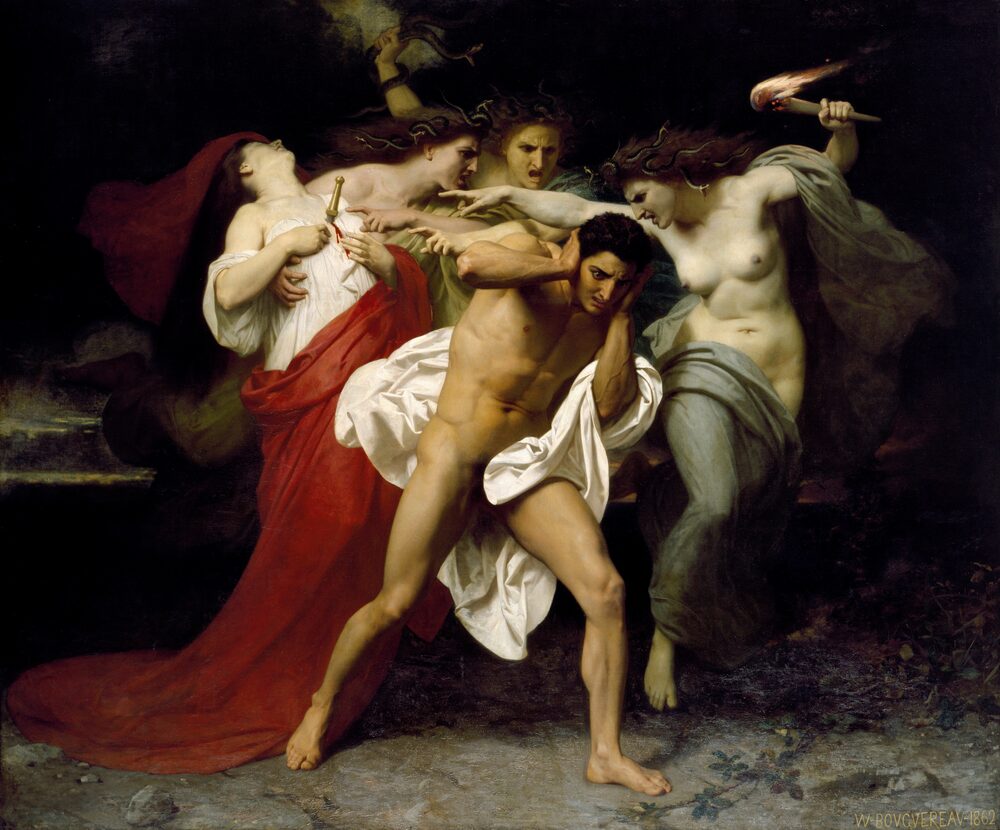
No sooner is the deed done than Orestes sees what no one else can yet see: the Erinyes — the Furies, the primordial avengers of kindred blood, especially a mother's — rising against him, black, snake-wreathed, their eyes dripping. They are the mother's curse made flesh, called up from the earth by her spilled blood. They fall upon him with madness and drive him from his home, hounding him in torment across the land of Greece, never resting, the living embodiment of the guilt of the deed he was commanded to do. Orestes flees to the one refuge the god who ordered the killing can offer.
Suppliant at Delphi and Athens
He came first to Delphi, to Apollo himself, and clung to the god's altar; Apollo acknowledged the charge as his own, laid the raging Furies briefly to sleep, and purified Orestes of the blood (in the old rite, with the blood of a young pig), but could not of himself free him from the Furies' claim — for they are older than the Olympians and will not yield their due (Aeschylus, Eumenides). So Apollo sent him on to Athens, to the shrine of Athena, to seek the goddess's judgement. Orestes crossed Greece as a suppliant, the Furies waking and taking up the chase again, until he reached the citadel of Athens and threw himself on Athena's mercy, grasping her ancient image.
The trial on the Areopagus
There Athena did a thing new in the world: rather than judge the matter herself, or let the ancient law of blood simply take its course, she founded a court — she chose the best citizens of Athens and set them on the hill called the Areopagus to hear the case and decide it by vote. This, Aeschylus tells, was the founding of the Areopagus as Athens's homicide court, the first trial by jury in the history of the world. The Erinyes stood as prosecutors, pleading the unanswerable claim of a mother's blood; Apollo stood as Orestes' advocate and witness, defending both the son and his own oracle, arguing (in the god's controversial case) the primacy of the father. The citizens cast their secret ballots, the voting-pebbles dropping into the urns. The votes came out equal — tied. And Athena, who had reserved for herself a vote, cast it for acquittal, declaring that a tie should favour the accused and that mercy should temper the ancient law. By her deciding voice Orestes was acquitted and set free.
The reconciling of the Furies
The furious Erinyes, cheated of their prey and raging that the younger gods had trampled the ancient law, threatened to blight the land of Athens with poison and barrenness. But Athena, with patient persuasion, reconciled them: she offered them an honoured home beneath the Areopagus and a lasting cult among the Athenians, transforming them from the dreaded Erinyes into the Eumenides — the "Kindly Ones," or the Semnai Theai, the August Goddesses — avengers still, but now guardians of the city and of its justice. So the trilogy ends not in more blood but in the turning of the oldest, darkest powers of vengeance into keepers of a new and lawful order. This is the deepest meaning the Athenians found in Orestes' story: the passage from the endless feud of blood-for-blood to the rule of the citizen court and the reconciled law.
The recovery of the lost sister: Iphigenia among the Taurians
Euripides tells a further chapter. Even after the acquittal, in his Iphigenia among the Taurians, some remnant of the Furies' claim pursues Orestes, and Apollo lays on him one last task: to go to the far and savage land of the Tauri (the Crimea) and bring back to Greece the ancient wooden cult-image of Artemis kept there, where strangers were sacrificed to the goddess. Orestes went with the faithful Pylades; the two were seized and condemned to be sacrificed — and the priestess appointed to kill them proved to be Iphigenia, Orestes' own sister, whom Artemis had snatched from the altar at Aulis long ago and carried here, so that she had not died as all believed. The scene of their recognition — the brother come to a strange land to steal an image, the sister about to sacrifice him with her own hand — is one of the great recognition scenes of the Greek stage. The three escaped together, carrying the image, and so Orestes recovered a second lost sister and completed Apollo's charge, the family's long affliction turning at last toward healing.
The later king
Freed of the Furies, reunited with both sisters, Orestes came into his inheritance. He recovered the kingdom of his father Mycenae (and in some tellings also ruled Argos and Sparta), and in the later legends married Hermione, the daughter of Menelaus and Helen — a marriage over which, in Euripides' Andromache, he contends with Neoptolemus, the son of Achilles. Herodotus and Pausanias record that in historical times the Spartans, obeying an oracle, recovered the great bones of Orestes from Tegea and brought them home, believing their possession would bring victory — so that the avenging son passed, as many heroes did, from the stage of myth into the cult of a worshipped hero whose very bones were a city's talisman. He is said at last to have died, old, of a snake-bite in Arcadia.
Worship — Ancient
A hero of cult, not a god
Orestes was honoured in historical Greece as a hero — a powerful mortal of the age of legend whose tomb and relics held real force — rather than worshipped as a god. The most famous instance is political and striking: Herodotus (1.67–68) tells how the Spartans, failing in their long war against Tegea, were told by the Delphic oracle that they must bring home the bones of Orestes if they wished to prevail. A Spartan found the enormous bones (a coffin seven cubits long) at a smithy in Tegea, stole them away, and from that time Sparta had the upper hand. Pausanias (3.3.5–6; and at 3.11.10 he reports the tomb of Orestes in the marketplace of Sparta) records the same tradition. The possession of a hero's remains was believed to bind his protecting power to the city that held them, and Orestes' bones became one of the most celebrated such relics in Greece.
The Choes and the stranger's cup at Athens
At Athens the matricide was woven into the ritual of the Anthesteria, the ancient spring wine-festival. The second day, the Choes ("Pitchers"), had a peculiar custom: the wine was not drawn from a common bowl, but each drinker was given his own separate pitcher and drank in silence, in a kind of competition, without the usual sharing of the cup. The Athenians explained this by the coming of the polluted Orestes to their city — a man stained with a mother's blood, whom no one could refuse as a suppliant yet with whom no one could share hearth, table, or mixing-bowl without taking on his pollution. So the king, it was said, ordered that each should be served his own pitcher and all drink apart, that the suppliant might not be shamed nor the others defiled. The uneasy fellowship of that day was remembered as the city's first dealing with the man it would later try and acquit.
The Areopagus and the Eumenides
Above all, Orestes' story was the founding legend of the Areopagus, the venerable homicide court of Athens that sat on the hill of that name below the Acropolis, and of the cult of the Semnai Theai or Eumenides, the reconciled Furies, whose sanctuary lay in a cleft beneath that same hill. The Athenians held that their court of blood was founded by Athena herself to try Orestes, and that the dread goddesses who had hounded him were there given their honoured home in the city. The trilogy of Aeschylus, performed at the festival of Dionysus, was itself a kind of civic liturgy of this belief, setting the myth of Orestes at the sacred origin of Athenian justice.
Shrines of the purified matricide
Pausanias, travelling Greece in the Roman age, was shown many places that kept a memory of Orestes: the spot where he was purified, stones and sanctuaries along the roads of his madness, and the tombs claiming his bones. Across Arcadia and the Peloponnese his wanderings had left a scattered geography of shrines — the mark of a figure whose story of pollution and cleansing lived close to the Greek concern with blood-guilt and its ritual removal.
Worship — Modern
The pattern of the burdened conscience
Orestes is remembered today less in cult than through the enduring power of his story, which has never left the Western imagination — above all through Aeschylus's Oresteia, read and staged continually as the founding drama of justice and conscience. A modern reader or honourer drawn to him meets a figure unlike the monster-slaying heroes: the man who must do a terrible thing, who does it, and who then must live with it and answer for it. He stands for the burdened conscience, for the doing of hard duty at great cost, and for the hard truth that even a justified act of violence leaves a wound that must somehow be healed.
The turn from vengeance to justice
His deepest meaning is the one Athena speaks over him: the passage from the endless feud — blood answering blood, each killing demanding the next — to the lawful court, where guilt is weighed, both sides are heard, mercy tempers the law, and the cycle is at last broken. For a modern devotee or reader this makes Orestes a patron of justice and of reconciliation: the ending of his story is not another death but a trial, a pardon, and the turning of the spirits of revenge into guardians of the city. In an age that still struggles to replace the reflex of retaliation with the rule of fair judgement, his myth keeps its force.
Loyal friendship and the recovery of the lost
Two gentler threads of his story also endure. One is the friendship of Orestes and Pylades, which became in antiquity and after the proverbial model of faithful, self-sacrificing friendship — each ready to die in the other's place. The other is the recovery of the lost sister in the land of the Tauri, a story of a family broken by violence and then, against all hope, reunited and healed. Honoured this way, Orestes speaks to loyalty that endures through madness and exile, and to the hope that even the most afflicted house may come at last out of its long darkness.
Epithets & Cult Titles
- mētroktonos (μητροκτόνος) — Mother-slayer — the terrible word the tragedians use of him, naming the deed that both avenged his father and brought the Furies down upon him; the whole of his story turns on this single, dreadful title
- patroûchos / avenger of Agamemnon — The son who takes up his murdered father's cause — in Homer already the model of the dutiful son who returns to punish his father's killer and win back his house (Odyssey 1.298–300)
- hiketēs (ἱκέτης) — The suppliant — his defining posture through the latter half of his story, the blood-stained man who clings to the altar of Apollo at Delphi and then to Athena's shrine in Athens, seeking cleansing and refuge
- exēlatheis / the pursued — The driven, hounded one — maddened and chased across Greece by the Erinyes (the Furies), the avenging spirits of a mother's spilled blood, until a god's court sets him free
Sources & Variants
- Homer, Odyssey 1.298–300 (Orestes held up to Telemachus as the model son who avenged his father by killing Aegisthus) — Greek, earliest
- Homer, Odyssey 3.306–310 (Nestor's account: Orestes returns from Athens, slays Aegisthus, holds the funeral feast) — Greek
- Homer, Odyssey 4.512–547 and 11.405–434 (the murder of Agamemnon by Aegisthus and Clytemnestra, foreshadowing the vengeance) — Greek
- Aeschylus, Agamemnon (the murder of Agamemnon by Clytemnestra on his return from Troy) — Greek, 458 BC
- Aeschylus, Libation Bearers (Choephoroi) (Orestes' return, the recognition with Electra at the tomb, Apollo's command, the slaying of Aegisthus and Clytemnestra, the rising of the Furies) — Greek, the central source
- Aeschylus, Eumenides (the pursuit by the Erinyes, purification at Delphi, the trial on the Areopagus, Athena's deciding vote, the reconciling of the Furies into the Eumenides) — Greek, the founding of the jury court
- Sophocles, Electra (the vengeance told from Electra's side; the false report of Orestes' death and the recognition) — Greek
- Euripides, Electra (a starker retelling; recognition by a scar, and the mocking of the hair-lock token) — Greek
- Euripides, Orestes (Orestes and Electra on trial before the people of Argos after the matricide) — Greek
- Euripides, Iphigenia among the Taurians (the recovery of the cult-image of Artemis from the Tauri and the recognition of the lost sister Iphigenia) — Greek
- Euripides, Andromache (Orestes' contention with Neoptolemus over Hermione) — Greek
- Pindar, Pythian 11 (the murder of Agamemnon and the vengeance of Orestes) — Greek
- Herodotus, Histories 1.67–68 (the oracle on the bones of Orestes and Sparta's recovery of them from Tegea) — Greek
- Pausanias, Description of Greece 2.16.7; 3.3.5–6; 3.11.10; 8.5.4 (the tomb and bones of Orestes, his kingship, shrines of his purification and wanderings) — Greek
- Apollodorus, Bibliotheca Epitome 6.24–28 (Orestes avenges his father, is tried on the Areopagus, recovers the image with Iphigenia, and later rules) — Greek handbook
Gallery