Iphigeneia
First Appearance
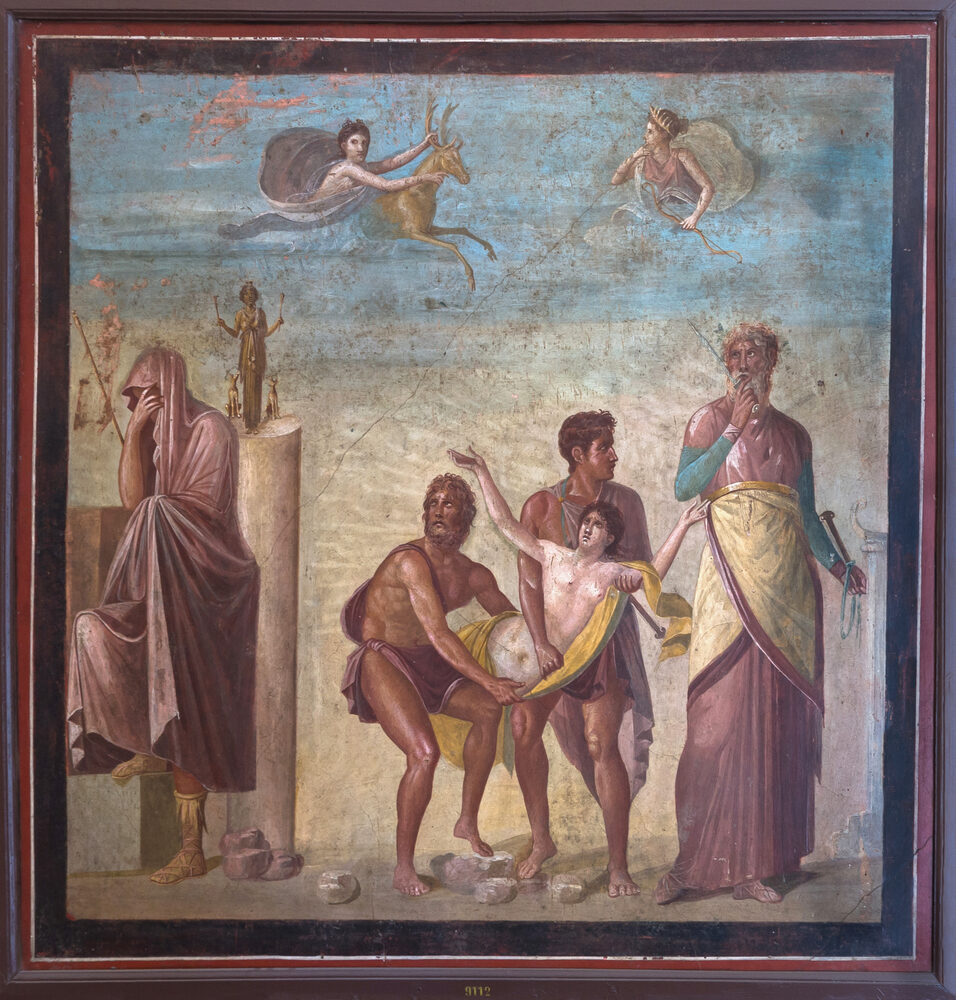
Iphigenia enters Greek poetry at the knife's edge. The lost epic Cypria (known from Proclus's prose summary) told how the Greek fleet, gathered at Aulis and held back by the anger of Artemis, could sail for Troy only if Agamemnon gave up his daughter — lured to the camp under the promise of marriage to Achilles — and how, at the altar, Artemis snatched her away and set a deer in her place. Hesiod's Catalogue (fr. 23a) names her Iphimede and says the goddess made her deathless. Aeschylus, in the Agamemnon (184–249), tells it without mercy: the maiden was truly cut down, gagged so her curse could not be heard, and that blood began the house of Atreus on its long road of murder.
— Hesiod, Catalogue of Women fr. 23a M–W (as Iphimede); Cypria (Proclus, Chrestomathy summary); Aeschylus, Agamemnon 184–249
Who They Are
Iphigenia (if-ih-juh-NY-uh) is the daughter of Agamemnon, the Greek high king, and his wife Clytemnestra — the maiden whom her own father brought to the altar at Aulis so that the fleet might sail for Troy. Her story is one of the most harrowing in all Greek myth, and the Greeks themselves could not agree on how it ended. In the telling many of them loved best, she does not die at all: at the last instant Artemis catches her up from the altar, sets a deer in her place, and carries her far across the sea to the land of the Tauri, to serve as the goddess's priestess — where, years later, she comes within a breath of sacrificing her own lost brother before she knows his face. In the darker telling she is truly killed, the first blood of a cursed house. This page follows both honestly, for both are ancient and both are true to the way the Greeks wrestled with her.
The merciful version is the one dramatized by Euripides in his Iphigenia among the Taurians. Snatched from death, Iphigenia is set down among the Tauri on the far shore of the Black Sea (the Crimea), a barbarous people who sacrifice every stranger cast upon their coast to a grim image of Artemis. For years she must consecrate those victims, hating the office. Then two young Greeks are taken — and one of them is her brother Orestes, come at Apollo's command to carry off the goddess's wooden image. Neither knows the other until the moment of recognition snatches them both back from the altar, and together they steal the sacred image and escape home. It is a tale of rescue answering rescue: the girl once saved from the knife now saves, and is saved.
The darker version is the one Aeschylus gives at the opening of his Agamemnon, and it spares nothing. The fleet lay windbound at Aulis; the seer Calchas declared that only the king's daughter's blood would appease Artemis; and Agamemnon, caught between his army and his child, chose. (Content note: this myth turns on the sacrifice of a child, and the ancient sources tell it as horror, not as glory. Even in the versions where Artemis rescues her, the terror of the altar is the heart of the story. It is set down here plainly but with the gravity the Greeks themselves gave it.)
Mythology
Called to Aulis under a false marriage
The Greek host, mustered under Agamemnon to sail against Troy, lay gathered at Aulis on the Boeotian coast and could not sail — the winds failed, or blew against them, and the fleet sat idle. The seer Calchas read the cause: Artemis was angry with Agamemnon (in the Cypria, because he had killed a deer in her grove and boasted himself the better hunter; in other tellings for an old debt or a careless word), and she would not free the winds until the king gave her his own daughter, Iphigenia, as a sacrifice. To bring the girl from home without alarm, Agamemnon sent word to Clytemnestra that Iphigenia was to be married at Aulis to Achilles, the greatest of the warriors — a wedding that was in truth a summons to the altar (Cypria, in Proclus's summary; Euripides, Iphigenia at Aulis). Euripides makes this deception the engine of his tragedy: the mother and daughter arrive joyful for a wedding, Achilles learns his name has been used without his knowledge, and Iphigenia, discovering the truth, at first begs for her life and at last — in the play's most famous turn — chooses to give herself freely for the sake of Greece.
Snatched from the altar: the deer in her place, and the land of the Tauri
In the telling the Greeks most wished to be true, Iphigenia never feels the knife. At the very moment of sacrifice Artemis snatches her away from the altar — invisible to the watching army — and leaves in her place a deer (a hind), which falls bleeding so that the host believes the girl is dead and the winds come. This is the version summarized from the Cypria (Proclus's Chrestomathy), and it is the ending given in the messenger's speech that closes Euripides' Iphigenia at Aulis (1581–1612): the blade comes down, and where the maiden stood a great dappled deer lies gasping on the ground, while Iphigenia is gone. Artemis carries her far off, across the sea to the land of the Tauri — the wild Tauric peninsula on the northern shore of the Black Sea, the Crimea — and there sets her as her own priestess. So the girl thought slain at Aulis is in truth living, deathless or near it, at the edge of the known world.
Priestess among the Tauri, and the brother nearly slain
Euripides' Iphigenia among the Taurians takes up her life in that far country. The Tauri sacrifice every Greek stranger who lands on their coast to their image of Artemis, and the dreadful office of consecrating the victims has fallen to Iphigenia, who performs it in grief and longing for the home she believes she will never see. Into this comes her brother Orestes, sent by Apollo — after the madness that followed his killing of their mother — to steal away the goddess's ancient wooden image (the xoanon) and bear it to Greece as the price of his peace. Orestes and his friend Pylades are captured and brought to the altar; brother and sister stand face to face and neither knows the other, until a letter Iphigenia means to send home betrays her name and his, and recognition breaks over them both at the edge of the knife (the great recognition scene, IT 725–841). The one who was saved from sacrifice now saves her brother from it. Together the three deceive the Tauric king Thoas, carry off the sacred image to the ship, and — with Athena's help at the last — escape toward Greece. Athena ordains that the image shall be set up in Attica and that Iphigenia shall serve Artemis at Brauron (IT 1446–1467), binding her story at last to a shrine her countrymen could visit.
The darker telling: truly sacrificed at Aulis
Against all this stands the older, bleaker tradition, and it must be told with equal weight. In Aeschylus, Agamemnon (184–249), there is no rescuing goddess and no deer. The chorus remembers the windbound fleet, the king's agony — "a heavy doom if I disobey, but heavy too if I must slaughter my child, the glory of my house" — and his terrible choice: Agamemnon hardens his heart, calls his men to lift the girl above the altar "like a yearling goat," and has her gagged with a bit so that her voice cannot lay a curse upon the house. The poet lingers on her: her saffron robe streaming to the ground, her eyes casting a glance like a figure in a painting that longs to speak, the girl who had sung at her father's feasts now struck dumb and slain. In this telling she dies, and her blood is the first of the murders that will bring Agamemnon himself down under Clytemnestra's hand — for the queen never forgives, and her daughter's death at Aulis is the wound from which the whole bloody fall of the house of Atreus flows. Both versions were known side by side; the Greeks did not resolve them, and neither will this page.
Made immortal: Hesiod's Iphimede and Artemis Einodia
The oldest surviving trace of the rescue stands in Hesiod's Catalogue of Women (fr. 23a M–W), where the maiden is called by the older form of her name, Iphimede. There the poet tells how, when she was about to be sacrificed, Artemis saved her — making a phantom in her likeness at the altar — and anointed her with ambrosia to make her deathless and ageless, giving her the name Artemis Einodia ("Artemis of the roadways"), the torch-bearing goddess of the crossroads whom the Greeks also knew as Hekate. In this most ancient version the girl is not merely rescued but transfigured, lifted out of mortality altogether and merged with the goddess who saved her — one of the rare mortals of Greek myth who do not die but become something divine. (Compare Ganymede, caught up living into heaven; Iphimede is caught up living into godhood.)
Homer's silence: the daughter who does not die
It is worth marking that the oldest Greek poet of all, Homer, never speaks of the sacrifice. In the Iliad (9.145, 9.287) Agamemnon names his three living daughters — Chrysothemis, Laodike, and Iphianassa — offering any of them to Achilles in marriage, and Iphianassa (a name many ancients took for Iphigenia under another form) is spoken of simply as alive at home. The story of the knife at Aulis, in all its versions, belongs to the epic Cypria and to the tragedians who came after. This is not a contradiction to be explained away but a sign of how the tradition grew: the daughter who is unharmed in Homer becomes, in later song, the maiden at the altar — saved by the goddess in the gentler tellings, slain by her father in the harsher ones.
Worship — Ancient
The priestess made a heroine
Unlike the great Olympians, Iphigenia was honoured not as a goddess with temples of her own (except where she was wholly merged with Artemis) but as a heroine — a figure of myth receiving the cult owed the powerful dead, closely bound to Artemis at the goddess's own sanctuaries. Her chief shrine was at Brauron in Attica, where, in the version Euripides gives (Iphigenia among the Taurians 1462–1467), she served as key-bearer and attendant of Artemis and was at last buried; there the garments of women who had died in childbirth were dedicated to her. The choice is telling: the maiden who had faced death at the altar became a patroness of women facing the mortal danger of the childbed, her shrine a place where the perils of a woman's life were set under her care.
The many cities that claimed her
Several Greek cities kept a cult of Iphigenia. The Megarians showed her tomb and honoured her as a heroine (Pausanias 1.43.1); at Hermione and elsewhere in the Peloponnese she was linked with Artemis under her own name. Where the rescue-tradition was followed, these were hero-shrines of a maiden saved and living on; where the older Hesiodic tradition held, the line between Iphigenia and Artemis herself blurred, and she was honoured as an aspect of the goddess.
The savage image of Tauric Artemis
The historian Herodotus (4.103), describing the Tauri of the Crimea, reports that they sacrificed shipwrecked men and captured Greeks to a virgin goddess whom they themselves identified as Iphigenia the daughter of Agamemnon — striking off the victim's head and fixing it on a stake. Whether this was a true memory of a local cult or a Greek reading of a foreign rite, it shows how firmly the myth had bound Iphigenia to a grim, archaic image of Artemis at the world's edge: the priestess of the altar of strangers, the mortal face of a goddess who demands blood. The wooden image the Greeks believed Orestes carried home from that land was shown in later times at more than one Greek sanctuary, each claiming to possess the true Tauric Artemis.
Worship — Modern
The maiden at the altar
For a modern reader or devotee, Iphigenia is among the most searching figures in all of Greek myth — not a goddess to petition for favours but a presence to sit with: the child brought to the altar by the one who should have shielded her, and the question of what is owed, and to whom, when duty and love are set against a life. Those drawn to her tend to honour her reflectively rather than ritually, as a patron of the innocent caught in the choices of the powerful, of women facing the dangers her Brauron shrine watched over, and of the hope her gentler myth holds out: that even at the knife's edge, rescue is possible.
Rescue, recognition, and homecoming
Her story in Euripides' Iphigenia among the Taurians has given later ages one of the oldest and most moving versions of a pattern the heart never tires of — the lost one found, the stranger revealed as kin at the last possible moment, the escape home. From that play grew operas, dramas, and poems across the centuries (Goethe's Iphigenie auf Tauris, Gluck's two operas), all returning to the same double image: the maiden saved from sacrifice who becomes, in turn, the saviour of her brother. A modern honouring of Iphigenia naturally holds to that merciful thread — the deer given in the girl's place, the goddess who would not after all let her die — while never forgetting the darker altar from which she was snatched.
Epithets & Cult Titles
- Iphimede (Ἰφιμέδη) — Her older name in Hesiod's Catalogue of Women, under which she is snatched from the altar and made deathless by Artemis — 'mighty in counsel' or 'strong-ruling'; the form from which the familiar 'Iphigeneia' later grew
- Artemis Einodia (Ἄρτεμις Εἰνοδία) — 'Artemis of the roadways' — the divine name Hesiod says Artemis gave the rescued girl when she made her immortal, identifying her with the roadside, torch-bearing goddess the Greeks also knew as Hekate
- hiereia (ἱέρεια) of the Tauri — Priestess — her office in the land of the Tauri, where Artemis set her to serve at the altar of the goddess's wooden image and to consecrate the strangers marked for sacrifice (Euripides, Iphigenia among the Taurians)
- Iphigeneia of Brauron — The name under which she received cult at Brauron in Attica as key-bearer and servant of Artemis, with a hero-shrine where the robes of women dead in childbirth were dedicated (Euripides, Iphigenia among the Taurians 1462–1467)
Sources & Variants
- Hesiod, Catalogue of Women fr. 23a M–W (as Iphimede: Artemis saves her at the altar, makes her deathless and ageless, and names her Artemis Einodia / Hekate)
- Cypria, in Proclus's Chrestomathy summary (the fleet windbound at Aulis; Artemis's anger; Iphigenia lured by a false marriage to Achilles; snatched from the altar and a deer set in her place; carried to the Tauri and made immortal)
- Aeschylus, Agamemnon 184–249 (the sacrifice at Aulis told without rescue: Agamemnon's choice, the girl lifted above the altar and gagged, her death the first blood of the house of Atreus)
- Euripides, Iphigenia at Aulis (the false wedding to Achilles; Iphigenia's plea and her final willing self-offering; the messenger's report, 1581–1612, of the deer substituted at the altar)
- Euripides, Iphigenia among the Taurians (Iphigenia priestess of Artemis among the Tauri; the capture of Orestes and Pylades; the recognition scene, 725–841; the theft of the cult-image and escape; Athena's ordinance of the Brauron cult, 1446–1467)
- Herodotus, Histories 4.103 (the Tauri sacrifice strangers to a virgin goddess they identify as Iphigenia daughter of Agamemnon)
- Homer, Iliad 9.145 and 9.287 (Agamemnon's daughters named — Chrysothemis, Laodike, Iphianassa — with no mention of a sacrifice; Iphianassa often taken for Iphigenia)
- Pausanias, Description of Greece 1.43.1 (the tomb and hero-cult of Iphigenia at Megara)
- Apollodorus, Epitome 3.21–22 (the oracle of Calchas, the pretended marriage, and Artemis's substitution of a deer)
- Lucretius, De Rerum Natura 1.84–101 (the sacrifice of 'Iphianassa' at Aulis, cited as the type of religion's power to compel evil) — Roman
Gallery