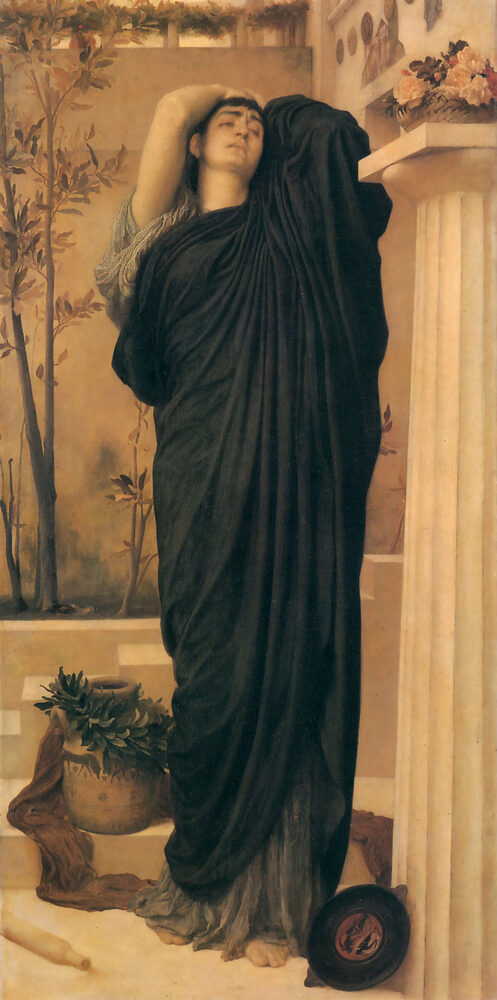
Ēlektra
First Appearance
Electra the daughter of Agamemnon is not named in Homer — the Iliad (9.145) lists three daughters of Agamemnon as Chrysothemis, Laodice, and Iphianassa, with no Electra among them, and the later poets were understood to have identified her with the Homeric "Laodice." The lyric poet Stesichorus, in his Oresteia (6th century BC), is credited with bringing her into the vengeance-story, and the grammarians note that Xanthus used the name before him, glossing it from her long unwed state (a-lektros). She steps fully into the light in Aeschylus's Libation Bearers (458 BC), the middle play of the Oresteia, meeting her returned brother Orestes at their father's tomb — the scene from which every later Electra descends.
— Aeschylus, Libation Bearers (Choēphoroi), 458 BC; earlier named by the lyric poets Xanthus and Stesichorus (6th century BC)
Who They Are
Electra (ee-LEK-truh) is the grief-consumed princess of the house of Atreus, daughter of King Agamemnon and Queen Clytemnestra, and sister of Orestes and Iphigenia. She belongs to the generation on which the long curse of the Atreidae came due: her father, the great king who led the Greeks to Troy, was murdered on his homecoming by her mother and her mother's lover Aegisthus, and Electra's whole life after that blow is shaped by it. She is the daughter who would not mourn and move on — who kept the memory of the murdered king alive year after year, who nursed an unquenchable hatred of the mother and the usurper who held the throne, and who, when her exiled brother at last returned, recognized him, spurred him on, and had her hand in the terrible vengeance that followed: the killing of Aegisthus and the matricide, the slaying of Clytemnestra by her own son.
She is counted here among the heroes as a mortal of the royal house whose story the Greeks told and retold — but she is a hero of endurance and will rather than of quest or battle. Her weapons are memory and grief; her field is the tomb and the palace; her deed is to hold fast to the dead when everyone around her counsels forgetting. The three great Athenian tragedians each gave her a play (or a central part in one), and each drew her differently, so that "Electra" is less a single fixed figure than a question the Greeks kept asking: what does unending grief do to a soul, and is a daughter's vengeance justice or its own new crime?
(Note: she must be kept distinct from the OTHER Electra of Greek myth — the Pleiad and Oceanid, daughter of Atlas or of Ocean, mother of Dardanus and of the rainbow-goddess Iris and the Harpies. That Electra is a figure of the old divine genealogies; this Electra is the mortal princess of Mycenae, Agamemnon's daughter, and the two share only a name.)
Mythology
The house of Atreus and the murder of Agamemnon
Electra was born into the most cursed house in Greek myth — the line of Atreus, haunted by inherited bloodguilt reaching back to Tantalus and Pelops. Her father Agamemnon, king of Mycenae (or Argos), was the commander of the whole Greek host at Troy; her mother was Clytemnestra, sister of Helen. She had a sister, Iphigenia, whom Agamemnon sacrificed at Aulis to win fair winds for the fleet, and another sister, Chrysothemis, and a young brother, Orestes. When Agamemnon came home from the ten-year war, Clytemnestra — nursing her rage over the sacrifice of Iphigenia, and having taken Agamemnon's cousin Aegisthus as her lover and co-ruler — struck him down, cutting him apart in the bath, and seized the throne beside Aegisthus. This murder is the wound from which Electra's whole story bleeds.
The saving of Orestes
In the hour of the killing, Electra did the one thing that would one day undo the murderers: she saved her little brother. Fearing that Aegisthus would kill the boy Orestes to secure the throne against any avenger, Electra smuggled him out of the palace and had him carried away to safety — to Phocis, to the court of King Strophius, where he was raised alongside the king's son Pylades, who became his inseparable friend. By this act Electra kept the avenger alive. Through the long years that followed she remained in the palace (or, in Euripides, was thrust out of it), waiting, mourning, and keeping faith that Orestes would one day come back to set the house right.
The years of mourning
What makes Electra Electra is the long middle of her story — not an event but a condition. Year upon year she refused to forget. She mourned her father openly and would not be consoled; she nursed her hatred of Clytemnestra and Aegisthus and would not pretend peace; she was kept unmarried and childless, denied the honoured marriage her royal birth should have brought, for the usurpers feared the sons she might bear as avengers. She lived humiliated and watched within her own home, treated as a servant or worse, dressed in mourning, grieving at her father's tomb. Her name itself was heard as a-lektros, "the unwed" — the princess kept from the marriage-bed, her life arrested in grief. In this unbroken, unbending sorrow the tragedians found her power: she is the keeper of the dead man's claim, the one conscience in a house that wants to move on.
The recognition at the tomb
The turning-point, and the most famous scene of her myth, comes when Orestes returns in secret, grown to manhood, sent by the oracle of Apollo at Delphi to avenge his father. He comes first to Agamemnon's tomb and lays on it a lock of his own hair as an offering. Electra, coming to the grave with libations, finds the lock — and knows it for a kinsman's, matched to her own hair — and finds a footprint by the tomb that answers to her own foot. These tokens (the shorn lock of hair and the footprint) are the signs by which, in Aeschylus's Libation Bearers, brother and sister come to recognize each other at their father's grave; Orestes then shows a piece of weaving she herself had made, and the recognition is complete. (The later playwright Euripides, in his Electra, pointedly mocks these tokens as implausible — how should a brother's and sister's hair or feet match? — and has his Electra recognized instead by a scar on Orestes' brow, a sly literary quarrel with Aeschylus's scene.) The reunion of the grieving sister and the returning avenger at the tomb is the hinge of the whole story, the moment the long waiting turns toward action.
The vengeance and the matricide
Reunited, brother and sister join in the vengeance. Electra does not wield the sword herself, but she is its spur and its will — she strengthens Orestes' resolve, shares in the great lament at the tomb that calls up their father's spirit and their own fury, and in some tellings takes an active hand in the plot against their mother and Aegisthus. Orestes and Pylades, coming in disguise, kill Aegisthus the usurper; and then comes the terrible deed toward which the whole house has been driven — the matricide, the killing of Clytemnestra by her own son, with Electra urging him on even as their mother bares her breast and pleads for her life. The vengeance is accomplished; the murdered father is answered. But the act is also a fresh horror, mother-murder, the very crime that in Aeschylus brings down upon Orestes the Furies (Erinyes) and sends him fleeing to be judged. Electra's story is thus poised on a knife-edge the Greeks would not resolve simply: her cause is just — a father cries out from the grave for vengeance — and the means is a crime that calls for its own reckoning.
After the deed
The tragedians part ways on Electra's end. In the plays where the aftermath is shown, Orestes is pursued by the Furies and eventually tried and absolved (in Aeschylus's Eumenides, acquitted by Athena's court on the Areopagus at Athens), the ancient chain of blood-for-blood broken at last by a court of law. Electra herself, in Euripides' Electra and Orestes, is at the end betrothed or married to Orestes' loyal friend Pylades — the unwed mourner finally given a marriage, carried out of her long grief into the ordinary world of the living. It is a quiet closing of the wound that defined her: the daughter who kept the dead man's memory is at last allowed a life of her own.
The three Electras of the tragic stage
Electra survives above all as a creation of the Athenian tragic theatre, and each of the three great tragedians drew her differently, so that comparing their Electras is itself a study in the Greek imagination:
In Aeschylus's Libation Bearers (Choēphoroi, 458 BC, the middle play of the Oresteia) she is the more subdued of the three — present, grieving, central to the great tomb-scene and the recognition, but she withdraws before the killings and the focus falls on Orestes and the dreadful logic of the curse. Her role is to open the way, not to drive the whole action.
In Sophocles' Electra she becomes the central, unbroken figure of the play — the drama is wholly hers. The audience lives inside her years of grief: she is on stage mourning throughout, set against her compliant sister Chrysothemis; she is crushed by a false report of Orestes' death (and given an urn she believes holds his ashes to lament over), then lifted by the recognition, and she presses the vengeance home with fierce, undivided will. Sophocles' Electra is the great portrait of grief and hatred sustained to the very edge of what a human soul can bear, and the play ends with the vengeance presented almost as clean justice.
In Euripides' Electra she is harsher and more unsettling — married off to a poor farmer (a peasant who, to the play's credit and hers, honourably leaves her untouched), living in rustic poverty rather than palace confinement, her nobility galling against her low estate. This Electra is embittered and almost pathological in her hatred; she lures her mother to the farmhouse with a lie about a newborn child, takes a direct and chilling hand in the murder — and then, with Orestes, collapses into horror and remorse once the deed is done. Euripides turns a sharp, questioning eye on the whole vengeance, letting its glamour curdle into guilt. She appears again in his Orestes, sharing her brother's madness and peril in the grim aftermath, and is there betrothed to Pylades.
Taken together these three Electras — the subdued, the unbroken, the embittered — made her one of the richest roles the ancient stage bequeathed to the world, a figure endlessly re-read ever since as the very image of grief that will not be comforted and of vengeance that is at once righteous and ruinous.
Worship — Ancient
A figure of the stage, not the shrine
Electra had no cult of her own in the ordinary Greek sense — no temple, no priesthood, no festival-calendar of her own. She belonged not to religion but to poetry and the tragic theatre: she lived in the great choral odes and the plays performed at the Athenian festivals of Dionysus, where the sufferings of the house of Atreus were set before the whole city. Her "worship," insofar as there was one, was the civic experience of tragedy itself — the Athenians gathered in the theatre to watch, lament, and reflect upon her grief and the terrible justice of the Oresteia.
The rites her story enshrines
What her myth does preserve, vividly, is the shape of real Greek mourning-practice, for her story turns on it. The offerings she pours at Agamemnon's tomb — the libations (choai) that give Aeschylus's play its very name, Libation Bearers — the lock of hair laid on the grave in mourning, the formal lament (goos) sung for the dead, the kneeling at the grave-mound to call upon the dead man's spirit: these were the genuine rites Greeks performed for their own dead, and Electra is their archetype, the mourning daughter at the tomb. Through her, Greek audiences saw their own funerary piety raised to the pitch of myth.
The quarrel of the poets
Electra was also, unusually, a figure the poets consciously handed down and argued over. The lyric poet Stesichorus (6th century BC) seems to have drawn her into the vengeance-tale; Aeschylus, Sophocles, and Euripides each reworked her; and Euripides openly mocked the recognition-tokens of Aeschylus's tomb-scene within his own play. She is thus one of the clearest ancient examples of a mythic figure whose life is wholly literary — kept alive, reshaped, and debated from poet to poet rather than worshipped at any altar.
Worship — Modern
The patron of unconsoled grief
Electra is honoured today not through cult but through the endurance of her story, and a modern reader drawn to her tends to find in her a patron of grief that refuses to be tidied away — of loyalty to the dead, of memory held against all pressure to forget, of the long faithfulness of mourning. Where her brother's tale ends in a courtroom and an acquittal, hers is the harder, quieter heroism of keeping a wound open because the truth of it demands remembering. She speaks to anyone who has refused to "move on" from an injustice done to someone they loved.
The Electra on the modern stage and page
Above all she lives on in art. Her name and story have been taken up again and again by later writers and composers — the tragedians' three Electras have been staged for twenty-five centuries, and she stands behind countless later dramas of family, murder, and revenge. Richard Strauss's opera Elektra (1909) and modern retellings on stage and screen keep her before new audiences. And her name entered modern psychology as a byword (the "Electra" figure, named for her fierce bond to her father against her mother) — a use far removed from the ancient plays, but a measure of how deeply her image of a daughter consumed by loyalty and grief has sunk into the culture.
A note on the two Electras
A modern devotee or reader should keep clear, as the ancients did, that this Electra — the grieving princess of Mycenae, daughter of Agamemnon — is not the Electra of the star-myths, the shining Pleiad and Oceanid who was mother of Dardanus and of Iris. To honour "Electra" meaningfully is to know which one is meant: here, the mortal daughter of the house of Atreus, the keeper of her father's memory and the heart of the greatest revenge-story the Greeks ever told.
Epithets & Cult Titles
- Ēlektra (Ἠλέκτρα) — The amber-bright or shining one, from ēlektron ('amber') / ēlektōr ('the beaming sun'); the name the tragedians give the mourning princess of the house of Atreus
- a-lektros (ἄλεκτρος) — The unwed, the unbedded — a reading of her name that the poets play upon, for she is the daughter kept from marriage through the years of grief, a princess denied the husband and children her rank should have brought
- penthētria (πενθήτρια) — The mourner, she who keeps grief alive — not a formal cult-title but the role that defines her across all three tragedies: the daughter who will not let her father's murder be forgotten
Sources & Variants
- Homer, Iliad 9.145 (Agamemnon's three daughters named as Chrysothemis, Laodice, and Iphianassa — Electra is NOT among them; later poets identified her with 'Laodice')
- Stesichorus, Oresteia (6th century BC, fragmentary) — credited with drawing Electra into the vengeance-story
- Aeschylus, Libation Bearers (Choēphoroi), 458 BC — the recognition at Agamemnon's tomb (the lock of hair, the footprint, the woven token); Electra in her subdued role
- Aeschylus, Eumenides, 458 BC — Orestes pursued by the Furies for the matricide and acquitted at Athens
- Sophocles, Electra — Electra as the central, unbroken mourner; the false report of Orestes' death, the funeral urn, the recognition, and the vengeance
- Euripides, Electra — Electra married off to a peasant farmer, embittered; her active hand in the matricide and the remorse that follows; the recognition by a scar, mocking Aeschylus's tokens
- Euripides, Orestes — Electra sharing her brother's madness and peril, and betrothed to Pylades
- Apollodorus, Epitome 6.23–25 and Bibliotheca 3.10.6 (the children of Agamemnon and Clytemnestra; Electra's part in the vengeance and her marriage to Pylades)
- Hyginus, Fabulae 122 (Electra, the recognition and the vengeance; her later marriage to Pylades) — Roman-era handbook
Gallery