Psyche
First Appearance
The tale of Psyche and her divine husband comes to us fully told in only one place: the Latin novel Metamorphoses, better known as The Golden Ass, written by Apuleius in the 2nd century AD. This is a late, literary, and allegorical fable — not an early Greek myth. In the novel an old woman tells the story to comfort a captive girl, and it fills books 4 through 6. Older still, however, is the Greek picture of Psyche as the soul itself, shown from the 4th century BC onward as a girl with the wings of a butterfly, often together with the child-god Eros — so the idea of Psyche is far older than the story Apuleius gives her.
— Apuleius, Metamorphoses (The Golden Ass) 4.28–6.24
Who They Are
Psyche (SY-kee) is the human soul made into a person — and her name says so plainly, for psyche (ψυχή) is simply the Greek word for the soul, the breath of life that was thought to leave the body at the moment of death. The same word also means "butterfly," and that is no accident: the Greeks pictured the soul as a small winged thing, a butterfly slipping free of the body as it slips free of the chrysalis, and so in their art Psyche wears not the feathered wings of a bird but the delicate wings of a butterfly. To speak of Psyche is to speak of the soul; her whole story is the story of what the soul suffers, and where love may carry it in the end.
Her tale is the most beautiful thing in ancient prose, and one of the most important to say plainly: it is a late literary fable, not an old Greek myth. The full story of Psyche and her unseen husband survives in only one place — the Latin novel Metamorphoses, or The Golden Ass, written by Apuleius in the 2nd century AD, roughly a thousand years after Homer. It is told there as a fairy story within the novel, an old woman spinning a tale to comfort a frightened girl, and it reads like a fairy tale: "once upon a time there was a king and a queen, and they had three daughters." What is genuinely old is not the story but the idea — the picture of Psyche-as-butterfly, the winged soul, which Greek artists had been drawing for centuries before Apuleius gave her a plot.
And that plot is an allegory — a story that means something beneath its surface. Psyche is the soul; Eros is Love. Their tale is the tale of the soul's trials, its blind marriage to a love it cannot yet see, its terrible mistake and its long wandering, the near-impossible labours it must complete, and at the last its winning of immortality and its union with Love among the gods — a union that gives birth to a daughter named Pleasure. Read this way, Psyche's story is a small map of what the ancient world, and much of the world after it, hoped might be true of the soul: that through suffering and faithfulness it might be joined forever to what it loves, and not die.
Mythology
A word of caution: a late tale, told in Latin
Before the story, the plain fact behind it. The myth told below is not an archaic Greek myth handed down from Homer or Hesiod. It survives whole in exactly one ancient source — the novel Metamorphoses, called The Golden Ass, written by the Latin author Apuleius in the 2nd century AD. Apuleius wrote in Latin, and in his telling the god of love is called by his Roman name, Cupid (which is simply the Roman name for the Greek Eros). The story appears inside the novel as an entertainment — an old serving-woman tells it to soothe a kidnapped bride — and it has the shape and the opening of a fairy tale. So while we give the characters their Greek names here, this is a sophisticated literary and philosophical fable of the Roman age, an allegory of the soul, and not a piece of early Greek religion. What is old is the image at its heart: the Greeks had pictured Psyche as a butterfly-winged girl, the soul in visible form, for centuries before Apuleius wove her into a story.
A princess worshipped in the goddess's place
There was once a king and a queen who had three daughters, and the youngest, Psyche, was so astonishingly beautiful that people could find no words for her. Travellers came from far off simply to look at her; they scattered flowers before her and offered her the prayers and honours that belonged by right to Aphrodite (the Romans' Venus), the goddess of love and beauty herself. Men said that a new Aphrodite had been born among mortals, and the goddess's own altars grew cold and neglected while the crowds flocked to gaze at a girl. It is worth noticing the irony that runs through the whole tale: Psyche's beauty wins her worship but no husband — men adore her as they would a statue in a temple, and no one dares to ask for her hand, so that the most beautiful girl in the world sits alone.
Aphrodite's jealousy, and the arrow that misfires
Aphrodite was not a goddess to share her honours, and her jealousy blazed. She called her son Eros (Cupid in Apuleius's Latin) — the winged boy-god of love, whose arrows make gods and mortals fall helplessly in love — and commanded him to punish Psyche: he was to shoot her with his arrow and make her fall in love with the vilest, most wretched creature alive, so that her beauty would be joined to misery. Eros flew down to do his mother's bidding. But when he saw Psyche, he was so struck by her that — in one version — he pricked himself on his own arrow, and the boy who makes all the world fall in love fell in love himself. He could not carry out the punishment. He resolved instead to have her for his own, in secret.
The wedding that was a funeral
Meanwhile Psyche's parents, troubled that their peerless daughter had no suitor, consulted an oracle, which gave a dreadful answer: Psyche was to be dressed as for a wedding and left on a mountain crag, where no mortal husband but a fearsome winged serpent — a monster feared even by the gods — would take her. In grief the whole city led her up the mountain in a procession that was more funeral than marriage, and left her alone on the rock. But as she waited in terror, a gentle wind — Zephyros, the West Wind — lifted her softly from the crag and carried her down into a hidden valley, and set her in a meadow, where she slept.
The unseen husband and the palace of gold
When Psyche woke she found before her a palace more magnificent than any king's — walls of gold, ceilings of citrus-wood and ivory, floors of cut jewels, its treasures uncounted and unguarded. Bodiless voices waited on her, serving her food and music from the empty air, telling her the whole house and all its riches were hers. And at night, in the total dark, a husband came to her bed — tender, loving, wholly hers — but he forbade her ever to bring a light or to try to see his face, and he was gone again before the first light of dawn. She never saw him. She lived in happiness and luxury, loving a husband she knew only by his voice and his touch in the darkness, and in time she conceived his child. He warned her, gently and often, of one thing only: her sisters would come searching for her, and she must not listen to them, or she would bring ruin on them both.
The sisters' envy and the fatal lamp
This is the turn on which the whole tale hangs. Psyche, lonely, begged and begged until her husband allowed Zephyros to carry her two elder sisters down to visit. They saw her palace and her riches and were eaten with envy — their own marriages were nothing beside this. When they wormed out of her that she had never seen her husband, they poisoned her mind with fear: surely, they said, the oracle was right and she was sleeping with a monstrous serpent that would devour her and her unborn child. They pressed on her a plan: she must hide a lamp and a sharp knife by the bed, and when he slept, light the lamp and cut off the beast's head.
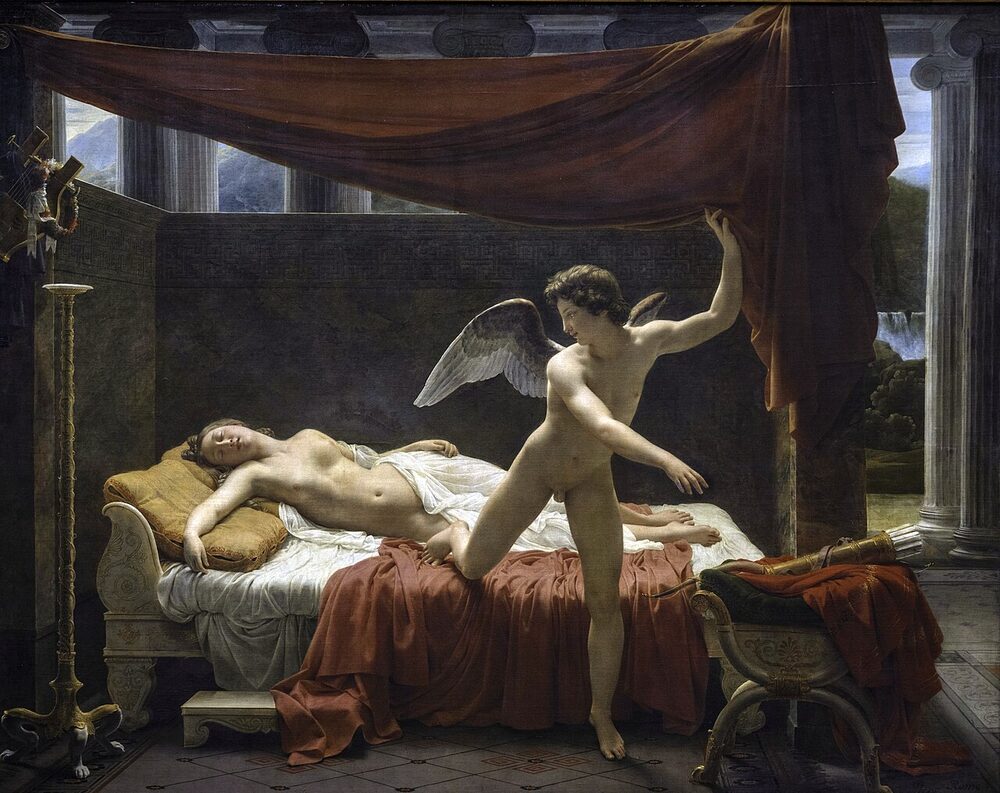
That night, torn between love and terror, Psyche lit the hidden lamp — and saw, asleep on her bed, not a monster but the most beautiful of all the gods: Eros himself, Love, with his soft wings folded, his bow and arrows at the bedside. Overcome, gazing at him, she pricked herself on one of his own arrows and fell deeper in love than ever. But as she leaned close to look, a drop of hot oil fell from the tilted lamp onto his bare shoulder and burned him. Eros woke, saw the light, saw that she had betrayed his one command — and without a word he rose and flew up and away, leaving her clinging to his leg until her strength failed and she fell. "Love," he told her as he went, "cannot live where there is no trust." So she lost him in the very moment she first saw him.
The wandering and the wrath of Aphrodite
Now begins the soul's long punishment. Psyche wandered the earth, ruined and grieving, searching for the husband she had lost. She threw herself into a river to die and was cast up unharmed; she went from temple to temple begging for help, but no god would shelter her against the anger of Aphrodite. At last, worn down, she gave herself up and came before the goddess herself — who fell on her with fury and mockery, had her beaten, and set her to a series of cruel, impossible tasks, meaning either to break her utterly or to be rid of her.
The impossible tasks
Aphrodite's tasks are the labours of the soul, and Psyche could not have done a single one alone — help came each time from the humblest creatures and forces of the world.
First the goddess poured out a vast heap of mixed grains — wheat, barley, poppy-seed, lentils, beans, all jumbled together — and ordered Psyche to sort every seed into its own kind by nightfall. It was hopeless; Psyche sat and did not even begin. But a column of ants took pity on her and swarmed over the heap, sorting every grain into neat piles before dark.
Next she was sent to a river-meadow to fetch a hank of the golden fleece from a flock of wild, sun-maddened sheep whose wool was living gold — but the rams were savage and would have killed her. A green reed by the river's edge whispered to her to wait: at noon the sheep were murderous, but in the cool of evening they grew calm, and she could gather the shining wool caught on the briars of the thicket without going near the beasts at all.
Then Aphrodite sent her to fill a jar with black water from the source of the rivers Styx and Cocytus — a spring that gushed from a sheer cliff and ran down into the Underworld, guarded by sleepless dragons, its very waters crying out warnings. This too was beyond her, until the eagle of Zeus swept down, took the jar in its talons, and filled it for her from the deadly stream.
The box of beauty from the Underworld
The last and cruelest task sent Psyche down among the dead. Aphrodite gave her a box and ordered her to carry it to the Underworld, to Persephone, queen of the dead, and ask her for a portion of her divine beauty — and bring it back shut. To go down living into the land of the dead and return is the hardest thing of all, and again Psyche despaired and climbed a high tower to throw herself off and simply be done. But the tower itself spoke to her, and told her the whole secret road: how to enter the Underworld, the coins to carry for the ferryman Charon, the sops of barley-cake to quiet the three-headed hound Cerberus, and — above all — the warnings. She must refuse every plea for help along the way, and she must on no account open the box or look at what was inside.
She did everything the tower said and came safely back up into the light of the living world, the shut box in her hands, her task all but done. And there, at the last step, she failed a second time — for the same reason as the first. Curiosity overcame her. She thought: I am carrying the beauty of a goddess, and I am worn and haggard from all my grief; surely I may take a little for myself, to please my husband when I find him. She opened the box. But there was no beauty inside — only an infernal, deathlike sleep, which rushed out and fell upon her, and she dropped where she stood, still as a corpse, in the middle of the road.
Reconciliation, and the soul made immortal
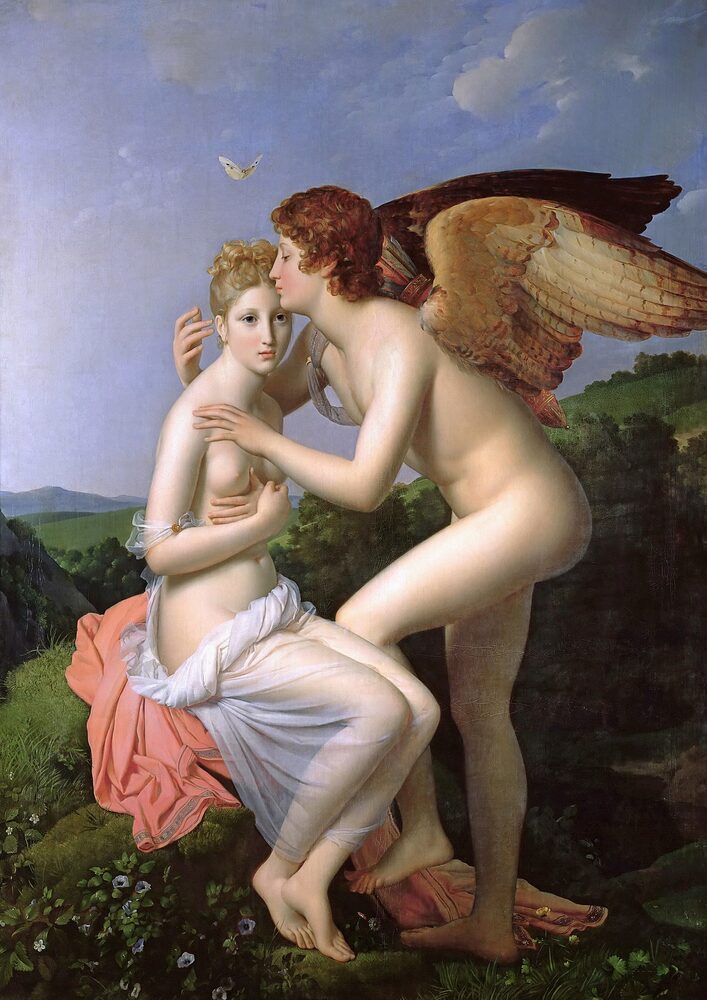
It was Eros who saved her. His burn had healed; he had never stopped loving her; and now, escaping through the window of the room where his mother had shut him up, he flew to where Psyche lay in her deathly sleep. He wiped the sleep from her and shut it back in the box, woke her with the harmless prick of an arrow, and told her to finish carrying the box to his mother — he would see to the rest. Then Eros flew up to Zeus himself and pleaded his cause, and Zeus, smiling, agreed to make the marriage right. He called the gods together, quieted Aphrodite's anger, and had Hermes bring Psyche up to Olympos. There Zeus handed her a cup of ambrosia, the food of the gods, and said, "Drink this, Psyche, and be immortal" — and the mortal soul became deathless, a goddess among the gods. So the wedding that had begun in darkness and secrecy was celebrated at last in the open hall of heaven, all the gods at the feast; and in time Psyche bore to Eros a daughter, whom they named Hedone — in Latin Voluptas — that is, Pleasure. Love and the Soul, joined forever, and their child is Joy.
How to read it: the soul's own story
Apuleius surely meant all this to be read beneath its surface, for the names give the game away. Psyche is the soul; Eros is love. Told as allegory, the tale becomes the story of every soul: it is joined to a love it cannot yet see and must trust in the dark; it is betrayed into doubt and loses that love through its own fault; it wanders and suffers and is set trials it cannot pass by its own strength, but is carried through them by help freely given; it goes down even into death, and fails again through the same weakness; and yet at the last it is not the soul's worthiness but Love's own faithfulness that saves it, lifts it up, and makes it immortal. Her emblem, the butterfly, is the soul itself — the small winged thing that struggles out of the chrysalis and rises, which is why the Greeks called both the soul and the butterfly by the one word, psyche.
Worship — Ancient
A figure of art and idea, not of cult
It must be said clearly: Psyche was not worshipped in the ancient world in the way the Olympian gods were, or even in the way heroes were. She had no temple, no altar, no priesthood, no festival on any city's calendar. She is not a goddess of Greek religion but a figure of philosophy, art, and — very late — of story. To look for shrines of Psyche is to look for something that never existed. What the ancients gave her was not cult but meaning.
The winged soul in Greek art and thought
Long before Apuleius told her story, Greek artists and thinkers had made Psyche the visible image of the soul. From at least the 4th century BC she appears in Greek art as a slender girl with the wings of a butterfly, because the butterfly — which the Greeks also called psyche — was the emblem of the soul: a creature that leaves its old body behind and rises transformed, as the soul was believed to leave the body at death. She is very often shown together with Eros, the two of them as children or young lovers, and their pairing was itself an idea before it was a plot — Love and the Soul, drawn to each other, sometimes tormenting each other. Greek philosophy, above all in Plato, had made the soul (psyche) and its longing love (eros) central to its picture of the world, and the images of the winged girl and the winged boy gave that philosophy a face.
Apuleius and the allegory of the soul
Apuleius, who wrote her story, was not only a novelist but a Platonist philosopher, steeped in the idea of the soul's descent, suffering, and return. His tale of Psyche is widely read as a deliberate allegory in that tradition — the soul falling into the body and the world, losing sight of the divine love it was joined to, undergoing trials and even a kind of death, and being raised at last to the immortal life it was made for. In the centuries after him, both Platonist thinkers and, later, Christian readers found in the story a mirror of their own beliefs about the soul's journey, its testing, and its hope of eternal life — which is much of why this one late fable survived and mattered so far out of proportion to its origins.
Worship — Modern
Not a goddess to petition, but the soul to contemplate
Because Psyche never had ancient cult, there is no old rite to revive. She belongs to modern devotion in a gentler and more inward way — not as a deity to be asked for favours, but as the image of one's own soul and its journey. To turn to Psyche is really to turn toward oneself: to consider the soul's need to trust what it loves before it can fully see it, its habit of ruining its own happiness through doubt and restless curiosity, and its hope that faithfulness and love might carry it through trials it cannot pass alone. She is a figure for reflection and meditation far more than for sacrifice.
Simple observances
A person drawn to Psyche today might keep her in the simplest ways. A lit lamp or candle recalls the fatal lamp of her story — but turned to good: the light by which the soul at last sees clearly what it loves. A butterfly — an image, a small ornament, a live one glimpsed in a garden — is her oldest and truest emblem, the soul itself in its rising, transformed shape. One might read her tale aloud, or sit with the meaning of it: that the soul is tested, that it fails and is forgiven, and that Love does not let it go. Where a devotee honours Aphrodite or Eros, it is fitting to remember Psyche beside them, the mortal bride raised to sit among the gods.
Her long afterlife in art and language
More than through any worship, Psyche lives on in art and in the very words we use. Her name became the Greek and then the modern word for the soul and the mind — it is the root of psychology ("the study of the psyche"), psychiatry, and every "psych-" word we have. Her story, retold as Cupid and Psyche, became one of the most beloved subjects in all of Western art: painters from the Renaissance onward, and above all sculptors — Antonio Canova's marble of Psyche Revived by Cupid's Kiss is among the most famous statues in the world — returned again and again to the winged god bending over the sleeping soul. In poetry she has her own great hymn in Keats's Ode to Psyche, which laments that she came "too late for antique vows" and pledges the poet himself as her priest. So the soul that had no temple in the ancient world was given a thousand of them afterward, in marble and paint and verse.
Epithets & Cult Titles
- Psyche (Ψυχή), the Soul — Her name is simply the Greek word for the soul or the breath of life — she is the human soul made into a person, and her whole story is read as the soul's own journey
- the butterfly-winged — In Greek art Psyche is shown with the wings of a butterfly rather than the feathered wings of a bird — the butterfly (also called psyche in Greek) was the emblem of the soul, and it grew its wings and left the body as the soul was thought to leave at death
- the deified bride of Love — By the end of her tale she is made immortal and wedded to Eros (Love himself) among the gods — the mortal soul raised to share the life of the deathless ones
Sources & Variants
- Apuleius, Metamorphoses (The Golden Ass) 4.28–6.24 — the only full ancient telling of the tale of Cupid (Eros) and Psyche; a 2nd-century-AD Latin novel, and an allegorical literary fable rather than an early Greek myth
- Apuleius, Metamorphoses 6.23–24 (Zeus grants Psyche immortality with the cup of ambrosia; the wedding of the gods; the birth of the daughter Voluptas / Hedone, 'Pleasure')
- Greek vase-painting and terracottas, 4th century BC onward (Psyche shown as a butterfly-winged girl, often paired with Eros — the image of the soul that long predates Apuleius's story)
- Plato, Phaedrus 246a–256e and Symposium (the winged soul, psyche, and its love, eros — the philosophical background that gave the image of Psyche its meaning)
- Antonio Canova, Psyche Revived by Cupid's Kiss, 1787–1793 (Louvre, Paris) — the most famous later depiction of the tale
- John Keats, Ode to Psyche, 1819 (the Romantic poet's hymn to the soul who came 'too late for antique vows')
Gallery