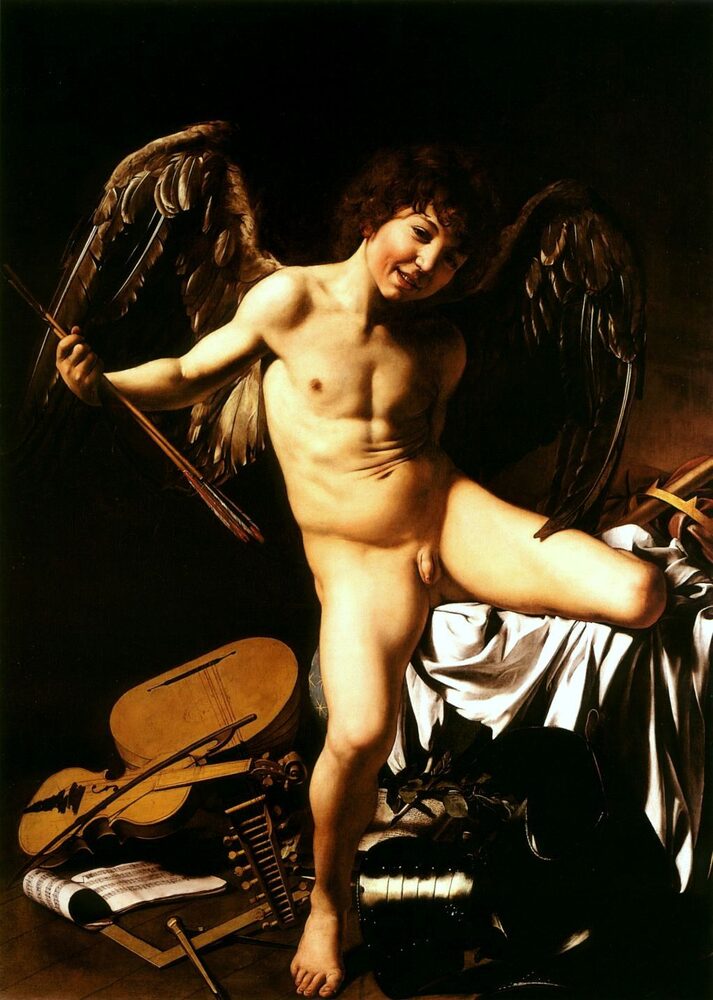
Eros
First Appearance
"First of all Chaos came to be, but next wide-bosomed Gaia... and Eros, who is fairest among the deathless gods, who unnerves the limbs and overcomes the mind and wise counsels of all gods and all men within them." So Hesiod names Eros among the very first powers to arise at the dawn of the world — not born of any parent, but standing at the beginning beside Chaos, Gaia, and Tartarus as one of the four that first came to be.
— Hesiod, Theogony 116–122
Who They Are
Eros (EER-oss) is one of the oldest powers in the Greek account of the world — and one of the most easily mistaken. In everyday imagination "Eros" (Roman Cupid) is the winged boy who fires arrows of love at the command of his mother Aphrodite. But that mischievous child is a later figure. The Eros described here is the primordial Eros: one of the first beings ever to come into existence, named by Hesiod in the same breath as Chaos and Earth, and utterly unlike the playful archer of later art. This Eros has no parents, no bow, no childhood. He is the raw force of attraction and generation itself — the power that makes all coupling and all begetting possible.
Hesiod places Eros at the very opening of the Theogony. After Chaos, Earth (Gaia), and Tartarus have come to be, "and Eros, who is fairest among the deathless gods, who unnerves the limbs and overcomes the mind and wise counsels of all gods and all men" (Theogony 116–122). He is not a god who loves, but the very principle by which love and union happen — the cosmic drive that draws the separate powers of the young universe together so that they can join and bring forth offspring. Without Eros, the great genealogies that fill the rest of the Theogony could not begin: Earth could not pair with Sky, night could not pair with darkness, and the world would stay a scatter of unmoving first things. Eros is what sets the generations flowing.
Because he is a principle rather than a personality, the primordial Eros barely acts in the myths. He comes into being, he does his work of drawing things together, and then he recedes behind the couplings he makes possible. Yet in one strand of Greek religious thought — the Orphic cosmogony — this first Eros returns to the very centre of the story, reborn as Protogonos-Phanes, the shining first-born god who hatches from the cosmic egg and fathers the whole ordered world. Whether kept in the background as Hesiod's fair and limb-loosening force, or exalted as the Orphic king of creation, the primordial Eros stands for the same idea: that desire is not a late arrival in the world but one of its foundations.
Mythology
Eros the primordial versus Eros the son of Aphrodite
It is easy to confuse two very different gods who share a name, so it is worth drawing the contrast plainly. The primordial Eros of Hesiod is one of the first four powers to come into being at the dawn of the cosmos — Chaos, Gaia, Tartarus, and Eros (Theogony 116–122). He has no parents; he simply "came to be," parentless and coeval with Earth itself. Hesiod calls him "fairest among the deathless gods," but describes his power in terms that are anything but sweet: he "unnerves the limbs" (lysimelēs, "limb-loosener") and "overcomes the mind and wise counsels of all gods and all men." This is Eros as an overwhelming cosmic force — the drive of attraction that compels union and generation. His function is structural: he is the reason the primordial powers can pair off and beget, the engine that turns a set of separate first things into a teeming, self-propagating world.
The later Eros — the winged boy-god who is the familiar Cupid of art and poetry — is a quite different conception, and a much younger one. In the tradition that becomes standard, he is the son of Aphrodite (often with Ares named as father), a youthful attendant of the goddess of love who wields a bow and looses arrows that kindle desire in gods and mortals. This is the Eros of Anacreon's playful verse, of Hellenistic epigram, of the tale of Eros and Psyche in the Roman writer Apuleius, and of the plump putto of later painting. He acts within the world of the established gods rather than helping to found it; he serves and sometimes torments, but he does not create. (This later, personal Eros — Aphrodite's son and companion, the winged archer better known as Cupid and the bridegroom of Psyche — carries the same divine name but is a distinct, much younger conception; the point here is only to keep the two apart.) The single name thus spans an enormous range: from a nameless generative principle at the origin of all things to a characterful boy-god with a quiver, born late into an already-furnished cosmos. When Hesiod's Eros is meant, it is the first that is in view — the ancient force, not the archer.
The Orphic egg: Eros as Protogonos-Phanes (Orphic variant)
Hesiod's was not the only Greek account of Eros's origins. In the Orphic cosmogonies — the body of creation-poetry attributed to the legendary singer Orpheus and used in mystery cult — Eros is given a far more exalted role, and a birth. In this tradition the starting point is not Chaos but Chronos (Time) and Night (Nyx); from their working, a great silver world-egg is fashioned in the depths, and from this egg hatches the first of the gods. He is called Protogonos ("First-born") and Phanes ("the Shining One," from phainō, "to bring to light"), and he is identified with Eros: a radiant, golden-winged, bisexual deity who bursts from the shell as the first light in the darkness and becomes the first king of the gods. From Phanes-Eros the rest of the ordered cosmos is generated. This is the same idea as Hesiod's — desire as a foundational, world-making power — but raised to its highest pitch: here Eros is not merely present at the beginning but is the creative source from which everything unfolds.
A memorable echo of this Orphic myth survives in comedy. In Aristophanes' Birds (lines 693–702), a burlesque of an Orphic creation-hymn, the birds sing that in the beginning there were only Chaos, Night, Erebus, and Tartarus — no earth, no air, no sky — and that black-winged Night laid a wind-egg in the boundless bosom of Erebus, from which, as the seasons revolved, hatched golden-winged Eros, gleaming and swift, who then mingled all things together and brought the race of birds and every living thing to light. The joke depends on the audience knowing the solemn Orphic original: the primal egg, and the shining winged Eros born from it as the true first cause of the living world. Flagged as Orphic and playful though it is, this variant preserves one of the grandest ancient visions of Eros — not love's servant, but the light that begins the world.
Worship — Ancient
Little cult for the cosmic principle
The primordial Eros — Hesiod's parentless force of generation, or the Orphic Phanes of the egg — had, in and of itself, almost no independent cult. Like Chaos or Tartarus, this Eros belonged to the world of cosmogonic poetry and mystery-teaching rather than to the everyday religion of altar and sacrifice; the Orphic Phanes in particular was a figure of secret hymn and initiation, invoked in ritual but not served by public temples. One should be honest about this: where the Greeks did build sanctuaries and hold festivals for a god named Eros, they were for the most part honouring Eros as the god of love and desire — a power felt in the body and in the city — rather than making a fine distinction about which Eros, the primal principle or Aphrodite's boy, they meant. The two ran together in cult far more than they do in the neat pages of a genealogy.
Thespiae, Parion, and the Erotes
That said, Eros as a divine power was genuinely and anciently worshipped, above all at Thespiae in Boeotia. There, the traveller Pausanias records (Description of Greece 9.27.1), "of the gods the Thespians have from the beginning honoured Eros most," and his oldest image was not a statue at all but an argos lithos — a rough, unwrought stone — a sign of very archaic reverence. Thespiae later held a festival for him, the Erotidia, with games and contests, and its sanctuary became famous for housing a celebrated marble Eros by the sculptor Praxiteles. A cult of Eros is also attested at Parion on the Hellespont. Beyond these, Eros was frequently honoured together with Aphrodite — the two shared a sanctuary on the north slope of the Athenian Acropolis — and was invoked in the gymnasia, where his image stood beside those of Heracles and Hermes as a patron of the bonds formed among the young. In poetry and art he multiplies into the Erotes, a whole company of winged love-spirits (among them Himeros, "Longing," and Pothos, "Yearning"), attendants of Aphrodite who personify the many faces of desire. Whether met as a nameless stone at Thespiae or as a crowd of golden wings around the love-goddess, Eros was, in lived religion, honoured chiefly as the power of attraction between beings — the same power Hesiod set at the beginning of the world.
Worship — Modern
Honouring the first Eros today
A modern devotee drawn to the primordial Eros honours something larger and stranger than the greeting-card Cupid. This Eros is not the archer who makes two people fall for one another, but the deeper force beneath all such joinings: the pull that draws the separate toward union, the generative desire that Hesiod placed among the first powers of the cosmos. Devotion here means reverencing attraction itself — the drawing-together that makes new life, new work, and new bonds possible — rather than petitioning for a particular romance. It is closer to honouring a law of the world than to praying to a person.
Practice and offerings
Because the primordial Eros had little fixed rite, a devotee has honest freedom, and simple acts suit him best. Where the ancients at Thespiae kept a bare stone, a modern shrine might hold something equally elemental — a single flower, a pair of joined objects, a lit flame for the "shining" Phanes of the Orphic egg. Roses and myrtle, long associated with love and with Aphrodite's circle, make fitting offerings, as does a libation of honeyed wine. The truest devotion, though, is contemplative: to notice and honour the countless attractions that hold the world together — between people, between ideas, between the elements themselves — and to recognise in them the working of the oldest Eros, the fair and limb-loosening force that Hesiod said no god and no mortal can resist.
Epithets & Cult Titles
- Πρωτόγονος (Protogonos) — "First-born" — the title of Eros in the Orphic cosmogony, the first being to emerge from the world-egg
- Φάνης (Phanes) — "The Shining One" or "He who brings to light" (from φαίνω, 'to reveal') — the Orphic name for the primordial Eros as revealer of the cosmos
Sources & Variants
- Hesiod, Theogony 116–122 (Eros among the first four powers — Chaos, Gaia, Tartarus, Eros; 'fairest among the deathless gods', the limb-loosener who overcomes mind and counsel)
- Aristophanes, Birds 693–702 (the parodied Orphic cosmogony: Night's wind-egg in Erebus and the birth of golden-winged Eros)
- Orphic cosmogonies / Orphic Rhapsodies (fragments collected by Kern and Bernabé): Eros as Protogonos-Phanes, the shining first-born god hatched from the world-egg made by Chronos and Night
- Pausanias, Description of Greece 9.27.1 (Eros most honoured at Thespiae; his ancient aniconic image as an unwrought stone; Praxiteles' Eros; the Erotidia festival)
- Apuleius, Metamorphoses (The Golden Ass) 4.28–6.24 (Roman/later: the tale of Cupid — the winged boy-god Eros, son of Venus/Aphrodite — and Psyche, illustrating the later personal Eros)
- M. L. West, Hesiod: Theogony (1966), and The Orphic Poems (1983), on Eros as cosmogonic principle and on Phanes-Protogonos in the Orphic tradition
Gallery