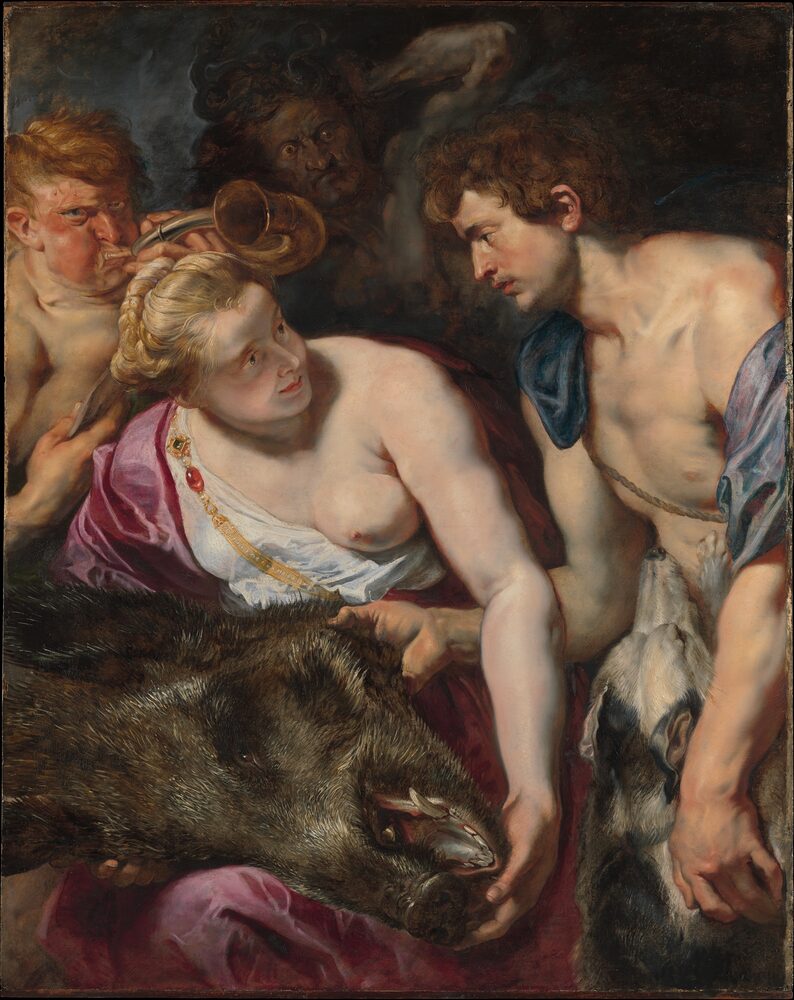
Meleagros
First Appearance
Meleager first appears in Phoenix's parable to the sulking Achilles: after the boar is slain, war breaks out between the Aetolians of Calydon and the Curetes over the beast's head and hide; Meleager fights, then withdraws in anger at his mother's curse and lies idle with his wife Cleopatra while the enemy storms the walls — rejoining the battle only at the last, and too late to claim the gifts once offered him. In this oldest surviving version there is no burning brand at all: Meleager is simply a great warrior whose wrath, like Achilles' own, costs him dearly.
— Homer, Iliad 9.529–599
Who They Are
Meleager (mel-ee-AY-gur) is one of the great heroes of the generation before the Trojan War — a prince of Calydon in Aetolia, captain of the most famous hunt in Greek myth, and the subject of one of mythology's starkest stories of a life measured out and cut short. His name is bound above all to two things: the Calydonian boar, the monstrous beast he gathered the heroes of Greece to kill, and the burning brand (Greek dalos, a log or firebrand) on which the Fates hung his life at his birth. He is a hero not of the gods' descent but of mortal Aetolian kingship, and his tale is threaded through with the goddesses who shape mortal fate — the Moirai who spun his doom, and Artemis whose anger set the whole tragedy in motion.
The son of King Oeneus and Queen Althaea of Calydon (both prose figures in these pages, not divine ancestors), Meleager belongs to the heroic age of gatherings and quests: the Argonauts, the boar hunt, the wars of Aetolia. Yet what makes him unforgettable is not simply his valour but the terrible economy of his death. At his birth, the story goes, the three Fates came to the house and foretold the length of his days — and his own mother, hearing it, seized the one object on which that length depended and hid it away, so that for years the hero's life sat locked in a chest, a piece of half-burnt wood no fire could be allowed to touch.
Because Meleager's oldest appearance, in Homer's Iliad, tells his story without any burning brand at all, he stands at a fascinating fork in the tradition. To the archaic poet he is a warrior undone by his own wrath and his mother's curse — a mirror held up to Achilles. To the later poets, above all Ovid, he is a man whose life is literally a log on the hearth, extinguished by a mother's grief-maddened hand. Both versions are preserved here, side by side, as two ancient memories of the same doomed prince.
Mythology
The Fates and the burning brand
When Meleager was born to Althaea, queen of Calydon, the three Moirai — the Fates, spinners of every mortal's destiny (they have their own page) — came to the house to pronounce his lot. Clotho said the child would be noble, and Lachesis that he would be brave; but Atropos, she who cannot be turned, looked to the log then burning on the hearth and declared that the boy would live only so long as that piece of wood remained unconsumed. The moment the Fates departed, Althaea sprang from her childbed, snatched the blazing brand from the fire, quenched it, and hid it away in a chest, guarding it through all the years of her son's growing. So Meleager came to manhood with his life kept, quite literally, under lock and key — a hero whose death would come not by spear or sickness but by fire, whenever the hidden wood should burn. This is the version told most fully by Ovid (Metamorphoses 8) and by the mythographers; it does not appear in Homer, and belongs to the strand of the tradition that made his fate a matter of sympathetic magic between a man and a log.
The Calydonian boar hunt
King Oeneus of Calydon, giving thanks at harvest, made offerings to all the gods — but forgot, or slighted, Artemis alone. The goddess of the wild does not forgive neglect, and in her anger she loosed upon the fields of Calydon a boar of monstrous size, a beast with bristles like spears and tusks like an elephant's, that trampled the crops, gored the herds and the herdsmen, and shut the people behind their walls. Against this scourge Meleager summoned the finest hunters and heroes of Greece, and they came: among them Meleager's uncles, the brothers of Althaea; the twins Castor and Polydeuces; Theseus and Peirithous; Jason; the swift-footed Idas and Lynceus; Ancaeus and Cepheus; the seer Amphiaraus; Nestor in his youth — and, alone among the men, a woman: Atalanta of Arcadia, the virgin huntress sworn to Artemis (she has her own page here). The gathering of so many named heroes made the hunt one of the great "assemblies" of myth, rivalled only by the voyage of the Argo.
The chase was bloody and confused. The boar broke from a marshy thicket and scattered the hunters, killing several outright and maiming others; spears flew wide, and some struck their own throwers' companions in the chaos. It was Atalanta who drew first blood, planting an arrow behind the beast's ear — and then, as it turned in its fury, Meleager drove his spear home and killed it. The greatest monster of the age lay dead in the Aetolian mud, and the honour of the kill was his to award.
The quarrel over the hide
Meleager, who loved Atalanta, gave to her the spoils of the hunt — the great boar's hide and its head — declaring that she had wounded the beast first and deserved the prize by right of the first blow. But his uncles, Althaea's brothers, were enraged that a woman should carry off the trophy while men stood by, and they seized the hide from her by force, saying it was theirs by kinship if Meleager would not take it himself. At this Meleager's anger blazed up. In defence of Atalanta and of his own gift freely given, he fell upon his mother's brothers and killed them — spilling the blood of his own kin in the quarrel over a dead animal's skin. (Content note: kin-killing follows through the rest of his story.) With that stroke the hunt's triumph curdled into the doom that had waited for him since his birth.
His death — the brand on the fire
Word came to Althaea in the palace: her son had killed her brothers. The queen who had once snatched a burning log from the fire to save her newborn was torn now between two loves — the son of her body and the brothers of her blood. Grief for her brothers, and rage at the hand that had shed their blood, mastered her mother's love. She went to the chest, took out the half-burnt brand she had guarded for so many years, and cast it into the flames. As the wood caught and blackened and fell to ash, far off Meleager felt an unseen fire eating him from within; his strength failed, his body burned though no flame touched it, and as the last of the log crumbled on the hearth he died. Althaea, waking to what she had done, took her own life; and the women who mourned Meleager were said to have been turned into the guinea-fowl the Greeks called meleagrides, still bearing his name. So the Fates' word was kept to the letter — the hero outlived the log by not a moment.
The older Homeric version (variant)
The oldest telling knows nothing of the brand. In the Iliad (9.529–599), Phoenix recounts Meleager's story to Achilles as a warning against ruinous wrath. There, after the boar is dead, Artemis stirs up war between the Calydonians and the neighbouring Curetes over the beast's head and hide; Meleager fights well until, in the killing, he too slays his mother's kin. Cursing him, Althaea beats the earth and calls on the powers below for her son's death — and Meleager, in bitter anger at the curse, lays down his arms and withdraws to lie idle with his wife Cleopatra while the enemy presses Calydon to the brink. Elders, priests, and his own father beg him with great gifts to return; he refuses them all, and rises only when the foe is burning the city and Cleopatra herself pleads with him — winning the battle, but too late to claim the gifts, and (the poem darkly implies) meeting his death in the fighting. This Meleager is undone not by magic but by his own withdrawing wrath, the very fault Phoenix warns Achilles against. The two versions — the firebrand and the Iliad's wrath — are irreconcilable, and both are given here as genuine ancient forks in his story.
Worship — Ancient
A hero of story, not of the great temples
Meleager was, first and foremost, a figure of poetry and legend rather than of widespread cult. Unlike an Olympian god, he had no famous sanctuary, no Panhellenic festival, no great temple raised in his name; to write of altars smoking for Meleager across the Greek world would be to invent what the sources do not attest. His true home was in song and image — in the Iliad's parable, in the tragedians who dramatised his death (Phrynichus, Sophocles, and Euripides all wrote a Meleager, now lost), and in the mythographers who preserved the tale of the brand. Where he lived most vividly was on the walls, vases, and carved sarcophagi of the ancient world.
The boar hunt in ancient art
If Meleager had little cult, the hunt he led was one of the most beloved subjects in all of Greek and Roman art. The Calydonian boar and its ring of heroes appear again and again: on the great early "François Vase" (c. 570 BCE), where the hunters are named in painted labels; on countless later vases; on temple sculpture — famously the pediment sculptures once associated with the Temple of Athena Alea at Tegea (the work of Skopas), Atalanta's own city, which took special pride in her role; and, in the Roman period, on a whole class of marble sarcophagi carved with the hunt as an image of heroic death and the shortness of life. The scene's popularity says much: it gathered the heroes of an age into a single frame, and it carried, in Meleager's own fate, a meditation on valour and mortality that Roman patrons found fitting for a tomb.
Local memory in Aetolia
What hero-honours Meleager received were local, tied to Calydon and Aetolia where his story was rooted. Pausanias, travelling in the second century CE, was shown Aetolian sites and relics connected with the hunt — and reports that the tusks of the Calydonian boar were kept as treasured objects, carried off in time to the sanctuary of Athena Alea at Tegea and later, he says, taken to Rome by Augustus. Such relics and local traditions are the measure of his worship: not a living cult of sacrifice so much as a remembered hero whose fame, and whose great hunt, the Aetolians and Arcadians kept as their own.
Worship — Modern
Honouring Meleager today
Meleager is honoured today not as a god to be petitioned but as a hero to be remembered — one of the mortal figures whose stories the Hellenic tradition keeps alive alongside the gods. A modern devotee drawn to him might set his image or name among the heroes on a shrine, perhaps with a token of the hunt (a carved or pictured boar, a spear, or an oak brand), and mark his memory with the quiet respect owed to the great dead rather than the offerings made to the immortals. In reviving Hellenic practice, heroes like Meleager receive libations and remembrance — poured wine or water, a few words of his story told aloud — as the ancients honoured their heroes at the tomb, not the incense-smoke of the Olympian altars.
What his story offers
More than ritual, Meleager offers a story to sit with. His tale speaks to the reach and the limits of courage — a man who could gather all Greece to kill a monster, yet could not outlive a log on his own hearth. It speaks to the tangle of loyalties that undoes families: a mother caught between her son and her brothers, a gift given in love that turns to slaughter. And through Artemis's boar and the Fates' brand it holds a hard old truth the Greeks kept returning to — that mortal life is measured out by powers beyond the mortal's reach, and that even the greatest hero lives, in the end, only so long as the thread, or the firebrand, is allowed to last.
Remembering the hunt
Because Meleager's fame lived most of all in the Calydonian hunt, one fitting modern devotion is simply to keep and retell that story — the neglected goddess, the monstrous boar, the gathering of heroes, Atalanta's first arrow and the hero's fatal generosity. To remember the hunt with its heroines and heroes named, and to honour Atalanta's part in it rather than let it be seized away, is itself a way of doing justice to Meleager, who gave her the prize and died defending the gift.
Epithets & Cult Titles
- The Calydonian (descriptive) — Of Calydon in Aetolia — the city of his father's kingdom and of the great boar hunt that made his name
- Slayer of the Boar (descriptive) — The hero whose spear brought down the monstrous Calydonian boar that Artemis had loosed upon the land
- The Fated (descriptive) — He whose life the Moirai bound to a burning log — 'firebrand-souled', a man who lived only so long as a piece of wood lay unburnt
- Lord of the Hunt (descriptive) — Gatherer and captain of the heroes of Greece who came to the chase in Aetolia
Sources & Variants
- Homer, Iliad 9.529–599 (Phoenix's parable: the boar, the war over the hide, Meleager's wrath, Cleopatra — the oldest version, with no burning brand)
- Ovid, Metamorphoses 8.260–546 (the fullest surviving account: the neglect of Artemis, the hunt and its heroes, Atalanta's first blood, the killing of the uncles, the burning brand, Althaea's death)
- Apollodorus, Bibliotheca 1.8.1–3 (the Fates and the brand at Meleager's birth, the Calydonian hunt and its roll of heroes, the quarrel over the hide, his death)
- Bacchylides, Ode 5 (Heracles meets Meleager's shade in the underworld, who tells of the boar, the war, and his mother's fatal act)
- Pausanias, Description of Greece 8.45–47 (the tusks of the Calydonian boar, the Tegea pediment and Atalanta's part); 10.31.3 (Meleager in Polygnotus's underworld painting)
- Diodorus Siculus 4.34 (the hunt, the quarrel, and Meleager's death)
Gallery