Atalantē
First Appearance
Atalanta first appears in the fragmentary Hesiodic Catalogue of Women, already as the swift-footed maiden who will marry no man who cannot outrun her: "swift- footed Atalanta, who had the beauty of the golden Aphrodite" refuses the marriage- bed and sets her suitors a deadly footrace, until Hippomenes, aided by Aphrodite's golden apples, defeats her — the earliest surviving sketch of the race that defines her.
— Hesiod, Catalogue of Women (fragments 72–76 Merkelbach–West)
Who They Are
Atalanta (at-uh-LAN-tuh) is the great heroine-huntress of Greek myth — the swift-footed maiden who ran with heroes, drew first blood on the monstrous Calydonian boar, and would wed no man who could not beat her in a footrace. Not a goddess but a mortal woman, she stands almost alone among the heroes of the age as a female figure admitted to their company on equal terms: a companion (some said) of the Argonauts, a match for any man with bow or spear, and a devotee of Artemis who kept to the wild and refused, as long as she could, to be any man's wife.
Her Greek name, read as "equal in weight, a match for," is her whole story in a word. She was exposed at birth by a father who had wanted a son and left a daughter to die on a hillside; she survived because a she-bear — the beast sacred to Artemis — came and suckled her, and hunters found and raised her. From that beginning she grew into a woman who balanced against men in every arena they claimed as theirs, and who belonged, body and vow, to the virgin goddess of the hunt rather than to any husband.
Two traditions preserve her, and the Greeks themselves were unsure whether they spoke of one woman or two: an Arcadian Atalanta, daughter of Iasus, the mountain huntress of the boar hunt; and a Boeotian Atalanta, daughter of Schoeneus, the runner of the golden-apple race. This page treats them, as much of the tradition did, as a single braided figure — the swift-footed maiden of the wild whose life turns on three things: the boar, the race, and the price the gods exact when the wild is forced at last into marriage.
Mythology
Exposed at birth, suckled by the bear
Atalanta's father — Iasus in the Arcadian telling, Schoeneus in the Boeotian — wanted a son, and when his wife bore a daughter he ordered the infant carried out and left on the wooded slopes of a mountain to die of cold and hunger, as the ancient world too often did with unwanted children. But the child did not die. A she-bear, her own cubs perhaps taken by hunters, came upon the crying infant and gave her the teat, and the bear — an animal sacred to Artemis — nursed her until a band of hunters found the girl and took her in to raise as their own. So Atalanta grew up in the wilderness, reared to the bow and the spear, swift and strong and wanting no part of the settled world of women. She swore herself to Artemis and to lifelong maidenhood, and an oracle (in some tellings) warned her that marriage would be her undoing — a warning she took to heart, and kept as long as the gods allowed.
The Calydonian boar hunt
When Oeneus, king of Calydon, forgot Artemis in his harvest sacrifices, the angry goddess sent a monstrous boar to ravage his land, tearing up the crops and killing those who faced it. His son Meleager (who has his own page) gathered the greatest hunters of Greece to destroy it, and Atalanta came among them — the one woman in a company of heroes. Her presence outraged some of the men, who thought it shame to hunt beside a girl, but Meleager, half in love with her, insisted she stay. When the boar broke from cover it gored and killed several of the hunters before Atalanta struck the first wound, an arrow that drew the beast's blood; Meleager then closed and made the kill. In honour of the maiden who had drawn first blood, he awarded her the boar's hide and head — the trophy of the hunt.
This gift lit the quarrel that destroyed him. Meleager's uncles, his mother's brothers, were enraged that the prize should go to a woman and seized the hide from her. Meleager, defending Atalanta's honour, killed his uncles — and so brought down on himself the fatal working of his mother Althaea's grief and vengeance (a story told in full on his own page). Atalanta walked out of the hunt crowned with its glory and trailing its ruin: the first to wound the great boar, and the innocent cause of a hero's death.
The footrace and the golden apples
(Content note: this myth turns on a marriage the heroine is compelled into, and ends in her transformation.) Grown famous, Atalanta was sought in marriage by many men, but she had sworn to stay a maiden — and so she set a condition that was a death-sentence dressed as a contest. She would marry only the man who could beat her in a footrace; every suitor who lost would be put to death. Being the swiftest of mortals, she outran and killed suitor after suitor, and the losers' heads (some say) were set up as a warning.
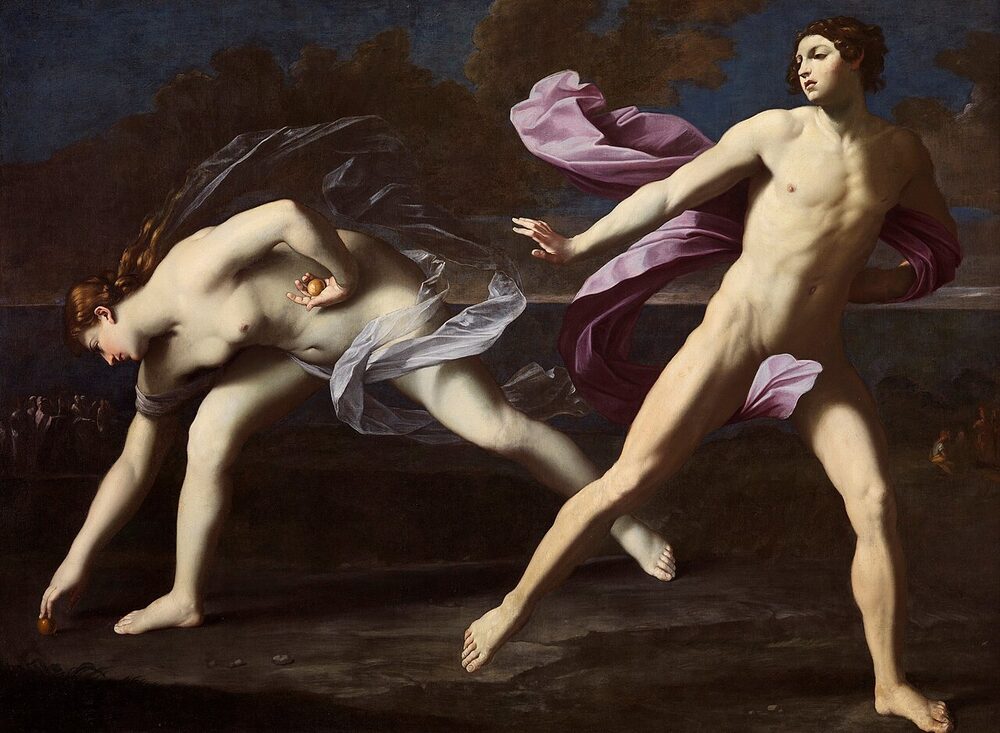
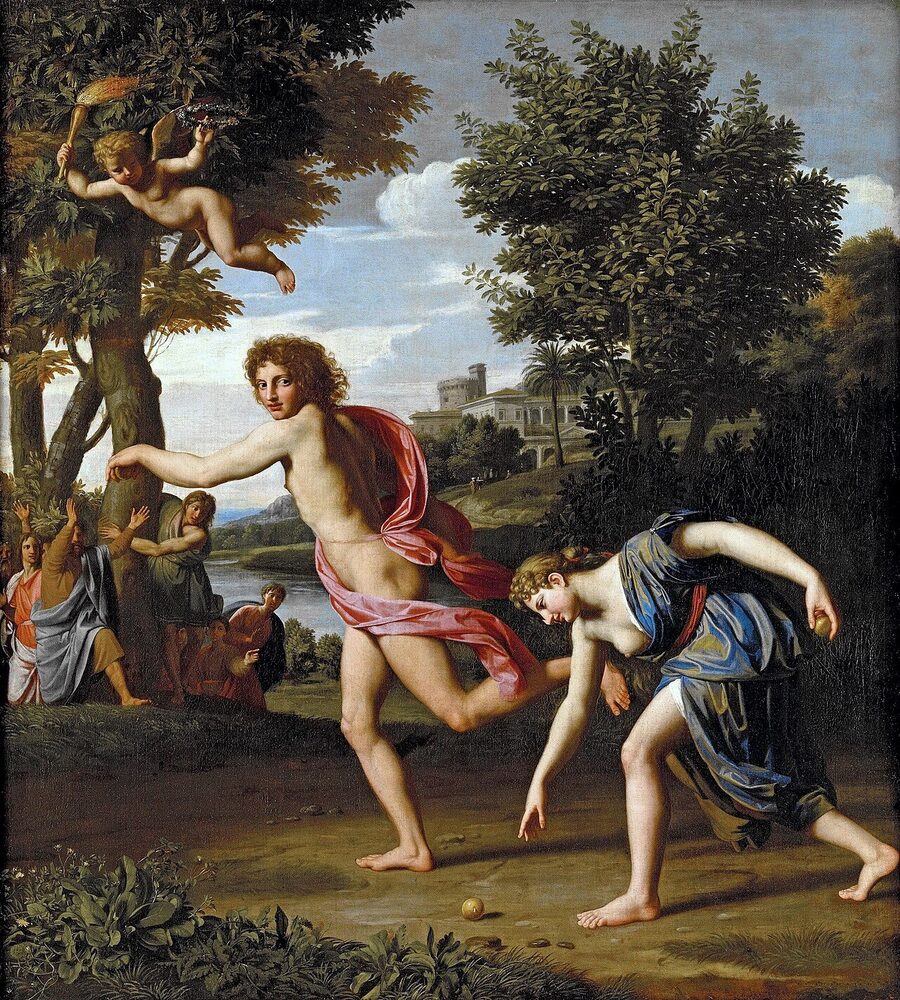
Then came Hippomenes (called Melanion in some sources; this page follows the tradition that names him Hippomenes). Watching the deadly races, he fell in love, and rather than trust his own feet he prayed to Aphrodite — the goddess most affronted by a woman who scorned love and marriage. Aphrodite gave him three golden apples from the garden of the Hesperides, radiant fruit no eye could pass by, and told him how to use them. When the race began Atalanta swiftly drew level and ahead, as always; but each time she gained on him Hippomenes rolled one of the golden apples across her path, and each time she could not resist stooping to snatch up the gleaming fruit. Three times she stopped, three times she lost ground — and so, by Aphrodite's cunning and not by any man's speed, Hippomenes reached the goal first and won her hand. The maiden who was "equal to" every man was beaten only by a goddess's trick.
The lovers turned to lions
Marriage, the oracle's warning fulfilled, was indeed Atalanta's undoing — but the ruin was as much Hippomenes's, and it came through his own forgetting. In his joy at winning her he neglected to thank Aphrodite for the apples and the victory she had given him, and the slighted goddess took her revenge. Passing a sanctuary sacred to Zeus (or, in Ovid's telling, to the Mother of the Gods, Cybele), the two were seized by a sudden overpowering desire — sent by Aphrodite — and lay together in the holy precinct, profaning it. For this sacrilege the offended deity transformed them both into lions, yoked ever after to draw the goddess's chariot and never again to know each other as lovers: for the Greeks believed that lions could not mate with their own kind but only with leopards, and so the punishment fit the crime — the two who had defiled a shrine with their passion were condemned to a shape in which that passion could never be shared again. So the swift-footed maiden ends her tale as a beast of the wild once more, drawn back into the animal world from which the she-bear had first delivered her.
Among the Argonauts?
Whether Atalanta sailed with Jason and the Argonauts is one of the genuine disputes of her tradition, and the sources do not agree. Some include her by name in the roll of the heroes who sought the Golden Fleece, fitting company for a maiden who hunted with the best of them; Apollodorus lists her among the crew. But others report that Jason refused to take her — not for any want of skill, but for fear that the presence of a single young woman among a shipful of men would breed rivalry, desire, and discord on the long voyage, and so he turned her away to keep the peace of the Argo. The two traditions cannot both be true, and this page lets the dispute stand: Atalanta was either heroic enough to be numbered among the Argonauts, or heroic enough that her exclusion needed explaining. Her surer place is at the boar hunt of Calydon, where every account agrees she stood.
Worship — Ancient
A heroine more sung than worshipped
Atalanta was a figure of myth and story far more than of cult. Unlike the gods, she received little in the way of formal, organised worship: there was no great temple of Atalanta, no Panhellenic festival in her name, no priesthood tending her rites. She lived in the imagination of the Greeks chiefly through poetry and painted image — the swift runner and the boar-slayer — rather than through the altar. What devotion attached to her was local, scattered, and bound up with the greater powers and places she belonged to.
Ties to Artemis and to Arcadia and Boeotia
Her true religious home is in the shadow of Artemis, the virgin goddess of the hunt to whom she was sworn. Atalanta is in many ways a mortal reflection of the goddess — the armed maiden of the wilderness, the sworn virgin, the huntress nursed by the bear that was Artemis's own sacred beast — and to honour Atalanta was, in effect, to honour the world of Artemis. Her cult-geography follows her two homelands: Arcadia, the wild mountain heart of the Peloponnese, where the bear-nursed huntress and the Calydonian boar belong, and Boeotia, where the runner of Schoeneus and the footrace were placed. Pausanias, travelling in the second century CE, was still shown Atalanta's landmarks — a spring she was said to have struck from the rock, and images of her — as living local memory.
The footrace and the stadium
What cultic association she did carry clustered, fittingly, around running. Because her defining act was the footrace, Atalanta was linked in memory to the stadium and the running-track, and she appears in the iconography of athletic and funeral games — the maiden who could outrun any man was a natural patroness of the contest of speed. Pausanias records a running-track (a stadion) associated with her, and her image was set among the scenes of games. Hers was a worship of story and of place: a heroine remembered at the spring, the track, and the hunting-ground, honoured through the goddess she served rather than in a great cult of her own.
Worship — Modern
Honouring Atalanta today
For a modern devotee, Atalanta is honoured less as a goddess to be petitioned than as a heroine to be admired and drawn strength from — a patron of the woman who claims the wild, the race, and the right to belong to herself. Because her worship in antiquity flowed through Artemis, many who feel her pull honour her alongside the goddess of the hunt: a small shrine set with an image of a running figure, a bow or a spear, a boar or a bear, and above all the three golden apples that are her unmistakable emblem. A candle, a wildflower gathered outdoors, or a token of some race or trial come through gives her a fitting place.
Offerings and devotion
Where the ancients had no great cult to imitate, a modern devotee can give simply: a libation of clean water or wine poured out, a share of fruit — an apple most aptly of all — a little honey or a cake, presented with a few words of respect to the swift-footed huntress. But Atalanta's truest devotion is lived rather than poured. To run, to hunt or walk in wild places, to train the body to speed and endurance, to meet men on equal terms in any contest they would keep to themselves, and to guard one's own independence and self-possession — these honour her far more than any offering on a shelf. She is a heroine for those who refuse to be left on the hillside.
Her legacy
Atalanta has outrun her own myth into the modern world. She is a favourite of retellings and children's collections as the girl who beat the boys, a feminist emblem of the woman admitted to the heroes' company and the athlete who would not be caught; her name has been given to towns, ships, sporting clubs, and an Italian football team, and the "golden apple" of her race has become a byword for the sweet distraction that costs the prize. Remembered as the exposed infant saved by the bear, the first spear at Calydon, and the runner undone only by a goddess's trick, she endures as the great heroine of the Greek wild — equal, as her name says, to any man who ever ran or hunted beside her.
Epithets & Cult Titles
- Swift-footed (descriptive) — The runner no suitor could outpace — her defining attested quality, the speed by which she set the terms of her own marriage
- The Arcadian (descriptive / regional) — Daughter of Iasus of Arcadia in one tradition — the huntress of the mountain wilds and companion of Artemis, associated with the Calydonian boar
- The Boeotian / Schoenean (descriptive / regional) — Daughter of Schoeneus of Boeotia in the other tradition — the runner of the footrace and the golden apples; the two regions preserve what may be two Atalantas fused into one
- The Maiden Huntress (descriptive) — Sworn virgin devoted to Artemis, who ranged the wilderness armed and refused marriage until forced to it — a mortal echo of her goddess
- Suckled of the Bear (descriptive / cultic) — The exposed child nursed by a she-bear, an animal sacred to Artemis — a title binding her to the goddess's Arcadian bear-cult
Sources & Variants
- Hesiod, Catalogue of Women fr. 72–76 M–W (the swift-footed maiden, the footrace, Hippomenes and the golden apples — the earliest account)
- Apollodorus, Bibliotheca 1.8.2–3 (Atalanta at the Calydonian boar hunt, drawing first blood; Meleager's award of the hide and the fatal quarrel); 1.9.16 (listed among the Argonauts); 3.9.2 (her exposure, the she-bear, the footrace, and the transformation into lions)
- Ovid, Metamorphoses 8.317–444 (the Calydonian boar hunt and Atalanta's first wound) and 10.560–707 (the footrace, the golden apples, and the lovers turned to lions in the shrine of Cybele) — later Roman retellings, cited as such
- Pausanias, Description of Greece 3.24.2, 5.19.2, 8.35.10, 8.45.2 (Atalanta's Arcadian and Boeotian landmarks, her spring, and her image among the games)
- Aelian, Varia Historia 13.1 (a full biographical account of the bear-nursed huntress of Arcadia)
- Xenophon, Cynegeticus 1.7 (Atalanta named among the great pupils of the centaur Chiron and honoured for her skill in the hunt)
Gallery