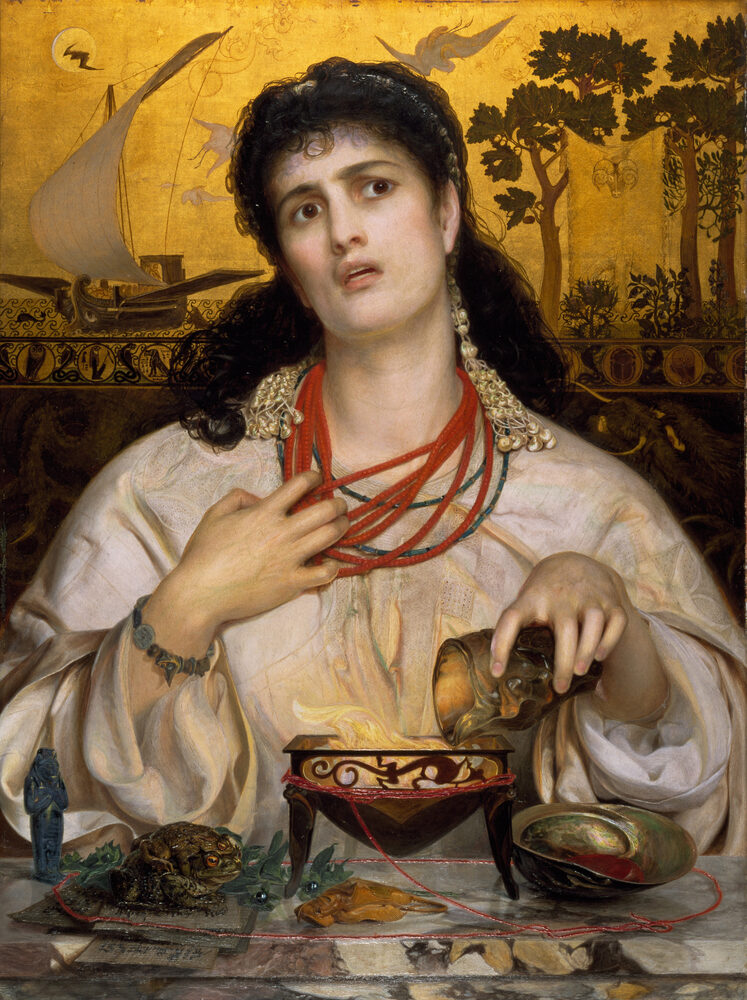
Medeia
First Appearance
Medea appears already in the earliest Greek poetry as the daughter of King Aeetes and granddaughter of the Sun. Hesiod's Theogony (992–1002) tells in a few lines how Jason carried her off from her father's halls after completing the trials the gods laid on him, made her his wife, and she bore him a son, Medeus — a bare, untroubled note with none of the later horror. Pindar's fourth Pythian ode (462 BC) gives the fuller heroic version: the Colchian girl, taught the arts of persuasion and drugs, who saves Jason and the Argonauts by her craft and flees with them. Her great tragedy, and the source of her lasting fame, is Euripides' Medea (431 BC), which fixed forever the image of the betrayed wife who takes an unthinkable revenge.
— Hesiod, Theogony 992–1002; Pindar, Pythian 4 (462 BC); Euripides, Medea (431 BC)
Who They Are
Medea (meh-DEE-uh) is the most formidable and the most troubling of the women in Greek myth — a princess, a priestess, and a sorceress; a granddaughter of the Sun and a servant of the witch-goddess Hecate; the woman without whom the greatest of all Greek quests would have ended in the death of every hero who sailed for the Golden Fleece. She is not a goddess but a mortal of half-divine blood, and she belongs to the tier of the heroes because her story runs alongside theirs — the story of Jason and the Argonauts — and because, like the greatest heroes, she is remembered less for what she was than for what she did. What she did is terrible, and it is also, seen whole, the act of a brilliant and passionate woman who gave up everything for a man and was betrayed.
To tell Medea sympathetically is not to excuse the darkness in her story but to refuse the easy version in which she is simply a monster. The Greeks themselves did not agree about her. In the oldest tellings she is a helper-maiden and a healer whose drugs save lives; in Euripides' great tragedy of 431 BC she becomes the archetype of vengeance, a wronged wife who strikes back at a faithless husband in the one way that will destroy him utterly. Between these lies the real Medea: clever beyond any man around her, loving to the point of ruin, a foreigner who abandoned her home and killed for love and was repaid with abandonment. Her intelligence is the engine of the whole tragedy — the same cunning that wins Jason the Fleece is the cunning that, turned against him, breaks him.
(Content note: Medea's story contains dark magic, deception, and killings, including — in one major tradition — the deaths of her own children. The sections below tell these fully but with care.) Her craft is the craft of pharmaka: herbs, roots, drugs, and spells, the knowledge of what grows in the earth and what it can do to a body — heal it, deceive it, burn it, or bring it back from age to youth. She wields this knowledge as her only weapon in a world of armed men and unfaithful husbands, and it makes her the presiding figure of Greek witchcraft, the model for every enchantress who came after. When at the end she rises above her enemies in a chariot drawn by dragons, out of reach of every man who would punish her, she is beyond the reach of the ordinary human story altogether — half victim, half force of nature, and wholly herself.
Mythology
The princess of Colchis and the coming of the Argonauts
Medea was the daughter of Aeetes, king of Colchis — a rich and distant land at the far eastern edge of the Black Sea, beyond the reach of the Greek world. Her father was a son of Helios the Sun, so that Medea was the Sun's granddaughter; and her father's sister was the enchantress Circe, the witch of the island who would later detain Odysseus, so that the greatest sorceress of Greek myth was Medea's own aunt. From this line Medea inherited both her divine blood and her craft: she was a priestess of Hecate — the goddess of the moon, the crossroads, and witchcraft — and skilled beyond any mortal in pharmaka, the drugs and herbs and spells that were the woman's power in a heroic world.
Into Colchis came Jason and the Argonauts, sent from Greece to fetch the Golden Fleece — the hide of a magical winged ram, which hung in a sacred grove guarded by a dragon that never slept. King Aeetes had no intention of giving it up. He set Jason an impossible trial: to yoke a pair of fire-breathing bronze-hoofed bulls, plough a field with them, sow it with a dragon's teeth, and cut down the armed men that would spring up from the furrows. No mortal could have survived it. But the goddesses Hera and Aphrodite, who favoured Jason, contrived that Medea should fall helplessly in love with him — and everything that follows flows from that love.
The drugs that won the Fleece
(Content note: from here Medea's craft is dark, and it is bound up with betrayal — first of her father, then, later, of everyone.) Torn between her father and the beautiful stranger, Medea chose Jason. Apollonius of Rhodes, in the Argonautica, gives us her sleepless night of anguish before she decides — one of the great psychological portraits of early literature, the young woman arguing herself into a betrayal she knows will cost her home and family. She came to Jason in secret and made him swear to marry her, and in return she gave him her craft.
She gave him a salve made from a magic herb — the "Promethean" plant, said to have sprung from the blood of the tortured Titan — and told him to anoint his body and his shield and spear with it by night, after bathing and making a lonely offering to Hecate. The drug made him invulnerable for a single day: fire could not burn him and iron could not cut him. So anointed, Jason yoked the fire-breathing bulls and ploughed the field; and when the sown warriors sprang up from the earth, Medea had taught him the trick of throwing a great stone into their midst, so that the armed men, not knowing who had struck, fell on one another and destroyed themselves. The trial that should have killed him, Medea's knowledge turned into a victory.
But Aeetes still would not yield the Fleece, and plotted against the Argonauts. So Medea went further. She led Jason by night to the sacred grove and, with her drugs and her whispered spells, charmed the sleepless dragon that guarded the Fleece — sprinkling its eyes with a potion, singing it into the first sleep it had ever known — until Jason could lift the Golden Fleece from the tree. Then she fled with him aboard the Argo, abandoning her father and her home forever.
The flight from Colchis and the death of a brother
(Content note: this episode is a killing, told in a particularly dark form in some sources.) Aeetes gave chase, and to slow him Medea committed the first of her terrible deeds. In the oldest and darkest version she had brought her young brother Apsyrtus aboard, and she killed him and cut his body to pieces, casting the limbs into the sea one by one — so that her father, stopping to gather up the scattered remains of his son for burial, fell behind and lost the chase. In a gentler variant she only lured Apsyrtus into an ambush where Jason killed him. Either way, the flight from Colchis is stained with a brother's blood, and Medea is from the start a woman who will destroy her own family for the man she loves — a pattern that returns, unbearably, at the end.
The rejuvenation of the old, and the trap for Pelias
(Content note: the following contains a deception that leads a group of daughters, unknowingly, to kill their own father.) Back in Greece, Medea's craft took a new and stranger form. Jason's rightful throne of Iolcus had been usurped by his uncle Pelias, the very man who had sent Jason after the Fleece in the hope he would never return. Medea resolved to destroy him — and she did it by turning her healing art into a trap.
First she gave a true demonstration of her power. She showed that she could restore the old to youth: taking an aged ram, she cut it up, boiled its pieces in a cauldron with her herbs and drugs, and drew out from the pot a living young lamb. (In another beloved version she genuinely restored Jason's aged father Aeson to youth by this art, draining his old blood and filling his veins with a brew of herbs — a rare instance of her power used purely to give life.) Then she went to the daughters of Pelias and offered them the same gift for their old father — that they too might make him young again. Trusting her, and loving their father, the daughters did as she instructed: they killed the old king, cutting him up and casting the pieces into the boiling cauldron. But Medea withheld the true herbs, and no young man rose from the pot. She had used their own love and her false promise to make the daughters the unwitting murderers of Pelias. It is her cruellest cold trick — vengeance worked entirely through deception, so that the victims kill themselves.
Corinth, and the betrayal
Driven from Iolcus for the killing of Pelias, Jason and Medea came at last to Corinth, and here the story turns to its famous end — the matter of Euripides' tragedy. For a time they lived as exiles with their young sons. But Jason, ambitious and weary of a foreign wife who had made him a hunted man, put Medea aside to marry Glauce (called Creusa in some sources), the young daughter of Creon, king of Corinth — a match that would make Jason a prince and heir. To Medea it was the final, unforgivable betrayal: for this man she had abandoned her father, killed her brother, murdered a king, made herself an exile with no home to return to — and he cast her off for a royal bride and ordered her banished from the city with her children.
Euripides' play begins here, and it gives Medea the greatest speeches in Greek tragedy — the wronged wife laying bare the whole condition of women in that world: how a woman must buy a husband with a dowry and take a master of her body; how she has no home to flee back to; how men say women live safe at home while men fight, when she "would rather stand three times in the battle-line than bear one child." She is not raving; she is terrifyingly lucid, and the chorus of Corinthian women, hearing her, side with her against her husband.
The poisoned robe
(Content note: a killing by poison, described plainly.) Medea's revenge began with the new bride. Feigning acceptance of the marriage, she sent her own children to the princess Glauce bearing gifts of reconciliation — a fine robe and a golden crown, beautiful and deadly, smeared with her drugs. Glauce, delighted, put them on; and the poison took fire against her skin. The robe and the crown burst into an unquenchable flame that clung to her and ate into her flesh, and she died in agony. Her father Creon, rushing to embrace his dying daughter, was caught in the same clinging fire and burned to death beside her. So Jason's new marriage and the royal house he had hoped to join were destroyed in a single stroke of Medea's craft.
The children — the two traditions
(Content note: this is the darkest turn of the whole myth — the death of Medea's own children. The ancient tradition tells it in more than one way, and both are given here.)
In the older tradition, the one that lies behind the Corinthian ritual, Medea did not kill her children with her own hand. In one form, after the deaths of Glauce and Creon, the enraged Corinthians took their revenge on Medea by seizing and killing her children at the altar of Hera Akraia — an act of civic murder for which the city was afterwards cursed with the deaths of its own infants and made to atone every year with the mourning-rites of its noble children. In another old form, Medea, believing she could make her children immortal, hid them in the sanctuary of Hera and performed a secret rite meant to give them deathless life — and the rite failed, and the children died. In these versions Medea is not a child-killer but a mother whose children are taken from her, by a vengeful city or by a magic that went wrong.
It was Euripides, in 431 BC, who made the version the world remembers — and it may have been his own bold invention. In the play, Medea herself resolves to kill her two sons: not from madness, but as the one blow that will hurt Jason past all bearing, robbing him of his heirs and his future and leaving him with nothing, while she takes from him the thing he loves. Euripides does not spare us her struggle. She wavers; she takes the children in her arms and weeps over them; the mother in her fights the avenger, and she speaks the terrible words — that she knows what evil she is about to do, but that her anger is stronger than her reason. Then she does it, offstage, and the audience hears the children's cries. It is one of the most harrowing scenes in all of drama, and it is meant to be: Euripides gives Medea real love for her children precisely so that the killing is not the deed of a monster but the self-wounding act of a woman who destroys what she most loves to punish the man who destroyed her. To read her sympathetically is to feel the horror of it as she felt it.
The escape in the chariot of the Sun
However the children died, the play ends with an image no ordinary human story could contain. When Jason comes to take his revenge on Medea, she is beyond his reach: she appears above the palace, out of his grasp, borne up in a winged chariot drawn by serpent-dragons — sent to her by her grandfather Helios, the Sun himself. From that height she looks down on the broken Jason and answers his curses with her own, denies him even the bodies of the children to bury, and foretells his mean and lonely death. Then the dragons carry her away through the air, untouched and unpunished by any human justice. It is a shocking ending — the murderess escaping in the vehicle of a god — and it is deliberately so; Medea passes out of the human world into something older and darker, a figure the gods themselves shield.
Refuge at Athens, and the trap for Theseus
The dragon-chariot carried Medea to Athens, and here her story has a strange coda. She found refuge with Aegeus, king of Athens — who in some versions had promised her sanctuary in exchange for her craft, for she promised by her drugs to cure his childlessness — and became his wife, bearing him a son, Medus. But when Aegeus's own long-lost son Theseus came to Athens as an unknown young stranger, Medea, alone in recognising him and fearing he would displace her own son, moved against him just as she had moved against Pelias. She persuaded Aegeus that the stranger was a danger, and prepared a cup of poison — the drug aconite — for Theseus to drink. At the last moment, as Theseus drew his sword to cut the meat at the feast, Aegeus recognised the family blade as his own son's, and dashed the poisoned cup from his lips. Theseus was saved, and Medea, unmasked, fled Athens once more — carried off, the sources say, in a cloud or her chariot, vanishing again beyond the reach of those she had wronged. In the latest traditions she returned at last to Colchis, or passed to the Elysian fields to be, some said, the deathless bride of Achilles — a fittingly uncanny end for a woman who was never quite mortal.
Worship — Ancient
A heroine of cult, not a goddess
Medea was not a goddess and received no worship as one; but she was not an ordinary mortal either, and around her clustered cult and ritual of the kind attached to powerful figures of the mythic past. Her divine descent from Helios, her lifelong service to Hecate, and in some local traditions an actual claim that she had once been a goddess of Corinth reduced to a heroine, all gave her a presence in cult that few mortal women had. Where she was honoured, it was in the chthonic, ground-facing manner proper to the dead and the powers of the earth — the manner of her own dark craft — rather than with the bright sacrifices of the Olympians.
The rite of the children at Corinth
The most important and best-attested cult connected to Medea is not to her but to her children, at Corinth. Pausanias (2.3.6–11), describing the city, records their tomb and a fearful ancient rite. At the sanctuary of Hera Akraia ("Hera of the Height") the children of Medea were said to be buried, and there the Corinthians for centuries performed a yearly expiation: seven boys and seven girls chosen from the noblest families were dedicated to the shrine to pass a year in mourning, dressed in black and with their hair shorn, to atone for the children's death. The rite plainly preserves the older story — that the children died at Corinth, whether killed by the citizens or lost in a failed rite — and that the city held itself polluted by their blood and bound to appease their angry ghosts. Pausanias also reports a local frightening figure, a "Terror" (a she-demon), said to prey on Corinthian infants until the rites were established — the memory, perhaps, of the curse the children's deaths were believed to have brought.
Hecate, herbs, and the night
As a priestess of Hecate, Medea belongs to the world of Greek witchcraft and its rituals, and the ancient descriptions of her craft double as a portrait of how such powers were sought: offerings and prayers made to Hecate at night and at the crossroads, the gathering of herbs and roots by moonlight with the proper words, libations poured at ground level rather than raised to the sky, and the whole apparatus of pharmaka — the drugs that heal, deceive, poison, or transform. Whether or not Medea was formally "worshipped," she was the mythic embodiment of these practices, and the literary accounts of her spells (in Apollonius, and later in the Roman poets) are among our fullest ancient descriptions of what a witch was imagined to do.
Worship — Modern
A heroine honoured with care
Medea is a mortal heroine, not a goddess, and modern Hellenic practice honours such figures differently from the Olympians — not with petition and public sacrifice but with remembrance, and in Medea's case with a particular care, for her story is a hard one. A devotee drawn to her honours a complex figure: the knowing woman, the mistress of herbs and healing, the foreigner and exile, the wife wronged past endurance. She is a patron, if of anything, of the outsider woman's intelligence and self-possession — of the refusal to be quietly discarded — and her cult, where it is felt at all, is bound up with the worship of Hecate, the goddess she served.
Through Hecate, and at the crossroads
Because Medea's power flows from Hecate, those who remember her most naturally do so in Hecate's key: a candle or lamp lit at night, an offering of herbs, a libation poured out onto the earth and not taken back, honour paid at month's end at the crossroads or the threshold. Her symbols — the gathered herbs, the casket of drugs, the dragon-drawn chariot of the Sun — belong to a devotion centred on knowledge, on the healing and dangerous power of what grows in the earth, and on the dignity of a woman who would not be silenced. This is honour rendered thoughtfully, with the darkness of her story acknowledged rather than smoothed away.
Legacy in art and thought
More than through any cult, Medea lives on as one of the most powerful figures the ancient imagination produced. Euripides' tragedy has never left the stage; his Medea — the betrayed wife who indicts a whole world's treatment of women before taking her appalling revenge — has been reimagined in every age, from Seneca's fierce Roman version and Ovid's retellings, through the operas and paintings of later centuries, to modern plays, films, and novels that read her as heroine, victim, and monster by turns. She stands at the head of the long line of literary enchantresses, the ancestor of every sorceress who followed, and she remains one of the sharpest challenges any story has posed: a woman whose intelligence and passion are unmistakably real and admirable, and whose deeds are unforgivable, held together in a single unforgettable figure. To take her seriously is to refuse both the excuse and the easy condemnation, and to feel the full weight of what betrayal made her do.
Epithets & Cult Titles
- priestess of Hecate (ἱέρεια Ἑκάτης) — Servant of the goddess of witchcraft, the moon, and the crossroads — Medea's craft with drugs and spells is drawn from Hecate, whom she serves; in some traditions the goddess is even called her kinswoman or teacher
- the knowing one / cunning in drugs (πολυφάρμακος, polypharmakos) — 'Rich in drugs, skilled in many potions' — the standard epithet for a mistress of pharmaka (herbal drugs, poisons, and healing charms alike); the word marks her as a knowing woman whose power is knowledge
- granddaughter of Helios (Ἡλιὰς) — Of the line of the Sun — daughter of King Aeetes and granddaughter of Helios the sun-god, a divine descent that gives her the dragon-chariot of the Sun as her escape and marks her as more than mortal
- the Colchian (ἡ Κολχίς) — The woman from Colchis — the far eastern land at the edge of the Black Sea, the barbarian kingdom of her father Aeetes; the name marks her throughout as a foreigner among the Greeks, never quite one of them
Sources & Variants
- Hesiod, Theogony 956–962, 992–1002 (Medea, daughter of Aeetes and granddaughter of Helios; carried off by Jason, bears him Medeus) — the earliest, untroubled version
- Pindar, Pythian 4 (462 BC) (the fullest early heroic narrative: Medea the Colchian, taught persuasion and drugs, who saves the Argonauts and flees with them)
- Euripides, Medea (431 BC) (the great tragedy: the betrayal by Jason, the poisoned robe that kills Glauce and Creon, Medea's own killing of her children, and her escape in the Sun's dragon-chariot)
- Apollonius of Rhodes, Argonautica 3–4 (3rd c. BC) (Medea's falling in love, her sleepless night of anguish, the Promethean salve that wins the trial of the bulls, the charming of the sleepless dragon, the flight from Colchis and the death of Apsyrtus)
- Apollodorus, Bibliotheca 1.9.23–28 (the connected narrative: the winning of the Fleece, the death of Pelias by the daughters' hands, Corinth and the children, the flight to Athens and the plot against Theseus)
- Pausanias, Description of Greece 2.3.6–11 (the tomb and cult of the children of Medea at Corinth, the yearly mourning-rite at the sanctuary of Hera Akraia, and the two older versions of the children's death)
- Diodorus Siculus 4.45–56 (a full euhemerising account of Medea's career, the rejuvenation demonstrations, and the trap for Pelias)
- Ovid, Metamorphoses 7.1–424 and Heroides 12 (the rejuvenation of Aeson, the death of Pelias, the poisoned robe, and the plot against Theseus) — Roman retelling, late
- Seneca, Medea (1st c. AD) (a fierce Roman tragic version, with an especially violent and self-aware sorceress) — Roman, late
Gallery