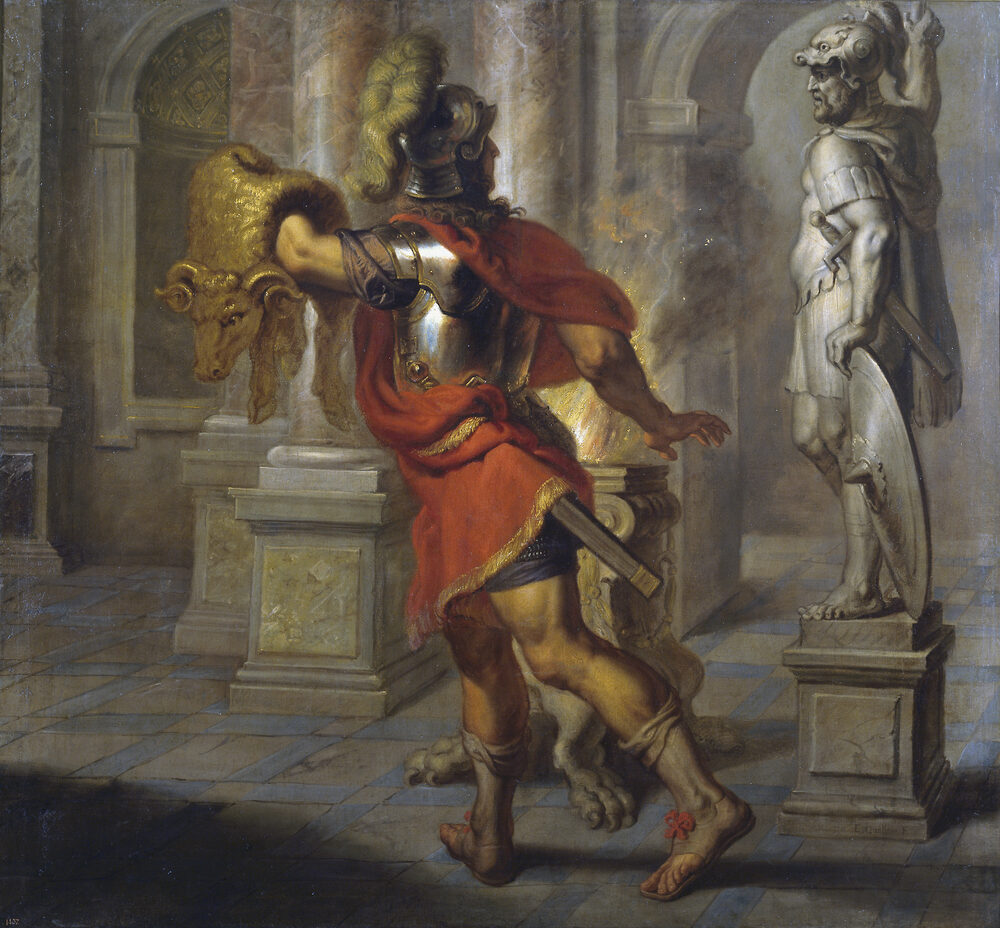
Iason
First Appearance
Jason has no surviving epic of his own from the archaic age, but Homer already assumes the story is famous: in the Odyssey, Circe warns Odysseus of the Clashing Rocks and says that only one seafaring ship has ever passed between them — the Argo, "known to all" (pasa melousa), sailing home from Aeetes, and even she was carried through only because Hera loved Jason. The full, connected narrative comes later, in Pindar's Fourth Pythian Ode (462 BCE) and above all in the Argonautica of Apollonius of Rhodes (3rd century BCE).
— Homer, Odyssey 12.69–72 (the Argo 'known to all', pasa melousa)
Who They Are
Jason (JAY-sun; Gk Iáson, "the healer") is the captain of the Argonauts and the hero of the oldest of the great Greek quest-legends — the voyage of the Argo to the far edge of the world to win the Golden Fleece. He is the rightful heir of Iolcus in Thessaly, cheated of his throne by his uncle Pelias, and the story of his life is the story of a single impossible task set to destroy him, which he survives only by gathering the finest heroes of the age and by the love and terrible sorcery of a foreign princess.
He is a hero of a particular and unusual kind. Where Heracles overcomes by strength and Achilles by martial fury, Jason overcomes by leadership, by beauty and persuasion, and — most of all — by the help of others: the gods Hera and Athena who protect the Argo, the seer Phineus who charts his course, and Medea of Colchis, the witch-princess without whom not one of the three deadly trials at Colchis could have been passed. This has led many readers, ancient and modern, to see Jason as a hero who is carried by his companions, a leader more than a champion — brilliant at binding a crew together, but dependent, and in the end faithless in a way that destroys him.
For his tale does not close in triumph. Having won the Fleece and a wife who gave up everything for him, Jason abandoned Medea to marry a Corinthian princess, and the vengeance that followed is one of the darkest in all Greek myth. He ended his life not on a battlefield or in glory but old, alone, and forgotten by the gods he had once charmed — killed, the tradition says, by a beam of the very ship that had carried him to fame. The Argo made him and the Argo unmade him.
Mythology
The one-sandalled man and the task of Pelias
Jason was the son of Aeson, the rightful king of Iolcus in Thessaly, but the throne had been seized by Aeson's half-brother Pelias. Fearing for the infant's life, Jason's parents smuggled him out of the city and gave him to be raised in secret on Mount Pelion, in the cave of the centaur Chiron — the wise, immortal tutor of heroes, healer and teacher, who reared the boy through his whole childhood in the mountain wilderness and taught him the arts of medicine, music, and the hunt. (It is from this healing lore that the ancients derived his name, Iason, "the healer.") So Jason grew to manhood far from the city that was his by right, knowing nothing of courts.
Pelias, meanwhile, had been warned by an oracle to beware the man wearing a single sandal. Years later, when Pelias held a great sacrifice, a tall young stranger came down out of the hills — long-haired, clad in a leopard-skin, and wearing only one sandal, having lost the other while carrying an old woman (the goddess Hera in disguise, the tradition says) across the flooded river Anauros. Pelias saw the single sandal and knew his doom had come. He asked the young man what he would do if an oracle told him he would be killed by one of his own people; Jason (prompted by Hera, some say) answered that he would send that man after the Golden Fleece — the hide of a magical golden ram, which hung in a sacred grove in far-off Colchis at the eastern end of the Black Sea, guarded by a serpent that never slept. Pelias seized on the answer and laid the quest on Jason himself, promising the throne in return, certain the young man would never return alive.
The Argo and the voyage out
Jason accepted the impossible task and had a great ship built for it — the Argo, constructed by the shipwright Argus with the help of Athena, who set into its prow a speaking beam of oak from the oracle of Dodona, so that the ship itself could prophesy. He then sent out a summons across Greece, and the finest heroes of the generation before Troy answered it: among the Argonauts came Heracles, the twins Castor and Polydeuces, the winged sons of the North Wind Zetes and Calais, the great singer Orpheus whose music kept the rowers in time, the keen-eyed helmsman Tiphys, the seer Idmon, and many more — the roll of the crew is one of the great catalogues of Greek myth.
The voyage out was a chain of wonders and dangers. On the island of Lemnos the Argonauts found a kingdom of women who had killed all their men, and lingered there in the beds of the Lemnian women — Jason with their queen Hypsipyle — before Heracles shamed them back to the sea. They passed through the country of the Doliones and, by tragic accident, killed their own host King Cyzicus in a night battle. They lost Heracles himself when his beloved companion Hylas was drawn down into a spring by a water-nymph and Heracles refused to sail on without him. At Salmydessus in Thrace they came to the blind prophet Phineus, whom the gods punished for misusing his gift of prophecy by sending the Harpies — foul winged snatchers — to befoul and steal his food at every meal, so that he was slowly starving. The winged sons of the North Wind drove the Harpies off through the sky, and in gratitude Phineus told the Argonauts the whole course ahead and how to survive its greatest peril. (The Harpies are treated in their own entry.)
That peril was the Symplegades, the Clashing Rocks (also called the Cyanean Rocks) at the mouth of the Black Sea — two cliffs that crashed together to crush anything passing between them. On Phineus's advice, the Argonauts loosed a dove to fly through first: the rocks smashed shut and clipped only the tips of its tail-feathers, then drew apart, and in that instant the Argo drove through under oar with Athena's hand at the stern, losing only the tip of its own stern-ornament as the cliffs closed behind. It was said that after the Argo passed, the Clashing Rocks were fixed forever and never moved again. Beyond them lay the open eastern sea and, at last, the kingdom of Colchis.
Medea and the three feats at Colchis
At Colchis reigned King Aeetes, son of the sun-god Helios, who had no intention of surrendering the Fleece. He agreed to give it up only if Jason could perform a set of tasks he believed no man could survive — and here the whole quest turned on the king's own daughter, the young princess and sorceress Medea. The goddesses Hera and Athena, who favoured Jason, had Aphrodite send her son Eros to make Medea fall desperately, helplessly in love with him; torn between her father and the stranger, she chose Jason, and secretly gave him the magic and the knowledge without which he was a dead man. Three feats stood between him and the Fleece:
First, the fire-breathing bronze bulls, the khalkotauroi — a yoke of monstrous bulls with hooves of bronze and breath of living flame, forged by Hephaestus. Jason had to harness these to a plough. Medea gave him a salve made from a magic herb that made his body and shield proof against fire and iron for a day; anointed with it, he mastered the bellowing bulls, forced the yoke onto their necks, and drove them.
Second, the sowing of the dragon's teeth. With the bulls yoked, Jason had to plough a field and sow it not with seed but with the teeth of a dragon — and from every tooth sprang up an armed warrior out of the earth, the Spartoi ("Sown Men"), a whole army rising fully grown and hostile. Medea had warned him what to do: Jason threw a great stone into the midst of them, and the Sown Men, unable to see who had struck, turned on one another and cut each other down until the field was littered with the earth-born dead.
Third, and last, the sleepless dragon. The Fleece hung in the grove of Ares, coiled about by an enormous serpent that never slept and let nothing pass. Medea went with Jason by night to the grove and, singing a spell and sprinkling a drink of magic herbs, charmed the great dragon into a sleep it had never known — the first sleep of its unsleeping life — so that Jason could climb past its drooping coils, lift down the shining Golden Fleece, and carry it away. That same night the two fled to the Argo and put to sea, Medea leaving her home and her father forever.
The wanderings home
The return voyage was longer and stranger than the voyage out, a wandering across half the mythic world with Aeetes's fleet in pursuit. In the most terrible episode of the flight, Medea's young brother Apsyrtus was killed to slow the Colchian pursuit — in one version cut to pieces and scattered in the sea so that his grieving father would stop to gather the body — a blood-guilt that clung to Jason and Medea and had to be purified afterward by the enchantress Circe (Medea's own aunt) on her island. (Content note: this episode turns on the murder of a young kinsman.)
The Argo's course home carried it past the greatest hazards of the sea. It passed the Sirens, whose deadly song Orpheus drowned out by playing his lyre more sweetly still, so that only one man leapt overboard. It threaded the strait between Scylla and Charybdis and passed the Wandering Rocks with the help of the sea-nymphs. And when the ship came at last to Crete, it faced Talos, the giant bronze man — an automaton forged by Hephaestus who guarded the island by circling it three times a day and hurling boulders at any ship that approached, and by heating his bronze body red-hot to crush strangers in a burning embrace. In his single vein, running from neck to ankle, flowed the ichor of his life, stopped by a single bronze nail. Medea overcame him: by her sorcery (or, some say, by charming him with promises) she caused the nail to be drawn out, and the ichor ran from him like molten lead until the bronze giant crashed lifeless to the ground and Crete was passed. So, after many months and many countries, the Argo came home to Iolcus with the Fleece.
The betrayal, the revenge, and the fall of the Argo's beam
What Jason won by the quest he lost by faithlessness. In one tradition, once home, Medea's magic destroyed the usurper Pelias: she persuaded his own daughters that they could restore their aged father to youth by cutting him up and boiling him in a cauldron with the right herbs — and, having shown the trick on a ram that leapt out reborn as a lamb, she let them murder Pelias with the herbs left out, so that he died by his daughters' own hands. The crime drove Jason and Medea into exile, and they settled at last in Corinth.
There Jason abandoned her. Offered the hand of Glauce (also called Creusa), the young daughter of King Creon of Corinth, and with her a royal marriage and a throne, Jason cast off the foreign wife who had given up her home, her family, and her innocence for him, and who had borne him children. (Content note: what follows is one of the darkest revenges in Greek myth, and turns on the deaths of children.) Medea's vengeance, as Euripides dramatized it in his Medea, was total: she sent the bride a poisoned robe and coronet that burned Glauce and her father Creon alive when they touched it, and then — to leave Jason with nothing, no new marriage and no heirs, no future at all — she killed her own two sons by him, and escaped beyond his reach in a chariot drawn by dragons, sent by her grandfather the Sun. Jason was left with the corpses of his children and his bride and everything he had schemed for turned to ash.
His own end matched the emptiness of it. Old, broken, and dishonoured — abandoned by the gods who had once carried his ship, because he had broken the oaths he swore to Medea — Jason wandered back to where the rotting hulk of the Argo had been drawn up on land, a monument to a glory long past. As he lay in its shadow, remembering, the ship gave him his death: a beam from the decaying stern (the very speaking prow of Dodona, some say) broke loose and fell on him and killed him. So the ship that had made his name was the thing that ended his life — an inglorious death for the captain of the Argonauts, and a hard lesson the Greeks read in it, that the breaker of oaths outlives his glory only to be crushed by it.
Worship — Ancient
A hero of story rather than cult
Jason is, above almost any figure of his stature, a hero of literature rather than of worship. He had no great sanctuary, no Panhellenic games in his honour, no widespread hero-cult of the kind that grew around Heracles or the local heroes of the cities. The honest picture is that his enormous fame was carried by poetry — by the tellings and re-tellings of the Argo's voyage — and not by altars. Where he lives is in the mind of the Greek world as the captain of its first and greatest sea-quest, the story that Homer could already assume everyone knew.
Place in the story-geography of Greece
What Jason did give the Greek world was a map of legend. The voyage of the Argo threaded together an enormous sweep of places — Iolcus and Mount Pelion in Thessaly, Lemnos, the Propontis and the Clashing Rocks, the Black Sea coast and Colchis at its far end, and on the return the whole western sea of Sicily, Corcyra, Libya and Crete — and communities all along that route claimed the Argonauts as founders, namers of harbours, and leavers of relics. Cities pointed to the anchor-stone the Argo had left behind, to springs the heroes had opened, to altars they had raised. In this way Jason's story functioned less as a cult than as a charter of the seafaring Greek world, binding scattered colonies into a shared heroic past.
The literary monuments
His true temples are the poems. Pindar's Fourth Pythian Ode (462 BCE), written for a king of Cyrene, gives the oldest connected telling — the one-sandal omen, the confrontation with Pelias, the winning of the Fleece with Medea's help. Three centuries later the Alexandrian scholar-poet Apollonius of Rhodes made the voyage the subject of his Argonautica, the one full epic of the quest to survive from antiquity and the model for every later version. And Euripides, in his Medea (431 BCE), fixed forever the story of Jason's betrayal and its terrible cost — so that even Jason's cult, if he has one, is the continued reading of the works that made and unmade him.
Worship — Modern
A hero honoured in story
Jason was never a god and had little ancient cult, so a modern relationship with him is best understood not as worship but as honouring a hero — keeping his story alive and drawing from it. He is a natural patron for travellers and sailors, for anyone setting out on a long and daunting undertaking, and for those who lead teams and must weld very different people into one crew pulling together. His tale speaks to the truth that great things are rarely done alone.
Keeping his memory
Those who wish to honour Jason in a Hellenic spirit might do so by reading the Argonautica aloud, by remembering him at the start of a voyage or a hard journey, or by keeping some token of the story — a model ship, an image of the Fleece, a single sandal — as a reminder. Because he was aided at every turn by Hera and Athena, a devotee might more properly direct prayer to those goddesses for a safe voyage and wise counsel, honouring Jason as the mortal hero whose story they steered.
The lesson in the tale
Jason's myth also carries a hard moral the ancients themselves drew, and a modern reader can keep it: he won everything by the help and love of others and lost it all by faithlessness, and the gods who had carried him abandoned the man who broke his oaths. To honour Jason honestly is to hold both halves of him together — the brilliant young captain who bound the heroes of an age into one crew, and the older man whose broken faith left him crushed in the shadow of his own ship. His is a legacy that warns as much as it inspires.
Epithets & Cult Titles
- Aisonides (Αἰσονίδης) — Son of Aeson — the standard patronymic by which Apollonius and Pindar name him, marking his descent from the dispossessed king of Iolcus
- Monosandalos (descriptive) — The one-sandalled — the man of Pelias's prophecy, who lost a sandal in the river Anauros and so fulfilled the omen
- Archos of the Argonauts (descriptive) — Leader (archos) of the Argo's crew — the captain chosen to command the greatest gathering of heroes before Troy
- Aisonides Kouros (descriptive) — The young lord, son of Aeson — Pindar's image of the long-haired youth striding into Iolcus to claim his birthright
Sources & Variants
- Homer, Odyssey 12.69–72 (the Argo 'known to all', the only ship to pass the Clashing Rocks, saved because Hera loved Jason)
- Pindar, Pythian 4 (the oldest connected narrative: the one-sandal omen, Pelias, the Argonauts, and the winning of the Fleece with Medea's aid)
- Apollonius of Rhodes, Argonautica (the full epic of the voyage: the Argo and its crew, Lemnos, Phineus and the Harpies, the Symplegades, Medea and the three feats at Colchis, and the wandering return including Talos of Crete)
- Euripides, Medea 431 BCE (the betrayal at Corinth, the poisoned robe of Glauce, and Medea's revenge)
- Apollodorus, Bibliotheca 1.9.16–28 and Epitome 1.5–6 (the fosterage under Chiron, the tasks of Pelias, the voyage, the death of Pelias, and the beam of the Argo that killed Jason)
- Hesiod, Theogony 992–1002 (Jason brings Medea from Aeetes to Iolcus, an early notice of the story)
- Ovid, Metamorphoses 7.1–158 (Roman retelling of Medea's magic, the bulls, the Sown Men, and the sleepless dragon)
Gallery