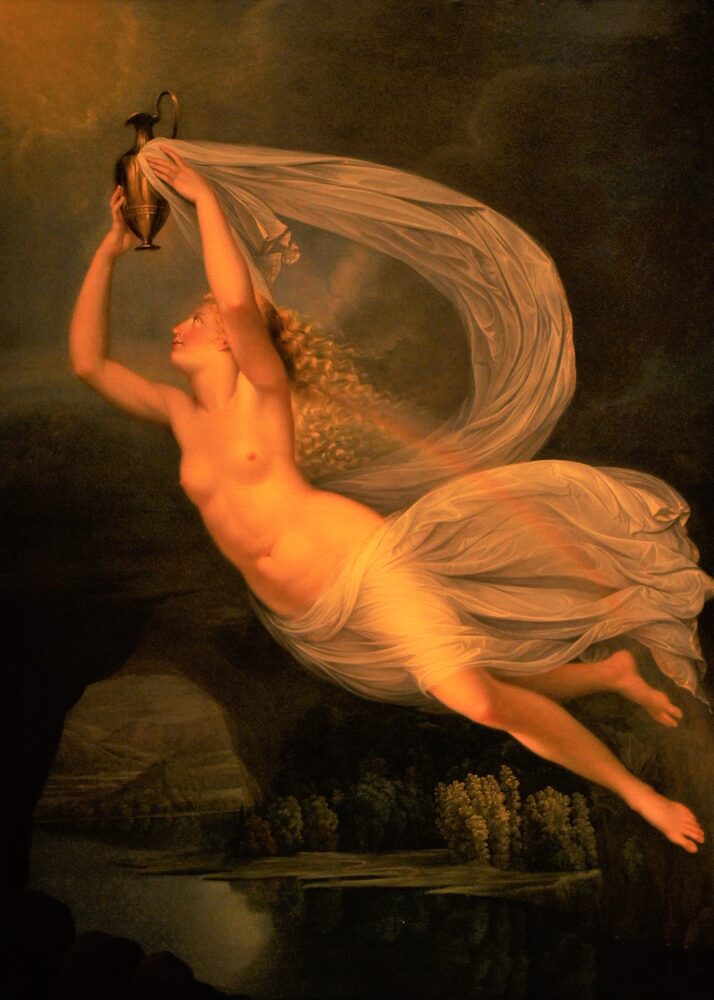
Iris
First Appearance
Iris appears from the very beginning of Greek epic as the swift messenger of the gods, again and again carrying the word of Zeus down to gods and mortals. In the Iliad she darts on golden wings between Olympus and the plain of Troy — rousing the Trojans to battle, warning off the meddling gods, and at the poem's close leading Priam safely through the night to beg his son's body from Achilles. Hesiod's Theogony (265–269) gives her descent — daughter of Thaumas ("Wonder") and the Oceanid Electra, and sister of the storm-winged Harpies — and later in the same poem (780–806) sends her down to the underworld to fetch the water of the river Styx in a golden ewer, so that the gods may swear their most binding oaths upon it.
— Homer, Iliad (e.g. 2.786–807, 8.397–425, 15.144–219, 24.77–188); Hesiod, Theogony 265–269 and 780–806
Who They Are
Iris (EYE-ris) is the rainbow made a goddess — the swift, golden-winged messenger who runs the errands of heaven, and whose bright path across the sky is the shining bridge she leaves between the gods above, the earth below, and the deep waters beneath. Where a mortal herald might carry a king's word from city to city, Iris carries the words of the gods from Olympus down to the world of men and back again, faster than thought, on wings that flash with all the colours of her arc. To the Greeks the rainbow was not merely a sign that a goddess had passed; the rainbow was the goddess, seen for a moment as she crossed the heavens on some divine errand.
In the oldest poetry, the Iliad of Homer, Iris serves the gods generally and above all Zeus, king of the gods — she is the herald of Olympus as a whole, sent by the Thunderer to command, warn, and summon. But as the myths grew and were retold by later poets, she became especially the personal messenger of Hera, queen of the gods: what Hermes is to Zeus — his own swift-footed herald — Iris becomes to Hera, the goddess who runs the queen's errands and attends her person. The two heralds make a natural pair, the winged god and the winged goddess, and later art and poetry loved to set them side by side.
She is also a creature of wonder by her very blood. Her father is Thaumas, whose name means "Wonder" or "Marvel," a sea-god son of Pontos (the Sea) and Gaia (the Earth); her mother is the Oceanid Electra, a daughter of Ocean; and her sisters are the Harpies, the snatching storm-winds. So Iris is born of the sea's shimmer and married into the moods of the sky — a family of everything bright and swift and stormy in the air above the water, which is exactly where a rainbow lives. Gentle and welcome where her sisters are fierce, she is the fair face of that same weather.
Mythology
The rainbow made a goddess
Before she is a character in any story, Iris is a thing everyone has seen: the rainbow that stands across the sky after rain, one foot in the clouds and one, it seems, in the far sea. The Greeks looked at that band of colour and saw a road — a bridge flung down from heaven to earth — and they saw a traveller on it. That traveller is Iris. When the poets say she "darts down" or "plunges" from Olympus to the world of men, they are describing what a rainbow looks like: a bright arc reaching from the height of the sky down to the horizon, from the home of the gods down to the ground where mortals live, and sometimes down into the grey water of the sea. Because a rainbow appears and vanishes in a moment, Iris is above all swift; because it touches both heaven and earth at once, she is the natural go-between of gods and men.
The swift messenger of the Iliad
In Homer's Iliad, Iris is the busiest of divine messengers. Again and again she is sent flying — most often by Zeus — to carry a command down to the battlefield of Troy. She takes the shape of a mortal to rouse the Trojan army to arms (Iliad 2); she flies to warn Hera and Athena to turn their chariot back when they try to meddle in the war against Zeus's will, and again to summon the gods off the field (Iliad 8); she carries Zeus's stern orders to Poseidon to quit the battle, and Poseidon, though he rages, obeys (Iliad 15). She rouses the hero Achilles and kindles the winds to light Patroclus's funeral pyre. In these scenes she is the herald of the gods in general and of the king of the gods in particular — the very voice of Olympus, arriving on golden wings, delivering the word exactly, and gone again. Homer's fixed phrases for her catch her whole nature: she is "golden-winged" (chrysopteros) and "storm-footed" (podas ōkea), as quick and tireless as the weather she is made of.
Leading Priam through the dark
The gentlest and greatest of her Iliad errands comes at the poem's end. When old King Priam of Troy resolves to go alone into the enemy camp to beg the body of his dead son Hector from Achilles, it is Iris whom Zeus first sends down — swift as the storm-wind — to put the courage and the plan into the old man's heart, telling him to go with only a herald and to fear nothing. Iris the herald prepares the way for the most tender scene in all of Homer, the night meeting of the grieving father and the man who killed his son. It is a fitting task for her: she is the goddess who joins two worlds that cannot otherwise reach each other, and here she joins, for one night, the two sides of a war.
Hera's own herald
In Homer, Iris serves the gods at large and Zeus above all; but as the tradition grew, later poets made her especially the personal messenger and attendant of Hera, the queen of the gods. The pairing is neat and was clearly felt to be right: just as Hermes is the swift herald who runs the errands of Zeus, so Iris becomes the swift herald who runs the errands of Hera. In this later picture she is the one who does the queen's bidding — carrying her messages, dressing and attending her, harnessing her chariot, and going where Hera cannot or will not go herself. Callimachus, the learned Alexandrian poet, gives a vivid comic image of her in his Hymn to Delos: Iris crouching tirelessly at the foot of Hera's throne like a faithful hunting hound, never fully asleep, ready to spring up at the queen's least word. The two heralds — the winged god of Zeus and the winged goddess of Hera — became a matched pair in the imagination of later Greeks, and artists liked to show them together.
The water of the Styx and the oaths of the gods
Iris's strangest and most solemn errand takes her not up to Olympus but down to the edge of the underworld. Hesiod tells it in the Theogony (780–806). When the immortal gods need to swear an oath that cannot be broken — the most binding promise a god can make — they swear it by the water of the Styx, the dread black river that winds through the underworld, whose eldest daughter of Ocean is a power the gods themselves fear to offend. And when such an oath must be sworn, it is Iris who is sent, far and swift over the wide back of the sea, to fetch the sacred water. She fills a golden jug — a pitcher or ewer — from the icy stream that pours down from a high rock through the dark, and carries that water up to the assembled gods, so that the god who swears may pour it out and call the Styx to witness. Any god who then swears falsely upon it is struck down into a year-long deathly trance and cut off for nine years more from the councils and feasts of the immortals. So the gentle rainbow-goddess is also the bearer of the most terrible oath in the cosmos: the one who brings up from the deep the very water on which heaven's promises are made unbreakable. It is a beautiful pairing — the goddess who is a bridge of light also carries, in a golden cup, the drop of darkness that binds the gods to their word.
Her wondrous family: Thaumas, Electra, and the Harpies
Hesiod places Iris in one of the loveliest small family-portraits in the Theogony (265–269). Her father is Thaumas, an old sea-god whose name simply means "Wonder" or "Marvel" — himself a son of Pontos (the Sea) and Gaia (the Earth). Her mother is the Oceanid Electra, "the Amber" or "the Shining," one of the daughters of Ocean, the great river that circles the world. And from Thaumas and Electra came two kinds of daughter: Iris the rainbow, and her sisters the Harpies — Aello ("Stormblast") and Ocypete ("Swift-flying"), the beautiful winged spirits who snatch things away on the gusts of the wind and race the birds and the winds themselves. It is a striking household: everything swift and winged and weather-born between the sea and the sky. The Harpies are the fierce and frightening face of the moving air; Iris is its fair and welcome one — the calm bright arc that comes after the storm her sisters are. Born of Wonder and of a shining daughter of the Sea, she could hardly be anything but the rainbow.
A gentler role: goddess of the sea's mists and the marriage-messenger
Because her father and mother are both of the deep, Iris keeps a link to water and its shimmering vapours: some ancient writers make her a goddess of the sea and of the mists that rise from it, the fine spray in which a rainbow is so often seen. In later art and poetry she also becomes a special attendant at weddings and a companion of brides — a fitting role for a bringer of good news and a maker of bridges, and for the goddess whose flower, the iris, blooms in every colour of her arc. Unlike so many Greek deities she has almost no dark story of her own: no jealous rage, no cruel punishment, no doomed love. She is, throughout, exactly what her sign in the sky is — swift, shining, and welcome, the fair messenger whose coming means that the word of heaven has reached the earth.
Worship — Ancient
A goddess more sung than shrined
Iris belongs to that class of Greek deities who were vividly present in poetry and art but received little formal cult of their own. She has no great temple, no major festival, and no priesthood that the sources record; she lived above all in the words of the poets and in the everyday sight of the rainbow, which was worship enough in its way — for every rainbow was, to a Greek, the goddess herself passing overhead. Where she was honoured with actual offerings, it was quietly and locally, and the record of it is thin but real.
The offering on Delos
The one clear notice of cult comes from the sacred island of Delos, the birthplace of Apollo and one of the holiest places in the Greek world. There, we are told, the islanders made offerings to Iris of dried figs and cakes of wheat — simple, sweet, bloodless gifts, the kind of food-offering fitting for a gentle messenger-goddess rather than the burnt animal sacrifice given to the great Olympians. The choice of Delos is telling: it was Iris, in the hymns, who was sent racing across the islands to fetch the birth-goddess Eileithyia to Delos so that Leto could at last bear Apollo, and so the island had its own reason to remember her kindly.
The rainbow as sign and as goddess
For most Greeks, the "worship" of Iris was really the reading of her sign. A rainbow standing in the sky was understood as Iris herself on an errand from the gods — a message in the very act of being carried — and so it was watched as an omen. Because she was the herald of Zeus and of Hera, her appearance could be read as a signal of coming weather (rain or the storm-winds of her Harpy sisters) or as a token that the gods were astir and communicating with the world. In this sense every Greek who looked up at a rainbow and thought "the gods are sending word" was acknowledging her, whether or not any altar-smoke ever rose in her honour.
In cult art and the poets
If she was rarely given her own altar, Iris was everywhere in the imagination of the Greeks. The poets from Homer onward kept her constantly in flight; the tragedians and the comic playwrights brought her on stage as the gods' herald (Aristophanes has great fun with her in the Birds, where she is stopped mid-flight by the birds who have walled off the sky); and the vase-painters and sculptors loved her winged, running figure, staff in hand, so like and so unlike her fellow-herald Hermes. She appears among the gods on the great Parthenon frieze and in countless painted scenes, forever caught in mid-stride between one world and another.
Worship — Modern
The messenger between the worlds
In today's revived Hellenic practice, Iris is honoured in much the shape the ancients gave her: as the swift, kindly messenger of the gods and the goddess of the rainbow, the bright bridge between heaven, earth, and sea. A modern devotee might turn to her as a patron of communication and of good news — of messages safely carried, words rightly delivered, and connections made across a distance — and as a gentle intermediary, the one who helps a prayer rise and an answer come down. Because she serves both Zeus and, especially, Hera, some who honour the queen of the gods keep Iris beside her as Hera's faithful herald.
Offerings in the old manner
Following the one ancient notice we have, offerings to Iris are naturally sweet and bloodless: dried figs and cakes — a small cake of wheat, or a sweet cake soaked in honey — set out for her, along with a libation of water or of well-watered wine. Fresh flowers suit her better than most deities, and above all the iris flower that bears her name, whose petals come in every colour of her rainbow; a single iris in a vase is a fitting and lovely gift. Anything that recalls her arc — a prism, a piece of coloured glass, a bowl of water set to catch the light — can serve as her token on a small shrine.
The rainbow, still hers
More than through any formal rite, Iris survives in the simplest place the ancients kept her: the sky. To see a rainbow and to greet it as her passing — to pause, give thanks, and read it as a sign of the gods' nearness and goodwill — is the oldest and most natural devotion to her, available to anyone, needing no altar. Her very name still lives in daily speech: the iris of the eye, that ring of colour, and the flower called iris, and the word iridescent for anything that shimmers with rainbow colours, all carry her name down to the present day. Every time we call something iridescent, we are naming the rainbow-goddess without knowing it.
Epithets & Cult Titles
- Chrysopteros (χρυσόπτερος) — Golden-winged — the standard Homeric picture of Iris, her wings shining like her rainbow path as she cuts through the sky
- Podas ōkea (πόδας ὠκέα) — Swift of foot / storm-footed — Homer's constant tag for Iris the runner-messenger, as tireless on her errands as she is quick
- Aellopos (ἀελλόπους) — Wind-swift, 'storm-foot' — literally 'with feet like the whirlwind,' marking her as fast as the gusts she is kin to (her sisters are the storm-winds)
- Thaumantias / Thaumantis (Θαυμαντιάς) — Daughter of Thaumas ('Wonder') — a poet's byname used by Hesiod and later writers, naming her by her marvel-father and fitting for the wonder that a rainbow is
Sources & Variants
- Homer, Iliad 2.786–807 (Iris rouses the Trojans); 3.121–140 (Iris summons Helen); 8.397–425 (Iris turns back Hera and Athena); 11.185–210 (Iris carries Zeus's word to Hector); 15.144–219 (Iris orders Poseidon from the field); 18.165–202 (Iris rouses Achilles); 23.198–211 (Iris kindles the winds for Patroclus's pyre); 24.77–188 (Iris sent to Thetis and to Priam)
- Hesiod, Theogony 265–269 (Iris the swift, daughter of Thaumas and the Oceanid Electra, sister of the Harpies)
- Hesiod, Theogony 780–806 (Iris fetches the water of the Styx in a golden ewer for the binding oaths of the gods)
- Homeric Hymn to Apollo 102–114 (Iris sent to bring Eileithyia to Delos for the birth of Apollo)
- Homeric Hymn to Demeter 314–324 (Zeus sends Iris to summon Demeter)
- Callimachus, Hymn to Delos 4.215–239 (Iris crouching like a hound at the foot of Hera's throne, the queen's tireless herald)
- Apollonius of Rhodes, Argonautica 2.284–300 (Iris halts the sons of Boreas from killing her sisters the Harpies, and swears by the Styx)
- Virgil, Aeneid 4.693–705 (Iris sent by Juno/Hera to release the dying Dido); 5.606–663 (Iris, disguised, fires the Trojan women to burn the ships) — Roman
- Ovid, Metamorphoses 1.270–271; 11.585–632 (Iris as Juno/Hera's messenger, sent to the House of Sleep) — Roman retelling
- Aristophanes, Birds 1196–1261 (Iris stopped in mid-flight by the birds who have walled off the sky) — comic treatment
- Athenaeus, Deipnosophistae 14.645b (the offering of figs and wheaten cakes made to Iris on Delos)
Gallery