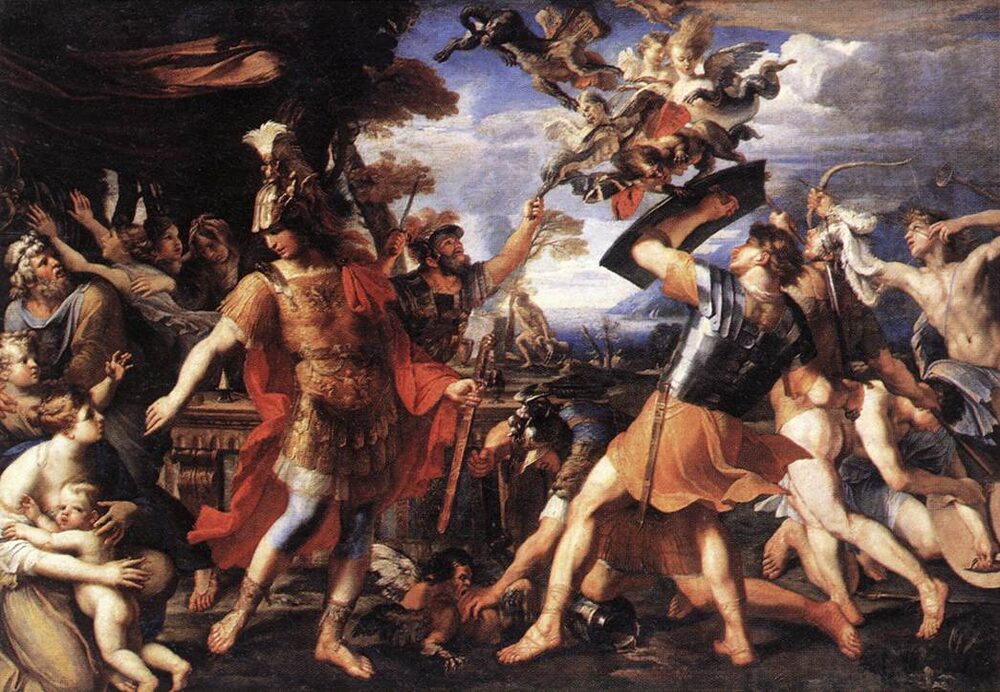
Harpyiai
First Appearance
The Harpies enter Greek poetry in Hesiod's Theogony (265–269) as the daughters born to Thaumas by the Oceanid Electra, sisters of swift Iris the rainbow: "the lovely-haired Harpies, Aello and Ocypete, who on their swift wings keep pace with the blasts of the winds and with the birds; for quick as time they dart along." Homer knows them too, and there they are beautiful rather than monstrous: in the Iliad (16.148–151) the horses of Achilles, Xanthus and Balius, are the foals the Harpy Podarge bore to the West Wind Zephyrus as she grazed in a meadow beside the swirling stream of Ocean. In this earliest layer the Harpies are simply the swift winds made into winged women — swift, lovely, and only later made loathsome.
— Hesiod, Theogony 265–269; Homer, Iliad 16.148–151 (Podarge)
Who They Are
The Harpies (HAR-peez), in Greek the Ἅρπυιαι (Harpyiai), "the Snatchers," are the storm-wind spirits of Greek myth — winged women who are the whirlwind and the sudden gust made flesh. Their name comes straight from the verb harpazein, "to snatch or carry off," and that is exactly what they are: the grasping wind that seizes a thing, or a person, and is gone with it into the sky. When something vanished without explanation — a child gone from a doorway, a sailor never found, a whole household swept away — the Greeks could say "the Harpies carried them off," and the phrase named both the wind that did it and the mystery that no body was ever found.
It is worth knowing from the start that the Harpies changed. In the oldest poetry — Hesiod and Homer — they are not monsters at all but beautiful, lovely-haired winged maidens, sisters of the rainbow-goddess Iris, so swift they race the storm-blasts and the birds, and one of them, Podarge, is lovely enough to be the mother of the immortal horses of Achilles. Only in later tradition, above all in the tale of the tormented seer Phineus and in the Roman poetry of Virgil, do they harden into the repulsive things most people picture now: filthy, shrieking bird-women with hooked talons and the faces of starving hags, who foul whatever they touch and snatch the food from a man's very mouth. This page keeps both images in view and flags where the shift happens, because the Harpies are one of the clearest cases in Greek myth of a lovely figure slowly turned into a horror.
Their parentage keeps them close to the sea and sky. Their father is Thaumas ("Wonder"), a sea-god son of Pontus and Gaia; their mother is the Oceanid Electra, a daughter of Ocean; and their sister is Iris, the swift messenger and rainbow — so the Harpies are, quite literally, sisters of the rainbow, two aspects of what the sky can do, the bright arc and the snatching gust. What they personify never really leaves them, in beauty or in horror: they are the whirlwind that lifts and carries away, the storm-gust that takes what it wants and cannot be caught, the invisible force behind every disappearance that has no other explanation.
Mythology
Daughters of Wonder, sisters of the rainbow
The Harpies belong to the sea-brood of the early cosmos. Hesiod places them in the line of Pontus, the Sea: Pontus and Gaia bore Thaumas, whose name means "Wonder" (the marvel of the sea and sky), and Thaumas took as his wife the Oceanid Electra, a daughter of deep-flowing Ocean. From that union came two kinds of swift, bright, sky-going daughter: Iris, the rainbow and the runner of messages between gods and men, and the Harpies, Aello and Ocypete, "who on their swift wings keep pace with the blasts of the winds and the birds." The pairing is deliberate and beautiful — the same parents produce the rainbow that spans the storm and the gusts that ride inside it. In this Hesiodic picture the Harpies are "lovely-haired" (ēÿkomoi); there is nothing foul about them. They are the wind's swiftness given a woman's shape, and their sister Iris will later be the one who saves them.
What the Harpies personify — the snatching wind
Before they were ever a monster, the Harpies were an explanation. The Greeks had no word for the way a whirlwind can lift dust, leaves, small animals — or, in a nightmare, a person — and carry them off into the air beyond all finding; the Harpies were that word. Homer uses them exactly so in the Odyssey (20.66–78), in one of the most haunting passages of the poem: Penelope, in her despair, prays to be snatched away and remembers the daughters of Pandareus, orphaned girls whom the gods had reared — and then "the spirits of the storm (Harpyiai) snatched the maidens away" and gave them to serve the Erinyes, and they were never seen again. That is the Harpies in their purest form: not a beast to be fought but the sudden vanishing itself, the gust that takes a life clean out of the world and leaves no grave. "The Harpies carried her off" is what you said when someone was simply, inexplicably gone.
Podarge and the immortal horses of Achilles
The loveliest survival of the old, beautiful Harpy is in the Iliad (16.148–151). Achilles' two divine horses, Xanthus ("Golden") and Balius ("Dappled"), the horses that run like the wind and one of which is briefly given the power of speech to foretell their master's death, are no ordinary foals: they were born of the Harpy Podarge ("swift-foot"), who, taking the form of a mare and grazing in a meadow beside the stream of Ocean, conceived them by Zephyrus, the West Wind. It is a perfect early-Greek image — the swift wind (a Harpy) mated to the swift wind (Zephyrus) to produce the swiftest creatures alive. Nothing here is monstrous; the Harpy is a wind-spirit lovely and free, and her children are the pride of the greatest of the Greeks. This is the same being that later poets would turn into a shrieking filth-bird, which is why the Iliad is worth holding onto.
The torment of Phineus
The story that made the Harpies famous — and made them monsters — is the torment of Phineus, and it is their centrepiece. Phineus was a king and seer of Thrace (at Salmydessus, on the Black Sea coast), a man with the gift of prophecy from Apollo. But he offended the gods — the reasons vary in the tellings: that he revealed too much of the future and disclosed the gods' designs to men, or that he cruelly wronged his own sons — and for this he was terribly punished. He was struck blind, and, worse, he was given over to the Harpies. Every time food was set before the starving old man, the Harpies would swoop shrieking from the sky, snatch most of it from the table, and befoul what little they left with such a stench that nothing could be eaten. So Phineus lived in perpetual, gnawing hunger amid plenty, wasting away beside a full table he could never touch — one of the cruellest torments in all Greek myth, and the episode in which the Harpies first appear as the loathsome, food-fouling creatures of the popular image.
The Boreads and the chase to the Strophades
Deliverance came with the Argonauts. When Jason's ship the Argo put in at Phineus's shore on the long voyage to Colchis, the blind seer knew them by his prophetic sight — and knew that among the crew were the two beings who alone could save him: Zetes and Calais, the Boreads, the winged sons of the North Wind Boreas. Phineus struck a bargain: rid me of the Harpies, and I will tell you how to pass the Clashing Rocks, the Symplegades, that guard the way ahead. So the heroes set a feast, and when the Harpies dived to plunder it, the two winged sons of the wind drew their swords, spread their own wings, and gave chase through the sky. The fullest telling is Apollonius of Rhodes' Argonautica (2.176–434): the Boreads pursued the Harpies far over the sea and would have killed them — but as they closed in, their sister Iris, the rainbow, came down from heaven and stopped them. "It is not lawful," she cried, "to strike the Harpies with your swords; they are the hounds of great Zeus" — and she swore by the water of the Styx, the oath no god may break, that the Harpies would never again come near Phineus. On that oath the Boreads turned back. The islands where they turned were afterward called the Strophades, "the Islands of Turning," from the Greek strephein, "to turn" — the very name a monument to the moment the chase was called off. The Harpies fled to their den on Crete (in Apollonius) or to the Strophades themselves (in later tellings), and Phineus, freed at last, ate his fill and gave the Argonauts the sailing-directions that carried them safely on. (Jason and the voyage of the Argonauts are told on their own page.)
Celaeno and the curse of the tables
The Harpies make one last great appearance in Roman epic, and it is the darkest. In Virgil's Aeneid (Book 3), the wandering Trojans under Aeneas land on the Strophades — now the Harpies' home — and, finding herds grazing, slaughter and roast the cattle for a feast. At once the Harpies fall on them out of the sky, snatching and fouling the food exactly as they did to Phineus; and when the Trojans draw their swords and fight, the blades cannot wound the creatures. Then their leader, the Harpy Celaeno ("the Dark"), perched on a high rock, cries out a prophecy of doom: the Trojans will indeed reach Italy, she says, but before they found their city they will be punished for this assault with a famine so terrible that they will be driven to eat their very tables. (The prophecy is later fulfilled in a harmless, almost comic way — the Trojans eat the flat bread-cakes they had used as plates — but Celaeno means it as a curse.) Here the Harpies are wholly the monster: filthy, invulnerable, and prophets of hunger, the exact opposite of Podarge and her lovely foals.
From lovely-haired maidens to filthy hags — the shift
Reading the sources in order, you can watch the Harpies change. In Hesiod and Homer (eighth–seventh century BC) they are "lovely-haired," swift and bright, sisters of the rainbow, mothers of divine horses — wind-spirits, not monsters. By the time of the Phineus legend as it was elaborated, and above all in the Roman poets, they have become the shrieking, stinking, hook-clawed bird-women with the shrunken faces of starving crones who snatch food and defile it — the image that Dante would later fix forever by setting the Harpies to nest in the ghastly wood of the suicides in his Inferno. Both pictures are genuinely ancient, and both are "the Harpies"; the beautiful storm-maiden and the loathsome food-fouler are the same idea — the snatching wind — seen once as a marvel and once as a horror. The Golden Thread flags the shift rather than choosing between them: the Harpies are what the wind is, and the wind is both.
Worship — Ancient
Feared, not worshipped — spirits of the vanishing
The Harpies had no cult. They were not gods to be petitioned but a dread to be explained — storm-spirits and agents of punishment, closer to the Erinyes (the Furies, to whom they hand the daughters of Pandareus) than to any Olympian who received sacrifice. What they "personified" was worship enough of a kind: they were the ancient answer to a real terror, the disappearance that has no cause you can see. A whirlwind that lifts and scatters, a gust that snatches a hat, a cloak, a lamb — and, in the imagination, a person — off the earth and into the invisible air: that force needed a name and a shape, and the Harpies gave it one. To say "the Harpies carried him off" was to name a death or a vanishing that left no body, no grave, and no explanation, and Homer's Odyssey uses the phrase in exactly that spirit for the lost daughters of Pandareus (20.66–78) and for Odysseus, feared snatched away and gone.
The Harpy Tomb of Xanthos
Their clearest mark in ancient sacred art is a monument that carries their name: the so-called Harpy Tomb of Xanthos in Lycia (in what is now southwestern Turkey), a tall pillar tomb of about 480–470 BC whose marble relief panels — the originals now in the British Museum, casts standing in their place at the site — show winged female figures gently carrying off small human figures in their arms. Early scholars named them "Harpies," reading the scene as the storm-spirits bearing away the souls of the dead, and the name has stuck to the monument ever since. (It should be flagged that the identification is disputed: many now think the winged women are Sirens rather than Harpies, carrying souls in the tender rather than the violent sense.) Either way the tomb witnesses the ancient association of such winged women with the carrying-off of the dead — the soul, like the body, snatched up and borne into the unseen.
Reception in the ancient imagination
In cult-terms the Harpies belong not to the altar but to the storyteller and the vase-painter. Archaic and Classical Greek art shows them as swift winged women, sometimes lovely, increasingly bird-bodied, most often in the one scene that fixed them in the popular mind: the chase, with the winged Boreads pursuing the Harpies away from the table of Phineus. They were, in short, a figure of poetry and warning rather than devotion — invoked to explain the storm and the vanishing, and to freeze the blood in the tale of the starving seer, but never given the honours of a god.
Worship — Modern
The word, and what it did to women
The most pervasive modern legacy of the Harpies is a single word. To call someone a "harpy" — a grasping, shrill, tormenting woman — is to invoke these creatures directly, and it is worth naming honestly what happened: an ancient storm-spirit, beautiful in Homer and sexless as the wind, was narrowed over the centuries into an insult aimed almost entirely at women, especially older women and women who make demands. The slur carries the whole downward arc of the myth in miniature — from the lovely-haired daughters of the rainbow's line to the shrunken, shrieking hag — and it is a small case study in how a culture's monsters get gendered. Modern retellings increasingly push back on this, recovering the earlier, freer image of the Harpies as wind-spirits rather than nagging crones.
The harpy eagle and the natural world
The Harpies also fly, quite literally, in the modern world: the harpy eagle (Harpia harpyja), one of the largest and most powerful birds of prey on Earth, was named after them by Linnaeus for its fierce talons and predatory swoop — a raptor of the South American rainforest that snatches monkeys and sloths from the canopy, the Harpies' grasping violence made into a living bird. The genus name Harpia keeps the Greek word in daily scientific use, and the bird has become the mascot of rainforest conservation, a rare case of the monster's name attaching to something the modern world wants to protect.
Art, literature, and the fixed image of the hag
In the arts the Harpies have kept the loathsome shape the ancients gave them at the end. Dante set them nesting in the wood of the suicides in the Inferno (Canto 13), foul birds with human faces feeding on the trees that are transformed souls, and that image — half-woman, half-vulture, clawed and shrieking — became the standard one, carried down through Renaissance painting, John William Waterhouse and the Victorians, and into modern fantasy, film, and games, where "harpy" now denotes a stock winged monster. The full arc is the real story, and the one this encyclopedia keeps: the Harpies began as the swift, lovely-haired sisters of the rainbow, the wind made into winged women and the mothers of immortal horses, and were slowly remade into the world's image of the snatching, filth-fouling hag — one figure, the storm-gust that carries things away, remembered once as a wonder and once as a horror.
Epithets & Cult Titles
- Ἅρπυιαι (Harpyiai) — "the Snatchers" — The name proper, from harpazein, "to snatch away"; they are the grasping storm-winds, and "the Harpies carried her off" was the Greek way of saying a person had vanished utterly, leaving no body and no trace
- Ἀελλώ (Aello), also Νικοθόη (Nicothoe) — "Storm-swift" or "Storm-wind" — one of the two Harpies named by Hesiod; later mythographers (Apollodorus) give her the variant name Nicothoe, "swift-victorious," for the same sister
- Ὠκυπέτη (Ocypete) — "Swift-flier" or "swift of wing" — the second Harpy named by Hesiod, who with her sister keeps pace with the blasts of the winds and with the birds; some sources give the variant Ocythoe or Ocypode
- Κελαινώ (Celaeno) — "The Dark One," the storm-black — a third Harpy added by later (mainly Roman) tradition; in Virgil she is the chief of the Harpies on the Strophades and utters the grim prophecy of the tables to Aeneas
- Ποδάργη (Podarge) — "the swift-footed" — "Bright-foot" or "swift-foot" — Homer's mare-Harpy, who grazing in a meadow by the stream of Ocean conceived by the West Wind Zephyrus the immortal horses Xanthus and Balius, later given to Achilles
- "the lovely-haired" / "the storm-footed" — Descriptive epithets of the Harpies in early epic: Hesiod calls them ēÿkomoi, "fair-tressed / lovely-haired," and Homer speaks of them as a thyella, the "storm-gust" that snatches people away (Odyssey 20.66) — the word is the wind's action, not a personal name — reminders that in the oldest poetry they were beautiful winged women, not the filthy hags of later art
Sources & Variants
- Hesiod, Theogony 265–269 (the Harpies Aello and Ocypete, lovely-haired daughters of Thaumas and the Oceanid Electra, sisters of Iris, who keep pace with the winds)
- Homer, Iliad 16.148–151 (the Harpy Podarge, mother by Zephyrus of Achilles' immortal horses Xanthus and Balius)
- Homer, Odyssey 20.66–78 (the Harpies snatch away the daughters of Pandareus and give them to the Erinyes; the paradigm of the vanishing without trace)
- Apollonius of Rhodes, Argonautica 2.176–434 (the fullest narrative: Phineus tormented by the Harpies, the Boreads Zetes and Calais give chase, Iris stops them by the oath of Styx, and the Strophades — 'Islands of Turning' — are named)
- Virgil, Aeneid 3.209–269 (the Trojans and the Harpies on the Strophades; the Harpy Celaeno and the prophecy of the tables)
- Ovid, Metamorphoses 7.1–4 and Fasti 6.131–140 (the Boreads and Phineus; the Harpies as bird-women, associated with the Strix)
- Apollodorus, Bibliotheca 1.9.21 and 1.2.6 (the Harpies at Phineus's court, the Boreads' pursuit, and the variant names Nicothoe/Aellopous and Ocypete/Ocythoe)
- Hyginus, Fabulae 14 and Preface (the Harpies among the Argonauts' foes; genealogy from Thaumas and Electra; the names Aellopous, Celaeno, Ocypete)
- The Harpy Tomb of Xanthos, c. 480–470 BC (Lycian pillar tomb, reliefs now in the British Museum; the winged women bearing off small figures — identification as Harpies or Sirens disputed)
- Dante, Inferno 13.10–15 (the Harpies nesting in the wood of the suicides — the source of the enduring monstrous image)
Gallery