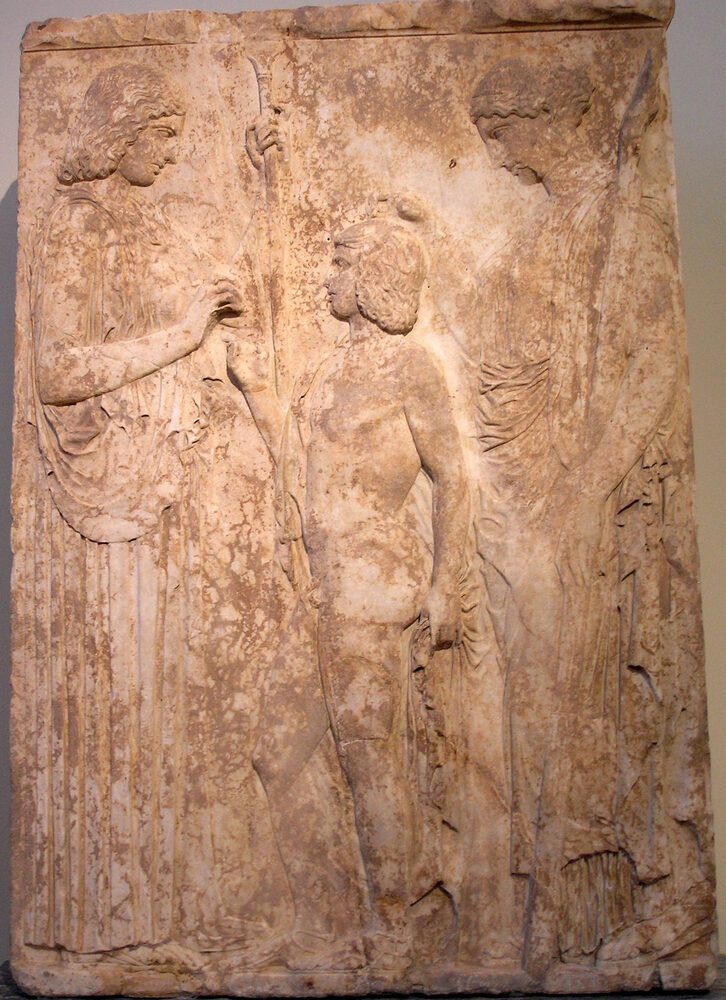
Triptolemos
First Appearance
Triptolemus first appears in the great Homeric Hymn to Demeter, among the ruling princes of Eleusis. When the grieving goddess, disguised as an old woman, comes to the town, the daughters of Keleos name for her the lords who "hold sway over Eleusis" — and Triptolemus is counted among them (lines 149–156). At the hymn's close, after Demeter has founded her rites and her temple on the hill of Eleusis, she goes "to the kings who deal justice — Triptolemus and Diokles the driver of horses, and mighty Eumolpus, and Keleos leader of the people — and showed them the conduct of her sacred things and taught them all her Mysteries" (473–479). In this earliest telling his glory is to be among the first mortals entrusted with the holy rites; the later, more famous story — of the winged chariot and the grain carried round the world — grows from this seed in the centuries that follow.
— Homeric Hymn to Demeter (2) 149–156 and 473–479
Who They Are
Triptolemus (trip-TOL-eh-mus) is the prince of Eleusis whom the goddess Demeter chose as her mortal son and messenger — the young man to whom she gave the first seed-corn of wheat and a marvellous winged chariot, and whom she sent out across the whole earth to teach humankind the art of agriculture: how to break the ground, scatter the grain, and gather in the harvest. He is counted here among the heroes because he began as a mortal prince of a small Attic town; but his heroism is of a rare and gentle kind, for he conquered no monster and sacked no city. His gift to the world was bread. Through him, the Greeks said, the human race passed from the wandering life of the gatherer to the settled life of the farmer — and so Triptolemus stands as a founder of civilization itself.
His story is bound up with the greatest of the ancient grief-and-return myths: the sorrow of Demeter for her stolen daughter Persephone. When the Corn-Mother wandered the earth disguised as an old woman, searching for her lost child, it was the royal house of Eleusis that received her kindly and gave her shelter. In gratitude — and as her gift to all mankind in the daughter's stead — Demeter took the young prince of that house and made him the bearer of grain. In the oldest telling he is simply one of the Eleusinian lords whom the goddess teaches her holy rites; in the fuller story that the Athenians loved and carved in stone, he is the single chosen youth who rides the sky in a serpent-drawn car, sowing the fields of every nation.
No image of the ancient world is more serene than the one the Eleusinians made of him: Triptolemus seated on his winged throne between two goddesses — Demeter on one side, Persephone on the other — receiving from the Corn-Mother's hand the ears of wheat he is to carry to the world. In that picture, the whole meaning of Eleusis is gathered: grief turned to grace, loss answered with a gift, and the hungry earth made to bear bread for the children of men.
Mythology
The prince of Eleusis
Triptolemus was a prince of Eleusis, the small town on the coast of Attica, not far from Athens, that would become the most sacred of all the places where Demeter was worshipped. The ancient sources do not fully agree on his parentage, and this uncertainty is itself old: in the most common account he is the son of Keleos, the king of Eleusis, and his wife Metaneira; in another he is the son of Eleusis, the hero for whom the town was named; and the poet Musaeus, Pausanias tells us, made him the son of Okeanos and Ge — of the great river that encircles the world and of the Earth herself (Pausanias 1.14.3). This last, strange parentage suited a figure who was to carry the gift of grain to the ends of the earth. Whichever father the teller chose, Triptolemus belonged to the royal house of Eleusis, and it was that house that the grieving goddess came to in her wandering.
The coming of the grieving goddess
When Persephone (whom the Eleusinians called Kore, "the Maiden") was carried off by Hades into the underworld, her mother Demeter wandered the whole earth in sorrow, searching for her, until she came at last — disguised as an old woman past the age of childbearing — to Eleusis. There she sat down by the Maiden Well, and the daughters of Keleos found her and brought her home, and the royal house received her kindly, not knowing she was a goddess (Homeric Hymn to Demeter 96–211). In this kindness of the Eleusinians to the disguised and grieving goddess lies the root of everything that follows: because they showed hospitality to Demeter in her sorrow, Eleusis was granted the gift of grain and the holy Mysteries, and its prince was made the giver of bread to the world.
Demophon in the fire
While she dwelt in the house of Keleos, Demeter became nurse to the king's infant son — in the Homeric Hymn he is named Demophon (Demophoön), the late-born child of Keleos and Metaneira; some later writers confuse him with Triptolemus, but the oldest telling keeps them distinct, and Triptolemus is the elder brother (or kinsman) who survives. Meaning to reward the house that had sheltered her, Demeter resolved to make the baby immortal: by day she anointed him with ambrosia, and by night she laid him secretly in the heart of the fire, burning away his mortality as a smith tempers iron (Homeric Hymn to Demeter 231–255). The child throve marvellously and grew like a god. But one night Metaneira, the mother, spied upon the nursery and saw her son laid in the flames, and she shrieked in terror, thinking him destroyed. Her cry broke the rite. Demeter snatched the baby from the fire and set him on the ground, angry and grieving, and declared that the mother's folly had cost her child the gift of deathlessness — "for I would have made your son immortal and unaging all his days." Then the goddess cast off her disguise, revealing her true shining form, and commanded the Eleusinians to build her a temple; and there she sat in her grief until the earth itself, barren at her sorrow, forced the gods to bring the Maiden back.
The gift of grain and the winged chariot
When at last Persephone was restored to her mother for two parts of the year, and Demeter in her joy made the fields bear fruit again, the goddess gave to Eleusis the gift for which it is forever remembered. To Triptolemus, the prince of the house, she gave the first seed-corn of wheat, and a marvellous chariot — a winged car drawn through the air by serpents (drakontes), the slow earth-dwelling creatures made to fly — and in it she sent him out over the whole inhabited world. (This full account of the grain-mission is told by the later writers — Apollodorus, Pausanias, and the Roman poet Ovid — and is not yet found in the Homeric Hymn, where Triptolemus is one of the lords taught the rites rather than the single rider of the sky; the famous chariot-and-grain story grows from that older seed in the classical age.) Riding the serpent-car, Triptolemus crossed the earth, and wherever he came down he scattered the grain into the broken ground and taught the peoples there to plough, to sow, and to reap — so that the art of agriculture passed from Eleusis to all mankind, and men left off their old wandering and wild-gathered diet and became tillers of the settled field (Apollodorus, Bibliotheca 1.5.1–2; Pausanias 1.14.1–3).
The dangers of the road
The gift of grain was not given without peril, and the stories of the journey carry a dark strand. It was told that a king named Lyncus, in the far land of the Scythians, received Triptolemus as a guest and then, envying him the glory of the gift, tried to murder the sleeping youth that he might claim the grain and the honour as his own; but Demeter struck him down, turning him into a lynx, and Triptolemus drove on unharmed (this episode is told by the Roman poet Ovid, Metamorphoses 5.642–661, and is a later, Roman elaboration of the journey). In another such tale a Thracian king, Charnabon, seized and killed the serpents of the chariot to halt him, and was punished for it. These stories of hostile kings along the road set the pattern of the hero who brings a blessing and is met with greed and violence — the giver of bread endangered by those who would hoard the gift.
The first sowing and the hero enthroned
When his long journey was done, Triptolemus came home to Eleusis, and there — on the Rharian plain beside the town — he made the first sowing in Greek soil and reaped the first Greek harvest; the Rharian field was still shown to travellers in Pausanias's day as the place where grain first grew and the first threshing-floor was set (Pausanias 1.38.6; 1.14.1–3). At Eleusis he was honoured ever after as the founder-hero of the rites and the giver of the corn, and the Eleusinians made of him their most serene image: Triptolemus seated upon his winged throne, a goddess at either hand — Demeter giving him the ears of wheat, Persephone raising her hand in blessing — the mortal prince between the Mother and the Maiden, receiving the gift he is to carry to the world. This is the subject of the great carved relief of Eleusis, one of the most famous sculptures of the ancient world, and of countless painted vases: in it the whole promise of the Mysteries is gathered into a single calm scene.
Worship — Ancient
The hero at the heart of Eleusis
Triptolemus was honoured above all at Eleusis, where his cult was woven into the greatest of the Greek Mysteries. He was not worshipped as a distant Olympian but as the founder-hero of the place — the mortal prince who had received the grieving goddess, been given the grain, and first been taught the holy rites. A Triptolemeion, a precinct or shrine of Triptolemus, stood at Eleusis, and Pausanias, walking the Sacred Way, records both his sanctuary and the tradition of his gift (Pausanias 1.14.1–3; 1.38.6). To the initiates who came in their thousands each year, he was the human face of the Mysteries' promise: that the goddess who gives the corn out of the dark earth, and takes her daughter down into it and brings her up again, holds a like gift of life for her faithful.
The corn carried to the world — and back again
Because the Greeks held that grain itself had first been given to men from the Eleusinian plain, and carried abroad from there by Triptolemus, Eleusis claimed a kind of spiritual motherhood over the whole settled, bread-eating world. This belief took concrete and binding form in the custom of first-fruits (aparchai): the cities of Greece — and, by an Athenian decree of the fifth century BC, their allies and others besides — sent a fixed measure of their wheat and barley harvest to the sanctuary at Eleusis in thanksgiving. The logic was plain and moving: if the corn of all the earth had gone out from this one plain through the gift of Triptolemus, then the harvest everywhere owed its first portion back to the place and the hero from which it came. Festivals of the ploughing and the sowing — the Proerosia ("before-ploughing") above all — kept his memory in the farmer's year, binding the high mystery of Eleusis to the common round of breaking ground and casting seed.
Image and honour across the Greek world
Beyond Eleusis, Triptolemus was known and depicted wherever the worship of Demeter reached. Athenian vase-painters of the sixth and fifth centuries BC returned again and again to the scene of the hero in his winged, serpent-drawn chariot, setting out or receiving the ears of corn from the goddess's hand, so that his image travelled on pottery across the Mediterranean. Sanctuaries of Demeter elsewhere in Greece claimed their own links to him and to the first sowing, and Pausanias, touring the Peloponnese, reports the rival traditions and the places that honoured him (Pausanias 7.18.3 and elsewhere). In art he is the eternal young giver: serene, princely, enthroned or riding, the sheaf of wheat in his hand — the most peaceable of all the heroes, remembered not for what he destroyed but for what he gave.
Worship — Modern
Patron of the harvest and the given gift
Triptolemus is remembered today chiefly through the thing he was said to have given — the cultivated grain, and with it the whole settled life of the farm and the table. A modern devotee drawn to him might honour him most naturally at the turning-points of the growing year: at the sowing, with a libation poured over the opened ground, and at the harvest, with the first-fruits of the grain set aside and given rather than kept — an echo of the ancient aparchai sent back to Eleusis. He sits well as a patron of agriculture and the land, of the baker and the farmer, of the sharing of bread, and of every teaching that lifts a people from want to plenty.
The quiet hero
Of all the heroes, Triptolemus offers perhaps the gentlest pattern. His greatness lies not in conquest but in a gift freely carried and freely taught — the knowledge that feeds, passed from hand to hand across the world. Honouring him can be a way of honouring the labour that stands behind every loaf, the long human work of cultivation, and the grace by which a grieving goddess turned her sorrow into bread for strangers. In a reflective modern reading his story speaks of generosity that asks for nothing back, of the dignity of the one who gives knowledge rather than hoards it, and of civilization understood not as power but as the sharing of the means of life.
Triptolemus in the record of the Mysteries
Because he stands at the centre of the Eleusinian Mysteries — the most celebrated and the most secret of all Greek rites — Triptolemus lives on in every modern account of Eleusis, and in the great carved relief of the hero enthroned between Demeter and Persephone, which hangs today among the treasures of the National Archaeological Museum in Athens and is reproduced in nearly every history of Greek religion and art. Wherever the story of Demeter's grief and the gift of the corn is told, the prince of Eleusis is there: the young man receiving the ears of wheat, setting out in his winged car to make the hungry earth bear bread.
Epithets & Cult Titles
- ho prōtos speiras (ὁ πρῶτος σπείρας) — The first to sow — the title the Eleusinians gave him as the man who first scattered seed-corn in the furrow and reaped a harvest, so that from him the whole art of agriculture passed to mankind
- hērōs tēs Dēmētros (ἥρως τῆς Δήμητρος) — Hero of Demeter — her chosen mortal and messenger, the prince of Eleusis through whom the Corn-Mother gave her gift to the world
- basileus Eleusinios (βασιλεὺς Ἐλευσίνιος) — Prince of Eleusis — one of the ruling lords of Eleusis to whom, in the oldest account, the goddess taught the conduct of her holy rites (Homeric Hymn to Demeter 473–479)
- dōtēr karpōn (δωτὴρ καρπῶν) — Giver of the fruits of the field — the one who carried the grain abroad in his winged car and taught the peoples of the earth to plough, to sow, and to reap
Sources & Variants
- Homeric Hymn to Demeter (2) 149–156 (Triptolemus named among the ruling princes of Eleusis)
- Homeric Hymn to Demeter (2) 231–255 (Demeter nurses the infant Demophon and lays him in the fire; Metaneira's cry breaks the rite)
- Homeric Hymn to Demeter (2) 473–479 (Demeter shows the conduct of her sacred rites and teaches her Mysteries to Triptolemus, Diokles, Eumolpus, and Keleos)
- Apollodorus, Bibliotheca 1.5.1–2 (Demeter at Eleusis; the fire-rite for the infant; the gift to Triptolemus of the wheat and the winged serpent-chariot in which he sowed the whole inhabited earth)
- Pausanias, Description of Greece 1.14.1–3 (the traditions of Triptolemus and the first sowing; the varying parentage — son of Keleos, or of Eleusis, or of Okeanos and Ge after Musaeus)
- Pausanias, Description of Greece 1.38.6 (the Rharian plain at Eleusis as the place of the first sowing and the first threshing-floor)
- Pausanias, Description of Greece 7.18.3 (Triptolemus and the spread of Demeter's grain-worship beyond Eleusis)
- Ovid, Fasti 4.549–560 (Ceres/Demeter and Triptolemus; the grain and the mission) — Roman retelling
- Ovid, Metamorphoses 5.642–661 (Triptolemus in the dragon-drawn chariot; King Lyncus of Scythia attempts his murder and is turned into a lynx) — Roman retelling
Gallery