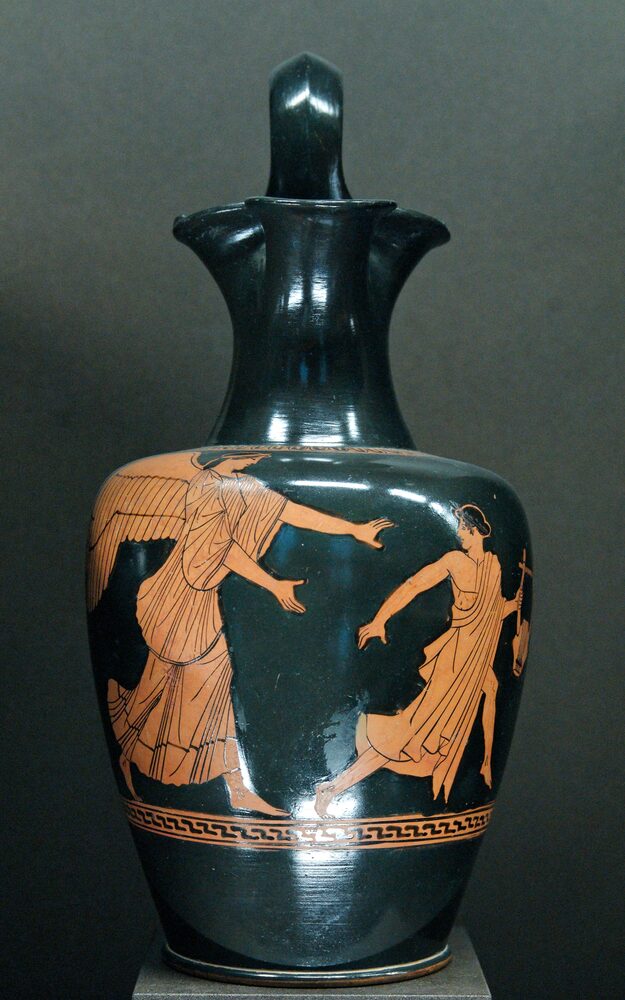
Tithōnos
First Appearance
Tithonus is present at the very edge of the oldest Greek poetry: both the Iliad (11.1–2) and the Odyssey (5.1–2) open the day with the same line — "Dawn rose from her bed, from beside lordly Tithonus, to bring light to the immortals and to men" — so that his name is bound into the daily rising of the sun before any myth about him is told. Hesiod (Theogony 984–985) records that Eos bore to Tithonus the sons Memnon, king of the Ethiopians, and Emathion. But the story of his fate is told most fully and most tenderly in the Homeric Hymn to Aphrodite (218–238), where the goddess tells it as a warning against the love of a goddess for a mortal man.
— Homer, Iliad 11.1–2 and Odyssey 5.1–2 (Eos rising from the bed of Tithonus); Hesiod, Theogony 984–985; Homeric Hymn to Aphrodite (5) 218–238
Who They Are
Tithonus (tih-THOH-nus) is the Trojan prince whom Eos, the Dawn, loved and carried away to be her husband at the edges of the world — and for whom she won from Zeus the gift of immortality, but forgot to ask also for immortal youth. So Tithonus cannot die; but he cannot cease to age. Year by year he grows older, frailer, smaller, until his strength is wholly gone and he lies helpless, a babbling voice in a shut room, with no release in death. He is counted here among the heroes because he began as a mortal prince of the house of Troy; but his is the strangest of heroic fates, for he is the one figure of Greek myth who received the thing all heroes long for — deathlessness — and found it the cruellest gift of all.
His story is the great Greek meditation on immortality without youth: the discovery that to live forever is a horror, not a blessing, unless one stays young. The Greeks returned to it again and again — not as an adventure but as a warning — and made Tithonus the very emblem of old age, the man for whom age had no end. In the earliest full telling (the Homeric Hymn to Aphrodite) the goddess Aphrodite herself relates it, precisely to explain why she will not make her own mortal lover deathless: she has seen what came of the Dawn's wish, and will not repeat it.
His name is older than his sad myth. Before any poet tells of his withering, Homer has already set him at the start of the day, for Eos rises each morning "from beside lordly Tithonus" to bring the light — so that the husband of the Dawn is woven into the turning of the world itself, left behind in his chamber at the eastern edge of things while his bride goes out across the sky.
Mythology
The Trojan prince loved by the Dawn
Tithonus was a prince of the royal house of Troy — a son of Laomedon, the king of Troy, and so a brother of Priam, who would rule the city in the years of the great war. He was, like others of that bright Trojan line, of extraordinary beauty; and his beauty drew the love of a goddess. Eos, the rose-fingered Dawn, who each morning rises from the eastern sea to bring the light to gods and men, was seized with longing for him. As she had carried off other beautiful mortals, so she bore Tithonus away — up and eastward, to the ends of the earth, to the streams of Ocean where the day begins — and there she took him as her husband and kept him in her house at the edge of the world.
The wish, and the thing forgotten
Loving him, and unwilling that he should ever die as mortals die, Eos went to Zeus and begged that Tithonus be made immortal — that he should live forever and never go down into death. Zeus granted it; the thing was done, and could not be undone. But in her longing the goddess had asked only that he should not die. She had forgotten to ask that he should not grow old — forgotten to beg for him eternal youth alongside eternal life. And so the two gifts that the gods themselves hold together, deathlessness and unageing youth, were split apart in Tithonus: he was given the one without the other, made unable to die but left wholly subject to age. (Homeric Hymn to Aphrodite 218–238.) It is from this single forgotten clause that all his sorrow flows.
The endless ageing
For a while, the Hymn says, all was well: while the bloom of youth was still on him Tithonus lived in joy beside the Dawn at the streams of Ocean. But when the first grey hairs came at his temples and in his beard, the goddess held back from his bed; and still she kept and cherished him in her house, feeding him on bread and ambrosia and clothing him in fair garments. Yet the years did not stop. When at last hateful old age pressed wholly upon him, and he could not move or lift a limb, this seemed to her in her heart the better course: she laid him away in a chamber, and shut the shining doors upon him. There his voice flows on endlessly, a thin and ceaseless stream of speech, but the strength is gone that once was in his supple limbs. So the husband of the Dawn ages without term and without death — shrunken, feeble, babbling behind a closed door, kept but no longer loved, while his bride rises young each morning and goes out across the sky. It is one of the most unsettling pictures in all Greek poetry: not a monster's doom but the ordinary terror of age, drawn out forever.
The warning Aphrodite draws from it
In the Homeric Hymn it is Aphrodite who tells the tale, and she tells it for a reason. Humbled by Zeus into loving the mortal Anchises, and ashamed that she has lain with a man who must die, she will not do for him what Eos did for Tithonus. She says plainly that she would not have her beloved live deathless and ageless among the immortals — for she has seen the end of that wish. Better, she says, that he grow old and die as men do than endure the fate of Tithonus, kept alive past all living. Thus the oldest full telling of the story frames it not as romance but as caution: a goddess looking on the ruin the Dawn made of her love, and choosing not to repeat it. The myth is, from its first full appearance, a warning about the thing mortals most desire.
Sappho and the sorrow of age
The poet Sappho of Lesbos took up Tithonus as the mirror of her own ageing. In the poem recovered on papyrus and known as the "Tithonus poem" (Sappho fr. 58), she grieves that her knees will no longer carry her in the dance and her once-dark hair has gone white, and sets against her own old age the myth of the Dawn and her husband: Eos, "with her rosy arms," for all her love carried Tithonus to the ends of the earth, and still old age in time laid hold of him, immortal wife and all. If even the beloved of a goddess could not escape age, Sappho reasons, then no mortal can — and her lament turns Tithonus into the common emblem of what time does to every living body. The earlier poet Mimnermus of Colophon had likewise named him among the sorrows of old age, counting the unending gēras ("old age") that Zeus gave Tithonus as a grief worse than any swift death.
Their son Memnon, and the children of the Dawn
From the union of Eos and Tithonus came children, and chief of them was Memnon, who became king of the Ethiopians in the lands of the sunrise (Hesiod, Theogony 984–985, which names also a second son, Emathion). Memnon grew to be a great and beautiful warrior, and in the tenth year of the Trojan War he led his eastern people to the aid of Troy — his father's own city — and did mighty deeds, until he met Achilles in single combat and was killed. His mother the Dawn, it was told in the lost epic of his death (the Aethiopis), won from Zeus a measure of honour for him even so; and her grief for her fallen son was said to show each morning in the dew, the tears of Eos for Memnon shed upon the grass at dawn. Thus the house of the Dawn and Tithonus is bound to the fall of Troy: the father withers deathless in his eastern chamber while the son goes west to die young and glorious on the plain before his uncle Priam's walls.
The late tradition: the shrinking into the cicada
The Homeric Hymn leaves Tithonus a voice behind a shut door; but a later tradition carried the image one grim step further. In the telling of Hellenistic and later writers (preserved in the ancient commentaries on the poets), Tithonus went on shrinking as he aged beyond all human smallness until he dwindled at last into a cicada (Greek tettix) — the small, dry, chirping insect of the summer heat — so that nothing was left of the once-beautiful prince but a thin, unending stir of sound. It is easy to see why the Greeks joined the two: the cicada was proverbially a creature of pure voice, a body all but gone to song, and that is exactly what the Hymn had made of Tithonus — a voice that flows on when the strength of the limbs has failed. This transformation is not in the oldest sources and belongs to the later shaping of the myth, but it became the image by which many knew him: the husband of the Dawn ended not as a man and not as a corpse, but as the dry ceaseless singing in the grass.
Worship — Ancient
A figure of poetry, not of cult
Tithonus had no temples, no priesthood, no festivals; he was never, so far as we know, an object of worship. He belonged wholly to poetry — to the singers' store of images for beauty, for the love of goddesses, and above all for old age and the folly of wishing wrongly. His "cult," if the word can be stretched, was his constant presence in verse: Homer setting him at the door of each new day, Hesiod naming his sons, the Homeric Hymn making him a warning, Sappho and Mimnermus making him the face of age itself.
The byword for old age
Among the Greeks his name became a kind of proverb. To speak of Tithonus was to speak of old age without end — of living too long, of the body outlasting all its strength and sweetness. Where other men feared death, the figure of Tithonus taught a stranger fear: that there might be something worse than dying, namely not being able to die. In this he stood as a quiet corrective to the longing for immortality that runs through so much of Greek myth and thought — a reminder, set at the very dawn of the day, that the gods' deathlessness is theirs because it comes wedded to an unfading youth no mortal can keep.
The lesson of the half-granted wish
The Greeks drew from him, too, a sharp lesson about prayer and wish — about asking rightly. Eos asked for much and still asked too little; she won her beloved life and doomed him to agony by the one thing she left out. Tithonus became, with a handful of other myths, a standing illustration that a wish granted exactly as spoken may be a curse, and that mortals (and even goddesses) rarely know the whole of what they are asking. The story carries its warning without need of a shrine: it was taught wherever the poets were sung.
Worship — Modern
The patron of a hard wisdom
Tithonus is not a figure of devotion but of reflection, and that is how a modern reader meets him best — as the keeper of a hard and necessary wisdom. His story is the plainest statement Greek myth makes of a truth the Greeks held close: that length of days is not the same as blessing, and that a life that cannot end, in a body that cannot stay young, is a horror rather than a hope. To hold his name in mind is to be guarded against the common confusion of more life with good life — to value the fullness and youth of a season over its mere endlessness.
"Only cruel immortality consumes" — Tithonus in later verse
Tithonus found his greatest afterlife in English poetry, in Alfred, Lord Tennyson's dramatic monologue "Tithonus" (published 1860), where the withered husband speaks from the Dawn's threshold and begs her to take her gift back and let him die: "The woods decay, the woods decay and fall... Me only cruel immortality / Consumes." Tennyson's poem fixed the myth for the modern imagination as the definitive meditation on the curse of deathlessness, and it is through these lines that most readers today first meet the Trojan prince. He has become a touchstone in every modern discussion of radical life-extension and the dream of conquering death — the oldest and sharpest reminder that to defeat death without defeating age would be to win the worst of both.
The voice at dawn
There is a gentler way to keep him, too. Because Homer set Eos rising each morning "from beside lordly Tithonus," he is bound forever to the dawn — the husband left in the east as the light goes out across the world. One who wished to honour him might do so at first light, listening in summer for the dry stir of the cicadas in the grass, and remembering in that thin unending sound the prince who was all voice at the last: a figure not of triumph but of pity and of warning, held gently in mind at the hour that bears his wife's name.
Epithets & Cult Titles
- husband of Eos (πόσις Ἠοῦς) — Consort of the rose-fingered Dawn, who loved him for his beauty and bore him away to the edges of the world — the relationship that defines him in every telling
- the deathless and ageing one — A figure held between the two things the gods usually give together: he was made athanatos ('deathless') but not freed from gēras ('old age'), so that immortality became for him not a gift but a sentence
- emblem of gēras (γῆρας) — To Greek poets his name became a byword for old age itself — Mimnermus and others name him when they speak of the long sorrow of growing old, the man for whom age had no end
Sources & Variants
- Homer, Iliad 11.1–2 and Odyssey 5.1–2 (Eos rising from the bed of lordly Tithonus to bring light to gods and men — his name woven into the daily dawn)
- Homer, Iliad 20.237 (Tithonus named among the sons of Laomedon of Troy, brother of Priam)
- Hesiod, Theogony 984–985 (Eos bore to Tithonus the sons Memnon, king of the Ethiopians, and Emathion)
- Homeric Hymn to Aphrodite (5) 218–238 (the core telling: Eos begs Zeus for Tithonus's immortality but forgets to ask eternal youth; his endless ageing; she shuts him in a chamber where his voice flows on; Aphrodite tells it as a warning)
- Sappho fr. 58 (the 'Tithonus poem,' recovered on papyrus: Sappho's own old age set against Eos's love for Tithonus, whom age laid hold of despite his immortality)
- Mimnermus fr. 4 West (the unending old age that Zeus gave Tithonus, counted a grief worse than death)
- Apollodorus, Bibliotheca 3.12.4 (Tithonus son of Laomedon, carried off by Eos, father of Emathion and Memnon)
- Proclus, summary of the Aethiopis (Memnon son of Eos and Tithonus, his aid to Troy, his death at the hands of Achilles, his mother's grief)
- Ancient scholia and later tradition on the cicada (the aged Tithonus shrinking at last into a tettix / cicada — a post-Homeric development of the Hymn's 'voice that flows on')
- Alfred, Lord Tennyson, 'Tithonus' (1860) — the modern poetic retelling of the curse of immortality without youth
Gallery