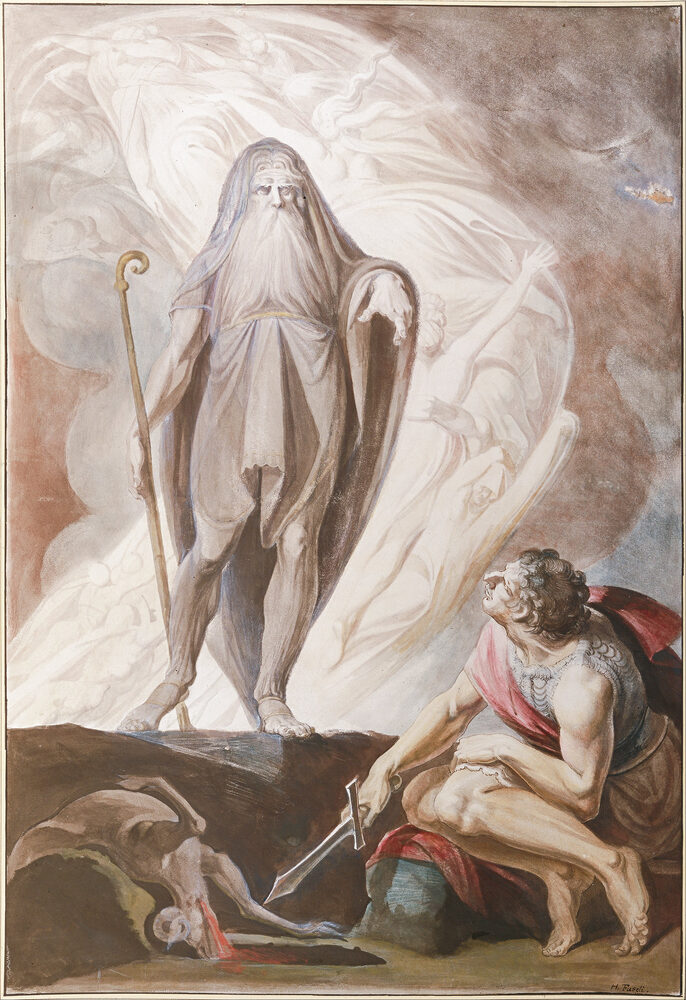
Teiresias
First Appearance
Tiresias enters Greek poetry already dead and still prophesying. In the Odyssey, Circe tells Odysseus he must go down to the house of Hades to consult "the shade of Theban Tiresias, the blind seer, whose mind is steadfast still" — for to him alone, dead though he is, Persephone has granted that he keep his understanding, "while the other dead flit about as shadows" (10.490–495). At the pit of blood Odysseus holds back every other ghost until Tiresias has come and drunk; and the seer, knowing him at once, foretells the hard road home, the anger of Poseidon, the cattle of the Sun that must not be touched, and the strange far death that will come to Odysseus "from the sea" (11.90–151). From his first appearance he is what he will always be: the one who sees true, past the edge even of death.
— Homer, Odyssey 10.490–495 and 11.90–151
Who They Are
Tiresias (ty-REE-see-us) is the great blind prophet of Thebes — the seer who, in the Greek imagination, stood above every other mortal reader of the gods' will, and whose gift was so bound up with his blindness that the two could hardly be told apart. He belongs among the heroes because he was a mortal man, of the old Theban stock sprung from the Sown Men; but he is a hero of a rare kind, for his deeds are not battles won or monsters slain but truths spoken — truths so hard that those who heard them often wished he had kept silent, and so true that they came to pass all the same.
His life is marked by two strange turnings. In the most famous, he was changed for seven years into a woman after striking a pair of coupling serpents, and so became the one person who had lived as both man and woman — which is why, when Zeus and Hera fell to quarrelling over who takes the greater pleasure in love, they called on Tiresias to settle it, and his answer cost him his eyes. In the other, older strand he lost his sight for seeing the goddess Athena bathing, and was given prophecy and the understanding of birds in recompense at his mother's plea. Either way the shape is the same: sight of the body given up, and sight of the hidden given in its place.
Through the whole tragic cycle of Thebes he stands at the hinge of every doom — warning Oedipus, defying Creon, counselling against the folly that brings down the Seven, resisting the new god Dionysus and yet bending to him. And when at last he died, drinking from a cold spring as the Thebans fled their fallen city, death itself could not silence him: his shade keeps its wits in the house of Hades, and still gives true oracles to the living who dare go down to ask.
Mythology
Seven years a woman: the serpents and the quarrel of Zeus and Hera
The best-loved tale of Tiresias tells how, as a young man, he came upon two great serpents coupling on Mount Cyllene (some say Mount Cithaeron) and struck at them with his staff — in one telling killing or wounding the female — whereupon he was changed on the instant into a woman. For seven years Tiresias lived as a woman, and lived fully so: the sources say that in this time she married, and some add that she bore children, so that Tiresias knew the life of a woman from within and not from without. Then in the eighth year, coming again upon the same sight of coupling serpents, Tiresias struck them a second time (now, in the matching telling, the male), and was restored to a man.
Because of this Tiresias became the one mortal who had been both man and woman, and knew the pleasure of love from both sides. So when Zeus and Hera fell to a lovers' quarrel on Olympus — Zeus teasing that a woman takes the greater pleasure in love, Hera insisting it is the man — they agreed to call the one being who could truly judge, and summoned Tiresias. Tiresias answered for Zeus: if the pleasure of love were counted in ten parts, he said, the woman takes nine and the man but one. Hera, enraged to have her secret told and her side overthrown, struck Tiresias blind on the spot. Zeus could not undo what another god had done, but in recompense he gave Tiresias long life — some say the span of seven generations of men — and the gift of prophecy, so that the eyes Hera darkened opened an inner sight that no other mortal had. (This is the version Apollodorus gives at length, Bibliotheca 3.6.7; the Roman poet Ovid retells it famously at Metamorphoses 3.316–338, where he fixes the seven years and the quarrel, though his is a later Latin shaping of the old Greek tale.)
The other blinding: Athena at the bath
An older and quite different account of how Tiresias came to be blind is given by Callimachus in his Hymn 5, the Bath of Pallas (the Bathing of Athena). In this telling there is no quarrel of the gods and no serpents. Tiresias, still a boy, was out hunting on Mount Helicon when, at high noon, overcome by thirst, he came unknowing upon a spring where the goddess Athena was bathing with the nymph Chariclo, who was his mother and Athena's own beloved companion. The boy saw what no mortal may see — the naked goddess — and in that instant his eyes went dark, for it is the hard law of heaven that whoever beholds a god unwilling pays with his sight.
Chariclo cried out in grief and reproached the goddess for blinding her child. Athena answered that she had not willed it — the law was older than she, set down by Cronus, that the price of seeing an immortal unbidden is blindness — but that she could not give back the eyes. Instead, for love of Chariclo, she gave the boy gifts beyond the sight of the eyes: she gave him the seer's staff to guide his steps and to mark his office, a long life, and above all the gift of prophecy and the understanding of birds — to know the cries of the birds of omen, which bring luck and which bring doom — and she granted that even among the dead he should keep his mind and prophesy still. So in this telling too the darkening of the outer eye is the opening of the inner, and a mother's plea turns a punishment into a calling.
The prophet through the doom of Thebes
For the long span of his life Tiresias was the prophet of Thebes, standing at the turning of every great crisis of that ill-fated house. When the plague fell on the city and Oedipus sought the cause, it was Tiresias he summoned — and the seer, knowing the dreadful truth, first refused to speak and then, goaded, told the king to his face that he himself was the killer of his father Laius and the husband of his own mother; Oedipus, blind in his rage to the truth, mocked the blind man who alone could see it (Sophocles, Oedipus Tyrannus). When Creon, ruling after, forbade the burial of Polyneices and walled up Antigone alive, it was Tiresias who came to warn him that the gods were offended and his own house would pay in death — a warning Creon heeded too late (Sophocles, Antigone 988–1090).
In the war of the Seven against Thebes his counsel again stood between the city and ruin: he declared that Thebes would be saved only if Menoeceus, Creon's son, gave his life for it, a demand the young man met by his own hand (Euripides, Phoenician Women). And when the new god Dionysus came to Thebes and the young king Pentheus scorned his rites, it was old Tiresias — wreathed in ivy, fawn-skin on his shoulders, ready to dance — who urged the king to receive the god and not to fight the power that cannot be fought; Pentheus would not hear him, and was torn apart (Euripides, Bacchae 170–369). In every case the pattern holds: the seer speaks the truth plainly, the great man will not bear it, and the doom the seer foretold comes to pass exactly as he said.
His death at the spring Tilphoussa
Tiresias lived through the fall of Thebes itself. When the sons of the Seven, the Epigoni, took the city at last, the Thebans fled by night at the seer's own counsel, and Tiresias went out with them. On the road, old beyond the age of men, he stopped to drink at the cold spring Tilphoussa (Tilphossa) near Haliartus in Boeotia — and the chill of its water, or the fullness of his long-appointed span, took his life there on the spot, so that he died in flight from the city he had served and warned for generations (Apollodorus 3.7.3; Pausanias 9.33.1, who notes the spring and the memory of his death there). His daughter Manto, herself a prophet, was taken among the captives and dedicated to Apollo; but Tiresias himself passed down to the house of the dead.
The shade that still prophesies
Death did not end Tiresias. Alone among all the dead, he kept his understanding in the house of Hades, for Persephone granted to him — and to him only — that his mind should stay whole and his gift unbroken, "while the other dead flit about as shadows" (Homer, Odyssey 10.490–495). So it was that Odysseus, needing to learn his road home, was sent by Circe not to any living oracle but down to the very edge of the underworld to consult the dead seer of Thebes. There, at a pit filled with the blood of a black ram and ewe, Odysseus kept back the crowding ghosts until Tiresias came; and the shade, drinking, knew him and the truth of him at once, and foretold the whole hard way home — the wrath of Poseidon, the cattle of the Sun on Thrinacia that must not be touched on pain of the loss of all his men, the suitors to be faced in his own hall, and the strange gentle death that would come to Odysseus at last "from the sea," in a sleek old age among a peaceful people (Odyssey 11.90–151). Thus the blind prophet of Thebes gave true oracles even out of death, and his office — to see and to speak what is hidden — proved stronger than the grave.
Worship — Ancient
A prophetic hero, honoured at oracle and tomb
Tiresias was worshipped not as a god but as a prophetic hero — one of that class of the mighty dead whose power was believed to linger at their resting place and to answer those who came to ask. His honours clustered where his memory was strongest: in Boeotia, the land of Thebes. Near Orchomenos there was an oracle that bore his name, where men sought answers as from the seer himself; and the Thebans kept his memory as the greatest of their line of prophets. Pausanias, travelling the land in the second century AD, records the spring Tilphoussa where Tiresias died and the place held sacred to his passing (9.33.1), and notes the honour the Boeotians still gave his name.
The rite of calling up the seer
Because his gift was held to outlast death, the natural way to honour Tiresias was the way Odysseus honoured him in the poem: by the rites owed to the prophesying dead. These were the offerings of the underworld — the black ram and black ewe whose dark blood was poured into a pit to summon and strengthen the shade, the mingled libation of milk and honey, sweet wine, and clear water, and the scattered barley, with prayers to the powers below. Such a rite (a nekyia, a calling-up of the dead) was the fitting approach to a hero whose temple was the threshold of Hades itself and whose answer came from beyond it.
The seer among the poets
More than in any shrine, Tiresias lived in the mouths of the poets, and this was itself a kind of cult — the keeping-alive of his name and his truth-telling. He is the fixed figure of the prophet in Greek tragedy, summoned onto the stage at Thebes by Sophocles and Euripides whenever a king must be warned and will not hear; and he is the dead seer of the greatest of all the journeys to the underworld. To name Tiresias was to name prophecy itself, and the Greeks named him constantly, so that his memory never dimmed.
Worship — Modern
Patron of the inner sight
Tiresias is honoured today less at any altar than as the enduring image of the seer whose blindness is insight — the one who cannot see the world of the eyes and sees instead the truth of things. A modern devotee drawn to him finds in his story a patron of prophecy, dreams, divination, and the reading of signs; of the courage to speak a hard truth that will not be welcomed; and of the strange grace by which a loss of one kind of sight may open another. His emblem is the darkened eye that nonetheless sees, and his word is the word spoken plainly whatever the cost.
The one who was both
Because he lived seven years as a woman and seven generations as a man, and knew life from both sides, Tiresias has long spoken to those who find themselves between or across the lines the world draws — a figure of a self not fixed to one shape, whose very doubleness was the source of a wisdom none else could reach. In this he is honoured as a patron of those who have crossed from one way of being to another and carry the knowledge of both; the quarrel of Zeus and Hera, in which he alone could judge, is remembered as the moment his lived doubleness became a kind of authority no single life could hold.
The voice that outlasts death
Above all Tiresias is remembered as the prophet whom death could not silence — the shade that keeps its mind in the dark and still gives true answers to any who dare come down and ask. For a modern reader his story holds out a quiet promise: that true seeing and true speaking do not end, that wisdom can keep its wits even past the losses of the body, and that the hard word honestly spoken outlives the one who speaks it. The blind seer of Thebes still stands at the edge of the underworld, waiting by the pit of blood with the truth ready for whoever is brave enough to hear it.
Epithets & Cult Titles
- mantis (μάντις) — Seer, diviner — the plain Greek word for a prophet, and the office Tiresias holds above every other mortal in Greek story; the one whose sight is inward and true though his eyes are dark
- ho orniothoskopos (ὁ ὀρνιθοσκόπος) — The bird-watcher, reader of birds — he who understands the speech and the flight of birds and reads the will of the gods in them, a gift given him when his mortal sight was taken
- ho typhlos mantis (ὁ τυφλὸς μάντις) — The blind seer — his defining paradox, the man robbed of outer sight and given inner sight in its place, so that blindness itself became the mark of his truth-telling
- eidōlon (εἴδωλον) with mind intact — In the underworld his shade alone keeps its wits — Persephone granted that Tiresias keep understanding among the dead while the others flit as mindless shadows (Homer, Odyssey 10.490–495), so that even death did not end his prophesying
Sources & Variants
- Homer, Odyssey 10.490–495 (Circe sends Odysseus to Tiresias, the blind Theban seer whose mind Persephone left whole among the dead)
- Homer, Odyssey 11.90–151 (Tiresias' shade drinks the blood and prophesies Odysseus' homeward road, the cattle of the Sun, and his death 'from the sea')
- Hesiod, Melampodia fr. 275 (the quarrel of Zeus and Hera over the pleasure of love, and Tiresias' judgement that the woman has nine parts to the man's one; Hera's blinding and Zeus's gift of long life and prophecy)
- Callimachus, Hymn 5 (The Bath of Pallas / Bathing of Athena) 57–136 (Tiresias sees Athena bathing with his mother Chariclo and is blinded; at Chariclo's plea Athena gives him the seer's staff, long life, prophecy, and the understanding of birds)
- Sophocles, Oedipus Tyrannus 300–462 (Tiresias summoned by Oedipus, refuses then declares him the killer of Laius and husband of his mother)
- Sophocles, Antigone 988–1090 (Tiresias warns Creon that the gods are offended and his house will pay in death)
- Euripides, Bacchae 170–369 (old Tiresias, ivy-wreathed, urges Pentheus to receive the god Dionysus)
- Euripides, Phoenician Women 834–959 (Tiresias declares that Thebes will be saved only by the self-sacrifice of Menoeceus)
- Apollodorus, Bibliotheca 3.6.7 (the serpents, the seven years as a woman, the quarrel of Zeus and Hera, Hera's blinding and Zeus's gift of prophecy and long life)
- Apollodorus, Bibliotheca 3.7.3 (the fall of Thebes to the Epigoni and the death of Tiresias in flight; his daughter Manto given to Apollo)
- Pausanias, Description of Greece 9.33.1 (the spring Tilphoussa where Tiresias died, and the honour given his memory in Boeotia)
- Ovid, Metamorphoses 3.316–338 (the serpents, the seven years, the quarrel of Jove and Juno, the blinding and the gift of prophecy) — later Roman retelling
Gallery