hoi megaloi alitroi
First Appearance
The great sinners first appear as a group in Homer's Odyssey (11.576–600), in the underworld scene called the Nekyia, where Odysseus, summoning the dead at the edge of the world, sees three of them at their endless labours. He sees Tityos stretched over nine acres of ground while two vultures tear at his liver; Tantalus standing in a pool that drains away whenever he stoops to drink, under fruit-laden boughs that the wind tosses out of reach whenever he grasps; and Sisyphus heaving a great stone up a hill, only to have it roll thundering back down each time he nears the top, sweat pouring off him and the dust rising from his head. This is the earliest catalogue of the damned, and every later account builds on it.
— Homer, Odyssey 11.576–600 (the punishments of Tityos, Tantalus, and Sisyphus)
Who They Are
The damned (in Greek οἱ μεγάλοι ἀλιτροί, hoi megaloi alitroi, "the great sinners") are not one figure but a small, famous company: the handful of named wrongdoers whom Greek poetry shows suffering endless, purpose-built punishment in the depths of the underworld. They are gathered here on a single page because they belong together — the Greeks themselves listed them as a set, and their stories rhyme. Each committed an outrage so great that an ordinary death was not enough to answer it; each was given instead an eternity of torment shaped, with a terrible fitness, to the exact form of the crime. Five of them stand out above the rest, and this page tells each one's story in turn: Sisyphus, who cheated Death; Tantalus, who abused the gods' hospitality; Ixion, who murdered his kinsman and then lusted after Hera; the Danaids, who murdered their husbands; and Tityos, who assaulted the goddess Leto.
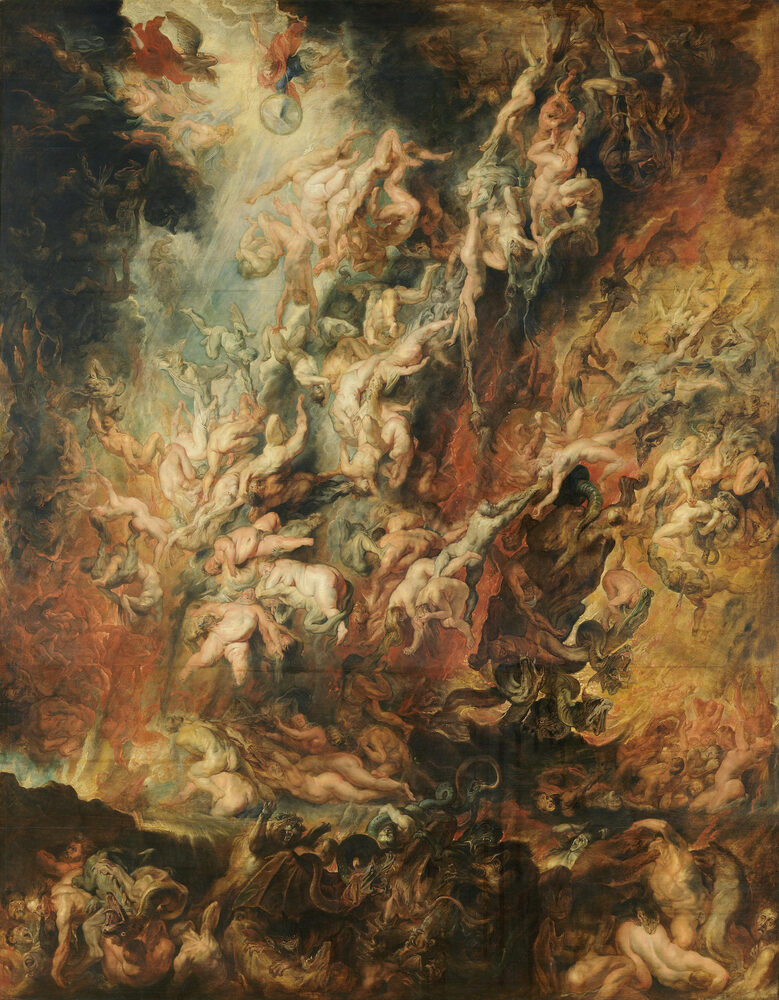
The setting of their suffering is Tartarus (Τάρταρος) — not Hades in general, but the deep prison-pit that lies below the ordinary land of the dead, as far beneath Hades as the earth lies beneath the sky. Hesiod pictures it as a windy chasm sealed with bronze gates, the oldest dungeon of the cosmos, where Zeus locked away the defeated Titans. It is the place the gods reserve for those who offend against the very order of things — who break the boundaries that hold the world together: the guest-bond, the ties of blood, the honour owed to the immortals, the line between the living and the dead. To be sent to Tartarus is not merely to die but to be made an everlasting example.
What makes these figures so memorable — and why their names still live in our language — is the exact, poetic justice of what is done to them. The punishment always answers the sin. Sisyphus, who spent his life on clever schemes that never quite ran out, must push a stone that never quite stays up. Tantalus, who abused a feast, is starved forever at a feast he cannot touch. The Danaids, who poured out their bridegrooms' lives, must pour water forever into a jar that never fills. This is the Greek imagination at its most unflinching and its most orderly: a underworld where the shape of the crime becomes the shape of the doom, and stays that way, without end.
Mythology
All five of these figures suffer in Tartarus, the pit below the underworld. Hesiod (Theogony 720–819) describes it as lying as far beneath Hades as the sky is above the earth — a "great chasm" (chasma mega) shut behind bronze gates and a bronze threshold, ringed by night, the storehouse where Zeus imprisoned the Titans after the war in heaven. Over time it became, in the poets' imagination, the place of punishment for the worst of mortal sinners as well: the deep dungeon reserved for those who broke the deepest laws. Homer's underworld does not yet sharply separate Tartarus from the rest of the land of the dead, but by the time of Plato (Gorgias 525c–526d, Republic 615c–616a) Tartarus is firmly the destination of the incurable wrongdoer. Each of the five stories below names a crime, describes the punishment fitted to it, and flags the places where the ancient sources disagree.
Sisyphus — the king who cheated Death
The crime. Sisyphus (Σίσυφος), the founder-king of Corinth (Ephyra), was the cleverest and most cunning of mortals — and he used his cleverness against Death itself. The sources give two overlapping accounts of what earned him his doom. In the first, when Thanatos (Death) came to take him, Sisyphus tricked the god and chained him up, so that for a time no one on earth could die at all, until Ares freed Death and handed the king over. In the second (Apollodorus, Bibliotheca 1.9.3; and a much-loved fuller version in later sources), Sisyphus, foreseeing his own death, instructed his wife to leave his body unburied and perform none of the customary rites; then, arriving in the underworld, he complained to Persephone that his wife had neglected him, and won her permission to go back up to the living world just long enough to set matters right — and once back in the sunlight he simply refused to return, living on to a ripe old age until he had to be fetched down a second time. The Greeks also remembered his lifelong wickedness: he was a betrayer of the gods' secrets (he told the river-god Asopus that Zeus had carried off his daughter Aegina) and a robber and killer of travellers.
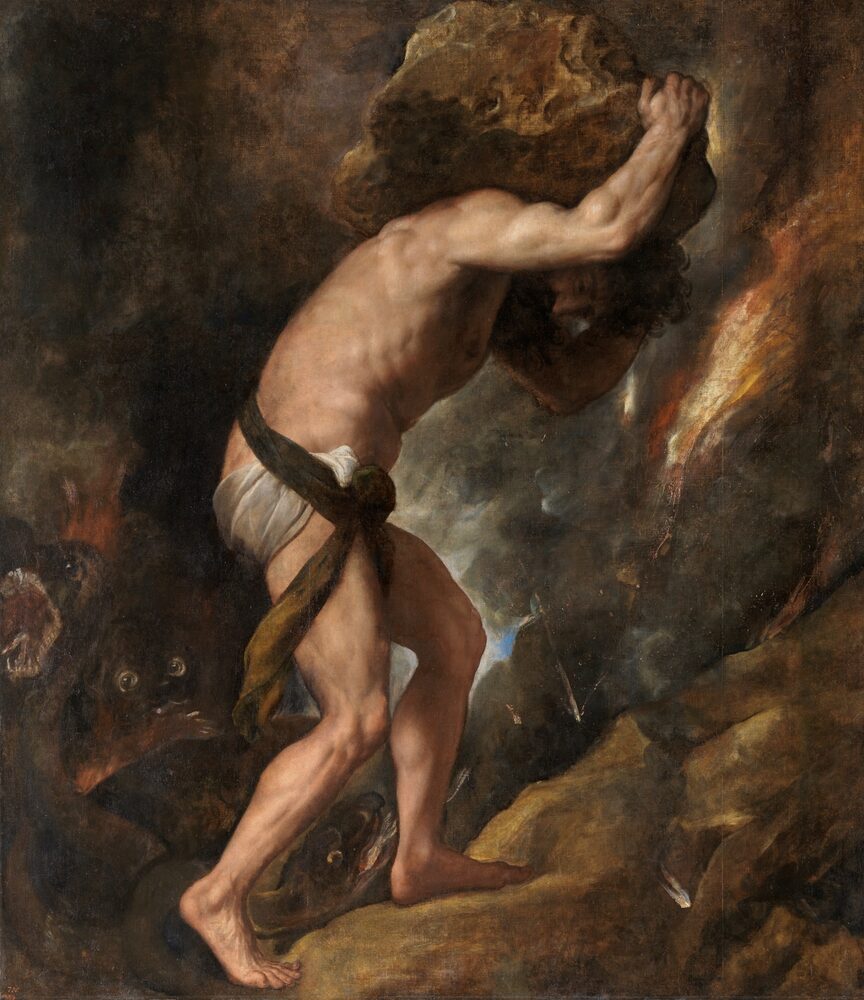
The punishment. For cheating Death, Sisyphus was condemned in Tartarus to roll a great boulder up a hill — and every time he strains it near the crest, its weight overpowers him and the stone goes thundering back down to the bottom, and he must trudge down and begin again, forever. Homer's picture (Odyssey 11.593–600) is unforgettable: the sweat runs off his limbs, the dust rises from his head, and the "shameless stone" (laas anaidēs) rolls back down the moment he gets it to the top. The endlessness is the whole point: the punishment, like his schemes, never finally succeeds and never finally ends. His name gives us the adjective "Sisyphean," for any labour that must be repeated forever without ever being completed.
Variants to flag. The ancient sources differ on which offence earned the punishment — the chaining of Thanatos, the trick played on Persephone, or simply his general treachery — and Homer names the punishment without spelling out the crime at all, leaving later poets and mythographers to supply the reasons. (The twentieth-century essayist Albert Camus, in The Myth of Sisyphus, famously reread the endless labour as an image of the human condition and imagined Sisyphus happy — a modern interpretation, far outside the ancient sources, but worth noting for how alive the image remains.)
Tantalus — the guest who abused the gods' table
(Content note: this crime, in its darkest version, involves a father killing his own child.) The crime. Tantalus (Τάνταλος), a king of Lydia or Phrygia and a son of Zeus, was so favoured by the gods that he was admitted to their table and allowed to share their food. He repaid that intimacy with a series of outrages, and the sources offer several — sometimes stacked together. In one, he stole the nectar and ambrosia, the gods' own food of immortality, and carried it down to share with his mortal friends. In another, he betrayed the gods' secrets, as Sisyphus did. But the darkest and most famous version is a crime against hospitality in its most monstrous form: to test whether the gods were truly all-knowing, Tantalus killed his own son Pelops, cut him up, cooked him, and served the boy to the gods at a banquet. The gods, of course, saw through it at once and would not touch the meal — all except the grieving Demeter, distracted by the loss of Persephone, who absent-mindedly ate one shoulder. The gods restored Pelops to life and made him a shoulder of ivory to replace the missing piece, and cast Tantalus down to Tartarus.
The punishment. Tantalus is "tantalized" forever. He stands up to his chin in a pool of clear water beneath a tree heavy with ripe fruit — pears, pomegranates, apples, figs — and is racked with endless hunger and thirst; but whenever he stoops to drink, the water drains away into the black earth at his feet, and whenever he reaches up to eat, the wind tosses the branches up and out of his grasp (Odyssey 11.582–592). Food and drink hang forever a hand's breadth away and forever escape him. His name is the direct root of the English verb "to tantalize," to torment with something desirable that stays just out of reach.
Variants to flag. In a second, quite different tradition — followed by Pindar (Olympian 1.55–60) and others — the punishment is not the receding water and fruit but a great stone forever poised over his head, hanging by a thread and threatening at every instant to crush him, so that he lives in ceaseless dread. Pindar, notably, is squeamish about the cannibal feast: he refuses to believe the gods ate human flesh and retells the Pelops story more decorously (saying Poseidon carried the boy off out of love), while insisting on Tantalus's guilt for stealing the divine nectar and ambrosia. So the sources disagree both on the crime (theft of divine food, betrayal of secrets, or the murder of Pelops) and on the punishment (the receding feast, or the overhanging rock). The house of Tantalus, through his son Pelops, becomes the cursed line of Atreus — Agamemnon, Menelaus, and their bloody descendants — so his sin is the fountainhead of one of myth's darkest family stories.
Ixion — the kinsman-slayer who lusted after Hera
(Content note: this story turns on murder within the family and on attempted assault of a goddess.) The crime. Ixion (Ἰξίων), a king of the Lapiths in Thessaly, committed two great crimes, and it is the doubling that makes him so infamous. First he became, by tradition, the very first human being to murder a member of his own family (the first kin-slayer, the first to shed kindred blood). Having promised his father-in-law, Eïoneus, a rich bride-price for his wife, Ixion refused to pay it; and when Eïoneus came to collect, Ixion treacherously dug a pit filled with burning coals and let the old man fall in, killing him. This was a pollution so new and so terrible that no one on earth would purify him of it — until Zeus himself, in an act of extraordinary mercy, cleansed Ixion of the blood-guilt and even invited him up to Olympus as a guest. There Ixion committed his second crime: he repaid Zeus's hospitality by lusting after Hera, the queen of the gods, and trying to force himself upon her. Zeus, to test him and to trap him, shaped a cloud into the exact image of Hera — the cloud-phantom called Nephele (Νεφέλη, "Cloud") — and Ixion, deceived, embraced it. From that union of a man and a cloud were born the ancestors of the Centaurs, the half-horse creatures of the wild.
The punishment. For raising his hand against a guest-friend and then against the wife of his host and benefactor, Ixion was bound by Zeus to a wheel of fire that turns forever without stopping — in some tellings whirling through the sky, in others spinning endlessly in the depths of Tartarus. Pindar (Pythian 2.21–48), our fullest early source, describes him "on his winged wheel" rolling round and round and made to proclaim a warning to all mortals: that one must repay a benefactor with kindness, and never reach above one's station. His crime — the abuse of xenia, the sacred guest-bond, twice over — is punished with an image of dizzy, ceaseless motion, the exact opposite of the settled honour he threw away.
Variants to flag. Ixion is essentially a post-Homeric figure — he is not among the sinners of Homer's underworld; his story is developed by Pindar and the tragedians. The details of the fiery wheel (whether it turns in the sky or in Tartarus, whether it is winged, whether he is lashed to it with snakes) vary from source to source and grow more elaborate in Roman poetry. The cloud-woman Nephele he embraced went on to bear, or to be linked with, the Centaur race — a genealogy the sources tell in slightly different ways.
The Danaids — the brides who murdered their husbands
(Content note: this story turns on mass murder of husbands by their wives on the wedding night.) The crime. The Danaids (Δαναΐδες) were the fifty daughters of Danaus, king of Argos. Danaus was locked in a bitter quarrel with his twin brother Aegyptus, who had fifty sons; and when Aegyptus pressed for a mass marriage of the fifty cousins to the fifty daughters, Danaus — fearing a plot, or hating the forced match — appeared to consent, but secretly gave each of his daughters a dagger and commanded them to kill their husbands on the wedding night. Forty-nine of the fifty obeyed: on the night of the great collective wedding, as their bridegrooms slept, they drew the hidden blades and killed them. Only one daughter, Hypermnestra, disobeyed and spared her husband Lynceus, because he had respected her and left her unharmed — and from that one merciful pair the royal line of Argos (leading eventually to Perseus and Heracles) descended. It is the forty-nine murderesses who are the damned.
The punishment. In the underworld the guilty Danaids are condemned to carry water forever in leaking vessels — jars, pitchers, or sieves full of holes — to fill a great tub or basin that can never be filled, because the water runs out as fast as they pour it in. They toil endlessly, fetching and pouring, and the vessel is always empty. The punishment answers the crime with grim aptness: women who poured out the lives of their husbands on the marriage-bed are set to pour out water forever to no purpose. The "vessel of the Danaids" (or "the Danaids' jar," and the related image of "carrying water in a sieve") became a proverb in antiquity for any labour that is endless and futile — like the Sisyphean task, a byword for effort that can never reach its end.
Variants to flag. This punishment is a later addition to the myth: it is not found in Homer, and the water-carrying appears clearly only in sources from around the Hellenistic and Roman periods onward (it is spelled out by writers such as pseudo-Plato and later mythographers, and is a favourite of Roman poets and vase-painters). Some scholars connect it to the language of religious initiation (the "uninitiated" were said to carry water in a sieve). The number of murdered husbands is forty-nine, the one spared being Lynceus; and though the sisters were purified by Athena and Hermes at Zeus's command in the upper world, the tradition still consigns them to endless labour below. Aeschylus dramatized the beginning of their story — their flight from the forced marriage — in his surviving tragedy The Suppliants (Hiketides).
Tityos — the giant who assaulted Leto
(Content note: this crime is an attempted rape.) The crime. Tityos (Τιτυός) was a giant, a son of Zeus (and of Elara, or in another version a son of Gaia, the Earth herself — which is why he is called "earth-born" and grows to such vast size). He committed a single, enormous outrage: he tried to rape the goddess Leto (the mother of Apollo and Artemis) as she passed through Panopeus on her way to Delphi (Pytho) — set on, some say, by the jealous Hera. He did not succeed. Leto's two divine children, Apollo and Artemis, came to their mother's defence and shot Tityos down with their arrows, killing him — after which he was cast into the underworld to suffer forever. (Homer, at Odyssey 11.580, says only that he "laid hands on Leto"; the detail that Apollo and Artemis killed him is spelled out by Apollodorus and Pindar.)
The punishment. Tityos lies stretched out over nine acres (in Homer's phrase, "nine pelethra") of the underworld floor, so vast is his body, pinned and helpless; and two vultures (in some accounts, two eagles, or a pair of serpents) sit one on each side and tear endlessly at his liver, plunging their beaks into it and devouring it — while the liver, the seat of appetite and desire in ancient thought, grows back as fast as it is eaten, so that the feast of the birds and the giant's agony never end (Odyssey 11.576–581). The choice of the liver is deliberate and pointed: the Greeks located lust and appetite in the liver, so the organ that drove his crime is the organ eternally consumed.
Variants to flag. The tormenting birds are vultures in Homer and two eagles or snakes in other tellings; and Tityos's parentage varies — son of Zeus and Elara in one line, son of Gaia in another (the two are sometimes reconciled by saying Zeus hid the pregnant Elara inside the earth, so that the child was born from the ground). His punishment is closely parallel to that of the Titan Prometheus, whose liver an eagle likewise devours daily — but the cases are opposite in moral: Prometheus suffers for helping mortals, Tityos for a crime of violence, and Prometheus is eventually freed while Tityos is not. Tityos is also shown, in Odyssey 7.324 and 11, as a landmark of the far West, once honoured on Euboea, which hints at an older cult-figure behind the punished sinner.
Worship — Ancient
Not gods, but warnings — the sinners had no cult
Unlike heroes, and utterly unlike the gods, the great sinners received no worship: there were no altars to Sisyphus the cheat, no offerings to Tantalus the child-killer, no festivals of the Danaids. They belonged to the opposite pole of Greek religious life. Where a hero was a mighty dead man whose goodwill a city courted, the damned were the anti-models — the named examples of exactly what a person must never do, held up in poetry and preaching precisely so that the living would recoil from their crimes and honour the bonds the sinners had broken. Their "cult," if the word can be used at all, was the cult of the negative example: they existed in the ancient imagination to teach, by their unending torment, the sacredness of the things they had violated.
The four broken bonds
Each of the five stands for a specific law that held the Greek world together, and their punishments were rehearsed to keep those laws in awe. Hospitality (xenia) — the sacred bond between guest and host, protected by Zeus himself under the title Zeus Xenios — is broken by Tantalus (who abused the gods' table) and by Ixion (who assaulted the wife of his host). The tie of kindred blood is broken by Ixion again (the first kin-slayer) and by the Danaids (who murdered the husbands who were also their cousins). The honour owed to the gods is broken by Tityos (who laid hands on a goddess) and by Tantalus (who stole the gods' food and tested their knowledge). And the boundary between the living and the dead, the natural order itself, is broken by Sisyphus (who cheated Death twice over). To recite the sinners' fates was to reaffirm, in the strongest terms the culture had, that these four things — the guest-bond, the blood-tie, the reverence due to heaven, and the acceptance of mortality — were not to be transgressed.
The place of the damned in ancient teaching
The catalogue of sinners entered Greek thought early and stayed central. Homer's underworld scene (Odyssey 11) fixed the images of Tityos, Tantalus, and Sisyphus for all time, and later poets simply expanded the list. Pindar used Tantalus and Ixion as moral exempla in his victory-odes, drawing an explicit lesson from each — Ixion, lashed to his wheel, is made literally to proclaim to mortals that they must repay kindness and not reach above their station. By the Classical age the sinners had become a fixture of philosophy and of the mysteries: Plato places them among the "incurable" souls whose everlasting punishment in Tartarus serves as a deterrent to others (Gorgias, Republic), and the imagery of the water-carriers and the endless labours was woven into teachings about the fate of the uninitiated and the unjust in the afterlife. The Eleusinian and Orphic traditions promised initiates a better lot in the beyond and pointed, by contrast, to the toiling damned as the fate awaiting the profane. What began as vivid poetry became, over centuries, the standard Greek picture of divine justice reaching beyond the grave.
The sinners in ancient art
Because their torments are so visual, the damned were a gift to the painter and the sculptor. Polygnotus, the great fifth-century painter, included Tityos, Tantalus, and Sisyphus in his famous underworld mural (the Nekyia) in the Cnidian Lesche at Delphi, which Pausanias describes in detail (10.28–31), noting also the water-carriers — figures pouring water into a broken jar, whom he interprets as the uninitiated. Attic and South-Italian vase-painters returned again and again to the underworld scene, showing Sisyphus at his rock, the Danaids at their leaking jars, and Ixion on his wheel; the great "underworld vases" of Apulia lay the whole company out together around the house of Hades and Persephone. In art as in poetry, the sinners were kept perpetually before the ancient eye — a permanent gallery of what the gods will not forgive.
Worship — Modern
A hero, honoured differently
The great sinners are not gods or heroes to be honoured, and no modern devotional practice petitions them or sets offerings before them. They live on instead in the two ways the ancients most wanted them to: as cautionary examples and as unforgettable images. A person today drawn to reflect on these figures does so not in worship but in the spirit the myths intended — as a meditation on the bonds they broke (the duties of a guest and a host, the ties of family, reverence toward what is greater than oneself, the acceptance of death) and on the ancient conviction that such bonds are worth taking seriously. To remember Tantalus is to remember what hospitality costs when it is betrayed; to remember the Danaids is to remember that some acts cannot be poured away.
The words they left in our language
More than almost any other figures in myth, the damned survive in everyday speech. "Tantalize" — to torment with something desirable held just out of reach — comes straight from Tantalus and his receding water and fruit; the mineral tantalum was named for him in 1802 because, immersed in acid, it stubbornly refused to absorb any, "tantalized" amid plenty. "Sisyphean" describes any task that must be repeated endlessly and never completed, and the "Sisyphean struggle" is a stock phrase for futile, unending effort. The "Danaids' jar" or "carrying water in a sieve" was a proverb in antiquity and lingers still as an image of pointless, bottomless labour. Even Ixion's wheel and Tityos's devoured, regrowing liver have become shorthand — the fire-wheel for dizzying, inescapable torment, the reborn liver (shared with Prometheus) for a suffering that renews itself forever. The sinners are, in a sense, more present in modern language than most of the Olympians.
The images that never let go
Above all, the damned endure as pictures the imagination cannot shake. Sisyphus and his stone became, in the twentieth century, one of the defining images of the whole human condition: Albert Camus's essay The Myth of Sisyphus (1942) reread the endless, hopeless labour as a mirror of a life lived without ultimate meaning, and ended with the startling line that "one must imagine Sisyphus happy" — a reading utterly foreign to the ancient sources, yet proof of how much force the old image still carries. Titian painted the sinners of Tartarus for the Spanish court; poets from Virgil and Ovid to the moderns have kept returning to the underworld's prisoners; and the boulder, the receding feast, the burning wheel, the leaking jar, and the torn liver remain among the most instantly recognizable images in Western culture. The Greeks built these figures to be unforgettable, so that their fates would teach forever — and in that, at least, the sinners have their strange immortality: they are punished still, in every retelling.
Epithets & Cult Titles
- Σίσυφος (Sisyphos) — Sisyphus — the cunning king of Corinth who twice cheated Death, condemned to roll a great stone forever up a hill from which it forever rolls back down; his name became the byword for endless, futile labour ("a Sisyphean task")
- Τάνταλος (Tantalos) — Tantalus — the favoured king who abused the gods' hospitality, set forever amid water and fruit that shrink from his reach whenever he stoops or grasps; his very name gave English the verb "to tantalize"
- Ἰξίων (Ixiōn) — Ixion — the first man to murder a kinsman, who then lusted after Hera herself, and was bound to a fiery, ever-turning wheel that whirls him through the sky or the underworld without rest
- αἱ Δαναΐδες (hai Danaïdes) — The Danaids — the forty-nine daughters of Danaus who murdered their husbands on their wedding night, sentenced to carry water forever in leaking jars to fill a vessel that can never be filled
- Τιτυός (Tityos) — Tityos — the earth-born giant who assaulted the goddess Leto, pinned across nine acres of the underworld floor while two vultures tear eternally at his ever-regrowing liver
Sources & Variants
- Homer, Odyssey 11.576–600 (the Nekyia: the punishments of Tityos torn by vultures, Tantalus amid the receding water and fruit, and Sisyphus and his stone — the earliest catalogue of the damned)
- Hesiod, Theogony 720–819 (Tartarus: the bronze-gated chasm below Hades where the Titans are imprisoned, the model for the prison of the damned)
- Pindar, Olympian 1.36–64 (Tantalus, the feast of Pelops retold decorously, and the overhanging stone as his punishment); Pythian 2.21–48 (Ixion, his two crimes, the cloud-Hera Nephele, and the fiery winged wheel with its warning to mortals)
- Apollodorus, Bibliotheca 1.9.1–3 (Sisyphus and the trick that cheats Death); 1.9.7 and 2.1.4–5 (the Danaids, the fifty daughters of Danaus, the wedding-night murders, and Hypermnestra sparing Lynceus); 1.4.1 (Tityos assaults Leto and is shot by Apollo and Artemis); Epitome 2.1 (Tantalus and the stone / the receding food)
- Plato, Gorgias 525c–526d and Republic 615c–616a (Tartarus as the destination of incurable sinners, whose everlasting punishment serves as a deterrent)
- Aeschylus, Suppliants (Hiketides) (the Danaids' flight from the forced marriage to the sons of Aegyptus)
- Pausanias, Description of Greece 10.28–31 (Polygnotus's underworld painting at Delphi: Tityos, Tantalus, Sisyphus, and the water-carriers, whom Pausanias reads as the uninitiated)
- Ovid, Metamorphoses 4.457–463 and 10.41–44 (the Roman catalogue of the damned: Tityos, Tantalus, Sisyphus, Ixion's wheel, and the Danaids' jars, briefly stilled by the song of Orpheus) — Roman retelling
- Virgil, Aeneid 6.595–627 (Tityos over nine acres, and the sinners of Tartarus glimpsed on Aeneas's descent) — Roman
- Lucretius, De Rerum Natura 3.978–1023 (the philosopher rationalizes Tantalus, Tityos, Sisyphus, and the Danaids as figures for the torments of the living mind) — Roman
Gallery