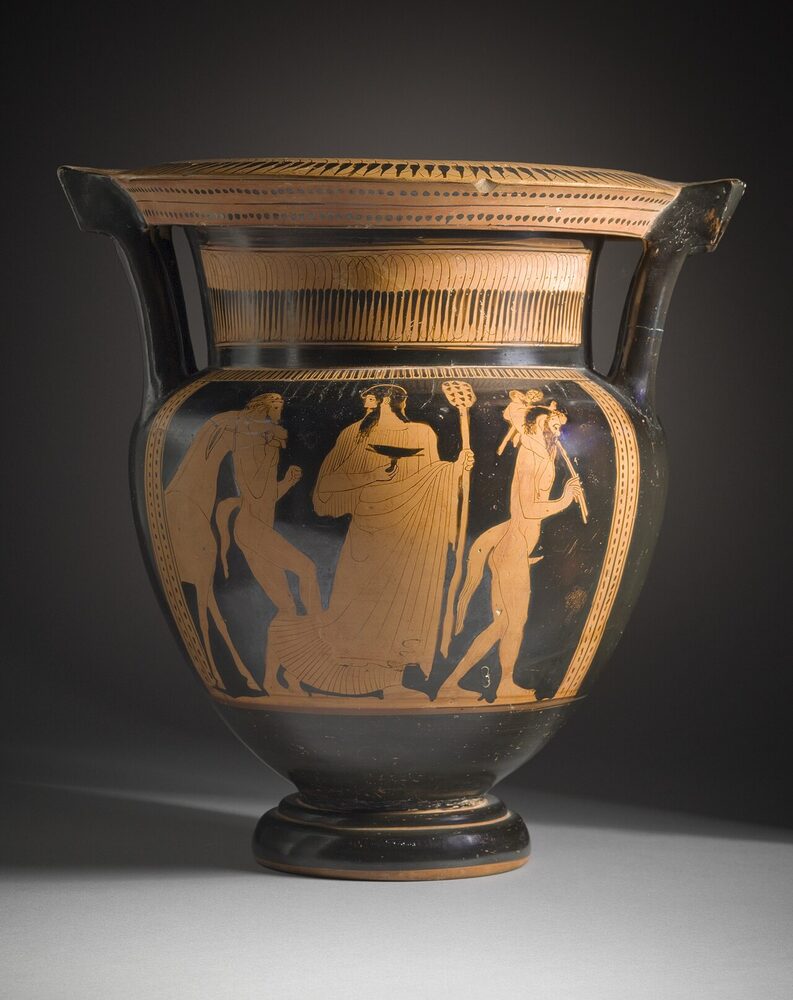
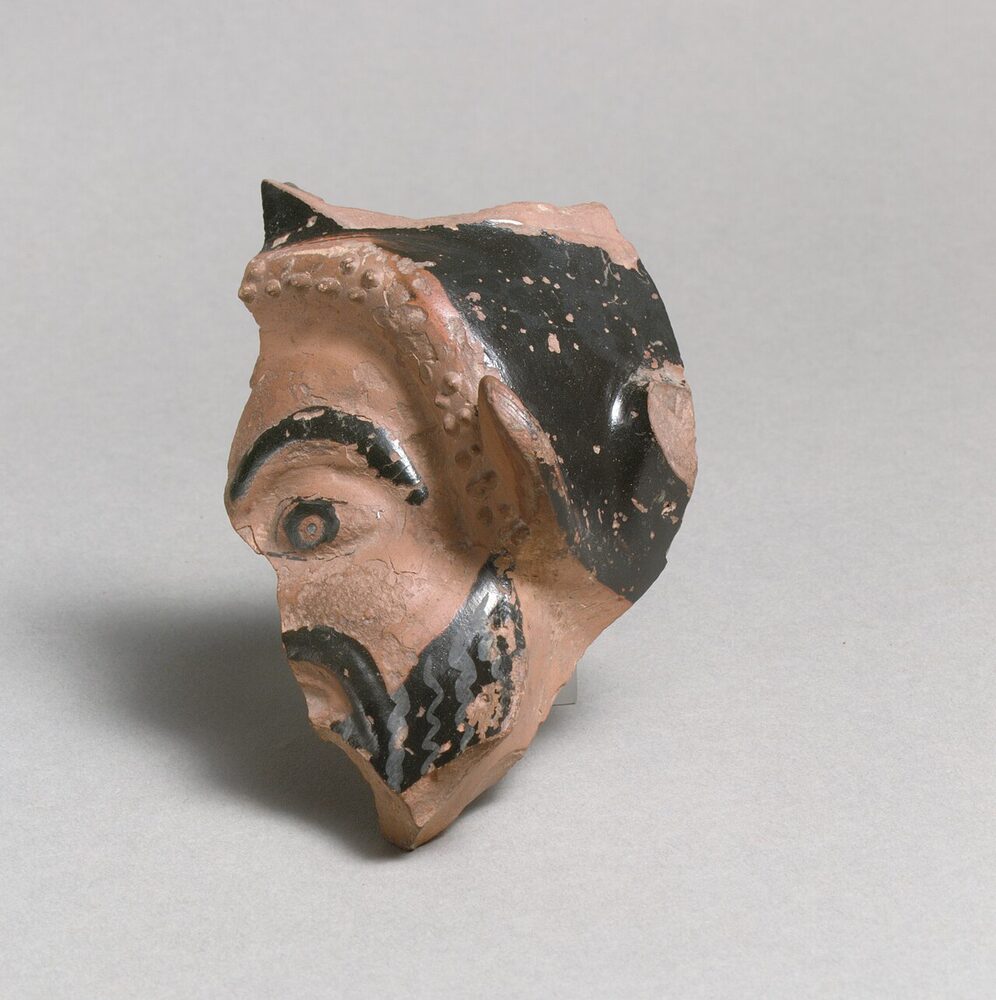
Satyroi / Satyrs
First Appearance
The satyrs step into literature already characterised. The Hesiodic Catalogue of Women (fr. 10a Merkelbach–West) names them in a single famously unflattering line, calling the race of Satyrs "good-for-nothing and unfit for work" (a tribe born, in that genealogy, alongside the mountain nymphs and the Kouretes) — the earliest verdict on the satyrs is that they will not do an honest day's labour. The Homeric Hymn to Aphrodite (5.256–263) gives the other half of their nature: it tells how the long-lived mountain nymphs, in the deep glens of the hills, "mingle in love with the Silenoi and with the keen-sighted Slayer of Argos (Hermes)" — so from the first the satyrs are the wild lovers of the nymphs among the woods and springs. From these two early strokes — idle, and amorous — the whole later figure grows; and by the fifth century BC the Athenian satyr-play had put a whole chorus of them on stage.
— Hesiod, Catalogue of Women fr. 10a (M–W); Homeric Hymn to Aphrodite (5) 256–263
Who They Are
The Satyrs (SAY-terz; in Greek the Σάτυροι, Satyroi) are the wild male spirits of the countryside — the tribe of horse-eared, snub-nosed, tailed revellers who follow the wine-god Dionysus through the hills, forever drinking, dancing, chasing the nymphs, and making music on pipe and flute. They are nature with its manners off: the untamed male energy of the wild woods and vineyards, given a shaggy body and a permanent thirst. Where the maenads (the god's frenzied women-followers) carry his ecstasy, the satyrs carry his mischief and his appetite, and the two together make up his thiasos, the rowdy revel-band that dances at the heart of every Dionysiac scene.
The first thing to get straight is what a Greek satyr actually looked like — because most people today picture the wrong creature. (Roman note: the goat-legged "faun," the shaggy man with a goat's hindquarters and horns, is a later Roman conflation, the blending of the Greek satyr with Italy's own woodland Fauni and the goat-god Faunus. It is a real and famous image — but it is Roman, not Greek.) The classical Greek satyr is a man with a horse's ears and a horse's tail, snub-nosed and often balding, human from the waist down but for the flicking tail; on the vases he capers on two human legs. Only in later, Hellenistic and Roman art do the goat-features creep in and the satyr slide toward the faun. On this page the satyr is the Greek one — the horse-man of Dionysus — and the goat-legged faun is flagged wherever it appears as the Roman reworking it is.
Standing at the head of the tribe is one great individual: Silenus (Σιληνός), the fat, bald, perpetually tipsy old satyr who is the foster-father and tutor of Dionysus himself. Too drunk to walk, he rides slumped on a donkey, held upright by the younger satyrs — and yet, caught and bound, this ridiculous old drunkard turns prophet, and will sing the deepest and most sorrowful truths about the world (it is Silenus whom King Midas captures, and Silenus whose golden touch Midas wins). The satyrs are also, remarkably, the ancestors of Western theatre: the fourth play every Athenian tragedian staged was a satyr-play, a bawdy comic afterpiece with a chorus of satyrs, and the very word tragedy (tragōidia) seems to mean "goat-song" — a hint that drama itself was born out of the goat-sacrifice and the satyr-dance of Dionysus. To meet the satyrs, then, is to meet the Greek imagination at its most frankly physical and its most creative at once: the laughing, drinking, dancing edge of the wild, and the cradle of the stage.
Mythology
What a satyr is — the horse-man of the wild
(Content note: the satyrs are frankly sexual figures, and this section, like the ancient sources, describes their bawdy nature plainly.) A satyr is the spirit of male wildness given a body. In the earliest and truest Greek conception he is a man with the ears and tail of a horse — snub-nosed, thick-lipped, often bald or shaggy-haired, with a broad grinning face and, on the vase-paintings, a frankly and comically erect and animal vigour that is the visual shorthand for everything the satyr is: pure untamed appetite, for wine and for the nymphs alike. He is not evil, and not really dangerous in the way a monster is; he is uncivilised, the opposite of the restrained and self-controlled citizen. He will not work (the oldest source calls the satyrs "good-for-nothing and unfit for labour"), he cannot resist a wineskin or a woman, he is a coward when the fighting starts and a boaster when it is over — and he is, for all that, joyous, musical, and irrepressibly alive. The Greeks used the satyr to think about the animal that lives inside the man, and they did it with laughter rather than horror.
The Roman faun — a later goat-legged conflation
It is worth stopping over the picture in most people's heads, because it is not the Greek one. The familiar goat-legged faun — horns, a goat's shaggy hindquarters and cloven hooves, human above the waist — is largely a Roman development, produced when Latin culture identified the imported Greek satyr with its own native woodland spirits, the Fauni, and with the rustic goat-god Faunus (a figure close to the Greek Pan, who was himself goat-legged). Greek art of the classical age keeps the satyr firmly equine: horse-ears, horse-tail, human legs. The goatish traits drift in only later, in Hellenistic and then Roman art and poetry, until "satyr" and "faun" blur into the single goat-man that the Renaissance inherited and passed on to us. Both images are worth knowing — but they belong to different worlds, and the Golden Thread keeps the Greek horse-satyr distinct from the Roman goat-faun.
The companions of Dionysus — the thiasos
The satyrs belong, heart and soul, to Dionysus, the god of wine, vegetation, ecstasy, and release. They are his thiasos, his sacred revel-band or retinue, and wherever the god goes his satyrs go with him — pouring and drinking his wine, treading his grapes, piping and drumming, and dancing the wild dance of his worship. Beside them in the thiasos dance the maenads (the "raving women," also called Bacchae), the god's female followers; and the eternal, never-quite-successful pursuit of the maenads and nymphs by the satyrs is one of the great recurring images of Greek art — the satyr forever reaching, the nymph forever twisting away, desire in motion frozen on a thousand vases. The satyrs also attend Dionysus in his greatest deeds: they march in his triumphant train when he returns from conquering India, they help gather in the vintage, and they share in his gift of wine to humankind. To picture Dionysus is to picture him surrounded by his satyrs; the god and his revel-band are inseparable.
Silenus — the drunken, prophetic tutor of the god
At the head of the satyrs stands one figure who has grown into a person of his own: Silenus (Greek Seilenos). In the oldest usage the Silenoi are simply the older, more horse-like satyrs — the shaggy senior kinsmen of the tribe — but the plural narrows over time into a single great individual, the Silenus: the foster-father, tutor, and constant companion of Dionysus. When the infant wine-god was given into the care of the nymphs and the woodland spirits to be raised, it was Silenus who reared him; and ever after the old satyr rolls along in the god's train, the most devoted and the most disreputable of his followers. He is drawn as fat, bald, snub-nosed, and hopelessly drunk, so far gone in wine that he cannot stand: the younger satyrs prop him up, or he rides slumped and swaying on the back of a donkey, a wineskin in his arms — one of the most beloved comic images in all of ancient art, the tipsy old man on the little ass.
The wisdom of the drunken old man — the Midas episode
And yet Silenus is far more than a figure of fun, for the Greeks tied to him a strange and profound idea: that this ridiculous old drunk, when he can be caught and bound, becomes a prophet, and will disclose the deepest secrets of existence. The most famous instance is his capture by King Midas of Phrygia. Silenus, having wandered off drunk from the god's train, was found asleep in the king's rose-gardens (some say Midas's people trapped him by lacing a spring with wine); bound and brought before the king, the old satyr was made to answer the great question — what is the best thing of all for a human being? His reply is one of the bleakest and most haunting sentences in Greek thought: the very best thing of all, he said, is never to have been born; and the next best is, having been born, to die as soon as possible. When Midas released him and returned him to Dionysus, the grateful god granted the king a wish — and Midas, foolishly, asked that all he touched turn to gold, and so won the famous golden touch that nearly starved him before he begged to be rid of it. Silenus is thus the paradox at the centre of the satyr-world: the buffoon who holds the tragic wisdom, the drunkard who alone will say aloud the hardest truth about the human lot.
The satyrs and the birth of theatre — the "goat-song"
The satyrs' strangest and most far-reaching role is as the ancestors of Western drama. At the great Athenian festival of Dionysus, the City Dionysia, each tragic poet competed with three tragedies followed by a fourth, lighter play — a satyr-play (satyrikon drama), whose defining feature was a chorus of satyrs led by old Silenus. The satyr-play took a serious mythic subject and played it for bawdy comedy, the leaping, joking, cowardly satyr-chorus puncturing the high heroic tone — a burst of Dionysiac release after the weight of the tragedies. Only one complete satyr-play survives, Euripides's Cyclops, which retells Odysseus's blinding of Polyphemus with Silenus and the satyrs enslaved on the giant's Sicilian island; large fragments of Sophocles's Trackers (Ichneutae) give another, the satyrs snuffling like hounds on the trail of Apollo's stolen cattle. The connection runs to the root of the words themselves: the ancient name for serious drama, tragōidia — our "tragedy" — appears to mean literally "goat-song" (from tragos, "goat," and ōidē, "song"), whether because a goat was the prize, or the sacrifice, or because the earliest choruses dressed as the goatish followers of Dionysus. Either way, the tradition remembered that theatre itself was born out of the song and dance of Dionysus's satyrs, and the Greeks staged that memory every spring by putting the satyrs back on the stage.
Individual satyrs and cautionary tales
A few satyrs step out of the chorus as individuals. Marsyas, a satyr (sometimes called a silenos) of Phrygia, found the double-flute (aulos) that Athena had invented and thrown away, and grew so skilled that he dared to challenge Apollo and his lyre to a music contest, judged by the Muses — a contest the satyr lost, and for his presumption in challenging a god he was flayed alive, his skin hung in a cave from which a river took his name. His story (a warning against hubris, the pride that competes with the gods) is told more fully with Apollo. Others of the tribe appear by name on the vases and in satyr-drama — figures like Papposilenus, the "grandfather-Silenus" who fathers and herds the stage-chorus. But for the most part the satyrs act as a collective: a crowd of interchangeable revellers, defined not one by one but all together, as the dancing, drinking, laughing tribe of the wild that streams forever after their god.
Worship — Ancient
Not gods but presences — the spirits of the wine and the wild
The satyrs were not, for the most part, gods to whom one built temples and made sacrifice in their own right; they were daimones, lesser divine presences of the countryside, honoured chiefly through the worship of Dionysus, whose revel-band they were. To pour a libation of wine to Dionysus, to keep his festival, to tread the grapes and drink the new vintage, was already to move within the world of the satyrs — for the satyr was the very spirit of that wine, that wildness, that release. Where the satyrs were felt most strongly was in the untamed places: the mountain glens, the springs and woods where (as the Homeric Hymn to Aphrodite says) they mingled in love with the nymphs, and the vineyards where the god's gift was made. Country people who felt a presence in the lonely wild — a rustle, a piping, a sudden animal fear — might name it a satyr, or its cousin Pan.
The satyr in the festival — the worshipper as reveller
The satyrs' truest cult-life lay in the great festivals of Dionysus, and above all in the role the worshipper himself stepped into. At the Rural Dionysia of the Attic villages, and in the revelry (kōmos) of the wine-feasts, ordinary men put on the satyr — masked, tail tied on, tipsy on the new wine — and danced the god's dance, becoming for a night the very creatures of the myth. At the City Dionysia in Athens, the satyr-play with its chorus of costumed satyrs was a fixed and sacred part of the dramatic competition, so that the satyrs held a permanent, institutional place at the centre of the city's greatest religious festival of the theatre. To worship Dionysus was, in a real sense, to play the satyr: the boundary between the human celebrant and the mythical follower of the god was meant to dissolve in the wine and the dance.
Silenus and the satyrs in cult, art, and the countryside
A handful of local cults gave the satyrs and the Silenoi a firmer footing. Silenus in particular received honours in places that claimed a special tie to him — there were traditions of a Silenus worshipped in Elis and elsewhere, and springs and grottoes associated with his capture. Across the Greek world the satyrs were among the most popular subjects in art of any mythological figures: they crowd the great Dionysiac vases, especially the drinking-cups and wine-mixing bowls (kraters) whose very use — the mixing and pouring of wine — belonged to the satyrs' world; they caper across relief and mosaic; and the finest sculptors gave them enduring form, as in the famous "Resting Satyr" of Praxiteles (the leaning satyr, copied endlessly in antiquity) and the sleeping "Barberini Faun." In the countryside, small shrines to Pan and the nymphs — the satyrs' near kin — dotted the caves and springs, and the whole cluster of wild woodland powers was honoured together as the presences of untamed nature.
Worship — Modern
The satyr and the faun in the modern imagination
The satyrs never had a temple to lose, and so their survival has been through image and idea rather than formal cult — and few figures of Greek myth are more instantly recognisable today. Through the Roman faun especially, the horned, goat-legged, pipe-playing woodland spirit became one of the permanent furnishings of the Western imagination: he is the model behind the fauns of Renaissance painting and Baroque garden statuary, behind Debussy's languid Prélude à l'après-midi d'un faune, behind Mr Tumnus with his umbrella in the snow of Narnia, and behind the horned nature-spirits of countless later fantasies. When a modern reader pictures a "satyr," it is very often this Roman goat-faun they see — which is exactly why it is worth remembering that the classical Greek satyr was the horse-man, and that the goat-legs are Rome's addition.
The living meaning of the satyr
Beyond the picture, the satyr survives as a concept. The word "satyr" still names the frank, appetitive, animal side of human nature, and the medical term "satyriasis" (the male counterpart of nymphomania) was coined directly from it. But the deeper modern inheritance is the idea the Greeks themselves worked out through the satyr-play: that a healthy culture needs its moment of release — that after the high seriousness of tragedy comes the licensed laughter of the satyrs, the wild dance that lets the pressure out. In this the satyrs stand for something the modern world still recognises: the necessary, joyous, faintly disreputable counterweight to order and restraint. And in Silenus the ancient paradox endures — the drunken fool who knows the tragic truth — a figure that thinkers from Plato (who has Alcibiades compare Socrates to a Silenus-statue, ugly outside and full of gods within) to Nietzsche (who built his theory of tragedy on "the wisdom of Silenus") have found irresistible.
The satyrs and the modern devotee of Dionysus
For those who today honour the old gods in a reconstructed Hellenic practice, the satyrs are approached as they were in antiquity — not as gods to be petitioned in their own right, but as the spirits of the god's revel, honoured within the worship of Dionysus. A devotee keeping the god's feast with wine poured out and drunk, with music and with a deliberate, joyful loosening of everyday restraint, stands in the satyrs' own tradition: the celebrant who, for the space of the festival, lets the wild and laughing spirit of the thiasos come near. The satyrs remind such a worshipper that the sacred is not only solemn — that dance, wine, laughter, and the frank life of the body were, for the Greeks, a genuine way of drawing close to the divine.
Epithets & Cult Titles
- Σειληνοί (Seilēnoi) — "Silenoi" — The older, more horse-like elder satyrs; in early poetry the Silenoi are the shaggy senior kinsmen of the satyrs. Over time the plural blurs into the singular Silenus, the one great old satyr who tutors Dionysus
- Σιληνός (Silēnos) — "Silenus" — The foremost individual satyr: the fat, bald, perpetually drunk old tutor and foster-father of Dionysus, wise and prophetic when sober enough to be caught and bound. Where the young satyrs are all appetite, Silenus is appetite grown old and grown wise
- Σάτυροι (Satyroi) — "the Satyrs" — The group-name for the whole tribe of male nature-spirits: the horse-eared, snub-nosed, tailed companions of Dionysus, lovers of wine, music, and the nymphs, who dance in his revel-band (thiasos)
- Παππόσιληνος (Papposilēnos) — "Grandfather-Silenus" — A stage-name from satyr-drama for the eldest Silenus, the shaggy white-haired father of the satyr-chorus who leads them on the tragic stage — the old man of the troupe
Sources & Variants
- Hesiod, Catalogue of Women fr. 10a (Merkelbach–West) (the earliest naming of the race of Satyrs, called 'good-for-nothing and unfit for work,' born alongside the mountain nymphs and the Kouretes)
- Homeric Hymn to Aphrodite (5) 256–263 (the mountain nymphs mingling in love with the Silenoi and with Hermes in the deep glens — the satyrs as wild lovers of the nymphs)
- Hesiod (attrib.), the tradition of the Silenoi as the elder, horse-like satyrs
- Euripides, Cyclops (the only complete surviving satyr-play: Silenus and the satyr-chorus enslaved to Polyphemus in Sicily, Odysseus, and the blinding, played as comedy)
- Sophocles, Ichneutae (Trackers) (large papyrus fragments of a satyr-play: the satyr-chorus tracking Apollo's stolen cattle by scent)
- Herodotus, Histories 8.138 (the capture of Silenus in the rose-gardens of Midas in Macedonia/Phrygia)
- Aristotle, Fragment / the tradition of the 'wisdom of Silenus' (best of all is never to be born; the story recurs in Plutarch, Consolatio ad Apollonium 27, and in Cicero, Tusculan Disputations 1.114)
- Ovid, Metamorphoses 11.85–193 (Silenus found and returned to Bacchus by Midas; the golden touch, and its undoing) — Roman retelling
- Plato, Symposium 215a–222a (Alcibiades compares Socrates to a figure of Silenus — ugly and comic without, holding images of the gods within)
- Apollodorus, Bibliotheca 1.4.2 (Marsyas the satyr, the aulos of Athena, the contest with Apollo, and the flaying)
- Pausanias, Description of Greece 1.23.5–6 (the conversation with Euphemus, the Satyrides islands, and the appearance of a Silenus — Pausanias' discussion of satyrs and Silenoi); on the popularity of the satyr in vase-painting and sculpture (the 'Resting Satyr' of Praxiteles)
- Aristotle, Poetics 1449a (drama's growth out of the leaders of the dithyramb and the 'satyric' — the satyr-play — and the origins of tragedy in the Dionysiac chorus)
- Nonnus, Dionysiaca (the satyrs and Silenoi in the vast train (thiasos) of Dionysus, including his Indian campaign) — late antique epic
Gallery