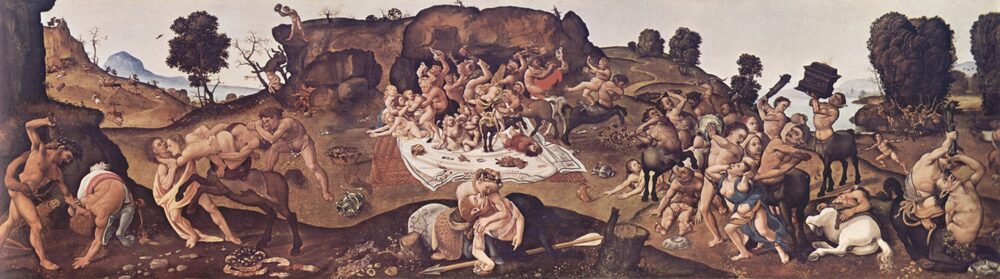
Peirithoos
First Appearance
Pirithous enters Greek poetry already a legend of the elder age. In the Iliad (1.262–268) old Nestor names him first among the mightiest men he ever knew — Pirithous and Dryas and Caeneus and Theseus, "the strongest of men that the earth has reared, who fought against the strongest, the beast-men of the mountains, and destroyed them terribly" — the earliest surviving allusion to the war of Lapiths and Centaurs. The catalogue of ships (2.740–744) calls him a son of Zeus and names his own son Polypoetes, born "on the day when he took vengeance on the shaggy wild-men." And in the Odyssey (11.631) Odysseus, among the ghosts, longs to have seen "Theseus and Pirithous, glorious children of the gods" — the two friends named together, as they almost always are.
— Homer, Iliad 1.262–268 and 2.740–744; Odyssey 11.631
Who They Are
Pirithous (py-RITH-oh-us) was king of the Lapiths, the mountain people of Thessaly, and above all else the sworn and inseparable friend of Theseus of Athens — the two of them the very pattern of heroic comradeship, so joined in the Greek imagination that they are scarcely ever named apart. His story is a story of bonds and of their breaking: the friendship he forged with Theseus in a moment that might have been a war; the wedding that turned, in the space of a cup too freely poured, into the first battle of Lapiths and Centaurs; and the reckless pact that carried the two friends down alive into the house of Hades, where one was torn free and the other was left fixed to the rock forever.
He belongs among the heroes as a man of the generation before the Trojan War — a contemporary of Theseus and of Heracles, remembered by Homer's Nestor as one of the mightiest men the earth ever bore. But his is a hero's tale shadowed by excess. Where Theseus ordered Athens and slew the Minotaur, Pirithous is remembered for daring that overreached itself: he feasted the untameable Centaurs at his own wedding, and he aspired, in the end, to carry off Persephone, the dread queen of the dead, from the side of Hades himself. The one reckless friendship produced great deeds and a great punishment in equal measure.
His myth gathers three famous scenes the Greeks loved to tell and to carve: the meeting and oath with Theseus; the Centauromachy, the battle of Lapiths and Centaurs at his marriage-feast, a favourite of sculptors from the Parthenon to Olympia to Bassae; and the descent to the Underworld, from which Heracles freed Theseus but left Pirithous bound below as the price of his presumption.
Mythology
The friendship with Theseus
The friendship that defines Pirithous began, in the oldest tellings, as a test that might have been a war. Pirithous had heard of the strength and fame of Theseus, king of Athens, and resolved to prove it for himself: he drove off a herd of Theseus's cattle from the plain of Marathon, a deliberate provocation (Plutarch, Theseus 30). When Theseus armed and came in pursuit, the two men met face to face — and each, seeing the other, was so struck with wonder at his beauty and bearing that neither would strike the first blow. Pirithous, by the old account, stretched out his hand first and offered himself as the wronged man's to judge, bidding Theseus set what penalty he would for the cattle; and Theseus forgave him freely and asked only that they be friends. There on the field they swore eternal friendship (Plutarch, Theseus 30; the pairing is already fixed in Homer, Odyssey 11.631). From that day the two were inseparable, comrades in every venture, the model to which later Greeks pointed whenever they spoke of a perfect and equal friendship between men.
The wedding to Hippodamia
When Pirithous came to marry, he took as his bride Hippodamia, a woman of his own Lapith people (she must not be confused with the other Hippodamia, daughter of Oenomaus, whom Pelops won in the chariot-race — this is a different woman of the same name). To the wedding-feast Pirithous invited the great men of Thessaly, Theseus among them, and the gods, and — because they were his kin and neighbours — the Centaurs, the half-horse, half-human mountain-dwellers descended from Ixion's son Centaurus. It was a fateful courtesy. The Centaurs, unused to wine, drank the mixed cup of the feast too deeply, and as the drink took hold their wild nature broke out (Homer alludes to the quarrel at Odyssey 21.295–304; the fullest early narratives are in Apollodorus, Epitome 1.21, and Diodorus 4.70). What should have been the happiest of days became the ignition of a famous war.
The Centauromachy
The most drunken and violent of the Centaurs, Eurytion (Eurytus), seized the bride Hippodamia herself and tried to carry her off, and the other Centaurs in their frenzy laid hands on the Lapith women and boys at the feast (Apollodorus, Epitome 1.21; Diodorus 4.70; the scene is already implicit in Homer, Odyssey 21.295–304, where Antinous is warned by the fate of the Centaur Eurytion, "crazed with wine" in the hall of Pirithous). At once the hall erupted. Pirithous and Theseus and the Lapith heroes — among them Caeneus, the warrior no weapon could pierce — fell upon the Centaurs, and so began the Centauromachy, the battle of Lapiths and Centaurs. It was fought amid the overturned tables and the wine-mixing bowls and the torches of the wedding, man against beast-man, and in the end the Lapiths drove the Centaurs out of Thessaly in a bloody rout (Diodorus 4.70; Pausanias 5.10.8 describes the same battle carved across the west pediment at Olympia).
To the Greeks the Centauromachy became far more than a brawl at a wedding: it stood as the very emblem of civilization's war against savagery, of law and the ordered feast against drunken violence and lust. For that reason it was carved and painted again and again in the greatest Greek art — on the south metopes of the Parthenon at Athens; on the long interior frieze of the temple of Apollo at Bassae; and across the west pediment of the temple of Zeus at Olympia, where Apollo stands at the centre bringing order to the chaos, with Pirithous fighting at his side (Pausanias 5.10.8). Few mythic scenes meant so much to the Greek eye, and at the heart of every version stands the broken wedding of Pirithous.
The pact to wed daughters of Zeus
The ruin that would overtake both friends grew from a single prideful compact. Theseus and Pirithous, so the tale ran, swore together that each would win for a wife a daughter of Zeus himself, and that each would help the other to his bride, whatever it should cost (Apollodorus, Epitome 1.23; Diodorus 4.63; Plutarch, Theseus 31). For Theseus they chose Helen of Sparta — then still a child — and the two of them carried her off and left her in Aphidnae under the keeping of Theseus's mother Aethra, until she should be of age to marry (Plutarch, Theseus 31; Apollodorus, Epitome 1.23). It was an act for which Athens would later pay dearly, when Helen's brothers the Dioscuri came in arms to fetch their sister home. But the first half of the oath was kept; and now it was Pirithous's turn to choose, and he chose the most impossible bride of all.
The descent to the Underworld
For his own daughter-of-Zeus, Pirithous set his desire on Persephone, the queen of the dead — the wife of Hades and mistress of the Underworld itself (Apollodorus, Epitome 1.23–24; Diodorus 4.63; Plutarch, Theseus 31, 35). It was the most presumptuous aim in all Greek myth: to carry off the dread goddess from her own husband's realm. Bound by their oath, Theseus went down with his friend into the house of Hades to help him take her. But Hades had learned their purpose, and met them not with force but with a terrible hospitality: he welcomed the two friends as guests and bade them sit, and they sat down upon the Chair of Forgetfulness (the thronos tēs Lēthēs) — and at once they grew fast to the stone, held by coils of serpents or by the rock itself, their very memory of who they were and why they had come dissolving away (Apollodorus, Epitome 1.24; Diodorus 4.63). So the raiders of the underworld were caught and fixed, living men chained in the land of the dead by their own overreaching.
Freed and left behind
There the two friends sat, immovable, until Heracles came down to the Underworld on the last of his labours, to fetch up the hound Cerberus (Apollodorus, Epitome 1.24, and Bibliotheca 2.5.12; Diodorus 4.26, 4.63). The bound men stretched out their hands to him in silent appeal. Heracles took hold of Theseus and by main strength tore him free from the rock — though in one grim tradition a part of Theseus was left stuck fast to the Chair forever (the Athenians, Pausanias and others report, pointed to this as the reason their descendants were lightened in that part of the body). But when Heracles laid hold of Pirithous to free him likewise, the earth quaked and would not give him up: Pirithous was the author of the outrage, the one who had desired the queen of the dead, and his punishment was not to be undone (Apollodorus, Epitome 1.24; Diodorus 4.63). So Theseus returned to the light, but Pirithous remained below, fixed in the house of Hades forever — the heaviest price in Greek myth for a mortal's reaching after what belongs to the gods. Homer's Odysseus, longing in vain to see "Theseus and Pirithous, glorious children of the gods" among the ghosts (Odyssey 11.631), looks for a hero who could never come up again.
Worship — Ancient
A hero of saga, not of cult
Pirithous had no temple, priesthood, or festival of his own. He belonged to the heroic saga of the generation before Troy rather than to the local hero-cults that honoured so many Greek figures at their tombs; and the one shadow he cast over religion was a dark one, for his attempt on Persephone made him the very type of impious presumption. Where a hero like Theseus was given a great shrine and yearly games at Athens, Pirithous was remembered chiefly as the companion who shared Theseus's glory and then drew him into ruin — honoured in story, not at an altar.
The battle on the temple wall
If Pirithous had a shrine, it was the carved wall of the Greek temple, for his wedding-battle became one of the supreme subjects of monumental art. The Centauromachy ran along the south metopes of the Parthenon; it filled the interior frieze of the temple of Apollo Epikourios at Bassae; and it crowned the west pediment of the temple of Zeus at Olympia, where Pausanias (5.10.8) describes Pirithous fighting among the Lapiths with Apollo at the centre of the composition, the god of order stilling the drunken violence of the beast-men. To the Greeks these were not mere decoration but a statement of what their civilization stood for — reason and law and the ordered feast against savagery and lust — and Pirithous, the bridegroom whose feast was broken, stood at the heart of the lesson. His myth was thus "worshipped," in a sense, by being set in stone on the holiest buildings of Greece.
The pattern of friendship
The one living devotion Pirithous commanded was moral rather than cultic: he and Theseus were the Greeks' standing example of perfect friendship, the pair invoked whenever men spoke of comrades who would follow one another even into death. Plutarch devotes much of his Life of Theseus (30–35) to their bond, and the phrase "Theseus and Pirithous" served the Greeks as shorthand for inseparable loyalty — a friendship so absolute that one man went down living into Hades for the sake of the other's oath.
Worship — Modern
Patron of the sworn bond
Pirithous lives on today less as a figure of cult than as the emblem of a particular virtue and a particular warning. A modern reader drawn to him most often meets him as half of the great friendship-pair — the companion who stood by Theseus so utterly that he followed him into the land of the dead and was left there. For anyone who honours the bond of chosen companionship, of the friend one swears to stand beside whatever the cost, Pirithous is a fitting patron: the pledged cup shared between comrades, the hand clasped in an oath of loyalty, belong to him.
The warning in the story
But his tale carries its own hard counsel, and a thoughtful honouring of Pirithous holds both halves together. His downfall came not from his loyalty but from his excess — the reckless daring that invited the untameable Centaurs to his wedding and then reached, at the last, for the very queen of the dead. He is the Greek figure of overreaching, of the mortal who will not accept the limits set for mortals, and whose punishment is to be held fast forever by what he grasped at. Read rightly, his story honours friendship and warns against presumption in a single breath: the oath that bound him to Theseus was noble, but the ambition it served was ruin.
The broken feast in art
Above all Pirithous survives wherever the Centauromachy is seen — and it is seen everywhere, for the Parthenon metopes, the Bassae frieze, and the Olympia pediment are among the most studied works of Greek sculpture in the world. Every visitor to the British Museum or to Olympia who stops before the writhing tangle of Lapith and Centaur is looking at the wedding of Pirithous; every retelling of Theseus's life carries him in it. The bridegroom whose feast became a battle, and whose friendship carried him living into Hades, remains one of the most vividly remembered of the heroes of the elder age.
Epithets & Cult Titles
- basileus Lapithōn (βασιλεὺς Λαπιθῶν) — King of the Lapiths — the mountain people of Thessaly whom Pirithous ruled, the kinsmen and neighbours of the Centaurs with whom they went to war at his wedding
- philos Thēseōs (φίλος Θησέως) — Friend of Theseus — the title by which he is best remembered, for the two were the pattern of inseparable comradeship, bound by an oath that carried them from Athens to the house of Hades
- the son of Ixion — In Homer he is reckoned son of Zeus (Iliad 2.741, 'whom immortal Zeus begot'), but the common tradition names him son of Ixion, the first man to shed kindred blood and the father, by a cloud, of the Centaur race — a parentage that made Pirithous and the Centaurs half-brothers, and his wedding-battle a quarrel within one monstrous kindred
Sources & Variants
- Homer, Iliad 1.262–268 (Nestor names Pirithous first among the mightiest men, who fought and destroyed the mountain beast-men — the earliest allusion to the Lapith-Centaur war)
- Homer, Iliad 2.740–744 (Pirithous a son of Zeus; his son Polypoetes born on the day he took vengeance on the shaggy Centaurs)
- Homer, Odyssey 11.631 (Odysseus longs to see 'Theseus and Pirithous, glorious children of the gods' among the dead — the two friends named together)
- Homer, Odyssey 21.295–304 (the Centaur Eurytion, crazed with wine in the hall of Pirithous, as the warning example of drunken outrage)
- Hesiod, Shield of Heracles 178–190 (the battle of Lapiths and Centaurs depicted, with Theseus and the Lapith chiefs)
- Apollodorus, Bibliotheca 2.5.12 (Heracles in the Underworld for Cerberus frees Theseus; Epitome 1.21 the Centaurs' drunken outrage at the wedding; Epitome 1.23–24 the pact for daughters of Zeus, the carrying-off of Helen, the descent for Persephone, the Chair of Forgetfulness, Theseus freed and Pirithous left)
- Diodorus Siculus 4.63 (the oath to win daughters of Zeus, the rape of Helen, the descent to Hades for Persephone, and Pirithous bound below); 4.70 (the Centauromachy at the wedding and the rout of the Centaurs); 4.26 (Heracles and Cerberus)
- Pausanias 5.10.8 (the Centauromachy on the west pediment of the temple of Zeus at Olympia, with Pirithous among the Lapiths and Apollo at the centre); 10.29 (Polygnotus' painting at Delphi shows Theseus and Pirithous seated below in the house of Hades)
- Plutarch, Theseus 30 (Pirithous raids Theseus's cattle to test him; the two meet, are struck with mutual admiration, and swear friendship); 31 (the carrying-off of the child Helen and her keeping at Aphidnae); 35 (the descent for Persephone, Theseus freed by Heracles, Pirithous left in Hades)
Gallery