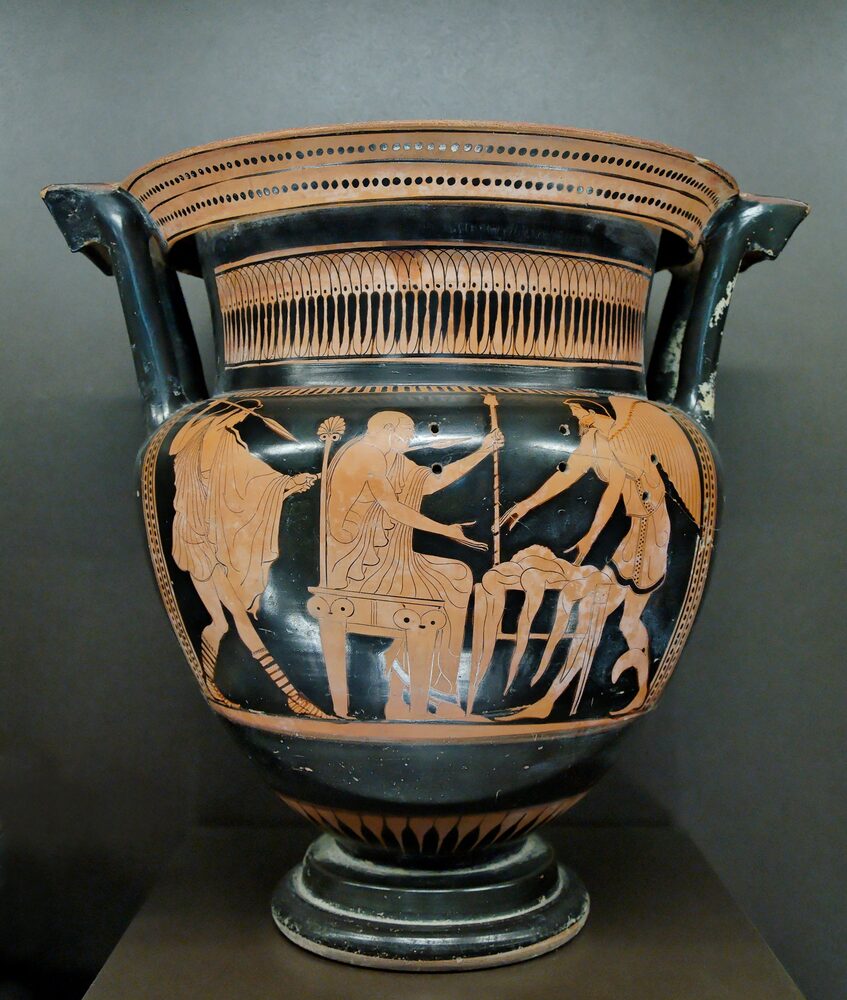
Phineus
First Appearance
Phineus is already old in Greek poetry. The Hesiodic Catalogue of Women (frr. 150–157 Merkelbach–West) told of the Boreads chasing the Harpies to the very ends of the earth on Phineus's behalf — a tale known to the poets long before it reached its fullest surviving form. That form is Apollonius of Rhodes, Argonautica 2.176–499, the central source: the Argonauts put in at the Thracian shore of Salmydessus and find the blind seer-king, wasted and filthy, tormented by the Harpies who snatch and befoul his every meal; the winged sons of Boreas drive the creatures off, and the grateful Phineus prophesies to the heroes the way through the Clashing Rocks and the perils of the voyage ahead.
— Hesiod, Catalogue of Women frr. 150–157 M-W (the pursuit of the Harpies by the sons of Boreas); Apollonius of Rhodes, Argonautica 2.176–499
Who They Are
Phineus (FIN-yoose) is the blind seer-king of Thrace — the prophet who knew too much, and paid for it. He ruled at Salmydessus on the bleak Black Sea coast, and he held the gift of prophecy more surely than almost any mortal: he could read the counsels of the gods and the shape of things to come. But the gift was also his ruin. For misusing it — the sources disagree on exactly how — he was struck blind and set upon by the Harpies, the snatching storm-spirits who swooped down at every meal to seize his food and foul whatever they left, so that he starved amid plenty, wasting away at a table he could never eat from.
His deliverance is one of the great scenes of the Argonaut voyage. When Jason and the Argonauts put in at his shore, Phineus begged their help, for he knew by prophecy that among them were the winged sons of Boreas, the north wind — Zetes and Calais — and that these alone were fated to drive the Harpies away. They did: rising on their wings, they chased the creatures far across the sea. In gratitude the seer unfolded to the Argonauts the way ahead, and above all how to pass the Clashing Rocks, the Symplegades, that ground together and crushed any ship between them. His prophecy is what carries the Argo through.
Phineus is the purest cautionary figure of the seer in Greek myth — the man whose very closeness to the gods' knowledge becomes the instrument of his suffering. To see too far, and to say too much, is a dangerous thing; the gift of prophecy, in him, is also a sentence. Yet his story turns at last toward grace: the tormented prophet, relieved of his curse, gives freely of the knowledge that once destroyed him, and so becomes the one who saves others.
Mythology
The seer-king of Salmydessus
Phineus was a king of Thrace, holding the harsh and storm-beaten coast of Salmydessus on the western shore of the Black Sea — a place the Greeks remembered as a graveyard of ships. His lineage was told differently by different poets: Apollonius names him son of Agenor (Argonautica 2.178), the great ancestor of the Phoenician house, while others make him a son of Phoinix, or even of Poseidon himself (Apollodorus, Bibliotheca 1.9.21, which reports the disagreement). Whatever his descent, his defining possession was a gift: he was a mantis, a seer, and one of extraordinary reach, able to read the hidden counsels of Zeus and to foretell the future with a plainness granted to few mortals. It is this gift, and what he did with it, that shapes everything that follows.
Why he was blinded — the three accounts
The ancient sources do not agree on why Phineus was struck blind and given over to the Harpies, and they preserve three distinct explanations — a rare case where the variants are worth holding side by side, since each reads his fate differently.
In the first and best-known account, his crime was with his prophecy itself: he revealed too much of the gods' counsels to men, disclosing to mortals what Zeus meant to keep hidden, laying bare the future too exactly and too freely. For this trespass against the secrecy of heaven he was blinded and tormented — the seer punished precisely through his seeing. (Apollonius of Rhodes gives this as the reason, Argonautica 2.181–184: Phineus "cared nothing even for Zeus himself, in that he unerringly declared his sacred mind to men.")
In a second account, the fault lay in a choice: offered by Apollo (or by Zeus) the gift of long life, Phineus chose a long life over his sight, or chose his prophetic sight over length of days, and the bargain cost him his eyes — the gift of vision inward paid for with blindness outward. This version makes his blinding less a crime than a price, the terms of a gift accepted.
In a third, darker account, his cruelty was domestic: at the false accusation of a stepmother — a second wife, in some tellings Idaia daughter of Dardanus — Phineus blinded his own two sons (the children of his first wife, Cleopatra, herself a daughter of Boreas), believing a lie that they had wronged her. For this savagery against his own blood the gods blinded Phineus in turn and set the Harpies upon him, so that the man who had put out his sons' eyes should himself grope in darkness and starve. (Apollodorus preserves this at Bibliotheca 3.15.3, within the house of Boreas; Sophocles dramatized the blinded sons, and the chorus of his Antigone 966–987 recalls the imprisoned, blinded children of Phineus and Cleopatra as an ancient example of suffering.)
The torment of the Harpies
Whatever the cause, the punishment was the same and terrible. The Harpies — the snatching storm-spirits, "the hounds of Zeus," winged and foul, who are treated on their own page — were loosed upon him. At every meal, the moment food was set before the blind king, they swept down out of the air, seized the greater part of it away in their talons, and befouled what little they left with a stench no one could bear, so that nothing remained that a man could eat. Thus Phineus, a king at his own table, starved amid plenty: surrounded by food he could never taste, wasting to skin and bone, filthy and trembling, kept barely alive only so that his hunger should never end. It is one of the cruellest images in all Greek myth — not death, but endless, gnawing deprivation, the seer who had feasted on forbidden knowledge now denied even bread.
The coming of the Argonauts and the Boreads
Deliverance came with the Argonauts. Voyaging toward Colchis in quest of the Golden Fleece, Jason and his company put in at the Thracian shore and found the wretched seer. Phineus, who still saw the future though he had lost his eyes, knew at once that his hour of release had come — for he knew by prophecy that among the heroes sailed the two winged sons of Boreas, the north wind: Zetes and Calais, the Boreads, and that these alone were fated to drive the Harpies from him. He begged their aid, and they gave it on one condition — that they should suffer no wrong from the gods for touching the creatures. Assured by the seer that it was fated and no sin, the winged brothers waited until the Harpies swooped once more upon the food, then rose on their own wings and gave chase, swords drawn, pursuing them far across the sea. In Apollonius they run the Harpies down as far as the Strophades — the "Islands of Turning" — where the creatures are spared at the command of Iris, the messenger of the gods (or in older versions of Hermes), on the oath that they will trouble Phineus no more; the islands took their name, the poets said, from this turning-back of the pursuit (Apollonius, Argonautica 2.273–300). The Harpies fled; the long torment was over.
The gift of prophecy returned: the Clashing Rocks
Freed of his curse, washed and fed at last, Phineus repaid the Argonauts with the one thing that was his to give — his knowledge of the way ahead. Above all he told them how to pass the dread Symplegades, the Clashing Rocks (also called the Kyaneai, the "Dark Rocks"), two great cliffs at the mouth of the Black Sea that clashed together and ground to splinters any ship caught between them. Phineus's counsel was exact: let the Argonauts first release a dove and watch its flight — if the bird passed through and the rocks caught only its tail-feathers, they might row through in the instant the rocks drew back; if it were crushed, they must turn home. The dove flew; the rocks snapped shut on its tail alone; and the Argonauts, straining at the oars in that breath of time, drove the Argo through with only her sternpost shorn away — and from that day, their passage accomplished, the Clashing Rocks stood fast forever and clashed no more (Apollonius, Argonautica 2.317–340, 549–606). He foretold, too, much of the voyage still to come, the perils and the peoples they would meet, as far as he was permitted to disclose — now, it is worth noting, speaking his prophecy within the limits the gods allowed, the man once punished for excess grown careful in his gift.
The meaning of his story
Phineus is the purest form of a figure the Greeks found both awesome and frightening: the seer who knows too much. Prophecy brings a mortal close to the mind of the gods, and that nearness is perilous — to see what heaven would hide, and to speak it, is to trespass; the gift and the punishment are the same faculty. His blindness is the deep irony at the heart of the Greek idea of the seer (as with Teiresias): the one who sees furthest into truth cannot see the ground before his feet, as though inner vision must be bought with the loss of the outer. And yet his story does not end in ruin. Delivered by the Argonauts, the tormented prophet gives freely and rightly of the knowledge that once destroyed him, and so becomes a savior of others — the man who knew too much made at last the man whose knowing carries heroes safely through.
Worship — Ancient
A figure of poetry, not of cult
Phineus had no temples, priesthood, or civic festival of his own; he was a figure of epic and tragic poetry rather than an object of worship. His life in Greek religious imagination belonged to the great story-cycles — the voyage of the Argo above all — and to the moral lessons the Greeks drew from him: the danger of prophecy too freely spoken, and the sanctity of the laws of hospitality. His starving at a fouled table was, in a sense, the perfect inversion of the sacred meal: where the gods honoured the stranger fed and the libation poured, Phineus embodied the horror of food denied and the table defiled, and so his tale stood as a dark witness to the very values Greek cult upheld.
In epic and tragedy
Phineus was a favorite of the poets. The Hesiodic Catalogue of Women (frr. 150–157 M-W) already told of the Boreads' pursuit of the Harpies on his behalf, chasing them to the ends of the earth. The episode reached its fullest surviving form in Apollonius of Rhodes (Argonautica 2.176–499), where the meeting with Phineus is the hinge of the whole outward voyage — the scene that equips the Argonauts with the knowledge they need to survive. Sophocles wrote at least two plays (both now lost) on his story, titled Phineus, and the chorus of his surviving Antigone (966–987) recalls the blinded sons of Phineus and Cleopatra, imprisoned in darkness, as an ancient instance of the reach of fate. Aeschylus too made him the subject of a lost Phineus, one of the plays of his Argonautic group. Through these works Phineus became the stock example, invoked for centuries, of the seer undone by his own sight.
The Strophades and the Clashing Rocks
Two features of the Greek map carried his story. The Strophades, a pair of small islands in the Ionian Sea, were said to take their name (from strophē, "a turning") from the point at which the Boreads turned back from pursuing the Harpies on Phineus's behalf. And the Symplegades, the Clashing Rocks at the Bosporus mouth that his prophecy let the Argo pass, were remembered as having stood fixed and harmless ever after that single passage — a landmark of the voyage his knowledge made possible. So the geography of the Greek world itself bore the marks of his tale.
Worship — Modern
The patron of knowledge held with care
Phineus has no modern cult, but his figure speaks with unusual force to anyone who thinks about the cost and the responsibility of knowledge. He is the archetype of the one who sees too far and says too much — and of the deprivation that can follow. A modern reader might honour him as a patron of prophecy, insight, and divination held with restraint: the reminder that some things are seen more wisely than they are spoken, and that a gift misused turns against its holder. His deliverance, in which the freed seer gives his knowledge rightly and saves the heroes who saved him, offers the hopeful counterpart — knowledge rendered as service rather than trespass.
The image of the fouled table
His most haunting legacy is the image itself: the blind king at a table laden with food he can never eat, the winged tormentors sweeping down to snatch and befoul every meal, starvation in the midst of plenty. It has become a lasting picture of futility and of appetite forever thwarted — of having everything set before one and able to take none of it. For a thoughtful reader it carries a quiet lesson about hospitality and its opposite: the sacredness of the clean meal set before a stranger, which the Argonauts restore to him, measured against the horror of the table defiled, which was his curse.
Epithets & Cult Titles
- mantis (μάντις) — Seer, diviner — Phineus is above all a prophet, one who reads the will of the gods and the shape of things to come; it is this gift, and his too-free use of it, that both raises and ruins him
- Agēnoridēs (Ἀγηνορίδης) — Son of Agenor — the patronymic by which Apollonius names him (Argonautica 2.178), marking his descent from the great Phoenician house of Agenor, though other sources give him a different father (Poseidon, or Phoinix)
- Thrēïkios (Θρηΐκιος) — The Thracian — king of Salmydessus on the wild Thracian coast of the Black Sea, where the Argonauts find him; his kingship is always bound to that bleak northern shore
- typhlos (τυφλός) — Blind — the defining mark of his punishment; the seer who could look into the counsels of the gods was robbed of ordinary sight, so that his inner vision cost him the outer
Sources & Variants
- Hesiod, Catalogue of Women frr. 150–157 Merkelbach–West (the Boreads' pursuit of the Harpies on Phineus's behalf, to the ends of the earth)
- Apollonius of Rhodes, Argonautica 2.176–499 (the central source: the Argonauts find the blind, Harpy-tormented Phineus at Salmydessus; the Boreads Zetes and Calais drive the Harpies to the Strophades; Phineus prophesies the Clashing Rocks and the voyage ahead)
- Apollonius of Rhodes, Argonautica 2.273–300 (the pursuit to the Strophades and Iris's oath that the Harpies will trouble him no more)
- Apollonius of Rhodes, Argonautica 2.317–340 and 549–606 (the counsel of the dove and the passage of the Symplegades)
- Sophocles, Antigone 966–987 (the blinded, imprisoned sons of Phineus and Cleopatra recalled as an example of fate)
- Sophocles, Phineus A and B (two lost plays on his story, known from fragments and testimonia)
- Aeschylus, Phineus (lost play of the Argonautic group, on the Harpies and the seer)
- Apollodorus, Bibliotheca 1.9.21 (Phineus the Thracian seer tormented by the Harpies, freed by the Boreads; reports the disagreement over his parentage and the reason for his blinding)
- Apollodorus, Bibliotheca 3.15.3 (the account in which Phineus blinds his own sons at a stepmother's false accusation, within the house of Boreas, and is punished in turn)
Gallery