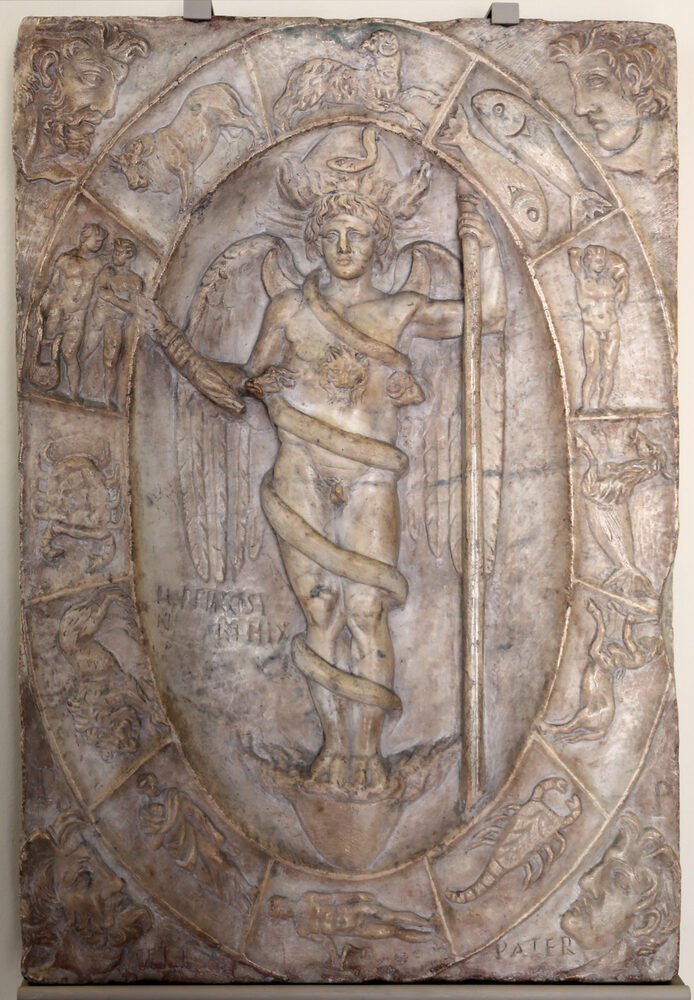
Phanēs
First Appearance
Phanes belongs to the Orphic tradition — the body of cosmogonic poetry ascribed to the legendary singer Orpheus — and NOT to Hesiod's mainstream Theogony, where Chaos comes first. His earliest clear echo in surviving Greek is a parody: in Aristophanes' comedy Birds (414 BC, lines 693–702) the chorus sings a mock-cosmogony in which black-winged Nyx (Night) lays a wind-egg in the boundless dark, and from it hatches golden-winged Eros, "like to the whirling winds" — the shining, winged firstborn from whom all else springs. This is plainly a comic glance at the Orphic egg-and-firstborn myth, which means the full doctrine was already current in Athens by the later fifth century BC. The doctrine itself survives only in fragments and in the reports of much later writers — the Derveni Papyrus (4th c. BC), and the Neoplatonic commentators Damascius and Proclus (5th–6th c. AD), who quote and summarise the lost Orphic Rhapsodies.
— Aristophanes, Birds 693–702 (the earliest clear Greek witness to the cosmic egg and the shining winged firstborn); the Orphic theogonies and Rhapsodies (preserved only in fragments and late reports)
Who They Are
Phanes (FAY-neez) is the firstborn god of creation in the Orphic tradition — the strand of Greek religious poetry ascribed to the mythical singer Orpheus, which told its own, distinct account of how the world began. This is essential to understand from the outset: the Orphic cosmogony is not the mainstream Greek story. In Hesiod's Theogony, the standard and best-known account, the first thing to come to be is Chaos, the yawning gap. The Orphics told a different tale — a secret, mystical cosmogony belonging to a mystery-cult, in which the beginning of things is a radiant, golden-winged deity born from a cosmic egg. Everything on this page describes that Orphic account, and it should be held apart from the Hesiodic one throughout.
In the Orphic theogonies, before the familiar gods there was Chronos (Time) and Ananke (Necessity), and from them came a great silver cosmic egg. From this egg hatched Phanes — whose name means "the Revealer" or "the Shining One," from the Greek phainō, "to bring to light." He is also called Prōtogonos ("the Firstborn"), Eros (generative Love), Ērikepaios (a secret cult-name), and Mētis (Counsel). He is described as a being of overwhelming radiance: golden-winged, bearing the heads of various beasts, both male and female at once, and carrying within himself the seeds of all the gods and of all creation. He it was who brought the first light into the dark cosmos and who generated the first generation of gods.
Phanes is thus the hidden god at the root of the Orphic world — the shining origin from whom Night and Sky and Earth descend, and whose kingship is handed down a line of divine rulers until, in the Orphic Rhapsodies, Zeus swallows Phanes whole, taking all creation back into himself so as to remake the world from within. He is a figure known not from the open poetry of the city but from the fragments, papyri, and late reports that preserve the secret cosmogony of the mysteries.
Mythology
An Orphic god, not a Hesiodic one
Everything that follows belongs to the Orphic tradition and must be kept distinct from Hesiod's Theogony, the mainstream Greek account. Hesiod opens with Chaos, the yawning gap, as the first thing that comes to be (Theogony 116). The Orphics — the followers of a body of sacred poetry ascribed to Orpheus, bound up with a mystery-cult and its promise of a blessed afterlife — told the beginning of the world differently. Theirs was a hidden cosmogony, passed within the rites, and it set at the head of all things not an impersonal gap but a radiant, living god hatched from an egg. The two accounts are separate traditions that answer the same question in incompatible ways; this page describes the Orphic one and does not harmonise it with Hesiod.
Chronos, Ananke, and the cosmic egg
In the Orphic theogonies (as reported by the Neoplatonic commentators Damascius and Proclus, who quote the lost Orphic Rhapsodies), the very first principle is Chronos — Time itself, sometimes pictured as an ageless, serpent-formed power — together with Ananke (Necessity), the inescapable law coiled about him. From Chronos, in the fullest version, came Aether (the bright upper air) and the dark immensity of Chaos, and within these Chronos fashioned a great gleaming egg — the cosmic egg, silver or shining, in which the seed of all things lay enclosed. This egg is the pivot of the whole Orphic story: the womb of the world, holding the unborn god of creation within its shell.
The hatching of Phanes, the Revealer
The egg split in two, and from it burst Phanes — "the Revealer," "the Shining One," from the Greek phainō, "to bring to light." At his appearing the light of creation first blazed out into the dark, which is the meaning folded into his name: he is the first appearing, the moment the cosmos becomes visible. The Orphic hymns and the reports of Damascius describe him as a being of staggering form — golden-winged, blazing with light, bisexual (both male and female in one body, so that he could generate without a partner), bearing within himself the seeds of all the gods, and marked with the heads of various beasts (a bull, a serpent, a lion, a ram are named in different reports), with a serpent coiled about him. He carried many names at once: Prōtogonos (the Firstborn), Eros (the generative Love at the root of all begetting), Ērikepaios (a secret, probably non-Greek cult-name used in the hymns and in the Derveni Papyrus), and Mētis (Counsel, the wisdom at the heart of creation). He is the firstborn of the universe and the fount of everything that comes after.
The earliest Greek witness: Aristophanes' parody
The oldest surviving Greek trace of this doctrine is, fittingly, a joke. In Aristophanes' Birds (414 BC, lines 693–702) the chorus of birds sings a mock-cosmogony to prove the birds older than the gods: in the beginning were Chaos and Night and black Erebus and wide Tartarus, and "black-winged Night" laid a wind-egg in the boundless dark, from which in due season hatched golden-winged Eros, shining "like to the whirling winds," who then mingled all things together and brought the race of birds and gods to be. This is plainly a comic glance at the Orphic egg-and-firstborn myth — Eros here is Phanes/Protogonos in all but name — and because it is a parody the audience was expected to recognise, it shows that the Orphic cosmogony was already well known at Athens by the later fifth century BC, even though the sacred poems themselves survive only in fragments.
The first generation and the Orphic succession
From Phanes the generations of gods began to flow. He brought forth Nyx (Night) — in the Orphic account his daughter and also, in some reports, his consort — and with her he produced Gaia (Earth) and Ouranos (Sky). He then handed down the sceptre, the kingship over the cosmos, beginning a line of divine rulers that is one of the most distinctive features of Orphic myth: the succession runs Phanes → Nyx → Ouranos → Cronus → Zeus. This is recognisably parallel to Hesiod's succession (Ouranos → Cronus → Zeus), but the Orphics prefaced it with two further reigns, Phanes and then Nyx, pushing the origin of kingship back to the shining firstborn and his daughter the Night. Phanes thus stands not only as the first god but as the first king of the universe, the head of the whole royal line of heaven.
Zeus swallows Phanes
The most startling episode in the Orphic story is its climax. In the Orphic Rhapsodies (as preserved by Damascius and Proclus), when the kingship at last comes to Zeus, he does not merely inherit the world — he swallows Phanes whole, taking the firstborn god, and with him the seeds of all creation and all the gods, back down into his own body. By this act Zeus absorbs the entire cosmos into himself, becoming, as a famous Orphic verse puts it, the beginning, the middle, and the end of all things — "Zeus the first, Zeus the last... all things lie within the body of Zeus." Then, holding all creation within him, Zeus brings it forth again and remakes the world from within himself, so that the cosmos is, in effect, created a second time. This swallowing is the Orphic way of declaring that everything that exists is contained in, and issues from, the sovereign god — a profoundly different theology from Hesiod's, and the reason the Orphics are sometimes called the mystics of the Greek world.
The hidden god of the mysteries
Phanes remained always a god of the mysteries rather than of the open city. His names were secret, his image belonged to the initiates, and his cosmogony was taught within the rites rather than sung in the marketplace. He is the hidden origin — the radiant firstborn glimpsed only through the fragments of the Orphic poems, the parody in Aristophanes, the quotations of the late philosophers, and the charred lines of the Derveni Papyrus. That hiddenness is itself part of his character: the Revealer is, paradoxically, the most concealed of the Greek gods, known to us only at second hand and from within a tradition that kept its deepest teaching veiled.
Worship — Ancient
A god of the mystery-cult, not the public temple
Phanes had no great civic temples, no public priesthood, and no Panhellenic festival in the way the Olympians did. He belonged entirely to the Orphic mysteries — the initiatory, text-centred religious movement that gathered around the sacred poems ascribed to Orpheus and promised its initiates a blessed lot in the afterlife. His "worship" lived in the reciting and expounding of the Orphic theogony within the rites, in the hymns sung to him under his many names, and in the private devotion of initiates rather than in any open cult. He was a god to be understood and invoked by those admitted to the mystery, not a god of the city's calendar.
The Derveni Papyrus and the Orphic hymns
The clearest ancient evidence for devotion to Phanes comes from texts tied to this initiatory world. The Derveni Papyrus — a carbonised scroll from the fourth century BC, the oldest surviving Greek philosophical papyrus — preserves an allegorical commentary on an Orphic theogonic poem, and in it the firstborn god appears under the secret name Ērikepaios, with the detail that the sovereign god swallows the "firstborn king." A set of later Orphic Hymns includes a hymn to Protogonos ("Firstborn") that addresses him as two-natured, egg-born, golden-winged, and "Phanes," invoking him to bring his light to the initiate. These texts show a real devotional life around the god, carried on within the mystery-tradition rather than in public shrines.
Reported by the philosophers
Because the Orphic poems were sacred and largely closed, much of what survives about Phanes comes not from cult records but from later writers who quoted the poems for their own ends. The Neoplatonic philosophers Damascius and Proclus (fifth and sixth centuries AD) preserved large parts of the Orphic Rhapsodies in their commentaries, treating Phanes as a key figure in their metaphysics of emanation — the first intelligible god from whom all else proceeds. Through their reports, and the parody in Aristophanes, the hidden god of the mysteries is known to us at all. These are late and philosophical witnesses, and they should be read as such: reports of an Orphic doctrine, refracted through the concerns of those who recorded it.
Worship — Modern
A touchstone for the Orphic and the esoteric
Phanes is remembered today above all by those drawn to the Orphic strand of Greek religion and to the esoteric and mystical traditions that have long found the figure of the shining, egg-born firstborn compelling. For a modern devotee or reconstructionist working within an Orphic frame, he stands as the radiant origin of all things — the first light, the generative love at the root of creation, the god from whom the whole divine order unfolds. Honour to him naturally takes the form the ancients used: the reciting of the Orphic hymn to Protogonos, meditation on the cosmic egg and the first appearing of light, and a devotion kept, as the Orphics kept it, more inward and contemplative than public.
The cosmic egg and the first light
The images that cluster around Phanes — the cosmic egg, the bursting-forth of light into darkness, the bisexual creative fullness that needs no partner to beget, the one radiant source containing the seeds of all things — have given him a long afterlife in Western esoteric, Hermetic, and comparative-mythological thought, where the Orphic egg is often set beside the world-eggs of other traditions. A modern honouring of Phanes tends to dwell on exactly these: beginnings, the dawning of light, the unity that holds all multiplicity within it before it is unfolded.
Held apart from Hesiod
A faithful modern reckoning with Phanes keeps the same care the sources demand: he is an Orphic god, the firstborn of a particular mystical cosmogony, and he does not belong to the mainstream Hesiodic account where Chaos comes first. To honour him well is to honour him within the tradition that actually knew him — the secret, text-centred religion of the Orphic mysteries — rather than to fold him into the more familiar Olympian story that was never his.
Epithets & Cult Titles
- Prōtogonos (Πρωτόγονος) — The Firstborn — the first of the gods to come into being in the Orphic account, the one born before all others from the cosmic egg
- Phanēs (Φάνης) — The Revealer / the Shining One — from phainō, 'to bring to light'; the name marks him as the god who first made creation appear and brought light to the dark cosmos
- Ērikepaios (Ἠρικεπαῖος) — A secret cult-name of uncertain, likely non-Greek origin, used of him in the Orphic hymns and the Derveni Papyrus; one of the hidden names by which the initiates invoked the firstborn god
- Mētis (Μῆτις) — Counsel / cunning wisdom — an Orphic name for Phanes identifying him with the generative wisdom at the root of creation (distinct from the Titaness Metis of the mainstream tradition, though the Orphics played on the overlap)
- Eros / Erōs (Ἔρως) — Love / Desire — the Orphics identified the firstborn with the generative Love that drives all begetting, echoing the primordial Eros of Hesiod but recast as the shining egg-born god
- Bromios and Antaugēs (Βρόμιος, Ἀνταυγής) — Further by-names reported for Phanes in the Orphic hymns — 'the Roarer' and 'the Resplendent' — marking his thunderous power and his blazing light
Sources & Variants
- Aristophanes, Birds 693–702 (the cosmic wind-egg laid by Night, and golden-winged Eros hatched from it — the earliest clear Greek witness, in the form of parody, to the Orphic egg-and-firstborn myth; 414 BC)
- The Orphic theogonies / Orphic Rhapsodies (preserved only in fragments; collected in O. Kern, Orphicorum Fragmenta) — the primary but lost Orphic poems recounting Chronos, the cosmic egg, and the birth and kingship of Phanes/Protogonos
- The Derveni Papyrus (4th c. BC; allegorical commentary on an Orphic theogony) — the firstborn god under the secret name Ērikepaios, and the sovereign god's swallowing of the firstborn king
- Orphic Hymns, Hymn to Protogonos (1 or 6, depending on the collection) — Phanes addressed as two-natured, egg-born, golden-winged, bringer of light — late (Hellenistic/Imperial)
- Damascius, De Principiis (On First Principles) — Neoplatonic report quoting and summarising the Orphic theogonies, including Chronos, the egg, and Phanes; 5th–6th c. AD
- Proclus, Commentary on Plato's Timaeus and other works — Neoplatonic reports and quotations of the Orphic Rhapsodies on Phanes as the first intelligible god and the succession of divine kings; 5th c. AD
- Note: Phanes is an Orphic and late-reported deity, distinct from Hesiod's mainstream Theogony (where Chaos is first). All details here derive from the Orphic tradition and its ancient reporters, not from the standard Hesiodic cosmogony.
Gallery