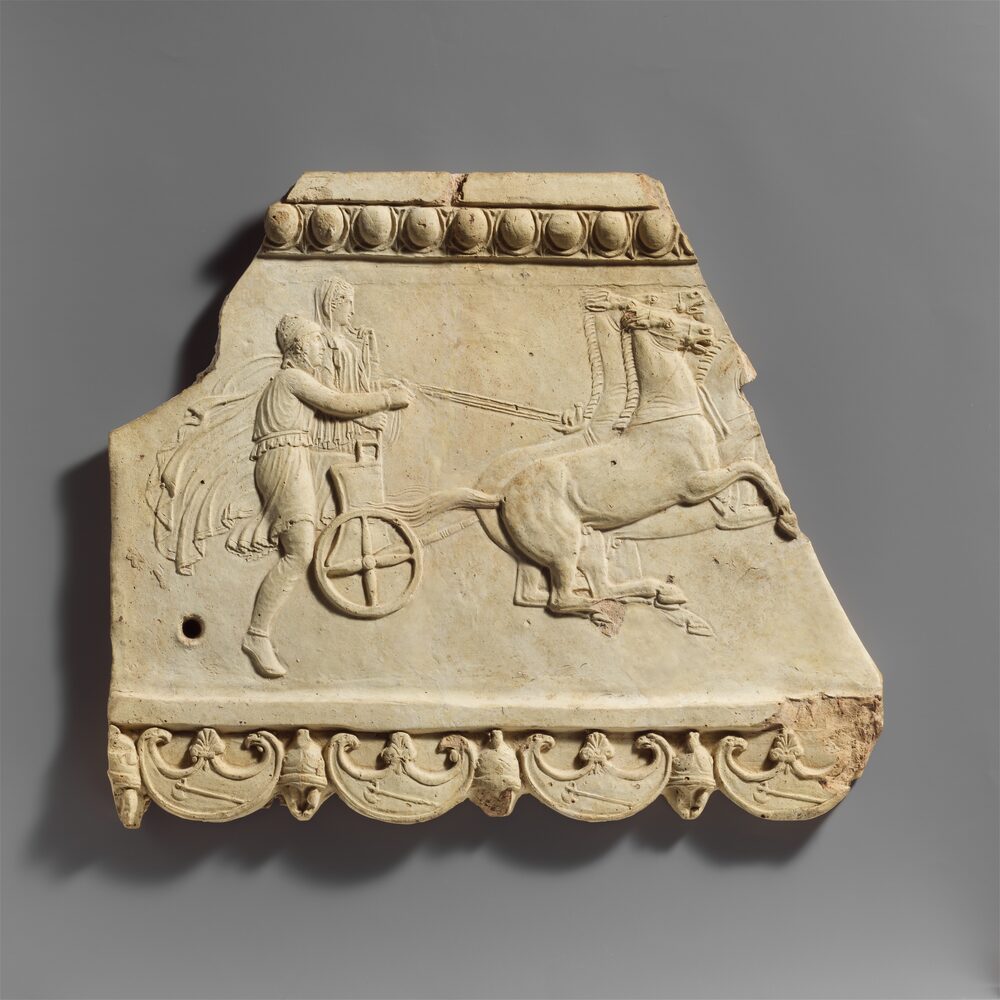
Pelops
First Appearance
Pelops enters Greek poetry already a king and an ancestor. In the Iliad (2.100–108), as Agamemnon takes up the great sceptre of his house, Homer traces the staff hand to hand down the generations: Hephaestus made it, Zeus gave it to Hermes, Hermes to "Pelops the driver of horses," Pelops to Atreus, and so at last to Agamemnon "to be lord of many islands and all Argos" — so that the war-king of the Greeks holds his power as the gift of Pelops. The first full and shaping telling of Pelops' own story is Pindar's Olympian 1 (476 BC), a victory-ode for a chariot-win that makes Pelops the patron hero of Olympia — and, famously, refuses the uglier version of his childhood.
— Homer, Iliad 2.100–108; Pindar, Olympian 1
Who They Are
Pelops (PEE-lops) is the hero who gave his name to the Peloponnese, the "island of Pelops" — the great southern peninsula that is still called by his name today. He is counted among the heroes as a mortal king and a founding ancestor, but his life stands at the hinge of two of the darkest things in Greek myth: a father's monstrous crime against him as a child, and a victory of his own, won by treachery, that laid a curse on all his descendants. From Pelops descends the house of the Atreidae — Atreus and Thyestes, and after them Agamemnon and Menelaus — the royal line whose inherited doom drives the tragedies of Troy and of the blood-soaked return home.
Two scenes hold his story. The first is from his boyhood: his father Tantalus, a king favoured by the gods, butchered his own son and served him at a banquet to test whether the gods truly knew all things. Only the grieving Demeter, lost in mourning for her stolen daughter Persephone, ate a portion — the shoulder — before the gods saw the horror and drew back; they restored the boy to life and made good the missing piece with a shoulder of ivory, and from that gleaming ivory shoulder, it was said, his descendants were known. The second scene is the centrepiece of his adult life: the chariot-race he ran against King Oenomaus to win the princess Hippodamia, a race Oenomaus had rigged so that every suitor died — and which Pelops won only by bribing the charioteer Myrtilus to sabotage his master's car, and then by betraying and killing Myrtilus, whose dying curse fell on the house of Pelops forever.
He is therefore a hero of two inheritances. From the gods he received life restored, an immortal's love, and the honour of the Peloponnese and of Olympia, whose games and hero-cult the Greeks traced to him. From his own deceit he received a curse that ran down his bloodline through murder after murder. The same hand that founded a sanctuary opened a wound that three generations could not close.
Mythology
The son of Tantalus, and the cauldron
Pelops was the son of Tantalus, the Lydian or Phrygian king of Sipylus who was dear to the gods and admitted to their table — and who repaid that honour with the most notorious of crimes. (Tantalus' own endless punishment in the underworld is told among the great sinners; see the Damned.) In the oldest and ugliest form of the tale, Tantalus, to test whether the gods were truly all-knowing — or to feast them in monstrous hospitality — killed his young son Pelops, cut him up, and boiled him in a cauldron, and set the flesh before the immortals at a banquet. The gods knew at once, and in horror none would touch the dish — none but Demeter, who, numb with grief over the loss of her daughter Persephone, absently ate one piece: the flesh of the shoulder (Apollodorus, Epitome 2.3; Pindar, Olympian 1.24–27, 46–53, who records the story in order to reject it).
The gods gathered the pieces back into the cauldron, and Pelops was restored to life and to a beauty greater than before. Only the eaten shoulder was missing, and in its place the gods set a shoulder of ivory — gleaming, flawless, and ever after the token of his line: his descendants were said to be born bearing a patch of ivory-white at the shoulder, the god-made mark of the house of Pelops. The resurrected boy, more beautiful than any mortal, drew the eye of a god.
Pindar's refusal: a pious revision
The poet Pindar, retelling the story in Olympian 1 for a chariot-victory, could not bring himself to repeat the cannibal tale as truth. He names it — the cauldron, the carving, the eaten shoulder — and then draws back: "it is impossible for me to call any of the blessed gods a glutton — I stand apart" (Olympian 1.52). In his telling the horror is slander, a rumour spread by an envious neighbour after the boy vanished; what truly happened, Pindar says, is that Poseidon, lord of the sea, overcome with desire for the beautiful youth, caught Pelops up and carried him away on golden mares to the high house of Zeus — just as Zeus would later carry off Ganymede. The ivory shoulder, in this gentler account, was Pelops' from birth, a mark he simply bore. Pindar's revision is one of the clearest moments in Greek poetry of a singer consciously correcting an inherited myth he found unworthy of the gods — and it is from Pindar above all that Pelops became the hero of Olympia. Both strands, the butchery and the god's love, were known to later readers; the darker was the older and more widespread, the Pindaric the more reverent.
Poseidon's love, and the gift of horses
Whichever way the childhood is told, Pelops was beloved of Poseidon, and that love bore directly on his great trial. When the time came for Pelops to win a bride by a chariot-race he could not hope to survive unaided, he went down to the sea's edge and called on the god who loved him; and Poseidon gave him a golden chariot and a team of winged, tireless immortal horses, "such as the sea-god drives" — the gift that let a mortal stand against a king whose own horses were the swiftest the north wind ever sired (Pindar, Olympian 1.67–87). Thus Pelops' victory had, from the gods' side, a fair and shining cause. But the myth would not let it rest there.
The chariot-race for Hippodamia
Across the sea in Pisa, beside Olympia in the western Peloponnese, reigned King Oenomaus, father of the princess Hippodamia. An oracle had warned Oenomaus that he would die at the hands of his daughter's husband — or else he desired the girl himself — and so he devised a deadly test for her suitors. Each who came must carry Hippodamia off in his chariot while Oenomaus sacrificed a ram; then the king, driving the fastest horses in Greece, would pursue, and if he overtook the suitor he drove his spear through the man's back. He had killed many this way — the sources count twelve, or thirteen, or more — and nailed their heads to the front of his palace, or heaped their bodies, to frighten off the rest (Apollodorus, Epitome 2.4–6; Pausanias 6.21.6–11, who names the slain suitors and shows their tomb).
Pelops came to Pisa to try the race, with Poseidon's golden team beneath him. But the myth gives the victory a second, darker engine. Before the race Pelops came to terms with Myrtilus, the son of Hermes and Oenomaus' own charioteer, who was himself in love with Hippodamia — or whom Hippodamia, in love with Pelops, herself persuaded. In return for a promised reward (half the kingdom, or the first night with the bride), Myrtilus betrayed his master: he drew out the bronze lynchpins that held the wheels to the axle of Oenomaus' chariot and replaced them with pins of wax, or left the sockets empty (Apollodorus, Epitome 2.6–7). When the great race was run, the wheels of Oenomaus' car worked loose at speed and flew off; the king was thrown and tangled in the reins and dragged to his death — cursing, as he died, the servant who had betrayed him.
The murder of Myrtilus, and the curse
Pelops had won Hippodamia and the kingdom. But he did not pay Myrtilus the promised price. Carrying Hippodamia home, with Myrtilus beside them, Pelops — whether to be rid of a witness, or because Myrtilus laid hands on Hippodamia — threw the charioteer from a headland into the sea. As he fell, or as he drowned, Myrtilus called down a curse upon Pelops and all his line (Apollodorus, Epitome 2.8; Euripides, Orestes 988–996). That stretch of sea, the Greeks said, was the Myrtoan Sea, named for the drowned man. Myrtilus' father Hermes did not forget, and the curse took root: it ran down from Pelops to his sons Atreus and Thyestes, who tore their house apart — Thyestes seducing Atreus' wife, Atreus serving Thyestes his own children at a banquet in a grim echo of Tantalus' crime — and on to the next generation, to Agamemnon, murdered on his return from Troy, and the bloodshed of Mycenae that only ended, in the tragedians, when the Furies were at last appeased. The hero who founded Olympia founded also a curse; the ivory-shouldered house carried both.
King in the Peloponnese
Settled at last as lord of Pisa and Elis, Pelops grew into one of the great kings of the heroic age, and his power and his many sons spread his house across the southern peninsula until the whole land took his name: the Peloponnese, Pelopos nēsos, the "island of Pelops." He was remembered as the founder of cities and of festivals, and above all as the hero of Olympia, whose cult and whose games the Eleans traced back to him. In death he did not leave the land that bore his name: his tomb lay in the heart of the sanctuary of Zeus, and his bones — a great shoulder-blade kept and shown at Olympia, said to be his — were a relic of the Trojan War, for an oracle had declared that Troy could not fall without a bone of Pelops brought to the Greek camp (Pausanias 5.13.4–6).
Worship — Ancient
The Pelopion: a hero honoured first
Pelops held at Olympia a place unlike that of almost any other hero. Within the Altis — the sacred grove of Zeus — stood the Pelopion, a walled, roughly five-sided precinct enclosing a mound and an altar that marked his grave, set close beside the great temple and altar of Zeus himself. Pausanias records that "Pelops is honoured by the Eleans above the other heroes at Olympia just as Zeus is honoured above the other gods" (Pausanias 5.13.1) — and that honour was expressed in sacrifice. Each year the Eleans killed a black ram for him in the pit of his precinct; the officiant who performed the rite might not afterward eat of the meat, and the wood burnt on the altar was white poplar (leukē). To sacrifice to Pelops was to approach him as a hero of the grave — with the dark victim, the blood poured down to the dead, the sombre rites of the underworld — and the Greeks who came to honour Olympian Zeus honoured his buried hero first.
The games and the hippodrome
The Eleans and the poets tied the founding of the Olympic Games, or at least of the chariot-race that was their most prestigious contest, to Pelops' victory over Oenomaus. Pindar's first Olympian ode — the opening poem of the whole collection of victory-odes — makes Pelops the presiding hero of the sanctuary and sets his chariot-race at the fountainhead of Olympic glory, so that every charioteer who won at Olympia won in Pelops' long shadow. The hippodrome itself kept his story in its ground: Pausanias describes there the tomb-mound of the suitors whom Oenomaus had slain, honoured yearly, and the dread spot called Taraxippos, the "Horse-frightener," where chariot-teams panicked and crashed — which some explained as the angry ghost of the betrayed Myrtilus, and others as the spirit of Oenomaus (Pausanias 6.20.15–21.11).
A relic of the war
Pelops' cult reached even into the greatest of Greek stories. An oracle had told the Greeks at Troy that the city could not be taken without a bone of Pelops; so his great shoulder-blade was fetched from Pisa, and (in the tale Pausanias reports) was lost at sea on the voyage home, later recovered by a fisherman's net and kept and shown at Olympia down into historical times (Pausanias 5.13.4–6). The ivory shoulder of the myth and the giant bone of the relic were, in the popular mind, one and the same — the mark the gods had made on him still present, still potent, in the sanctuary that was his home.
Worship — Modern
The hero whose name is a land
Pelops survives most of all in the map. A traveller who crosses into the Peloponnese — Mycenae, Olympia, Sparta, Corinth, the whole southern third of mainland Greece — crosses into "the island of Pelops," a hero's name worn by a region for three thousand years. No other Greek hero is remembered on that scale, every day, by everyone who names the place. A modern honouring of Pelops begins there: in the recognition that a single mortal life stands behind the name of a land.
The shoulder, the chariot, and the curse
His story offers a modern reader three strong and unsettling images. There is the restored shoulder of ivory — the child destroyed by a parent's crime and remade by the gods, bearing ever after the gleaming mark of what was done to him and undone: a figure of harm survived and transfigured. There is the chariot-race — ambition that will win at any cost, victory bought with a bribe and sealed with a murder. And there is the curse of Myrtilus, the truth that a wrong done and never paid for does not end with the one who did it but runs down the generations: from Pelops to Atreus and Thyestes to Agamemnon, the house destroying itself again and again. Those drawn to Pelops tend to be drawn by exactly this double nature — the founder who is also the poisoner of his own line, the man honoured at the altar whose victory was a betrayal.
At Olympia
And he lives wherever the Olympic Games are invoked, for the ancients made him their hero and the chariot-race his own. The visitor to Olympia today still walks past the low mound of the Pelopion in the grove, and the long flat ground where the hippodrome lay; and anyone who thinks of the Games as older than any nation is thinking, whether they know it or not, of the ivory-shouldered king who won a kingdom with a chariot and left his bones in the sanctuary of Zeus.
Epithets & Cult Titles
- epōnymos (ἐπώνυμος) of the Peloponnese — The 'name-giver' of the Peloponnese — Pelopos nēsos (Πέλοπος νῆσος), the 'island of Pelops,' the great southern peninsula of Greece that still carries his name; the whole land is his memorial
- elephantinos ōmos (ἐλεφάντινος ὦμος) — 'Of the ivory shoulder' — his mark and his descendants' token; where the gods had restored the shoulder once eaten at his father's table, his line was said to be born with a gleaming shoulder of ivory
- hērōs of Olympia — The hero of Olympia honoured above all other heroes as Zeus is honoured above the gods (Pausanias 5.13.1) — the sanctuary's founding mortal, whose grave-precinct the Pelopion lay within the sacred grove itself
- father of the Pelopidae / Atreidae — Forebear of the Pelopidai (Πελοπίδαι) — the doomed house that ran through Atreus and Thyestes to Agamemnon and Menelaus, the Atreidae of the Trojan War; his name stands at the head of the most cursed of Greek royal lines
Sources & Variants
- Homer, Iliad 2.100–108 (the sceptre of Pelops passed down to Agamemnon; 'Pelops the driver of horses')
- Pindar, Olympian 1 (the central source: Pelops as hero of Olympia; the ivory shoulder; Poseidon's love and the gift of golden horses; the chariot-race for Hippodamia; and Pindar's explicit refusal of the cannibal tale as slander unworthy of the gods — Olympian 1.24–27, 46–53, 67–87)
- Pindar, Olympian 10 (Olympia and its founding legends)
- Bacchylides (fragments; the house of Pelops and its fortunes in the lyric tradition)
- Apollodorus, Epitome 2.3–9 (Tantalus' butchery of Pelops and the eaten shoulder; the chariot-race against Oenomaus; the bribery of Myrtilus and the wax lynchpins; the murder of Myrtilus and his curse on the house of Pelops)
- Pausanias, Description of Greece 5.13.1–7 (the Pelopion at Olympia, the black-ram sacrifice, the white-poplar wood, and the relic of Pelops' shoulder-blade)
- Pausanias, Description of Greece 6.20.15–21.11 (the Olympic hippodrome, the tomb of the suitors slain by Oenomaus, and Taraxippos the Horse-frightener)
- Euripides, Orestes 988–996 and Electra 699–746 (the curse on the house of Pelops and the ancestral crimes of the Pelopidae)
- Sophocles, Electra 504–515 (the fatal chariot-race of Pelops and the drowning of Myrtilus as the root of the family's sorrows)
- Ovid, Metamorphoses 6.401–411 (the ivory shoulder of Pelops restored by the gods after Tantalus' feast) — later Roman retelling
- Hyginus, Fabulae 83–84 (Pelops, Oenomaus, Hippodamia and Myrtilus) — later Latin handbook
Gallery