Ōríōn
First Appearance
Orion steps into Greek poetry already a giant and already doomed. In the Odyssey, Calypso recalls how rose-fingered Dawn (Eos) took Orion for her own, until the gods in their envy sent chaste Artemis to slay him with her gentle arrows on the island of Ortygia (Odyssey 5.121–124). Later, when Odysseus looks into the land of the dead, he sees "huge Orion" driving across the meadow of asphodel the wild beasts he had killed in the lonely hills, his club of unbreakable bronze forever in his hand (Odyssey 11.572–575). Hesiod's Works and Days keeps him too, not as a man but as a constellation, the great sign in the sky by which the farmer reckons the threshing and the sailor dreads the storm.
— Homer, Odyssey 5.121–124 and 11.572–575; Hesiod, Works and Days (Orion as seasonal marker); Ps.-Hesiod, Astronomy (frs. on his birth and catasterism)
Who They Are
Orion (oh-RY-un) is the giant huntsman of Greek myth — the mightiest hunter who ever walked the earth, companion of the huntress-goddess Artemis, and, after his death, the most splendid constellation of the winter sky. He strides across the heavens still, club raised, sword at his belt, his great hounds at his heel and the beasts of the chase fleeing before him, pursued forever by the Scorpion that killed him. He is counted here among the heroes because he began as a mortal of enormous stature and ended, like so few, lifted whole into the stars.
His story is one of the strangest and most variously told in all Greek myth. The ancients could not agree on how he was born, whom he loved, or how he died — and so his page is a weaving-together of rival tellings, each old and each honoured. He is born, in the most famous tale, not of a mother at all but out of the buried hide of an ox, watered by three gods; he loses his sight and wins it back by walking into the rising sun; he loves and pursues and is punished; and he dies — in the version the Greeks loved best and the one this page leads with — by the arrow of Artemis herself.
Above all, Orion is a figure of the sky. Long before his myths were fixed, Greek farmers and sailors watched his constellation rise and set to mark the seasons of harvest and of storm. The man and the stars were never quite separable: to tell the tale of Orion the hunter is to explain how the great Hunter came to stride across the winter nights, and why the Scorpion rises as he sets, chasing him down below the edge of the world.
Mythology
The death that leads: the arrow of Artemis
Of all the ways the Greeks told Orion's death, the one they told most and loved best is that he died by the hand of Artemis, the virgin huntress, the very goddess who had been his companion in the chase. There are two strands to this telling, and the sources give both.
In one, Artemis is tricked into killing him by her own brother Apollo. Apollo, uneasy at the closeness growing between his sister and the giant — or jealous for her chastity, which he would guard even against her own heart — came upon Orion swimming far out to sea, so distant that only his head showed above the water as a dark moving speck. Apollo challenged Artemis: could she, the great archer, strike that far-off dark thing on the waves? Stung by the dare and sure of her aim, Artemis bent her bow and shot — and the arrow flew true, and struck, and the dark speck was the head of Orion. The waves carried his body to shore, and the goddess who had loosed the shaft in pride found she had killed the one companion of the hunt she had loved, and in her grief set him among the stars.
In the other strand, there is no trick: Artemis kills Orion for his own fault — for his presumption. He had boasted he would hunt down and kill every beast on the earth, or he had laid hands on the goddess herself or on one of her maidens, or he had challenged her at the discus or the chase. For that overreaching — the hunter who forgets he is mortal, who grasps at a goddess or at mastery over all living things — Artemis loosed her "gentle arrows," the swift painless death she deals to women and to those she loves, and struck him down. Homer knows this shape of the story already: in the Odyssey (5.121–124) it is Artemis who slays Orion on Ortygia, after Dawn had carried him off, because the gods begrudged a goddess her mortal love.
The scorpion sent against him
The other great death-tale, told by Ps.-Hesiod's Astronomy and by the writers on the constellations (Aratus and Eratosthenes), replaces the arrow with a scorpion. In this telling Orion's boast is the undoing — he swore he would kill every wild beast that walked the earth. The Earth herself, Gaia, heard the vast threat to all her creatures and was angered (in some tellings it is Artemis, or Artemis and Leto together, who are offended by the boast); and from the ground she sent up a single small and deadly thing against the giant who would slay the great ones — a scorpion. The creature stung Orion, and against its poison his size and his club were nothing, and he died.
Then, so that the lesson of the tale should never be forgotten, both hunter and scorpion were set among the stars — but set at opposite ends of the sky, so that the great constellation Scorpius rises in the east exactly as Orion sinks beneath the western horizon. The Hunter forever flees below the edge of the world as the Scorpion that killed him climbs into the night; they are never seen together, the pursued and the pursuer, wheeling through the seasons in an endless chase set in the stars.
(A note on the two deaths: these are rival tellings, not one story. The arrow of Artemis and the scorpion of Gaia are different endings the Greeks gave the same hunter, and the sources do not reconcile them. Some later writers tried to braid them — Artemis sending the scorpion, or Orion slain by the scorpion and then mourned by Artemis — but the oldest tellings keep them apart.)
His birth: the ox-hide and the three gods
Orion's birth is as strange as his death. In the tale told by Ps.-Hesiod and others, he had no mother. An old and childless man of Boeotia — called Hyrieus, founder of the town of Hyria — once gave generous hospitality to three travellers, not knowing they were the gods Zeus, Poseidon, and Hermes walking the earth in the guise of men. He had little, but he killed his one ox and feasted them. The gods, pleased, offered him any wish; and the old man, a widower who had sworn at his wife's death never to take another, asked for a son without a marriage.
The gods took the hide of the ox he had sacrificed to them, and — in the plain and earthy telling the Greeks did not soften — each of the three made water upon it (or into it), and bade Hyrieus bury the hide in the earth. After the turning of the months he dug it up, and out of it came a boy. Because of the manner of his begetting — from the poured-out water of the gods, Greek ouron — the child was first named Ourion, and only later, by the softening of the sound, Orion. So the ancients explained his name by his birth: the giant who came not from a womb but from the watered hide of an ox, fathered by three gods at once upon the earth.
His blinding and his healing in the sunrise
Grown to a giant, Orion came to the island of Chios, where he fell in love with Merope, daughter of Oenopion, the island's king (himself a son of Dionysus). Orion cleared the island of its wild beasts to win her, bringing the spoils of the hunt to lay before her; but Oenopion kept delaying the marriage. In anger — and, in the harsher tellings, heavy with the wine that Oenopion's own vineyards gave, for the king's name means "wine-face" — Orion forced his way to Merope or did her violence. For this Oenopion took a terrible revenge: with the help of his father Dionysus, who sank the giant into a drunken sleep, Oenopion put out Orion's eyes and cast the blind giant out upon the shore.
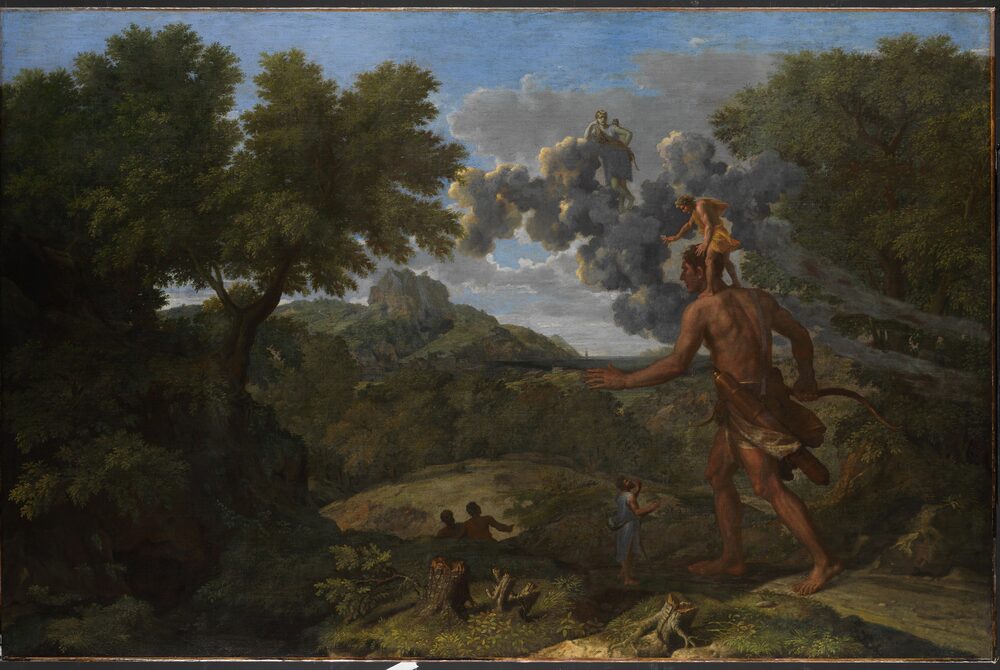
Blinded, Orion did not despair. An oracle (or his own knowledge) told him that he would see again if he went to the east and turned his sightless eyes toward the rising sun. So he waded and walked eastward across the sea toward the dawn. Coming to the forge of Hephaestus on Lemnos, he took up a boy of the smithy, Cedalion, and set him upon his shoulders to be his eyes and guide him; and so, the giant striding and the boy perched aloft pointing the way, Orion came to the farthest east, where Helios the Sun rises. There the healing rays of the rising Sun fell upon his ruined eyes and gave him back his sight. It is one of the great images of Greek myth — the blind giant walking into the dawn with a small guide on his shoulder — and painters and poets have returned to it again and again.
Side, the Pleiades, and Dawn
Orion's loves run like a thread of punishment through his tale. His first wife, in one tradition, was Side — her name the Greek word for the pomegranate — who was so proud of her beauty that she set herself against Hera, claiming to be the lovelier; and for that presumption Hera cast her down into the house of Hades while she still lived. So Orion lost his wife to the dark before his own story was done.
He was also remembered as a pursuer of the Pleiades, the seven daughters of Atlas and their mother Pleione. Ranging the hills, Orion grew enamoured of them and chased them, year upon year, until in pity the gods changed them first into doves and then set them among the stars, to be the little cluster of the Pleiades in the night sky. And even there the chase goes on, for the constellation of Orion rises behind the Pleiades and seems to follow them forever across the heavens — the hunter still pursuing the seven sisters he could never catch.
And Homer keeps another love: Eos, the rose-fingered Dawn, fell in love with Orion and carried him off to the holy island of Ortygia to be her own (Odyssey 5.121–124). It was there, the gods begrudging the goddess her mortal lover, that Artemis came and slew him — and so this love, too, ends under the huntress's arrow, binding the tale of Dawn back to the death that leads it.
Set among the stars: the great Hunter
Whatever death took him, Orion's end was the sky. He was set among the stars as the constellation that still bears his name — the most brilliant and most recognisable of the winter heavens, the great Hunter striding across the night. His shoulders and feet are marked by four bright stars (among them red Betelgeuse and blue-white Rigel); his famous belt is the three stars in a line that no one who has looked up in winter can forget; from the belt hangs his sword, and in his raised hand he holds his club, his other arm bearing a lion-skin or shield as he faces the charging Bull, Taurus.
He does not hunt alone. At his heel follow his two hounds, the constellations Canis Major and Canis Minor, the greater dog carrying Sirius, the brightest star in all the night sky, blazing at the hunter's foot. Before them flees the little constellation of the Hare, Lepus, the quarry of the eternal chase. And behind and opposite rises the Scorpion of his death, climbing the east as Orion sinks in the west, so that the whole drama of his myth — the hunter, his dogs, his prey, and the small deadly thing that killed him — is written across the turning sky, acted out night after night and season after season forever.
Worship — Ancient
A hero of the sky, not the temple
Orion had almost no formal cult in the Greek world — no great temple, no priesthood, no Panhellenic festival in his honour. He belonged not to the altar but to the sky, and his true "worship," if it may be called that, was the watching of his constellation. For the Greeks the stars were not mere lights but markers set in heaven to order the year, and Orion was among the most important of all.
The hunter in the farmer's calendar
Long before his myths were written down, Orion's rising and setting governed the labours of the farming year. Hesiod's Works and Days reckons the whole calendar of toil by the stars, and Orion is one of his chief signs: when Orion and Sirius climb to the middle of the sky, it is time to harvest the grapes; when Orion first appears, begin the threshing; and when Orion and the Pleiades set, the ploughman knows the rains and the storms of winter are near. For the sailor, the setting of Orion toward the sea was a warning to beach the ship and wait out the season of gales. So the dead giant, far from being forgotten, worked the clock of the living world — the hunter who timed the harvest and the storm.
A memory kept in Boeotia
Orion kept a local memory in Boeotia, the region said to be his homeland — at Hyria and Tanagra, where his birth from the buried ox-hide was told and where he was remembered as a founding giant of the land. The traveller Pausanias records that the Boeotians showed his great tomb and kept his story as their own. But even here he was a figure of legend and landmark rather than of living cult; his honour was the tale told and the stars watched, not the sacrifice offered.
Worship — Modern
The hunter everyone can find
Of all the figures of Greek myth, Orion may be the one most people still meet without knowing his story — for his constellation is the easiest and most splendid in the winter sky, visible from almost everywhere on earth, its three belt-stars in a line that the eye finds at once. A modern devotee or lover of the myths can honour Orion simply by going out on a clear winter night and finding him: the belt, the sword hanging from it, bright Betelgeuse at his shoulder and Rigel at his foot, his great dog Sirius blazing below, and — rising opposite, as he sets — the Scorpion that killed him. To know the story is to see the whole drama playing out overhead.
Patron of the hunt and the long walk toward light
Orion sits well as a patron of the hunter, the wanderer, and the one who ranges the wild — the archetype of the giant who lived by the chase under the open sky. But the strand of his myth that speaks most to a modern reader is the blinding and the healing: the giant who, robbed of his sight, did not sit down in the dark but walked east, toward the dawn, with a small guide upon his shoulder, until the rising Sun gave him back his eyes. It is an old and powerful image of endurance — of turning one's face toward the light and walking, however long the road, until sight returns.
A name across the sky and the sciences
Orion's name is everywhere in the way we speak of the heavens. The Orion constellation, the Orion Nebula within his sword (one of the great star-nurseries of the galaxy, where new suns are being born), and the whole Orion Arm of the Milky Way — the very spiral arm in which our own Sun sits — all carry the giant hunter's name. Spacecraft and star-charts, winter poems and planetarium shows keep him alive. The mortal giant set among the stars by a goddess's grief or a scorpion's sting strides on through every clear winter night, the Hunter forever, club raised and dog at heel, chasing the sisters he could never catch and fleeing the small thing that laid him low.
Epithets & Cult Titles
- the giant (gígas, γίγας) — Orion was remembered above all for his vast size — a giant among men, so tall that in Homer's underworld he towers over the shades, and in one tradition able to wade through the deepest sea with his head and shoulders still above the water
- mégas (μέγας) — 'the great' — The great hunter; Homer calls him 'mighty Orion' and shows him in the house of Hades still driving the beasts he had killed in life across the meadow of asphodel, club in hand
- the hunter (thēreutḗs, θηρευτής) — His defining office — the archetypal huntsman of Greek myth, companion of the huntress Artemis, who ranged the wilds of Boeotia and Crete with his club and his hounds
- Ōríōn the constellation — His name as the brightest and most splendid of the winter constellations, the Hunter striding across the sky with his belt of three stars, his sword, his club, and his dog at his heel — the shape by which most of the world still knows his name
Sources & Variants
- Homer, Odyssey 5.121–124 (Eos carries off Orion; the gods begrudge her, and Artemis slays him with her gentle arrows on Ortygia)
- Homer, Odyssey 11.572–575 (Odysseus sees huge Orion in the land of the dead, driving across the asphodel the beasts he killed, his bronze club in hand)
- Hesiod, Works and Days (Orion as seasonal marker — the rising and setting of his constellation times the harvest, the threshing, and the coming of storms)
- Ps.-Hesiod, Astronomy (fragments: Orion's birth from the ox-hide; his boast and the scorpion; his catasterism as the constellation)
- Pherecydes (on Orion's birth and parentage; cited by later mythographers for the ox-hide tale and his Boeotian origin)
- Apollodorus, Bibliotheca 1.4.3–5 (Orion's birth from Hyrieus and the three gods; his love of Merope and blinding by Oenopion; healing at the sunrise with Cedalion; his death by Artemis or by the scorpion; Eos and Ortygia)
- Aratus, Phaenomena (Orion as the great constellation; the Scorpion rising as he sets; his dog Sirius)
- Eratosthenes, Catasterismi 32 (Orion set among the stars; the boast against the beasts, the scorpion sent by Gaia/Earth, and the two placed at opposite ends of the sky)
- Pausanias, Description of Greece 9.20.3 (Orion's tomb and memory in Boeotia, at Tanagra)
- Ovid, Fasti 5.493–544 (the Roman telling of Orion's birth from Hyrieus and the three gods, with the folk-etymology of the name) — Roman
Gallery