Oidipous
First Appearance
Oedipus first appears in Homer, already the subject of a known and terrible story. In the Odyssey (11.271–280), Odysseus sees in the underworld the shade of "Epikaste, the mother of Oedipodes," who unknowingly married her own son after he had killed his father; when the gods made the truth known she hanged herself, and left him grief upon grief through his mother's avenging Furies — yet Homer's Oedipus, notably, goes on ruling in Thebes rather than blinding and exiling himself. The Iliad (23.679–680) glances at the funeral games held for the fallen Oedipus at Thebes, showing that his death and burial in the city were already part of the early tradition.
— Homer, Odyssey 11.271–280; Iliad 23.679–680
Who They Are
Oedipus (EE-dip-us / ED-ip-us) is the most tragic figure in all of Greek myth — the king of Thebes who solved the riddle of the Sphinx and freed a city, and who was destroyed not by any wickedness in himself but by a fate laid on him before his birth, which he fled with all his cleverness and strength and which his very flight carried out to the letter. His story is the great Greek meditation on the limits of human knowledge and the reach of the gods: the man renowned above all others for his intelligence, who could read the darkest riddle in the world, could not read the riddle of who he was, and walked open-eyed into the one doom he had spent his life trying to escape.
(Content note: Oedipus's story turns on parricide — the killing of a father — and on incest, the unknowing marriage of a son to his mother. This page treats both frankly but without dwelling on their horror for its own sake; they are the machinery of a tragedy about fate and self-knowledge, not its point.) The essential thing to hold onto is that Oedipus commits both of these acts in complete ignorance, believing himself to be doing the very opposite — fleeing the parents he loves precisely so that he cannot harm them. The Greeks did not tell his story to condemn him. They told it to feel the terror and the pity of a good and able man caught in a net woven by prophecy, and to ask how much of a life is chosen and how much is simply appointed.
His name is the key to him, and the Greeks heard two things in it. Oidipous means "swollen-foot," for the ankles his own father pierced and pinned when he exposed the infant to die — so that Oedipus carried the physical mark of his fate from the cradle. But the ear also caught oida, "I know": he is the man of knowledge, the one who knows the answer, and the deepest irony of his tragedy is that the great knower is the one man who does not know himself. To follow his story from the pierced ankles on Mount Cithaeron to the mysterious, sanctified death in the grove at Colonus is to trace the whole arc of the tragic hero — marked, exiled, exalted, and cast down — and then, at the very end, strangely blessed.
Mythology
The exposed infant and the pierced ankles
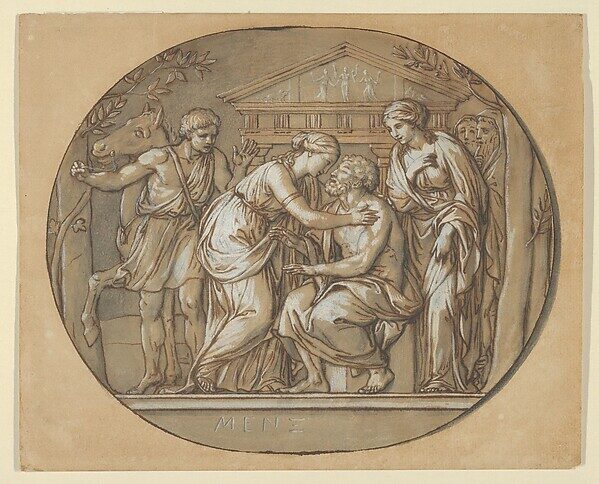
Laius, king of Thebes, and his queen Jocasta were warned by the oracle of Apollo at Delphi that any son born to them would grow up to kill his own father. When Jocasta bore a boy, the terrified Laius resolved to destroy the child before the prophecy could take root. He had the infant's ankles pierced and pinned together — the wound that would give the child his name, Oidipous, "swollen-foot" — and gave the baby to a herdsman to be carried up onto the wild slopes of Mount Cithaeron and left exposed to die of cold and hunger. But the herdsman, pitying the helpless child, could not do it. He gave the baby instead to a shepherd of Corinth, and so the infant meant for death on the mountain was carried over the hills into another kingdom, and raised in the palace of Polybus, king of Corinth, and his queen Merope, who had no child of their own and brought him up as their own son and heir. Oedipus grew to manhood in Corinth never doubting that Polybus and Merope were his true parents.
The crossroads: the killing in ignorance
(Content note: parricide, committed unknowingly.) A drunken man at a feast one day taunted the young Oedipus that he was not truly the son of Polybus. Shaken, Oedipus went — as his true father had once gone — to Delphi, to ask the oracle who his parents were. The god gave him no answer to that question, but something far worse: he was fated to kill his own father and to marry his own mother. Horrified, and believing Polybus and Merope of Corinth to be his parents, Oedipus resolved never to return home, so that he could never bring such horror upon the two people he loved. He set out on the road away from Corinth. At a narrow place where three roads met — a crossroads in Phocis, on the way from Delphi — he met an older man riding in a chariot with his attendants. The two quarrelled over the right of way; the older man struck at Oedipus, and Oedipus, in the heat of the moment, killed him and all but one of his companions. He did not know, and could not have known, that the arrogant stranger he had killed at the crossroads was Laius, king of Thebes — his own father. The first half of the prophecy was fulfilled, and Oedipus walked on toward Thebes believing he had left his fate behind him in Corinth.
The riddle of the Sphinx
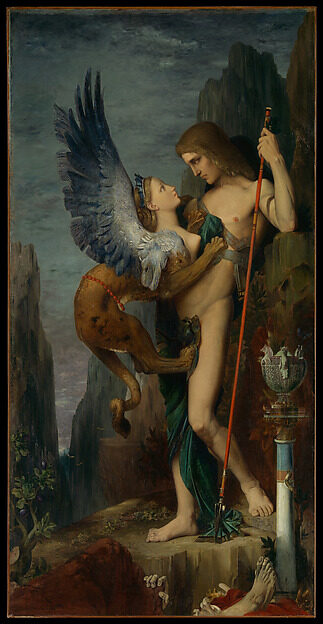
Thebes, at this time, lay under the terror of the Sphinx — a monster with the face of a woman, the body of a lion, and the wings of a bird, sent (the poets said) as a scourge upon the city. She sat upon a rock outside the walls and put to every passer-by a riddle, and devoured all who could not answer it, so that the road to Thebes was a road of death. The riddle she posed was this: "What is it that walks on four legs in the morning, on two legs at noon, and on three legs in the evening?" Traveller after traveller had failed and been killed. When Oedipus came to Thebes on his road from the crossroads, he faced the Sphinx and gave the answer no one else had found: Man — who crawls on all fours as an infant in the morning of his life, walks upright on two legs in his prime, and leans on a staff, a third leg, in the evening of old age. At the sound of the true answer the Sphinx, undone, threw herself from her rock to her death, and the city was free. (The Sphinx has her own page in this encyclopedia; her fuller story is told there.) The grateful Thebans, whose king Laius had lately been killed on the road by persons unknown, gave Oedipus the reward of the deliverer: the vacant throne of Thebes, and the hand of the widowed queen, Jocasta. So Oedipus married the woman who had borne him, and the second half of the prophecy came quietly true — and for years neither he nor she knew it. They ruled Thebes together and had children, and the city prospered, and the horror slept.
The discovery: the plague, the search, and the truth
(Content note: what follows is the unravelling of the incest and parricide, and ends in suicide and self-mutilation.) This is the action of Sophocles' Oedipus Tyrannus, the greatest of the Greek tragedies. Years into his reign, a devastating plague falls upon Thebes — the crops fail, the flocks die, women die in childbirth, and the city withers. Oedipus, the good king who once saved Thebes from the Sphinx, sends to Delphi to learn the cause, and the oracle answers that the plague will not lift until the unpunished murderer of the old king Laius is found and driven out of the land. Oedipus, not dreaming that he himself is the man, throws the whole force of his sharp mind and his royal will into the hunt for the killer, pronouncing a solemn curse upon the murderer and swearing to expose him whoever he is. He summons the blind prophet Teiresias, who knows the truth and begs not to speak it; goaded and accused by the furious king, Teiresias at last flings it in his face — you are the man you seek — and Oedipus, unable to believe it, takes it for the slander of a plot against his throne. Step by step, against the pleading of Jocasta, who begins to see the truth before he does and implores him to search no further, Oedipus drags the facts into the light: the herdsman who was to have exposed the infant on Cithaeron, and the Corinthian who received him, are brought together, and their two halves of the story lock into one. Oedipus learns that he is the exposed child of Laius and Jocasta; that the stranger he killed at the crossroads was his father; that the wife he loves is his mother; and that his own children are his brothers and sisters. Jocasta, unable to bear it, goes into the palace and hangs herself. Oedipus, breaking in and finding her dead, takes the golden brooches from her gown and drives them into his own eyes, blinding himself — because, he says, he cannot bear to look upon the father and mother he has wronged, nor upon the children of his cursed marriage, nor upon the city he has ruined; the man whose great gift was sight and knowledge puts out his own sight, having at last seen too much. Blinded and broken, he begs to be cast out of Thebes, the polluted thing whose presence poisons the land.
The wandering exile and the death at Colonus
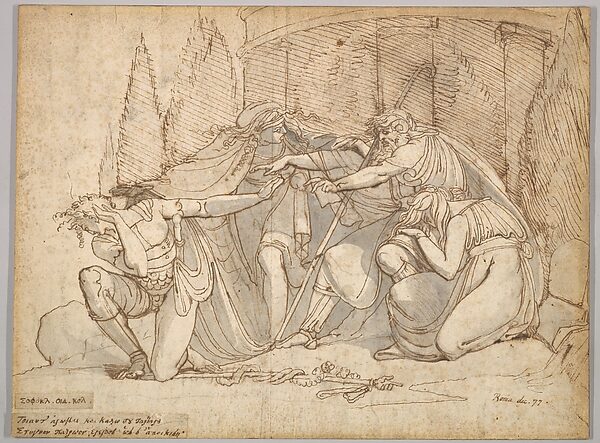
Sophocles returned to Oedipus at the very end of his own long life, in Oedipus at Colonus, and gave the ruined king a strange and luminous last chapter. Driven at length from Thebes, the blind old Oedipus wanders the roads of Greece as a beggar, an outcast whom no city wants, led and cared for through all his exile by his faithful daughter Antigone, who has given up her own youth to be her father's eyes. At last his wandering brings him to Colonus, a village just outside Athens, to a sacred grove belonging to the Eumenides — the "Kindly Ones," the awful goddesses of vengeance addressed by a soothing name. There a new oracle has told him his sufferings will end: this is the place appointed for his death, and the land that receives his body will be blessed by it. The Athenian king Theseus, alone among rulers, takes the polluted outcast in with honour and promises him protection. And there, at the last, the gods call Oedipus to them: a voice out of heaven summons him, and the blind old man, suddenly sure-footed, leads the way himself into the grove, and there — with only Theseus permitted to witness it, in a manner no one could afterward describe — he vanishes from the earth, taken by the gods in a death without pain, without a body, without a tomb that any but the king of Athens would ever know. The wretched exile whom his own city cast out passes, at the end, into something like sanctity, and his hidden grave becomes a lasting protection for Athens that sheltered him.
The curse on his sons and the road to Thebes
Before he was taken, the exiled Oedipus laid a terrible curse upon his two sons, Eteocles and Polynices, who (in the tragic tradition) had thrust their father out and quarrelled over his throne, valuing power above the duty they owed him. He cursed them that they should divide their inheritance by the sword and die each at the other's hand. That curse becomes the seed of the next great Theban tragedy: the two brothers agree to rule Thebes in alternate years, Eteocles refuses to yield his turn, and Polynices marches on the city with six allied champions in the war of the Seven Against Thebes. The brothers meet in single combat before the walls and kill each other, exactly as their father's curse foretold — and the aftermath, in which their uncle Creon forbids the burial of the traitor Polynices and Oedipus's daughter Antigone defies him to bury her brother, is the matter of Sophocles' Antigone. So the doom of the house of Laius, set in motion by the oracle before Oedipus was born, runs on past his own strange death into the generation of his children.
Worship — Ancient
Hero, not god
Oedipus was never a god, and was not worshipped as one. He belonged to the class of the heroes — the mighty dead whose tombs were held to hold power, who could bless or blight the living, and who received cult at their graves rather than the sky-facing sacrifices of the Olympians. What is remarkable in Oedipus's case is that a man defined by pollution — the parricide, the incest, the self-blinding, the curse — should become, in death, a source of protective power. This is the paradox at the heart of his hero-cult, and Greek religion embraced it: the very defilement that made him an outcast in life made his buried body a thing of dreadful potency, a talisman that a city would fight to possess.
The hero-cult at Colonus
The clearest and most famous form of his cult is the one Sophocles dramatises in Oedipus at Colonus — the poet's own deme, the village of Colonus just north of Athens. There, in the sanctuary of the Eumenides, Oedipus was honoured as a hero whose hidden grave protected Attica. The logic of the play is the logic of the cult: Oedipus promises Theseus that his body, secretly buried, will be a defence for Athens, worth more than many shields, turning back invaders from the land that holds it — and in return he receives the honours of a hero. The secrecy of the grave's location, known only to the reigning king and passed from king to king, is itself a cultic motif, guarding the source of the land's protection from any enemy who might seek to steal or neutralise it. That a hero-cult of Oedipus existed at Colonus is the historical ground on which Sophocles, a native of the place, built his last and strangest play.
Thebes, Boeotia, and the contested bones
In his own country, Thebes and the wider region of Boeotia kept their own memory of Oedipus. The early epic tradition — already visible in Homer, where funeral games are held for the fallen Oedipus at Thebes (Iliad 23.679–680) — assumed a Theban death and burial, and later writers record disputes over where his bones lay and which community had the right and the benefit of them. Such quarrels over a hero's remains were common in the Greek world precisely because possessing a great hero's tomb was believed to bring protection and good fortune; the traveller Pausanias, centuries later, still recorded competing local traditions about Oedipus's resting place. Whether at Colonus or in Boeotia, the shape of his cult is the same: honours at a tomb, offerings poured to a powerful and dangerous dead man, and a community trusting in the buried hero's guardianship.
Worship — Modern
A tragic hero, remembered rather than petitioned
Oedipus is a hero and not a god, and a tragic hero at that, so modern Hellenic practice honours him — where it honours him at all — in a wholly different key from an Olympian. He is not a deity to be asked for favours, but a figure to be remembered with pity and awe: the pattern of the noble mind broken by a fate it did not choose, and, at the very last, the outcast strangely redeemed. A devotee drawn to his story might keep his memory as one keeps the memory of the great dead — with a lamp lit, a libation poured to the earth in the manner owed to a hero, and above all with the telling of his story, which is the honour the Greeks believed a hero most desired.
Offerings and remembrance
Following the ancient shape of hero-cult, gifts to a hero are poured out at ground level, given to the earth and to the dead rather than raised to the sky-gods: a libation of water, honey, or wine poured onto the ground and not taken back is the simplest and most fitting offering. Because Oedipus's end at Colonus lay in the grove of the Eumenides, and because his whole story is one of pollution finally laid to rest, remembrance of him carries naturally a note of reconciliation — of grief acknowledged, wrongs suffered and outlived, and peace reached at the end of a hard road. Those who care for an ageing or afflicted parent, as Antigone cared for her blind father through all his exile, may find in that devotion a truer tribute to his story than any formal rite.
Legacy in tragedy and beyond
More than through any cult, Oedipus lives on as the central figure of Western tragedy. Sophocles' Oedipus Tyrannus was held by Aristotle in the Poetics to be the model of the tragic form — its relentless movement from ignorance to knowledge, its reversal and recognition falling in the same stroke, the very definition of what tragedy could do. His name has passed into ordinary speech and into psychology through Freud's "Oedipus complex," a modern reuse (many would say misuse) of the myth that has kept his name current far beyond the study of the classics. And his deeper questions — how much of a life is chosen and how much appointed, whether a man can be guilty of a crime he could not have known he was committing, and what it means to see the truth too late — are asked again in every age. To read his story is to meet the oldest and sharpest form of a question that has never been answered: how free are we, really, and how much do we simply walk, open-eyed, into the fate that was always waiting at the crossroads.
Epithets & Cult Titles
- Tyrannos (Τύραννος) — The King, the ruler — the title of Sophocles' great play (Oedipus Tyrannus), naming the man who won Thebes not by inheritance but by his own act, the ruler whose very kingship rested on the deed that would destroy him
- Oidipous, 'Swollen-foot' — The name itself as an epithet — the mark of the pierced ankles carried from the cradle to the grave, so that his body bore the sign of his fate before he could speak
- The Riddle-Solver — A descriptive title for the man who answered the Sphinx and freed Thebes — the one whose sharp mind conquered the monster and yet could not, until too late, read the riddle of his own birth
- Oidipous Kolonos, the Hero of Colonus — Of Colonus — the sanctified wanderer whose mysterious death in the grove of the Eumenides made his tomb a hidden blessing and protection for the land that received him
Sources & Variants
- Homer, Odyssey 11.271–280 (Epikaste/Jocasta and Oedipus in the underworld; her suicide, his continued rule at Thebes); Iliad 23.679–680 (funeral games for Oedipus at Thebes)
- Sophocles, Oedipus Tyrannus (the plague, the investigation, Teiresias, the herdsman, the recognition, Jocasta's suicide, and Oedipus's self-blinding with the golden brooches)
- Sophocles, Oedipus at Colonus (the blind exile led by Antigone, the grove of the Eumenides, the protection of Theseus and Athens, and the mysterious sanctified death); Antigone (the aftermath of the sons' war and the burial of Polynices)
- Aeschylus, Seven Against Thebes (the curse of Oedipus fulfilled in the mutual slaying of Eteocles and Polynices)
- Euripides, Phoenician Women (a fuller dramatic account of the fall of the house of Oedipus, the brothers' quarrel, and the war of the Seven)
- Hesiod, Theogony 326–329 (the Sphinx, Phix, as a scourge sent upon the Thebans); Works and Days 162–163 (heroes who died fighting at seven-gated Thebes)
- Apollodorus, Bibliotheca 3.5.7–9 (the connected narrative: Laius' oracle, the exposure and pierced ankles, Polybus and Merope of Corinth, the crossroads killing, the riddle of the Sphinx, the marriage to Jocasta, and the discovery)
- Pausanias, Description of Greece 1.28.7 and 1.30.4 (Colonus, the sanctuary of the Eumenides, and the Athenian hero-honours of Oedipus); 9.5.10–11 (Theban traditions of Oedipus and the dispute over his burial)
- Aristotle, Poetics 11, 13–14 (Oedipus Tyrannus as the model of tragic reversal and recognition)
Gallery