Minōtauros
First Appearance
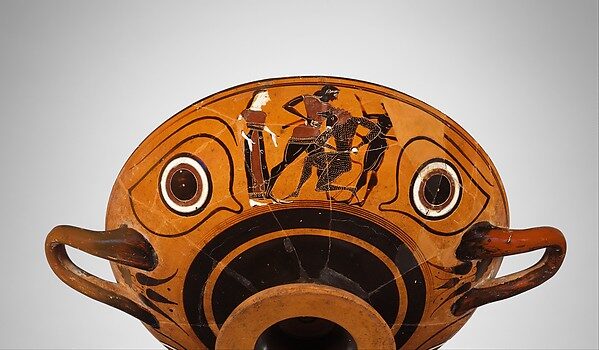
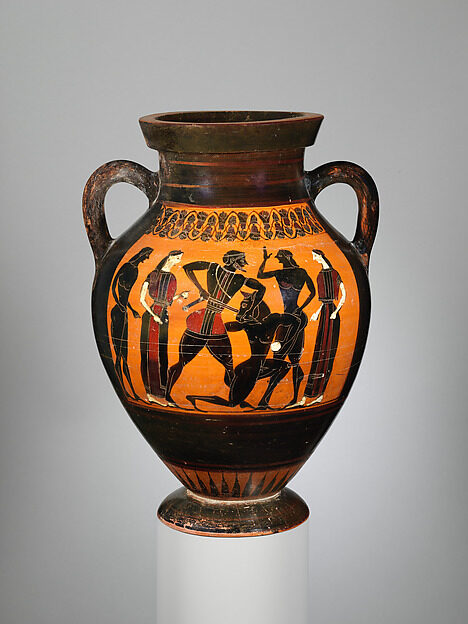
The Minotaur is one of the oldest images in Greek art before he is a fixed figure in surviving text: the fight of a hero against a bull-headed man appears on Cretan and mainland shield-bands and painted vases from the seventh century BCE, and the tribute-voyage of the Athenian youths to Crete is sung by Bacchylides in his seventeenth ode (early fifth century BCE). Homer already knows the world he belongs to — Knossos, Minos, Ariadne, and the dancing-floor Daedalus built (Iliad 18.590–592) — though he never names the monster. The fullest surviving account of the Minotaur's conception, his imprisonment in the Labyrinth, and his death is the mythographer Apollodorus (Bibliotheca 3.1.3–4), who alone records his real name: "she bore Asterius, who was called the Minotaur. He had the face of a bull, but the rest of him a man's."
— Greek art from the 7th century BCE (Theseus and the Minotaur on shield-bands and vases); Bacchylides 17; Apollodorus, Bibliotheca 3.1.3–4
Who They Are
The Minotaur (MIN-oh-tor / my-NOH-tor) is remembered as a monster, but his story is really the story of a prisoner. Behind the horns and the bull's face is a creature who chose nothing that made him what he was — conceived by a curse he did not ask for, born to a mother who could not love the sight of him, and shut away at birth in a lightless maze so that no one would ever have to look at him again. He is the most sympathetic of the Greek monsters precisely because he is the most passive: he does not hunt, he does not scheme, he does not leave his prison. He waits in the dark at the centre of the Labyrinth for the food that is walked in to him, and in the end he is killed in his sleep, or cornered, by a hero the whole world would rather remember. His birth-name, before terror gave him another, was Asterion — "the starry one" — a name for a child who would never once see a star.
His parentage is a scandal and a tragedy in equal measure, and it belongs entirely to others. His mother was Pasiphaë, queen of Crete and a daughter of the sun-god Helios; his father was not a man at all but a bull — the great white Cretan Bull that Poseidon sent up out of the sea. The Minotaur is thus the living evidence of a god's revenge and a king's broken promise, a shame made flesh that the king could neither kill nor acknowledge. So Minos hid him. The half-bull, half-man was walled into the Labyrinth, the inescapable maze built by the craftsman Daedalus, and there he became the dark engine of Crete's power over Athens: every so often a shipload of young Athenians was sent into the maze to be devoured, until a prince came who did not come back out the way the others had.
The Greeks told his tale as the tribute-story of Theseus, and the monster is usually only the obstacle at its centre. But the Minotaur has never quite stayed in that role. Even in antiquity his name — Asterion, the star — kept a strange tenderness about it, and the modern imagination has returned to him again and again not as the thing in the maze but as the one trapped inside it: Dante set him snarling at the edge of Hell, Picasso drew him a hundred times as a suffering, half-human creature, and Borges gave him a voice at last in a short story where the monster, lonely and gentle and slow, waits with something like hope for the one who will finally come to release him. To tell his story fairly is to tell it from the inside of the Labyrinth as well as the outside.
Mythology
The bull from the sea and the vow Minos broke
The Minotaur's whole existence hangs on a promise a king did not keep. When Minos was contending with his brothers for the throne of Crete, he claimed that the gods themselves had granted him the kingship, and to prove it he prayed to Poseidon to send a bull up out of the sea — vowing that he would sacrifice the animal to the god the moment it appeared. Poseidon sent a bull of extraordinary beauty, a great gleaming beast rising from the waves, and the sign did its work: Minos took the throne. But when the time came to make good on his vow, Minos could not bear to give up so magnificent an animal. He put it among his own herds and sacrificed a lesser bull in its place, keeping the god's bull for himself. Poseidon, cheated of what had been sworn to him, took a slow and terrible revenge — and the punishment fell not on Minos's body but through his household.
Pasiphaë and the wooden cow
(Content note: this origin turns on Poseidon's curse compelling an unwilling queen into a union with an animal; the account below is frank but not graphic.) Poseidon's vengeance was to twist desire itself. He caused Minos's wife, Queen Pasiphaë, to be seized by an overpowering and unnatural passion for the bull from the sea. (In a variant tradition the wrath is Aphrodite's rather than Poseidon's — the goddess punishing the daughters of Helios because the sun-god had exposed her affair with Ares — but the outcome is the same.) Tormented and unable to master the longing the god had planted in her, Pasiphaë turned to Daedalus, the brilliant Athenian craftsman then in exile at the Cretan court. Daedalus built for her a hollow wooden cow, cunningly covered in a real hide and mounted on wheels, and set it in the meadow where the bull grazed; Pasiphaë concealed herself inside it, and so the bull mated with her, taking the wooden cow for a real one. From that union she conceived. The child she carried was neither wholly bull nor wholly human — a body that came into the world already a scandal, already something to be hidden.
Asterion, the child named for the stars
Pasiphaë bore a son with the head and often the tail of a bull upon the body of a man, and she named him Asterion — "the starry one." It is the most quietly heartbreaking detail in the whole myth: the name of a mother who, for a moment, tried to love the child she had borne, and gave him a name fit for the grandson of the Sun. But Crete could not have such a creature in the daylight. He was living proof of Poseidon's curse and of Minos's broken faith, an heir to the throne who could never be shown, and as he grew he grew dangerous, for he would eat nothing but human flesh. The name Asterion faded, and in its place the people gave him the only name history kept — Minotauros, "the Bull of Minos" — as though he were not a person but a possession, the king's animal, the king's shame. Consulting an oracle on what to do with him, Minos was told to shut the creature away where he could never be found.
The Labyrinth
For this Minos again turned to Daedalus, and the craftsman built the thing his name has been bound to ever since: the Labyrinth (Λαβύρινθος), a structure of such intricate and winding passages that whoever entered it could never find the way out again. Ovid describes Daedalus confounding the usual marks of direction and leading the eye astray with a maze of turnings, so that the maker himself could scarcely return to the entrance he had made. Somewhere at the unreachable centre of this maze the Minotaur was walled in — sealed away from the sun and from every human face, fed on the only food that would keep him, and left to pace the dark. Whatever else the Labyrinth was, for him it was a prison and a life sentence, imposed for the circumstances of his birth. The later Greeks and Romans placed the Labyrinth at Knossos, the seat of Minos's power, and the very word became the name for any inescapable maze.
The tribute of Athens: seven youths and seven maidens
The Minotaur might have remained only a family secret walled up in Crete, but for a death far away. Minos's son Androgeos was killed while visiting Athens — cut down out of envy after winning every event at the Panathenaic games, some said, or destroyed by the very Cretan Bull that Athens's king set him against. In grief and fury Minos made war on Athens, and when the city was brought low (by his fleet, by plague, by famine, the sources differ), he imposed a monstrous peace. At fixed intervals Athens was to send seven youths and seven maidens — its finest young people, chosen by lot — as tribute to Crete, where they were driven into the Labyrinth to be devoured by the Minotaur. (How often the tribute fell is disputed even in antiquity: Apollodorus says every year, while Plutarch reports the more famous tradition of once every nine years, "the third year." Either way, it was a horror renewed on schedule.) So the imprisoned creature became the instrument of a kingdom's terror: a caged thing weaponised against a rival city, fed on the children of the conquered. It is worth seeing plainly that the youths were sent to be eaten — the tribute is a story of human sacrifice — and that the Minotaur at the centre of it was, in his way, as much used by Minos as the Athenians were.
Theseus, Ariadne, and the thread
The tribute ended when a prince chose to become one of the fourteen. Theseus of Athens — whose own story is told on his page — sailed to Crete among the tribute-youths, determined to kill the monster and break the tax of blood. In Crete, Ariadne, the daughter of Minos, fell in love with him and gave him the means to do what no victim before him had managed: a ball of thread (the famous "clew"), which he tied at the entrance and unwound as he went, so that after killing the Minotaur deep in the maze he could follow the line back out to the light. The killing itself the ancient sources pass over quickly — Theseus overcomes the creature with his hands, or with a sword smuggled in, in the heart of the Labyrinth — and it is Theseus, not his victim, whom the story is built to celebrate. For the Minotaur it is simply the end: the prisoner is finally killed in his prison, and the hero walks back out along the thread. (The rest — Ariadne carried off and abandoned, the black sails, the death of Theseus's father Aegeus — belongs to Theseus's story, not the monster's.)
The prisoner at the centre
Strip the tale to what the Minotaur himself does, and almost nothing remains: he is conceived, named, hidden, fed, and killed. He commits no crime that he was not made and placed to commit; he never leaves the maze; he is, from first to last, something that is done to rather than something that acts. This is why, of all the monsters the Greeks imagined, he is the one the later imagination has most wanted to pity. The Athenians he ate make him a horror — but they were sent to him, walked into his darkness by his father the king as an act of state. His mother's crime was a god's curse; his father's crime was another king's broken vow; his own "crime" was only to have been born of them. Asterion the starry one lived his whole life underground and died in the dark, and the world remembered him as a beast. The truest note of his myth is the one the storytellers almost never sound but that his very name insists on: that the monster in the maze was, before anything else, a prisoner.
Worship — Ancient
A monster, not a god — but rooted in a real place
The Minotaur received no cult; he was a creature to be killed, not a power to be honoured, and there were no altars, priests, or festivals in his name. But unlike most Greek monsters he is bound tightly to a real and remembered place — Knossos on Crete — and the ancient traditions about him are inseparable from a genuine memory of Cretan greatness. To the Greeks of the classical age, Crete was the site of a fabulously old and powerful kingdom that had ruled the seas under Minos before their own history began, and the Minotaur and his Labyrinth were, in part, how they explained the ruined grandeur they could still see there.
The Labyrinth and the palace of Knossos
When the Greeks pictured the Labyrinth, they set it at the palace of Minos at Knossos, and the modern rediscovery of that palace goes some way to explaining why. The Bronze Age Minoan complex excavated at Knossos was a vast, many-storeyed, densely interconnected warren of rooms, corridors, light-wells, and storerooms — a building genuinely bewildering to move through, and adorned throughout with the imagery of the bull. Whether or not any specific "maze" existed, a Greek visitor to those crumbling, labyrinthine ruins would have found the story of an inescapable house entirely believable. The word labyrinthos itself is pre-Greek and Cretan in origin, one of the old Aegean words the Greeks inherited rather than coined, which anchors the whole tradition in a real, pre-Hellenic Cretan past.
The resonance of the bull
Above all, the Minotaur belongs to a world saturated with the sacred bull. Minoan Crete has left us its famous frescoes and figurines of bull-leaping, in which young athletes vault over the horns of a charging bull, and the great stylised "horns of consecration" that crowned its shrines — evidence of a bull-centred religion whose exact meaning is lost but whose imagery is unmistakable. The Greek myth of a bull-man at the heart of Crete, fed on youths who dance and grapple with him in his enclosure, reads like a dark folk-memory of that vanished bull-cult, refracted through the fears of the mainland Greeks about the older civilisation that had once dominated them. In ancient reception the monster appears constantly in art — the contest of Theseus and the Minotaur was one of the most popular subjects in Greek vase-painting and sculpture for centuries, and Pausanias records the pair worked into monuments as far apart as the throne of Apollo at Amyclae, where Theseus is shown leading the Minotaur alive and bound.
Worship — Modern
No cult — a symbol instead
There is no worship of the Minotaur, ancient or modern, and modern Hellenic practitioners do not venerate him; he belongs to the world of story rather than of devotion. What he has instead is an extraordinarily long afterlife as a symbol — of the monstrous, of the trapped and divided self, of the labyrinth of the mind — and few figures from Greek myth have been reimagined as often or as sympathetically.
From Hell's gate to a suffering hero
In the Middle Ages Dante set the Minotaur (l'infamia di Creti, "the infamy of Crete") biting himself in rage at the broken cliff that guards the seventh circle of Hell (Inferno 12.11–25), the image of bestial fury. But the modern imagination has turned steadily toward pity. The greatest of these returns is Pablo Picasso's, who over the 1930s drew and etched the Minotaur obsessively — in the Vollard Suite and the great etching Minotauromachy (1935) — as a creature of suffering, tenderness, blindness, and desire, at times a monster and at times almost a self-portrait, so that the bull-man became one of the defining images of twentieth-century art. G. F. Watts had already painted him in 1885 as a brooding, melancholy figure leaning on a parapet, crushing a small bird in his hand.
Giving the monster a voice
The decisive modern move has been to let the Minotaur speak. Jorge Luis Borges' short story "The House of Asterion" (1947) is narrated by the monster himself — lonely, slow, strangely innocent, calling the Labyrinth his house and waiting with quiet longing for a "redeemer" to come, so that only in the final line do we realise we have been listening to the Minotaur await Theseus and his own death. That sympathetic frame runs on through modern literature: Mary Renault's Theseus novels, Steven Sherrill's The Minotaur Takes a Cigarette Break, and Friedrich Dürrenmatt's Minotaurus, among many others, all return to the creature imprisoned for the accident of his birth.
The labyrinth outlives the monster
The Minotaur's prison has arguably outlasted the Minotaur. The labyrinth became one of the most durable symbols in Western culture — laid into the floors of medieval cathedrals such as Chartres as a walkable path of pilgrimage, and used ever since as a metaphor for any bewildering, inescapable complexity, from the maze of the unconscious to the corridors of a bureaucracy. (The much-repeated idea that labyrinthos derives from labrys, the Cretan double-axe found throughout the Knossos palace, is a modern hypothesis associated with the excavator Arthur Evans and is disputed by linguists, who take the word as a pre-Greek borrowing of unknown root — a caution worth keeping.) Whatever its origin, the word and the monster at its heart remain among the most recognisable inheritances of Greek myth, and the starry-named prisoner still stands, in the modern retellings, less as a beast to be slain than as a soul to be understood.
Epithets & Cult Titles
- Asterios / Asterion (Ἀστέριος / Ἀστερίων) — The starry one — from ἀστήρ (astēr, 'star'). Apollodorus preserves this as his true given name: 'she bore Asterius, who was called the Minotaur.' It is a poignant name for a creature who never saw the sky, and it may echo his grandfather Helios and the earlier Cretan king Asterion who raised Minos
- Minotauros (Μινώταυρος) — The Bull of Minos — the descriptive by-name that swallowed his birth-name entirely. He is remembered not as a person with a name but as a possession of the king who caged him: the bull that belonged to Minos
- semibos vir / semivir bos — The half-bull man and the half-man bull — Ovid's neat chiastic tag for him (Ars Amatoria 2.24), catching the exact horror of the hybrid: neither wholly one thing nor the other, a body that language itself cannot settle
- the Cretan monster (Cretaeum monstrum) — A descriptive title used by the Roman poets (e.g. Ovid, Metamorphoses 8.156) — the shame and terror of Crete, the thing hidden at the island's heart
Sources & Variants
- Apollodorus, Bibliotheca 3.1.3–4 (Minos's broken vow, Poseidon's curse, Daedalus's wooden cow, the birth of Asterius called the Minotaur, and the building of the Labyrinth); 3.15.7–8 and Epitome 1.7–11 (Androgeos, the war with Athens, the tribute of youths, Theseus, Ariadne, and the thread)
- Diodorus Siculus, Library of History 4.13.4 (the Cretan Bull); 4.77.1–5 (Daedalus, Pasiphaë's passion, the wooden cow, and the Labyrinth)
- Bacchylides, Ode 17 (Dithyramb 3, 'The Young Men, or Theseus') — the tribute-youths sailing to Crete (early 5th century BCE)
- Plutarch, Life of Theseus 15–19 (the tribute and its disputed frequency, the voyage, the Minotaur, Ariadne, and rationalising variants)
- Catullus 64.50–264 (the ekphrasis of Ariadne on the coverlet, recounting Theseus's slaying of the Minotaur and Ariadne's abandonment) — Roman
- Ovid, Metamorphoses 8.152–182 (Pasiphaë, Daedalus and the Labyrinth, Theseus and Ariadne's thread); Ars Amatoria 1.289–326 (Pasiphaë) and 2.24 ('semibovemque virum semivirumque bovem'); Heroides 10 (Ariadne's letter) — Roman
- Virgil, Aeneid 6.14–30 (Daedalus at Cumae; the doors depicting Pasiphaë, the Labyrinth, and the Athenian tribute) — Roman
- Hyginus, Fabulae 40 (Pasiphaë and the Minotaur), 41–43 (the tribute, Theseus, Ariadne, and Daedalus)
- Homer, Iliad 18.590–592 (the dancing-floor Daedalus made for Ariadne at Knossos); Odyssey 11.321–325 (Ariadne, daughter of Minos)
- Pausanias, Description of Greece 1.27.9–10 (the Cretan/Marathonian bull) and 3.18.11 (Theseus leading the bound Minotaur, on the throne of Apollo at Amyclae)
- Dante, Inferno 12.11–25 (the Minotaur at the edge of the seventh circle) — medieval reception
- Jorge Luis Borges, 'The House of Asterion' (1947) — the Minotaur's own first-person voice — modern reception
Gallery