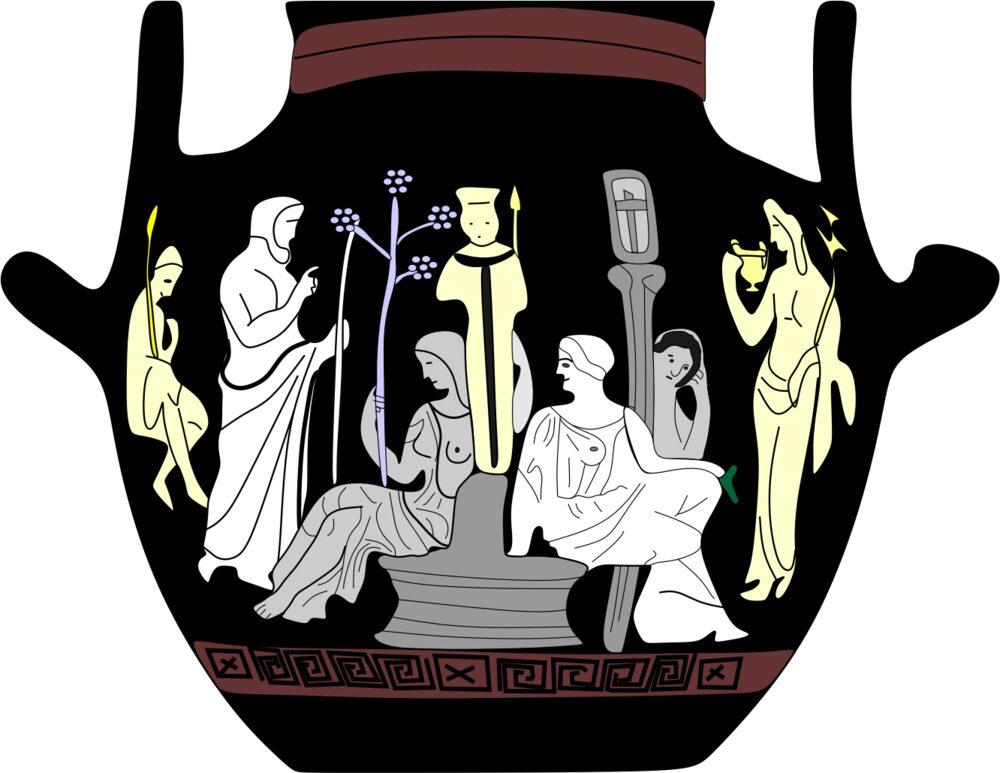
Melampous
First Appearance
Melampus enters Greek poetry in the Odyssey, where the wandering of Odysseus crosses the older story of the seer. In the catalogue of famous women in the underworld (Odyssey 11.287–297) Homer tells how Neleus would give his daughter Pero only to the man who could drive off the cattle of Iphiclus from Phylace — a deadly feat that "the blameless seer" alone undertook, for his brother's sake, and though he was bound a year in hard bondage he came through by his prophetic craft and won the cattle. The fuller notice at Odyssey 15.225–242 names him outright: Melampus, who once dwelt rich in Pylos, fled the violence of Neleus, endured grievous bondage for Neleus's daughter, escaped death, and drove the lowing cattle from Phylace to Pylos — founding there a line of seers that ran down to Theoclymenus, the prophet who boards Telemachus's ship.
— Homer, Odyssey 11.287–297 and 15.225–242
Who They Are
Melampus (MEL-am-pus), whose name means "Black-foot," is remembered as the first mortal seer — the man through whom the gift of prophecy entered the human race, and the founder of the great hereditary clan of diviners, the Melampodidae, who carried his blood and his craft down the generations. Where other heroes are known for strength or daring, Melampus is the hero of understanding: he could comprehend the speech of all living creatures — birds, insects, the very worms boring in a beam — and from their talk he read what was hidden and what was to come. To this listening gift he joined a direct line of divination from Apollo, the god of prophecy, so that both wings of Greek seercraft, the reading of signs and the god-given word, met in him.
His power had a gentle origin. Finding a brood of young serpents whose parents had been killed, Melampus did not fear or destroy them but reared the orphaned snakes with care; and the grateful serpents, as he slept, crept to him and licked his ears clean with their tongues, so that when he woke he found he could understand the voices of all the animals of the air and earth. From that waking he was a seer. It is one of the loveliest of the Greek accounts of how a man comes to prophecy — not seized or stricken, but given the gift as thanks for a mercy shown to the helpless young.
Two great stories carry his fame: how, imprisoned over a stolen herd, he overheard the woodworms in the roof foretell the collapse of the house and so saved himself, winning his freedom, the cattle, and a bride for his brother; and how he healed the daughters of Proetus and the maddened women of Argos, driven out of their minds to roam the hills as though they were cattle, curing them with the black hellebore and a ritual pursuit, and taking in payment a share of a kingdom. By that cure Melampus and his brother became kings in Argos, and his descendants ruled and prophesied there — the seer who began by listening to serpents ending as the founder of a royal and prophetic house.
Mythology
How he came to understand the animals
Melampus gained his seer's power through an act of kindness. He came upon a brood of young serpents whose parent snakes had been killed — in the common telling his own servants had slain the old ones at the foot of an oak — and rather than leave the orphaned brood to die he took them up and reared them with care, and gave the dead their due of burning. When the young serpents were grown they repaid him: as Melampus lay sleeping they crept up on either side of his head and with their flickering tongues licked his ears clean. He woke in terror — and found that he could understand the speech of every creature that flew or crept or crawled, the birds of the air, the insects, the worms within the wood. From the talk of the animals he learned to read the hidden and the coming thing, and so became a seer (Apollodorus, Bibliotheca 1.9.11). To this listening gift he joined divination of the ordinary Greek kind, the reading of omens at the altar; and tradition held that he received prophecy from Apollo himself, the god of the oracle, so that in Melampus the two streams of seercraft — the understanding of signs and the god-given word — ran together.
The cattle of Phylacus and the worms in the beam
The first great proof of his gift is bound up with his brother's love. Melampus's brother Bias desired Pero, the daughter of Neleus of Pylos, but Neleus would give her only to the man who could carry off the cattle of Phylacus (the herd of Iphiclus) from Phylace in Thessaly — beasts guarded by a sleepless dog that no man could pass. Knowing by his art that whoever first attempted the theft would be caught and held a year, but would then succeed, Melampus undertook it for his brother's sake. He was seized in the act and shut up in a cell (Homer, Odyssey 11.287–297; Apollodorus, Bibliotheca 1.9.12).
There his power saved him. As the appointed year drew to its close, Melampus heard, in the roof above him, the woodworms boring in the timber talking among themselves: one asked how much of the beam was left to gnaw, and the answer came that it was all but eaten through, and the beam would fall that very night. At once Melampus called to his keepers to carry him and his bed to the far side of the chamber. No sooner had they moved him than the beam came crashing down where he had lain. Phylacus, hearing that his prisoner had foretold the fall, knew him for a true seer and asked his help: his son Iphiclus was childless, and longed for sons. Melampus promised to find the cause in return for the cattle. By sacrifice and the reading of birds he learned the remedy — in the fullest telling (Apollodorus, Bibliotheca 1.9.12), a vulture revealed that Iphiclus's barrenness came of a childhood fright, when his father had set a bloodied gelding-knife in a sacred tree; the rust of that knife, scraped and drunk in wine over ten days, would cure him. It did; Iphiclus got a son, and Melampus took the cattle, drove them to Pylos, and won Pero as a bride for Bias — exactly as he had foretold.
The healing of the daughters of Proetus
Melampus's most famous deed was a great healing. Proetus, king of Tiryns and Argos, had daughters who were stricken with a wild madness — in one account because they scorned the rites of Dionysus, in another because they offended Hera — and in their frenzy they ranged over the countryside imagining themselves to be cattle, lowing and wandering the wilds; and the madness spread, until the women of Argos too were caught up in it, abandoning their homes and roaming the hills (Apollodorus, Bibliotheca 2.2.2; Herodotus 9.34). Melampus offered to cure them, but set his price: a share of the kingdom. Proetus at first refused so steep a fee, and while he delayed the madness only spread the wider and grew worse; so that in the end he was forced to come back and agree — and by then Melampus had raised his demand. He would heal them, he said, only for a third of the realm for himself and another third for his brother Bias. The king, with no better choice, consented.
Then Melampus worked the cure. He gathered the strongest of the young men and, with shouting and a wild inspired dance, drove the maddened women down out of the mountains — a ritual pursuit that answered their frenzy with a frenzy of healing. He purged them with purgings; tradition remembered the drug as hellebore, the bitter purging-herb, and the black hellebore was ever after called melampodion, "Melampus's plant," in his honour. The women were cleansed and restored to their right minds (the eldest of Proetus's daughters died in the pursuit, some said, but the rest were saved and given in marriage). So the madness was lifted from Argos, and Melampus had his price.
Kings and seers: the founding of the Melampodidae
By that cure Melampus and Bias became kings in Argos, holding two-thirds of the realm between them beside Proetus's own line, and their descendants reigned there for generations (Apollodorus, Bibliotheca 2.2.2; Pausanias 2.18.4). But Melampus founded more than a dynasty: he founded a line of seers. His blood carried the prophetic gift down the generations, and the clan of the Melampodidae — "the sons of Melampus" — were reckoned the hereditary diviners of Greece, among them the seer Amphiaraus and others who read the will of the gods for kings and armies. Through this line the Odyssey traces the prophet Theoclymenus, descended from Melampus, who foretells the doom of the suitors (Homer, Odyssey 15.225–256). Thus the man who first understood the serpents' gift became the ancestor of Greek prophecy itself, the fountainhead of a family craft.
The bringer of Dionysus and the first of the seers
Greek memory gave Melampus a still wider role. Herodotus (Histories 2.49) names him as the man who first taught the Greeks the name of Dionysus, his rites and the phallic procession, having learned them (Herodotus thought) from Egypt by way of Cadmus and the Phoenicians — "for Melampus was the one who introduced among the Greeks the name of Dionysus and the manner of his sacrifice and the phallic procession... being a wise man, he had acquired the art of divination." Whether or not the Egyptian derivation is believed, the notice shows how fully the Greeks regarded Melampus as a founder: of prophecy, of healing, and of a whole order of ritual. He stands at the head of the tradition as its first human master — the archetype of the seer who understands the speech of animals, and the father of all who came after.
Worship — Ancient
The ancestor of the seers
Melampus was honoured less as a god than as the revered founder-figure of Greek divination — the first mortal seer, whose name stood at the head of the prophetic tradition. His chief "cult" was the living institution of the Melampodidae, the hereditary clan of diviners who traced their descent and their art to him; to practise seercraft in that line was itself a kind of devotion to the ancestor. Where families or sanctuaries claimed his blood, his memory carried the authority of the craft's first master.
At Aigosthena and in Argos
Melampus did receive local cult as a hero. Pausanias records that at Aigosthena in the Megarid there was a sanctuary of Melampus with his statue, where the people held a yearly festival and sacrifice in his honour (Pausanias 1.44.5). In Argos, the land he had healed and ruled, his memory was woven into the city's own story: the Argives kept the tradition of his cure of their maddened women and of the kingship he and Bias held, and Pausanias (2.18.4) traces the royal houses of Argos through his descendants. So in the two places most bound to his legend — the Megarid shrine and the Argolid he governed — he was kept as a hero of the recent, founding past.
The plant that bore his name
A quieter memorial lived in the healer's craft. The black hellebore, the drug of his great cure, was called melampodion — "Melampus's plant" — by physicians and herbalists down the centuries, so that every purging of madness or melancholy with that herb named him unawares. In this he was remembered not only as prophet but as the first physician of the troubled mind, the pattern of the seer who is also a healer.
Worship — Modern
The seer who listens
Melampus speaks today to anyone drawn to the oldest image of the prophet — not the one who commands, but the one who listens. His gift came through attention and mercy: he spared the helpless young, and in return was given ears to understand the speech of all living things. A modern honouring of him sits well in the practice of careful attention to the natural world, in the reading of birds and weather and the quiet voices of creatures, and in the old conviction that wisdom comes to those who stoop to the small and the overlooked rather than to the loud and the strong.
Patron of the healer-diviner
Because his fame rests as much on healing as on prophecy, Melampus makes a natural patron of those who join the two — of herbal and psychological healing, of the care of troubled minds, and of the purging of what maddens and torments. The black hellebore that still bears his name, melampodion, keeps his memory in the physician's lore. His cure of the Argive women — frenzy answered not with punishment but with ritual, pursuit, and a cleansing drug — offers an old and humane image of madness healed rather than cast out.
The first of a long line
Above all Melampus is remembered as a beginning: the first mortal seer, the founder of a family of prophets, the man at the head of a tradition. For a devotee of the Greek seercraft he is the natural ancestor to invoke — the one through whom the gift first passed from the gods into human hands, and from whom, in the old reckoning, every true seer after him drew descent.
Epithets & Cult Titles
- mantis (μάντις) — Seer, diviner — the title that defines him; Greek tradition names Melampus the first mortal to possess the gift of prophecy and the founder of the whole art among men
- Melampous (Μελάμπους), 'Black-foot' — His name itself became an epithet of the seer-craft; the black hellebore used to purge madness was called melampodion ('black-foot plant') after him, the physician-prophet who first wielded it
- founder of the Melampodidae (Μελαμποδίδαι) — Father of the hereditary clan of seers who bore his name; from him descended a line of diviners — Amphiaraus, Polyidus and others were reckoned of his blood — so that he is the ancestor of Greek prophecy as a family inheritance
Sources & Variants
- Homer, Odyssey 11.287–297 (the cattle of Iphiclus at Phylace; the blameless seer bound a year who wins the herd and the bride for his kin)
- Homer, Odyssey 15.225–242 (Melampus named: his flight from Neleus, his bondage for Neleus's daughter, the driving of the cattle from Phylace to Pylos, and the line of seers descended from him down to Theoclymenus)
- Hesiod, Melampodia (the lost epic named for him, treating the deeds and lore of the great seers) and Catalogue of Women (his genealogy and the seer-line of the Melampodidae)
- Herodotus, Histories 2.49 (Melampus as the wise diviner who first taught the Greeks the name and rites of Dionysus) and 9.34 (the cure of the madness of the Argive women, and his bargain for a share of the kingdom for himself and Bias)
- Apollodorus, Bibliotheca 1.9.11–13 (how the serpents licked his ears so he understood the animals; the cattle of Phylacus, the worms in the beam, and the cure of Iphiclus's barrenness) and 2.2.2 (the madness of the daughters of Proetus and the women of Argos, the hellebore cure and the ritual pursuit, and the gift of two-thirds of Argos to Melampus and Bias)
- Pausanias, Description of Greece 2.18.4 (Melampus and his descendants among the royal houses of Argos) and 1.44.5 (his sanctuary, statue and yearly festival at Aigosthena)
Gallery