Kairos
First Appearance
Kairos is a late and deliberate personification — the Greeks had long spoken of kairos as a common noun for the 'right moment' (Hesiod already teaches that "due measure — kairos — is best in all things," Works and Days 694) before any poet made a god of it. The earliest known hymn to him as a deity was written by Ion of Chios in the fifth century BC; it does not survive whole, but Pausanias read it and reports that in it Ion made Kairos "the youngest of the children of Zeus" (Pausanias 5.14.9). From there the figure passed into the hands of the sculptor Lysippos, whose famous bronze fixed his strange allegory for all time.
— Ion of Chios, Hymn to Kairos (5th century BC), cited by Pausanias, Description of Greece 5.14.9
Who They Are
Kairos (KY-ross) is the god of the opportune moment — not time in general, but the single fleeting instant in which a thing may be done, the perfect opening that must be seized at once or lost forever. He is the youngest and strangest of the children of Zeus, a figure the Greeks invented less to tell stories about than to think with: a god made entirely of a lesson, the embodiment of the truth that opportunity comes swiftly, shows itself for only a breath, and does not return.
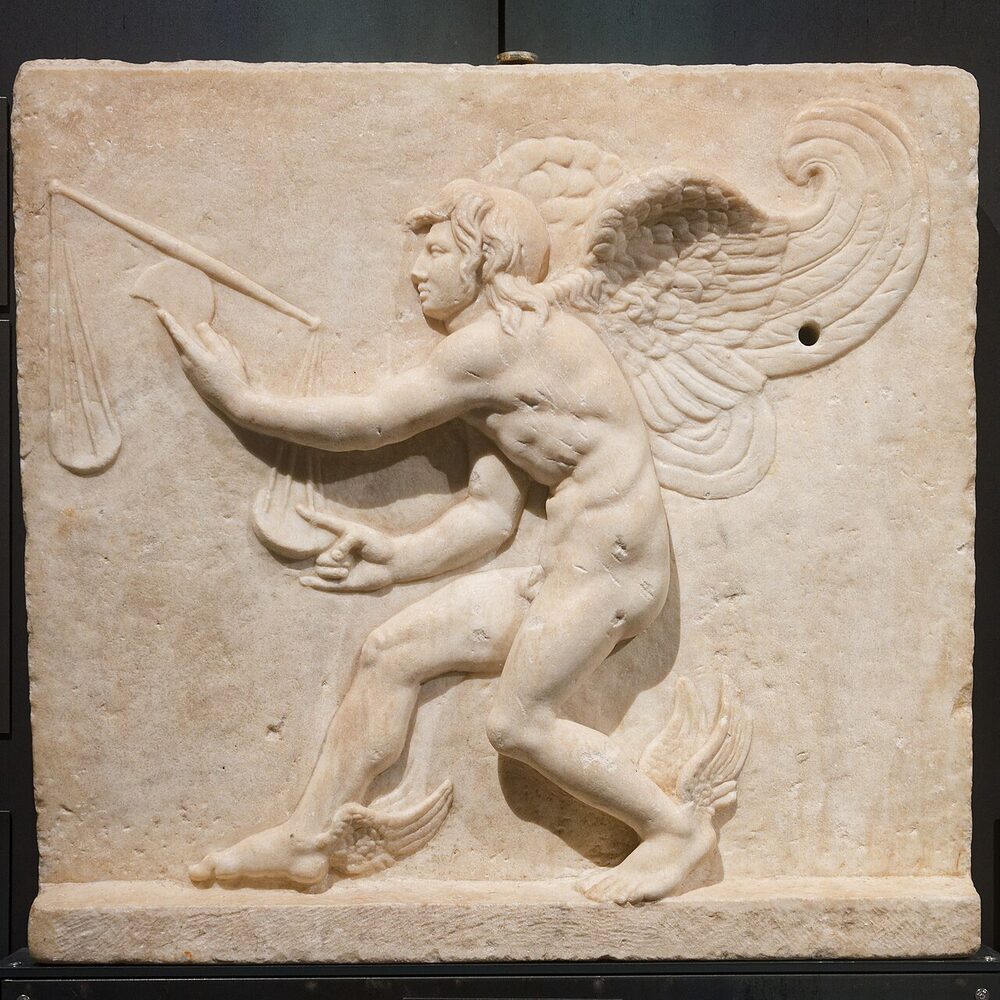
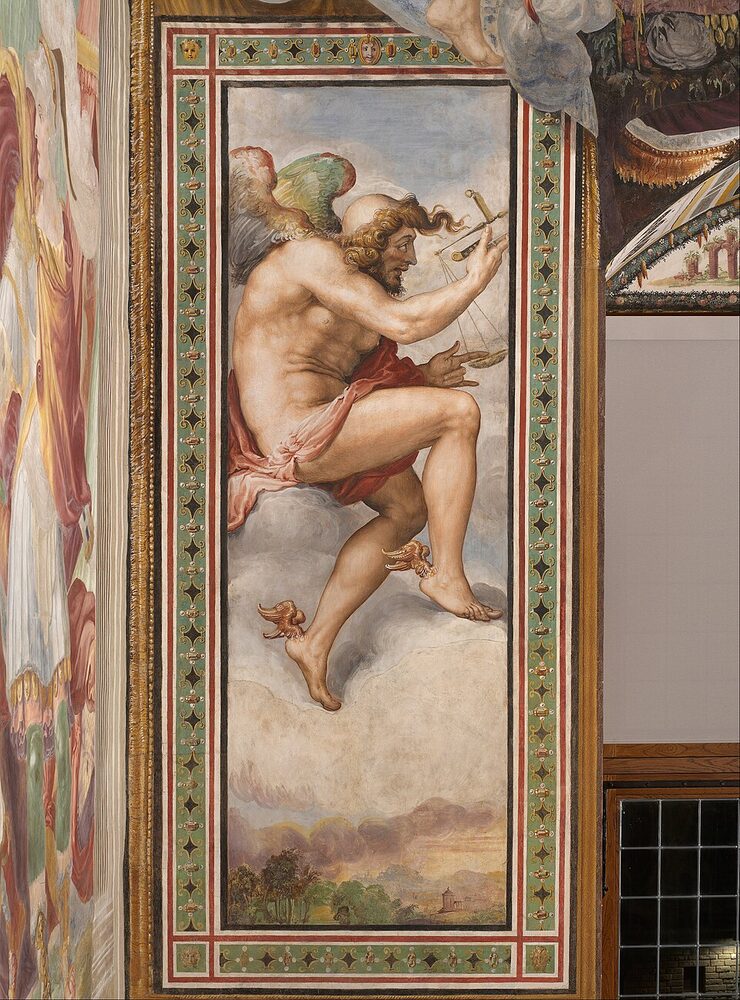
He has almost no myth in the ordinary sense — no loves, no quarrels, no deeds. What he has instead is an image, and one of the most celebrated images the ancient world ever made: the lost bronze statue by Lysippos of Sikyon, known to us through a riddling epigram of Poseidippos and a vivid description by Callistratus. In it Kairos is a young man at the height of his bloom, winged at the feet, racing forward on tiptoe or upon a rolling ball, holding a razor's edge — and wearing his hair in a long forelock that falls over his face, while the back of his head is shaved completely bald. The meaning is a puzzle that answers itself: as he runs toward you, you may catch him by the forelock; but once he has passed, there is nothing left to grasp. Seize the moment as it comes, or watch it flee beyond all recovery.
So Kairos stands a little apart from the gods of story. He belongs with the personifications — with figures like Nike (Victory) or Nemesis — who give a face and a body to an idea. But where many such figures stayed abstract, Kairos became, through Lysippos, almost proverbial: the pattern behind the saying that one must "take time by the forelock," and a standing image, in antiquity and long after, of the razor-fine, unrepeatable chance.
Mythology
The youngest child of Zeus
Kairos has no birth-story of the usual kind, no mother named beside the father, no childhood among the gods. What the sources give us instead is a single genealogical claim, and a pointed one: that he is the youngest of all the children of Zeus. The poet Ion of Chios, in the fifth century BC, wrote a hymn to Kairos in which he gave him this rank, and Pausanias, who had read the hymn, records it plainly when he comes to describe the god's altar at Olympia (Pausanias, Description of Greece 5.14.9). The claim is an idea dressed as a lineage: the opportune moment is the latest-born, the newest thing, forever young and forever swift — a child of Zeus because right timing is itself a kind of divine gift, and the last-born because the moment is always the thing most recently arrived and most quickly gone.
The statue of Lysippos: a god made visible
Kairos is, above all, a work of art before he is a tale. The great sculptor Lysippos of Sikyon — court sculptor to Alexander the Great and one of the most celebrated bronze-workers of the ancient world — made a statue of him that became famous across the Greek world and was copied for centuries in reliefs, gems, and smaller bronzes. The original is lost, but two ancient writers describe it so carefully that we can almost see it. Callistratus, in his Descriptions (Ekphraseis) 6, "On the statue of Kairos at Sikyon," pictures a bronze boy in the flower of youth, radiant and delicate, standing on tiptoe upon a sphere (a rolling ball, to show how unstable and unfixed the moment is), winged at the feet so that he seems always on the point of flight, holding in his hands a razor or a balance poised upon a razor's edge — a sign of how finely the decisive instant is weighed, how narrow the margin between catching it and missing it. And on his head, Callistratus notes the strange detail that makes the whole figure a lesson: the hair falls forward over the brow, but behind, the head is shorn bald.
Caught by the forelock
The meaning of that hair is spelled out in a famous epigram by Poseidippos (preserved in the Greek Anthology), written as a dialogue between a passer-by and the statue itself. Who made you, and whence? — Lysippos, and I am from Sikyon. — But who are you? — I am Kairos, the moment that masters all things. — Why do you run on tiptoe? — I am forever running. — Why are you winged at the feet? — I fly with the wind. — Why do you carry a razor? — As a sign to men that I am sharper than any sharp edge. — Why does your hair hang over your face? — So that whoever meets me may seize me by it. — And why, by heaven, is the back of your head bald? — Because none whom I have once passed on my winged feet may catch hold of me from behind, however much he longs to. Here is the god's whole teaching in a riddle: opportunity approaches with its forelock offered, and in the instant of meeting it may be grasped; but let it go by, and the smooth bald crown slips through the fingers — the chance, once past, offers nothing to hold. From this image comes the long-lived proverb that one must "seize the moment," and the old saying that Time, or Occasion, "has a forelock."
Kairos and Chronos: two kinds of time
The Greeks had two great words for time, and Kairos names the one that is not Chronos. Chronos is time in its ongoing flow — duration, sequence, the measured passage of hours and years, the time that can be counted. Kairos is time of another order entirely: not quantity but quality, not the river but the one stone in it on which a foot may land, the critical and opportune point within the flow at which a thing can rightly be done. A physician's kairos is the exact moment to act; an archer's kairos is the instant the shot will strike; an orator's or a general's kairos is the opening that decision must seize before it closes. Where Chronos simply runs on indifferent to us, Kairos demands something — attention, readiness, the nerve to act now — and punishes hesitation with irretrievable loss. To personify kairos as a winged runner who cannot be caught from behind is to make this difference vivid: the opportune moment is not a stretch of time you may enter at leisure, but a single passing figure you must meet head-on.
Worship — Ancient
The altar at Olympia
Kairos received genuine cult, if a modest one, at the holiest of athletic sites. Pausanias, walking through Olympia, found near the very entrance to the stadium two altars standing close together: one to Hermes of the Games, and beside it one to Kairos, "Opportunity" (Pausanias, Description of Greece 5.14.9). The placing is eloquent. Of all human undertakings, the footrace and the contest turn most sharply on timing — on the right instant to start, to strike, to spend one's strength — and so the god of the decisive moment was honoured at the threshold the runners crossed. Pausanias adds that he knew Kairos from the hymn of Ion of Chios, who made him the youngest of Zeus's children; the altar and the poem together show that the figure was taken seriously enough to be given both a cult-place and a divine pedigree.
The statue at Sikyon and the god of craftsmen
Beyond Olympia, Kairos was most present not in temples but in the renown of the Lysippos statue, which stood in its maker's native Sikyon — set up, the ancient descriptions suggest, in a public porch where passers-by would meet it, exactly as the figure demands to be met. Callistratus (Descriptions 6) describes seeing it there and being stopped by it, and Poseidippos's epigram imagines the chance encounter between a stranger and the bronze. A god whose whole nature is the seized or squandered moment belonged by rights to such settings — to the gateway, the starting-line, the place of decision — rather than to the enclosed sanctuary. He was a deity craftsmen, athletes, physicians, and men of affairs could recognise: the patron of acting at the right time.
Worship — Modern
Seizing the moment
Kairos has outlived almost all his fellow personifications, because the lesson he embodies never goes out of use. His image is the ancestor of every exhortation to "seize the day" and "strike while the iron is hot," and a modern devotee drawn to him honours him best not with offerings but with attention: by cultivating the readiness to recognise the opportune moment when it comes and the resolve to act in it rather than let it pass. He makes a fitting patron for anyone whose work turns on timing — the artist waiting for the right instant, the one who must choose, the person learning not to let the forelock slip by. To keep faith with Kairos is to live awake to the brief openings in ordinary time.
The forelock in language and emblem
The winged, forelocked figure of Lysippos proved one of the most durable images antiquity bequeathed to later ages. Through his Roman heir Occasio ("Opportunity") — a feminine personification who kept the forelock, the wings, the ball, and the razor, and who appears in Latin verse and fable (as in the epigram of Ausonius on a statue of Occasion, a Roman reworking of Poseidippos's dialogue) — the emblem passed into the art and proverb-books of the Renaissance and beyond. The bald-backed head became a standard device for Opportunity in emblem literature, and the saying to "take time (or occasion) by the forelock" survives in English to this day, a direct descendant of the Greek god's riddling hair. Kairos thus lives on chiefly as he always did: not as a story, but as an image that teaches.
Epithets & Cult Titles
- neōtatos Dios paidōn (νεώτατος Διὸς παίδων) — Youngest of the children of Zeus — the title given him by the poet Ion of Chios in his hymn to Kairos, and recorded by Pausanias (5.14.9); the opportune moment is figured as the last-born of the god's offspring, swift and new
- oxytatos (ὀξύτατος) — Sharpest of all — from the razor he carries, 'as a sign to men that he is keener than any keen edge' (Poseidippos's epigram on the statue); the decisive instant cuts finer than any blade
- Occasio — His Latin name, 'Opportunity' — the Roman personification who inherited his image of the forelock and the running feet; used here only to mark the later Roman line of the figure, not as an early Greek name
Sources & Variants
- Hesiod, Works and Days 694 (kairos as 'due measure, the right moment' — 'due measure is best in all things'; the concept before the god)
- Ion of Chios, Hymn to Kairos (5th century BC; made Kairos the youngest of the children of Zeus — known through Pausanias)
- Pausanias, Description of Greece 5.14.9 (the altar of Kairos beside that of Hermes at the entrance to the stadium at Olympia; cites Ion of Chios on Kairos as youngest child of Zeus)
- Poseidippos, epigram on the statue of Kairos by Lysippos (Greek Anthology / Anthologia Graeca 16.275 — the dialogue explaining the tiptoe, wings, razor, forelock, and bald crown)
- Callistratus, Descriptions (Ekphraseis) 6 (On the statue of Kairos at Sikyon by Lysippos — the winged bronze youth on the sphere, with razor and balance and forelock)
- Ausonius, Epigrams 33 (on a statue of Occasio and Metanoia — a later Latin reworking of the Kairos image) — Roman
Gallery