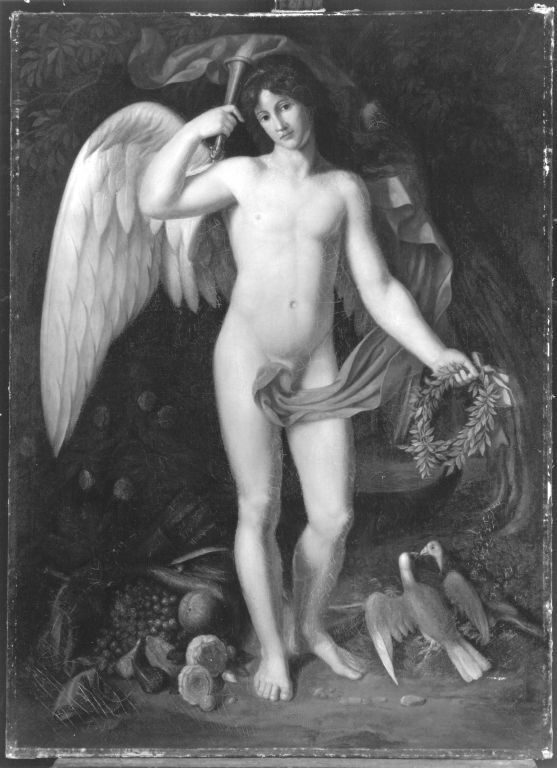
Hymenaios
First Appearance
Hymenaios steps into Greek poetry as a voice before he is a figure — he is first of all the song. In the wedding-songs of Sappho of Lesbos (early sixth century BC), composed to be sung as the bride was brought home, the refrain 'Hymēn, ō Hymenaie!' rings out, and in one famous song (fragment 111) the cry goes up around the roof-beam raised high for the bridegroom "like to Ares," "far taller than a tall man." Whether the Greeks of that age heard the word as the name of a young god or simply as the name of the wedding-cry itself, the two were already one: to sing the hymenaios was to invoke Hymenaios, and from that song the beautiful youth who personifies it took shape.
— Sappho, wedding-songs (epithalamia), 6th c. BC (e.g. fragments 111 and 44); the refrain 'Hymēn, ō Hymenaie'
Who They Are
Hymenaios (hih-meh-NYE-os), often called simply Hymen, is the Greek god of weddings and of the wedding-song — the beautiful youth who leads the bridal procession and whose name is the very cry raised when a bride is brought to her new home. He is one of those uniquely Greek divine figures who is at once a person and a thing: the god is the hymenaios, the marriage-song, so that every time the song was sung the god was present in it, and every wedding was in a small way his festival.
The Greeks imagined him as a radiant young man, crowned with flowers and robed for the feast, carrying the wedding-torch and walking at the head of the torch-lit evening procession (the gamos) that carried the bride from her father's house to the groom's. His office was not the making of love — that belonged to Aphrodite and Eros — but the rite of marriage itself: the singing, the procession, the garlands and torches, the good fortune asked for the new household. Without him, the poets said, no marriage was truly a marriage, for his name was the word that sealed it.
His parentage was never fixed, and the ancient writers offer many fathers and mothers for him — a sign less of confusion than of how many corners of Greek song claimed him. Some stories, too, remembered him not as a god born but as a mortal Athenian youth so brave in rescuing stolen brides that his name was ever after sung at weddings for luck. Whichever telling one followed, the Greeks agreed on his place: at the door of the marriage-chamber, torch lifted, the cry going up around him — "Hymēn, ō Hymenaie!"
Mythology
The god who is the song
Hymenaios is, before he is anything else, the wedding-song given a face. The Greek word hymenaios meant both the ritual marriage-song sung as the bride was led home and, with a capital letter, the young god who personified it — and the ancients did not always trouble to separate the two. The song had a refrain, repeated again and again over the flutes as the procession walked: "Hymēn, ō Hymenaie!" This cry, half the god's name and half a shout of blessing, was the heartbeat of every Greek wedding. We hear it already in the wedding-songs of Sappho (early sixth century BC), and it rings through the marriage-scenes of the later poets. Because the god lived inside his own song, he had no single great myth of his own in the way the Olympians did; instead he was present, by his name, at every marriage ever sung — which is a kind of ubiquity the greater gods might have envied.
The beautiful youth with the torch
Where the poets and painters did give him a form, Hymenaios was a young man of surpassing beauty, crowned with a garland and robed in the bright clothes of a feast, carrying the wedding-torch and often a flute or the thyrsus. He is the eternal bridegroom's companion, the figure who walks at the head of the bridal procession in the evening, leading the bride by torchlight to her new home while the company sings. In art he stands close to the circle of Aphrodite and Eros and the winged loves, but his part is distinct from theirs: desire and the drawing-together of hearts belong to them, while to Hymenaios belongs the ceremony — the ordered, sung, torch-lit rite by which two households are joined and a marriage is made lawful and blessed. He is beauty in the service of order, loveliness turned to the keeping of a sacred custom.
The uncertain parentage
No question about Hymenaios drew more differing answers than that of his parents, and the ancient writers never settled it. Many made him a son of Apollo, god of music, by one of the Muses — and even then they disagreed which Muse: some named Calliope, muse of epic song, some Terpsichore, muse of dance and choral song, some Urania, muse of the heavens. Apollodorus records the line that makes him a son of a Muse (Bibliotheca 1.3.3), which fits his nature well, for a god who is a song is fittingly born of music. Other tellings gave him wholly different parents — a child of Dionysus and Aphrodite, which joins the wine and revel of the feast to the beauty and desire of the bridal night. These disagreements were never resolved because they were never truly a problem: a figure so bound up with song and celebration was claimed by many quarters of myth at once, and each telling honoured a true part of what a wedding is.
The Athenian youth who rescued the maidens
Alongside the god born of a Muse, the Greeks remembered another Hymenaios — a mortal youth of Athens, so beautiful that he was often taken for a girl, of humble birth, who loved a maiden far above his own station and followed her hopelessly from a distance. The story tells how a company of Athenian maidens, his beloved among them, went in procession to a festival of Demeter outside the city, and were seized by pirates who carried them off by sea. Hymenaios, who had followed, was taken with them; and while the raiders slept he killed them, freed the maidens, and brought the daughters of Athens home safe. In reward the city granted him the hand of the girl he loved — and the marriage was so happy, and the omen of his name so good, that ever after the Athenians sang his name at every wedding, calling on him for the same good fortune he had won. So the two Hymenaioi, the god and the hero, met in one office: the name invoked over every bride for luck, safe passage, and a blessed match.
Varied ends, one honour
Because he was more a presence than a protagonist, Hymenaios gathered a scatter of small legends rather than one great tale. A few tellings gave the god himself a sorrowful note — a young singer who died or lost his voice on a wedding-day, so that his name was sung thereafter both in joy and as a remembrance — but these were minor strands, and the Greeks did not dwell on them. What held steady through every version was his function: whether god or hero, son of a Muse or saviour of Athenian maidens, he was the one whose name made a wedding a wedding. The poets honoured this directly: Euripides puts the wedding-cry in the mouth of the doomed Trojan princess Cassandra, who raises "Hymēn, ō Hymenaie!" over a marriage that is really a ruin (Trojan Women 308–341) — proof of how deeply the cry belonged to the very idea of a wedding, that its presence or its absence could mark joy or horror. Pindar, too, is said to have sung of Hymenaios among the powers of celebration.
Worship — Ancient
Invoked at every marriage
Hymenaios had little in the way of temples, priesthoods, or civic festivals — and yet few gods were invoked so often, for his worship was the wedding itself, repeated in house after house across the Greek world. The Greek marriage (gamos) was a rite rich in ceremony: the bride veiled in her saffron-coloured veil, the nuptial bath, the feast in the bride's father's house, and then, at evening, the procession by torchlight that carried her to the groom's home, the company walking and singing while the god's name rose in the refrain. To raise the cry "Hymēn, ō Hymenaie!" was itself an act of devotion — a calling-down of the god upon the new marriage, asking that he bless it with good fortune, fruitfulness, and peace. In this sense every bride who was ever sung home was, for an evening, in his service.
The song and the torch
His two great emblems were the wedding-song and the wedding-torch, and both were less objects of a temple-cult than living parts of the rite. The epithalamion — the song sung outside the bridal chamber — was his proper music, and poets from Sappho onward composed such songs as a sacred as well as a festive art. The torches carried in the evening procession, often said to be lit by the bride's own mother, were his light, the fire that led the bride through the dark to her new hearth. Where he was shown in sanctuaries and on painted vases it was almost always in the company of Aphrodite and the loves, a reminder that the Greeks set the ceremony of marriage within the wider circle of the powers of love and union, with Hymenaios as the particular god of its rite.
The month of marriages
The Athenians held that the best season for weddings was midwinter, in the month Gamēliōn — the "marrying month," named for the gamos and sacred to the marriage of Zeus and Hera, the divine pattern of all marriages. In that month, when the great sacred wedding of the king and queen of the gods was honoured, mortal weddings clustered thickest, and the name of Hymenaios was sung oftenest of all the year. He had no separate feast-day because he needed none: his festival was any day on which a bride was led home with the torch and the song.
Worship — Modern
The god still in the word
Of all the minor gods, Hymenaios may be the one most quietly alive in ordinary speech, for his name survives in the English word hymen and, more happily, in hymn by way of the Greek hymnos (though the two words came by different roads, the ancient ear heard them close). More to the point, his office survives wherever a wedding is sung: the figure of marriage as a thing to be celebrated with music, light, and procession is his gift, and every wedding that keeps a sung blessing, a candle or torch, a walk of the bride into a new life, keeps something of him. A modern devotee drawn to him might honour him exactly where the Greeks did — at the threshold of a marriage, with a song raised and a light carried, asking for the household the good fortune his name has always promised.
Patron of the rite, not the passion
He sits best as a patron of marriage as ceremony and covenant — the ordered, public, blessed joining of lives — as distinct from the private fire of desire, which belongs to Aphrodite and Eros. To call on Hymenaios is to ask not for love's spark but for its keeping: for a match that holds, a household that prospers, a union made in good faith and good fortune before gods and company. In this he answers a real need of the modern as of the ancient heart — the wish that a marriage be not only felt but made, witnessed, and blessed.
The song that outlasts the god
Above all Hymenaios lives on as the first of the wedding-singers. Every epithalamion, every song composed to be sung for a bride and groom, stands in a line that runs back through the Roman poets and the Greek lyricists to the refrain of Sappho and the cry of the torch-lit procession. When a song is raised at a wedding, the god who was never anything but a song is present once more — and the oldest of wedding-blessings, "Hymēn, ō Hymenaie," still means what it always meant: joy to the bride, good fortune to the house, and a marriage truly made.
Epithets & Cult Titles
- Hymēn (Ὑμήν) — The short form of his name, and the very cry sung at weddings — 'Hymēn, ō Hymenaie!' — raised again and again as the bride was led to the groom's house; the god is invoked in the refrain of his own song, so that to sing the wedding is to call on him
- theos gamēlios (θεὸς γαμήλιος) — The wedding-god, the god 'of marriage' — his office in a word; wherever a Greek marriage was made, his name opened and closed the singing
- the fairest of youths — A beautiful young man crowned and robed for the feast, torch in hand — the way poets and painters imagined him, a bridegroom's double leading every bride, forever young at the head of the procession
Sources & Variants
- Sappho, wedding-songs / epithalamia, 6th c. BC (fragments 44, 111, 112, etc.) — the refrain 'Hymēn, ō Hymenaie' and the earliest Greek witness to the wedding-song
- Euripides, Trojan Women 308–341 (Cassandra raises the wedding-cry 'Hymēn, ō Hymenaie' over her doomed marriage)
- Euripides, Iphigenia in Aulis (the wedding-song and the invocation of Hymen in a marriage that turns to sacrifice)
- Pindar (the praise of Hymenaios among the powers of celebration; the tradition of his song)
- Apollodorus, Bibliotheca 1.3.3 (Hymenaios reckoned a son of a Muse)
- Scholia and later mythographers on the Athenian youth Hymenaios who rescued the abducted maidens and was thereafter invoked at weddings
- Aristophanes, Peace 1332–1357 and Birds 1720–1765 (the wedding-cry 'Hymēn, Hymenai' sung in comic marriage-processions) — Greek
- Catullus 61 and 62 (the great Roman wedding-hymns to Hymenaeus, 'Hymen o Hymenaee'; the god as torch-bearing youth) — later, Roman
- Ovid, Metamorphoses 10.1–8 (Hymenaeus summoned to the wedding of Orpheus and Eurydice, where his torch smokes as an ill omen) — later, Roman retelling
Gallery