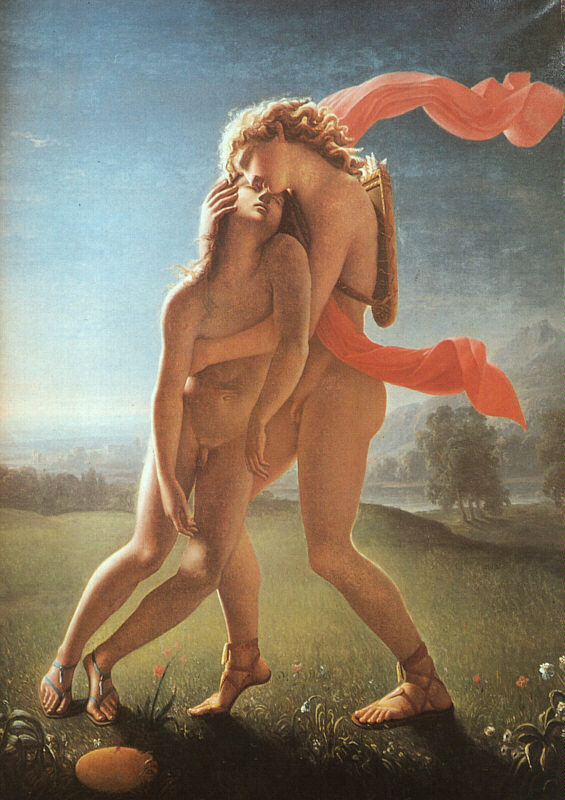
Hyakinthos
First Appearance
Hyacinthus is old in Greek song, bound from the first to Sparta and to the festival that kept his name. Euripides, longing homeward for Sparta in a chorus of the Helen (1465–1475), names the night-long celebration that Apollo set going for the dead Hyacinthus — the youth the god killed with the circling throw of the discus, for whom the Spartan land appointed a day of feasting. The mythographer Apollodorus gives the bare line of the story twice: that Hyacinthus, a most beautiful youth, was beloved of Apollo and was killed by the cast of a discus (Bibliotheca 1.3.3), and sets him among the sons of the Spartan royal house (Bibliotheca 3.10.3).
— Euripides, Helen 1465–1475; Apollodorus, Bibliotheca 1.3.3 and 3.10.3
Who They Are
Hyacinthus (HY-uh-SINTH-us; Greek Hyakinthos) is the beautiful youth of Amyclae, a prince of the land beside Sparta, whom the god Apollo loved and, by a terrible accident, killed — and from whose spilled blood, in the loveliest turn of the tale, Apollo made a flower spring up, its petals marked with a cry of grief. He is counted here among the heroes because he began as a mortal prince; but his truest life is older and stranger than that of an ordinary hero, for behind the beloved boy of the myth stands a very ancient figure of the land itself — a youth who dies and is mourned and whose rite returns each year — around whom the incoming worship of Apollo gathered and whom it never quite absorbed.
His story is short and grievous. Apollo and the young Hyacinthus were companions and the god loved him; one day, as the two of them threw the discus together in play, the heavy disc struck the youth on the head and killed him. In the plain version it is a pure accident of the game; in the darker and more famous version it is murder by jealousy, for the West Wind Zephyrus loved Hyacinthus too, and, maddened that the boy preferred Apollo, caught the flung discus in a gust and drove it down upon his head. Apollo, who could not save him, would not let him pass without a memorial: from the blood that soaked the ground he raised the flower that bears the youth's name, and on its petals set the letters AI AI — the Greek cry of mourning — so that the earth itself should grieve for Hyacinthus forever.
The name "hyacinth" is a warning not to picture the modern garden flower: the Greek hyakinthos was a different plant — most likely a larkspur or a small wild iris — whose markings the Greeks read as the written sound of grief. And the heart of his memory was never a flower-bed but a festival: the Hyacinthia, the three-day rite at Amyclae in which Sparta first mourned the dead youth and then broke into the joy of Apollo, keeping in the shape of a single feast the whole movement of his myth from death into gladness.
Mythology
The youth of Amyclae
Hyacinthus belonged to Amyclae, the ancient town a little south of Sparta in the valley of the Eurotas, and the myth makes him a prince of its royal house — a son (in the Spartan line that Apollodorus records, Bibliotheca 3.10.3) of Amyclas, the founder-king for whom the town was named, though other tellers give him other fathers of the same Lacedaemonian stock. What every account agrees on is his beauty: he was among the most beautiful of mortal youths, and that beauty is the hinge of his whole story. He is not a hero of quest or battle; he never grows to manhood or takes a throne. His myth is the myth of a lovely young man loved by a god and cut off at the very height of his youth — and of what was made to grow from his death.
Beloved of Apollo
The god Apollo loved Hyacinthus. In the Greek understanding this was the love of an older figure for a youth, the bond the Greeks honoured between a man and a beautiful young companion, with the god here taking the elder's part; and the sources name Hyacinthus plainly as the beloved of Apollo (Apollodorus, Bibliotheca 1.3.3). The two were companions, and the god — who keeps his distance from most mortals — is shown sharing the youth's own pastimes, the running and the hunting and the throwing of the discus, as though for love of the boy he set his godhead aside to be, for a while, simply a companion in the open air. It is one of the few myths in which Apollo, the far-shooter, the bright and unapproachable one, is drawn close to a single mortal and made, in the end, to grieve like a mortal.
The discus and the death
The death came in play. Apollo and Hyacinthus were throwing the discus together — the heavy disc of stone or bronze that the Greeks hurled in contest and in sport — when the thrown discus struck the youth upon the head and killed him (Apollodorus, Bibliotheca 1.3.3). In the simplest telling it is a pure and dreadful accident: the disc, flung by the god's own hand or rebounding from the hard ground, caught the boy as he ran in to take his turn, and no divine power could call him back once the Fates had cut the thread.
Zephyrus and the jealous wind
But there is a darker version, and it is the one that caught the imagination of later poets. In it the death was no accident but a killing out of jealousy. The West Wind, Zephyrus, loved Hyacinthus too; and when the youth chose Apollo over him, the slighted wind took his revenge. As Apollo made his cast, Zephyrus caught the flying discus on a sudden gust and drove it off its true course, down upon the head of Hyacinthus, so that the god's own hand became, against the god's own will, the instrument of the boy's death. (Some tellers name the North Wind Boreas instead of Zephyrus, but the West Wind is the usual culprit.) In this version the tale gains its full weight of grief: Apollo not only loses his beloved but is made the unwitting weapon of his murder, and the god who deals death from afar with his arrows is here undone by a death he never meant to deal.
The flower and the cry of grief
Apollo could not undo the death, but he would not leave it without a memorial. From the blood of Hyacinthus, where it soaked into the earth, the god caused a flower to spring up — the flower that has borne the youth's name ever since — and upon its petals, so the Greeks said, he set the letters AI AI, the Greek cry of lamentation (aiai, "alas, alas"), so that the flower itself should mourn and the earth should carry the sound of grief for Hyacinthus forever. It is vital to understand that the Greek hyakinthos was not the modern hyacinth of our gardens: it was some other spring flower — most scholars think a larkspur or a small wild iris — on whose marked petals the ancient eye could read the shapes of those two letters of sorrow. The flower is a true piece of the myth, not a decoration: it is the sign that the beautiful youth cut down in his spring was not wholly lost, but turned into something that rises again out of the ground each year.
The old youth beneath the myth
Behind this story of love and accident lies something older still. Hyacinthus is, in his origins, almost certainly pre-Greek — his very name, with its -nth- sound, is a word the Greeks inherited from the peoples who lived in the land before them — and in character he is one of the ancient figures of the dying and returning vegetation: a youth of the earth who is mourned when the green things wither and rejoiced over when they spring again. When the worship of Apollo spread into the valley of Amyclae it did not sweep this old local figure away; it gathered him in. Apollo rose above him as the great god, and Hyacinthus became the beloved and the mourned — but the old youth kept his tomb, his name, and his festival, and the rite of Amyclae held the two of them together, the newcomer god and the ancient youth of the land, in a single yearly movement from grief to joy.
Worship — Ancient
The tomb beneath the throne at Amyclae
The centre of Hyacinthus's worship was not a scattered cult but one holy place: Amyclae, where his tomb stood at the very foot of the great image and throne of Apollo. Pausanias, who saw it, describes the famous Throne of Apollo at Amyclae — a vast and ancient monument of carved and decorated work surrounding the god's tall image — and tells us that its base was built as a tomb, and that in this tomb Hyacinthus was buried; the Amyclaeans made offerings to him there as to a hero before they turned to honour the god (Pausanias 3.19.3–5). Nothing shows the binding-together of the two figures more plainly than this: the dead youth laid in the base of the monument, and the bright god standing above him, the one grief the foundation of the other's glory. There was shown there too, Pausanias adds, a bronze door in the tomb through which, the Amyclaeans said, offerings were sent down to Hyacinthus.
The Hyacinthia: from mourning into joy
The living heart of his cult was the Hyacinthia, the three-day festival kept each early summer at Amyclae and reckoned among the most sacred observances of all Sparta — so dear to the Spartans that they would leave off a campaign or hurry home from abroad rather than miss it. Its shape was the shape of the myth itself. The first day was given wholly to mourning for Hyacinthus: the people wore no garlands, sang no paeans, ate no festal bread, kept a grave and ordered grief, and made the offerings due to the dead youth at his tomb. Then, Athenaeus tells us (quoting the old historian Polycrates, Deipnosophistae 4.139), the mood was transformed, and the following days became a brilliant celebration of Apollo: boys in tunics played the lyre and sang to the pipe, choirs of youths and maidens processed and danced, maidens rode in richly decked wagons, there were horse-races and crowds and a great public banquet at which the citizens feasted everyone, even their own slaves and their guests. The festival thus moved, as the myth moves, out of death into gladness — the youth wept for, and the god of light and healing rejoiced in.
A rite rooted in one land
Hyacinthus never became a Panhellenic figure with temples across the Greek world; his worship stayed rooted where it began, in Amyclae and Sparta, bound to that one tomb and that one festival. This is itself a mark of his antiquity — he is a god of a place, older than the wandering tales of the poets, and it was the local people of Lacedaemon, not the Greeks at large, who kept his memory. Euripides, putting a homesick longing for Sparta into the mouth of his chorus, reaches at once for the Hyacinthia as the very image of home (Helen 1465–1475): the night-long festivity that Apollo appointed for the slain youth stands for Sparta itself.
Worship — Modern
The turning of grief into gladness
What Hyacinthus offers a modern devotee is the shape of his festival: the passage from mourning into joy, held together as one rite rather than torn apart. The Hyacinthia did not deny grief or hurry past it — the first day was given to it wholly — but neither did it let grief be the end; the same observance that wept for the dead youth broke, in its own time, into feasting and song. For anyone keeping a day of remembrance for someone young and lost, or marking the death of the green year and its return, that ancient pattern is a gift: to grieve fully and then, in due season and without betrayal of the grief, to let it open into gladness.
The flower that rises again
He is, at root, a figure of the vegetation that dies and returns, and that makes him a natural patron of the turning seasons — of the spring flower that comes up out of the bare ground, of what is cut down young and yet is not wholly lost. The flower marked with the cry of grief is the emblem of this: beauty struck down in its youth, and beauty springing again from the very place of its fall. To plant and tend a spring flower in someone's memory is to do, in a small and human way, exactly what the god did for Hyacinthus — to turn a death into something that rises.
A beloved youth remembered with dignity
Because his myth, like several of the old Greek tales, carries the frame of the love of a god for a youth, he is remembered best with the dignity the sources themselves give the story: not a tale of appetite but of love and unbearable loss, of a god brought to grief, of a death answered not with forgetting but with a memorial that outlasts the one who died. Hyacinthus endures as the pattern of the beautiful young beloved whom even a god could not keep — and of the grief that, rather than destroy the lover, made from the loss a lasting and living beauty.
Epithets & Cult Titles
- the beloved of Apollo — His defining place in myth — the Spartan youth whom the god Apollo loved above all others, and whose death the god himself unwillingly caused and unendingly mourned
- prince of Amyclae — Son of the royal house of Amyclae, the ancient town beside Sparta where his tomb lay and his festival was kept — a figure rooted in one place and one people, not a wanderer of Panhellenic myth
- the dying and returning youth — A name scholars give his underlying character: a very old figure of the vegetation that withers and springs again, mourned and then rejoiced over, whose rite the incoming worship of Apollo took up and kept
Sources & Variants
- Euripides, Helen 1465–1475 (the night-long festivity Apollo appointed for the slain Hyacinthus; the Hyacinthia as the image of home Sparta)
- Apollodorus, Bibliotheca 1.3.3 (Hyacinthus, a most beautiful youth, beloved of Apollo, killed by the cast of a discus)
- Apollodorus, Bibliotheca 3.10.3 (Hyacinthus among the Spartan royal house, son of Amyclas)
- Pausanias, Description of Greece 3.1.3 (Amyclas and the founding of Amyclae; the Lacedaemonian royal line to which Hyacinthus belonged)
- Pausanias, Description of Greece 3.19.3–5 (the Throne and image of Apollo at Amyclae; the tomb of Hyacinthus built into its base, and the offerings made to him there as a hero)
- Athenaeus, Deipnosophistae 4.139 (quoting Polycrates on the Hyacinthia: the day of mourning, then the music, choirs, processions, races, and great banquet in honour of Apollo)
- Ovid, Metamorphoses 10.162–219 (the fullest surviving narrative: Apollo and the discus — an accident, the rebound from the hard ground — the blood, and the flower inscribed with AI AI) — later Roman retelling, not early Greek evidence (the jealous-Zephyrus version belongs instead to Lucian and Philostratus)
Gallery