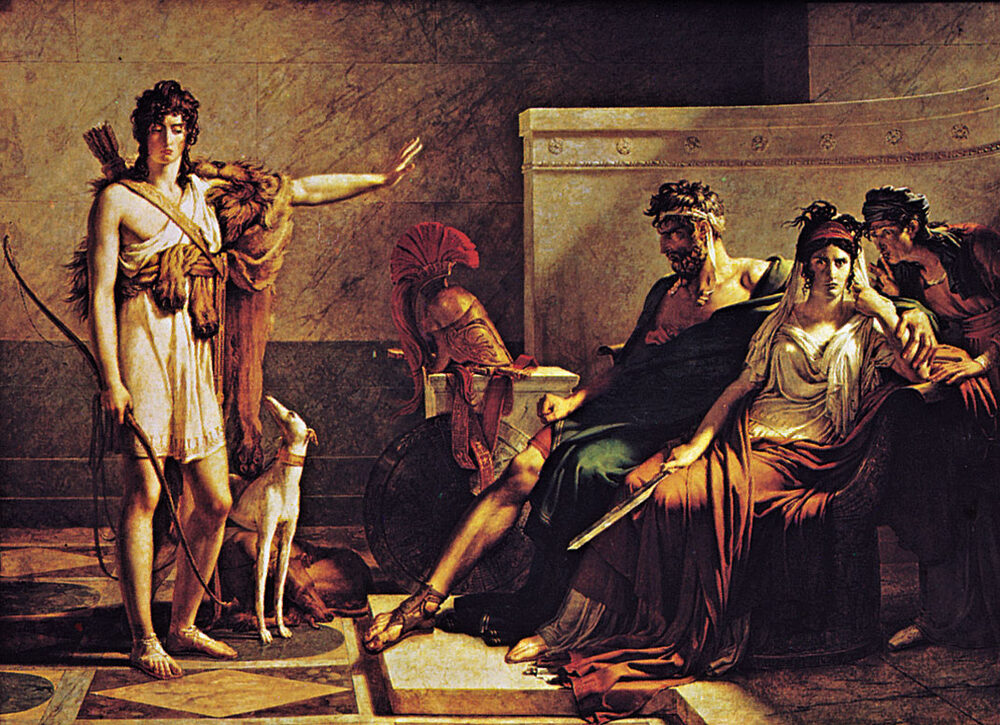
Hippolytos
First Appearance
Hippolytus steps fully into literature in Euripides' surviving tragedy Hippolytus (428 BC), which opens with the goddess Aphrodite herself declaring her grievance: this youth, son of Theseus and the Amazon, alone among men dishonours her, calling her the vilest of the gods, and spends his days in the green wild with the virgin Artemis, hunting and shunning all love — and for that scorn she will destroy him this very day. The older mythographers preserve the same shape of the story: Apollodorus (Epitome 1.18–19) records that Phaedra, Theseus's wife, fell in love with her stepson, that spurned she accused him falsely to his father, and that Theseus, calling down one of the curses Poseidon had granted him, brought about the young man's death.
— Euripides, Hippolytus (428 BC); earlier in Apollodorus's summary of the lost tradition, Epitome 1.18–19
Who They Are
Hippolytus (hih-POL-ih-tus) is the chaste huntsman prince of Troezen and Athens, the son of the hero Theseus and an Amazon — the warrior-queen named in different tellings as Hippolyte or Antiope. He is the great tragic example in Greek myth of a virtue carried to a fatal extreme: a young man who gives himself wholly to the virgin goddess Artemis, to hunting and the clean life of the wild, and who in that devotion scorns Aphrodite and all sexual love so pointedly that he brings the goddess's wrath down upon his own head. His is the best-known of all the ancient tales of the innocent destroyed by a false accusation of the "Potiphar's-wife" pattern — the youth undone not by any wrong he did, but by a desire he refused.
(He should not be confused with the Giant Hippolytus, one of the earthborn Giants slain in the Gigantomachy, the war of the gods against the Giants. They share only a name. This page concerns Theseus's son — the mortal huntsman of Troezen.)
His story, told most fully and famously in Euripides' tragedy Hippolytus, turns on a cruel engine of divine revenge. Stung by his contempt, Aphrodite makes his stepmother Phaedra fall helplessly in love with him; when the secret is forced into the open and Hippolytus recoils in horror, the shamed Phaedra kills herself, leaving behind a lie that destroys him. His father Theseus, believing the accusation, spends one of three curses the sea-god Poseidon had granted him — and the sea answers. It is a myth about chastity and its limits, about the terrible even-handedness of the gods who demand their due, and about a truth that arrives, through Artemis's own mouth, only when it is far too late to save.
Mythology
Son of Theseus and the Amazon
Hippolytus was the son of Theseus, king of Athens and the great hero who slew the Minotaur, by an Amazon — the Greeks named her variously as Hippolyte or Antiope, the warrior-woman Theseus carried off from the Amazons' country. From this mother Hippolytus took both his name (Hippolytos, bound up with hippos, "horse") and his nature: he was raised not to the soft life of a prince but to the chase, the horse, and the open wild. Because he was the child of a union outside true Athenian marriage — and because Theseus later married Phaedra, the Cretan princess, sister of Ariadne and daughter of King Minos — Hippolytus held an uneasy place in his father's house, a first-born son of an Amazon standing beside a lawful queen and her children. He was reared, and most honoured, at Troezen, his great-grandfather Pittheus's city across the water from Athens, and it is there that the tragedy falls.
The huntsman of Artemis
From boyhood Hippolytus gave himself utterly to the virgin goddess Artemis, mistress of the hunt and of the wild places. He was her companion in the green uplands, running with his hounds and his horses, and he worshipped her above all gods. In Euripides' play he brings her a garland woven of flowers from an "inviolate meadow" (akēratos leimōn) — a meadow no shepherd has grazed and no iron has cut, where only reverence may walk — and this image is the key to his whole soul: he offers the goddess his own untouched purity, his sōphrosynē (chastity, self-mastery, the sound mind), as a thing kept clean and whole. He vowed himself to the single life and would have no part of marriage or desire. In this he was blameless by his own lights, and even noble — but his devotion had a hard edge.
The scorn of Aphrodite — the hubris that dooms him
Hippolytus did not merely decline love; he despised it, and said so. He called Aphrodite the basest of the gods and would not honour her at all, keeping her statue ungarlanded while he heaped flowers on Artemis. This is his tragic fault — not lust, but its opposite pressed into hybris, the arrogance of a mortal who thinks he can refuse a whole power of the world and insult the goddess who holds it. Euripides makes the danger plain from the first scene: Aphrodite appears and vows that because this one young man alone among the people of Troezen reviles her and will have nothing of love, she will punish him this very day (Euripides, Hippolytus 1–57). An old servant warns Hippolytus to speak more gently of the goddess at his gate, but the youth will not bend. The Greeks heard in this the oldest of their warnings: that no mortal may safely scorn a god, and that even a virtue, held too proudly and turned to contempt of what others hold sacred, can become the sin that destroys.
Phaedra's doom: Aphrodite's revenge
Aphrodite's revenge is terrible precisely because it strikes through an innocent third person. She makes Phaedra, Theseus's wife and Hippolytus's own stepmother, fall into a helpless, consuming love for the young man — a passion she neither chose nor can confess, and which shames her to the point of death. In Euripides, Phaedra is no wicked seductress but a woman of honour destroyed against her will: she resolves to starve herself to death rather than betray her husband or speak her secret aloud. But her old nurse, meaning to save her, drags the truth from her and then — against Phaedra's desperate will — carries it to Hippolytus himself, first binding him with an oath of silence. When the nurse discloses Phaedra's love, Hippolytus recoils in violent horror and loathing, pouring out a famous tirade against all women (Hippolytus 616–668). He keeps his sworn silence, but Phaedra, overhearing his revulsion and knowing her shame is now known, is undone.
The false accusation and Theseus's curse
The shamed Phaedra hangs herself — but she does not die quietly. To shield her own name and, in her anguish, to strike at the youth whose contempt has broken her, she leaves behind a written tablet accusing Hippolytus of having assaulted her. Theseus, returning to find his wife dead and the lie clutched in her hand, believes it utterly. In his grief and fury he turns to a dreadful weapon: Poseidon, god of the sea, had granted Theseus three curses (or prayers) that would surely be fulfilled, and now Theseus spends one of them to call down death upon his own son, and banishes him besides (Hippolytus 887–898; Apollodorus, Epitome 1.18–19). Hippolytus, still bound by his oath never to reveal Phaedra's love, cannot clear himself without breaking his word, and his father will not hear him. He goes into exile protesting an innocence he may not prove — one of the most wrenching scenes in Greek tragedy, the honest man silenced by his own honour.
The bull from the sea
As Hippolytus drives his chariot along the shore road out of Troezen, the sea answers Theseus's curse. A great wave rears up, and out of it comes a monstrous bull from the sea (tauros), sent by Poseidon, bellowing and terrible. His horses — the creatures that had been his pride and are written into his very name — are maddened with terror; they bolt, the chariot is smashed against the rocks, and Hippolytus, tangled in the reins, is dragged along the ground behind his own runaway team, broken and dying (Hippolytus 1173–1254, in the messenger's great speech). The horseman is undone by horses, as his name had always foretold — Hippolytos, "loosed by horses." He is carried back to Troezen with the life ebbing out of him.
Artemis reveals the truth — too late
At the end the goddess Artemis herself appears to Theseus and to the dying Hippolytus, and speaks the truth at last: that Phaedra's accusation was false, that the whole ruin was Aphrodite's doing, and that Hippolytus was innocent all along (Hippolytus 1283–1341). Father and son are reconciled in the young man's final moments — Hippolytus, generous to the last, forgives Theseus the curse that killed him — but the knowledge comes far too late to undo any of it. Artemis cannot save her own devotee; even a goddess may not cross the will of another god, and she can only promise him lasting honour in the city that loved him, and vow that she will one day have her revenge on one of Aphrodite's own favourites. Hippolytus dies, and the play closes on the bitter lesson that the gods' justice, when it comes, comes without mercy and without haste.
Worship — Ancient
The hero-cult at Troezen
Hippolytus was a genuine object of hero-cult, honoured above all at Troezen, the city of his rearing. Pausanias, the Greek traveller, saw there a precinct sacred to him with a temple and an ancient image, a priest who held office for life, and yearly sacrifices (Pausanias 2.32.1–4). The Troezenians cherished a tender variant of his end: they would not point out his grave, though they knew where it was, and they refused to believe that he had truly been torn apart by his horses. Instead they held that the gods had set him among the stars as the constellation Hēniochos, the Charioteer (Auriga). In their telling his devotion had earned not annihilation but a place in heaven.
The lock of hair before marriage
The most striking rite of his cult bound the chaste huntsman, strangely and movingly, to the very marriage he had refused. At Troezen every girl, before she wed, cut off a lock of her hair and dedicated it to Hippolytus (Pausanias 2.32.1). The offering gave him, the eternal virgin youth, a token from each maiden as she crossed from girlhood into the married life — as though the brides honoured in him the purity they were leaving, and asked the protection of the young man who had kept his own. Nearby in the same precinct stood a temple and tokens of Aphrodite Kataskopia ("the Spying" or "Peeping" Aphrodite), named from the place where Phaedra was said to have watched Hippolytus at his exercises, and the myrtle with its leaves pierced (so the story went) by the pins of the love-sick queen — so that the two divine powers of the myth, the chastity he served and the love that destroyed him, stood side by side in his own sanctuary.
At Athens and in the tragic tradition
Hippolytus was remembered at Athens as well: Pausanias records a precinct and tomb of him by the Acropolis, near a temple of Aphrodite, and notes that the Athenians connected the cult to the same story (Pausanias 1.22.1–3). But his truest ancient "worship" was the one the theatre gave him — Euripides' Hippolytus, performed at Athens in 428 BC, won first prize and fixed his tragedy as one of the central stories of the Greek stage, retold and alluded to for centuries after.
Worship — Modern
A patron of the vowed and the wrongly accused
Hippolytus speaks today to anyone drawn to the clean, disciplined life — the hunter, the athlete, the one who chooses chastity or the single path, the lover of wild and open country and of the company of animals. He is a natural patron of Artemis's devotees, the young who give themselves to the wild rather than to the hearth. But his story also makes him a figure for the falsely accused and the honourably silent — the one destroyed by a lie he could have exposed only by breaking his word. A modern honouring of him might keep the old Troezenian gesture in spirit: an offering of something cut away and given up, a garland of wildflowers from an untrodden place, a lament for innocence wronged.
The warning in his virtue
His myth carries a caution that still bites: that even a real virtue, held with contempt for what others hold sacred, can curdle into the pride that destroys. Hippolytus is not punished for being chaste; he is punished for scorning Aphrodite and thinking a mortal may safely refuse a whole power of life. Read this way he is a lesson in balance — that to honour one good by despising another is itself a kind of hubris, and that the powers one refuses to acknowledge do not therefore cease to exist.
Virbius: the Roman afterlife (flagged Roman)
In Italy Hippolytus was given, uniquely, a second life. Later Roman legend held that Asclepius, the great healer, had raised him from the dead by his art, and that Artemis-Diana then hid the restored youth away and set him, under the new name Virbius, as a minor woodland god in her sacred grove at Aricia (Nemi), south of Rome — where, in memory of the horses that killed him, no horse was allowed to enter the sanctuary (Virgil, Aeneid 7.761–782; Ovid, Metamorphoses 15.497–546). This resurrection and the cult of Virbius are a Roman development, not early Greek myth, and are noted here only as the story's later Italian end.
Epithets & Cult Titles
- ho sōphrōn (ὁ σώφρων) — The chaste / self-controlled one — his defining virtue in Euripides, the vowed purity (sōphrosynē) of body and mind that he offers to Artemis and that becomes, pressed too far into scorn of Aphrodite, the very thing that destroys him
- amphithalēs kouros (ἀμφιθαλὴς κοῦρος) — The flourishing youth — the huntsman in his prime, companion of the virgin goddess in the green wild, before the ruin falls
- Virbius — His Latin name in the grove at Aricia, where later Italian legend said Asclepius raised him from death and Artemis-Diana hid him as a minor woodland god — used here only to mark the Roman end of his story, never as early Greek
Sources & Variants
- Euripides, Hippolytus (428 BC) — the central source: Aphrodite's prologue and vow of revenge (1–57); the inviolate-meadow garland for Artemis (73–87); the nurse's disclosure and Hippolytus's horror and tirade against women (616–668); Phaedra's suicide and the accusing tablet; Theseus's use of one of Poseidon's three curses and the banishment (887–898); the messenger's speech on the bull from the sea and the dragging by the reins (1173–1254); Artemis appears to reveal the truth and reconcile father and son too late (1283–1341)
- Apollodorus, Bibliotheca Epitome 1.18–19 (Phaedra's love for her stepson, the false accusation, Theseus's curse by Poseidon, and Hippolytus's death; the summary of the older tradition)
- Pausanias, Description of Greece 2.32.1–4 (the hero-cult at Troezen: precinct, temple, lifelong priest, the maidens' dedication of a lock of hair before marriage; the Troezenians' denial that his horses killed him and their claim that he became the constellation the Charioteer; Aphrodite Kataskopia and the pierced myrtle)
- Pausanias, Description of Greece 1.22.1–3 (the precinct and tomb of Hippolytus at Athens, near the temple of Aphrodite, and the Athenian form of the story)
- Virgil, Aeneid 7.761–782 (Virbius, son of Hippolytus, and the grove of Diana at Aricia where horses are forbidden; Asclepius's raising of Hippolytus) — Roman
- Ovid, Metamorphoses 15.497–546 (Hippolytus tells his own death and his restoration by Asclepius as the woodland god Virbius) — Roman
Gallery