Hekabē
First Appearance
Hecuba enters Greek poetry in Homer's Iliad as the queen of Troy, wife of Priam and mother of Hector. We first meet her within the city as Hector returns from battle (Iliad 6.251–296): she takes her son's hand, calls him "my child," and offers him wine to pour and to drink, which he gently refuses. Her greatest Homeric moments are moments of grief: she bares her breast and begs Hector not to go out to face Achilles (22.79–89), she shrieks from the walls as she watches him killed and his body dragged (22.405–436), and she speaks the second of the three laments over his recovered corpse at the close of the poem (24.747–760), calling him dearest of all her children to her heart. Already in Homer she is defined by what she loses.
— Homer, Iliad 6.251–296; 22.405–515; 24.747–760
Who They Are
Hecuba (HEK-yoo-buh), in Greek Hekabē, is the queen of Troy — wife of King Priam and mother of the great brood of Trojan princes and princesses, among them Hector, Paris, Cassandra, Helenus, Troilus, Polyxena, and Polydorus. She is the matriarch of the doomed city, and her story is the story of Troy itself told through a mother's body: its glory in the number of her children, and its fall in the losing of them, one after another, until nothing is left. She is counted here among the heroes as a mortal woman of the royal house whose sufferings the Greeks themselves made into the very measure of human grief.
Her life divides into two halves joined by the fall of the city. In the first she is the fruitful queen of the richest house in Asia, mother of nineteen children (Homer's count) or, in the fuller later reckonings, of fifty; before the birth of Paris she dreams she is carrying not a child but a blazing firebrand that burns Troy to ash, and the dream's dark meaning shadows everything that follows. In the second half, after the city burns exactly as the dream foretold, she is a slave in the Greek camp, forced to watch the sacrifice of her daughter Polyxena at Achilles' tomb and to find the murdered body of her last son Polydorus washed up on the shore — and out of that final grief she rises to a terrible revenge, and at the very end is changed into a dog and lost to the sea.
No figure in Greek tragedy is made to suffer more, or to carry more meaning in her suffering. Homer gives her the dignity of the mourning queen; Euripides, in the two plays he built around her — the Hecuba and the Trojan Women — makes her the voice of every mother ruined by war, and then shows that grief pressed past its limit does not always ennoble but can harden into something fierce and inhuman. She is the archetype of maternal love and maternal loss, and of the vengeance that loss can breed.
Mythology
The queen of Troy and her children
Hecuba was the second and principal wife of Priam, king of Troy, and with him the mother of the royal house. Homer gives her nineteen children "from one womb" (Iliad 24.496, where Priam says of his fifty sons that nineteen were born to him by a single mother), and the later mythographers, counting daughters and lesser sons, raise the full tally of her children toward fifty. Her offspring are the princes and princesses of Troy itself: Hector, the city's great bulwark and eldest son; Paris (also called Alexandros), whose carrying-off of Helen brought the war; the prophetess Cassandra, fated never to be believed; the seer Helenus; the boy Troilus; the maiden Polyxena; and the youngest, Polydorus. To be queen of Troy was, for Hecuba, to be the mother of Troy — and that is why the city's destruction falls on her as the loss of her own body's children, each death a fresh wound.
Her own parentage the ancients did not firmly fix. Homer makes her a daughter of Dymas, a Phrygian king by the river Sangarios (Iliad 16.718–719), while other traditions give her father as Kisseus, a Thracian king; the tragedians and later writers keep both, and Euripides in the Hecuba has her call herself the child of Kisseus. The uncertainty is old, and the sources simply disagree.
The dream of the firebrand
Before the birth of her second son, Hecuba dreamed a dream that hung over the whole of her life. She dreamed that she gave birth not to a child but to a blazing firebrand — a flaming torch — from which crept a mass of fiery serpents, and that the fire spread and burned the whole city of Troy to ash. Terrified, she and Priam sought out the meaning, and the seers (in some tellings the prophet Aisakos, a son of Priam; in others Apollo's own oracle) read the dream plainly: the child she carried would be the ruin and burning of his own city. When the boy — Paris — was born, the parents gave him to be exposed on Mount Ida to die, so that the dream should not come true. But the infant was suckled by a bear and found and raised by herdsmen, and grew up to return to Troy, to be recognised, and in the end to bring Helen home and the Greek fleet after her — and so the dream came true to the letter, and Hecuba's own child burned her city down. The story is told by Apollodorus (Bibliotheca 3.12.5) and lay behind Euripides' lost play Alexandros; its terrible irony is that the one act meant to save Troy — and the one Hecuba as a mother could least bear, the casting-out of her own newborn — was itself the thing that doomed it.
The mother on the walls: Hector's death
Through the long years of the war Hecuba is the queen within the city, and Homer gives her some of the Iliad's most piercing moments of a mother's helplessness. When Hector comes in from the fighting she offers him wine and a mother's comfort (Iliad 6.251–296). At the last, when he means to stand alone outside the walls and face Achilles, she leans from the rampart and bares the breast that nursed him, imploring him by it to come inside and not to die (Iliad 22.79–89) — and he will not, and she must watch. She shrieks as she sees him killed and his body lashed to Achilles' chariot and dragged in the dust around the city (22.405–436). And at the very end of the poem, when Priam has ransomed the body home, Hecuba speaks the second of the three great laments over Hector — after Andromache and before Helen, whose dirge comes last (24.761) — cradling his head and calling him the dearest to her heart of all her children, whom even in death the gods have cared for (24.747–760). Homer leaves her there, grieving but not yet destroyed — the full destruction is the work of the tragedians.
The fall of Troy and the slave-queen
When Troy at last fell, Hecuba lost in the sack almost everything that remained. She saw her husband Priam butchered at the household altar of Zeus Herkeios by Neoptolemos (Achilles' son), and her infant grandson Astyanax, Hector's child, thrown from the city walls so that no heir of Hector should live. In the division of the captive women among the Greek lords, the aged queen of Asia was allotted as a slave — in the common tradition to Odysseus, the man she most despised. Euripides' Trojan Women (415 BC) opens on this ruin: Hecuba lying prostrate in the dust before the smoking city, and around her the other captive women — her daughter-in-law Andromache, her daughter Cassandra (dragged off as the concubine-prize of Agamemnon, raving her true and disbelieved prophecies), and the rest — each led away in turn, while the old queen rises again and again only to be struck down by the next blow. The play is the great Greek meditation on the price of victory, and Hecuba is its enduring centre, the figure who must outlive everyone she loves.
The sacrifice of Polyxena
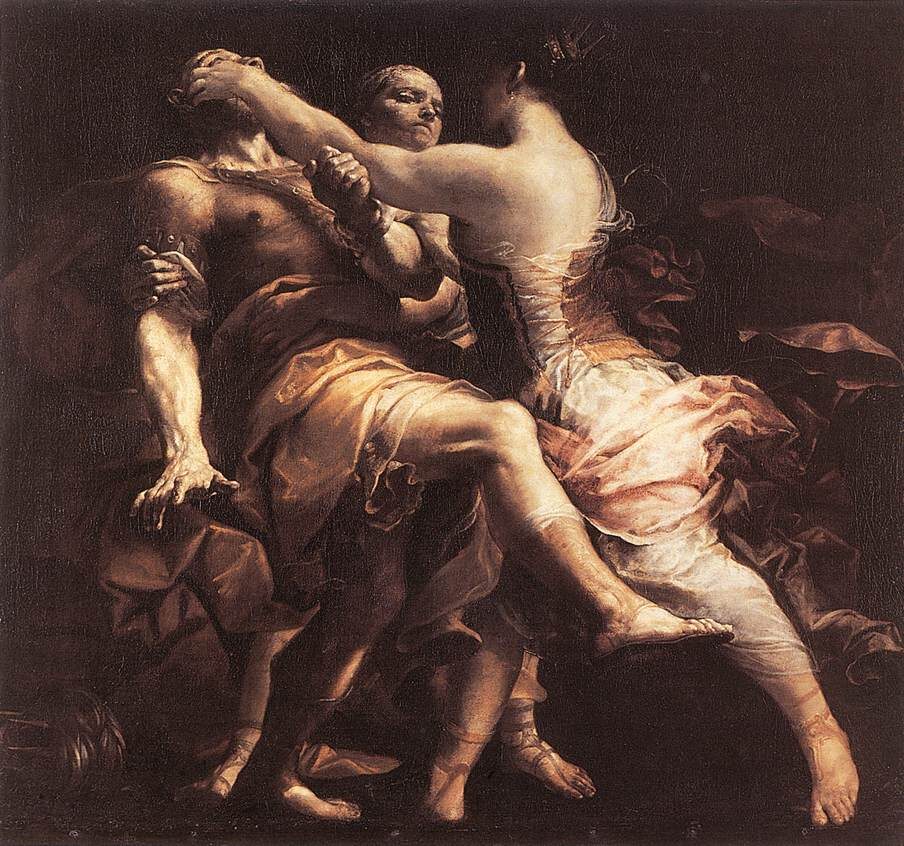
The first of the two blows around which Euripides built the Hecuba (c. 424 BC) falls upon her daughter Polyxena. As the Greek fleet waits to sail home, the ghost of Achilles appears above his tomb and demands that Polyxena be sacrificed to him — that the maiden be given as a death-offering to the dead hero before the ships are granted their wind. The Greeks consent, and Odysseus comes to take the girl from her mother's arms. Hecuba pleads, offers herself in her daughter's place, clings to her — and is refused. Polyxena, for her part, chooses to die nobly rather than live a slave, and goes to the altar with a courage that even her killers admire; Neoptolemos cuts her throat at his father's tomb, and the messenger brings word of how bravely she met it. Hecuba, enduring, turns to the one office left to a mother — the washing and dressing of her daughter's body for burial — and sends for sea-water to tend the corpse. It is while this is being done that the second, worse blow lands.
The murder of Polydorus and the revenge on Polymestor
Before the war, foreseeing danger, Priam and Hecuba had sent their youngest son Polydorus, too young to fight, for safekeeping to Polymestor, king of the Thracian Chersonese and a guest-friend of Troy — and had sent with him a great store of gold, that the boy might be raised in safety and the treasure kept for the family. But when Troy fell and the gold was no longer protected by Trojan power, Polymestor murdered the boy for the gold and cast his body into the sea. Now, as the captive women fetch sea-water for Polyxena's burial, the corpse of Polydorus is washed up on the shore, and Hecuba recognises her last son — murdered by the very guest-friend sworn to protect him. This is the breaking-point. The loss of so many children to war she had borne; this cold betrayal of the laws of hospitality (xenia, the sacred guest-bond that the Greeks held holy) by a trusted friend, for mere gold, turns her grief into a cold and terrible resolve.
Hecuba wins leave from Agamemnon and lures Polymestor and his two young sons into the women's tent with the promise of yet more hidden Trojan gold. There the captive women fall upon them: they kill Polymestor's two sons before his eyes, and then with their brooch-pins they blind Polymestor himself, putting out both his eyes. The blinded king gropes and roars among the tents like a beast, and in his agony he prophesies the dreadful fates to come — his own, and Hecuba's. The revenge is exact and dreadful, and Euripides does not let us simply cheer it: the wronged mother has become, in avenging the law of hospitality, something that has itself passed beyond the human.
The transformation into a dog
The end of Hecuba is a metamorphosis. The blinded Polymestor foretells it, and it stands in the tradition from early on: the grief-maddened queen is changed into a dog — in some versions a dog with fiery, blazing eyes — and either leaps or falls into the sea, and the headland on the Hellespont where it happened is named for her, Kynos Sēma, "the Dog's Monument" (or "the Bitch's Tomb"), a landmark that real sailors in historical times still knew and pointed out. The transformation is already named by Euripides (Hecuba 1259–1273) as Polymestor's prophecy, and the Roman poet Ovid gives the fullest narrative of it (Metamorphoses 13.565–575, flagged here as a later Roman retelling): as Hecuba, howling her grief, stoops to gather stones to hurl, her cries turn to a dog's barking, and she is transformed — the name Maera ("the gleaming / glistening one") is attached to the dog in some sources. Whether read as a final mercy that ends her unbearable grief, or as the last degradation of a queen reduced below even slavery to the shape of a beast, the dog-end is the fitting close of a life in which grief is pressed so far past all limit that it ceases to be human at all. So the great mother of Troy, who began as the fruitful queen of the richest city of Asia, ends as a howling dog upon a lonely sea-cliff — the archetype, for the Greeks ever after, of maternal grief turned to fury, and of the human spirit broken past its breaking-point by loss.
Worship — Ancient
The queen who had no cult
Hecuba was not a goddess and received no temple, priesthood, or sacrifice of her own in the Greek world. She lived in Greek culture not as an object of worship but as a figure of memory and of the stage — one of the most powerful such figures the Greeks possessed. Her "cult," if the word may be stretched, was the act of lament itself: she was the imagined mother behind the mourning of all the war-dead, the queen whose grief gave shape and dignity to the grief of ordinary women who had lost sons and husbands to war.
Hecuba on the tragic stage
Her true home in the ancient world was the theatre of Athens. The great poet Euripides made her the title figure of his Hecuba and the central presence of his Trojan Women, and gave her a role (or a leading part) in his lost Alexandros as well; she also appears in the tragedies of Troy's fall by other hands. On the stage of the City Dionysia the Athenians — whose own city had, in those same decades, put captive populations to the sword and the auction-block — were made to weep for the queen of their legendary enemy and for the women destroyed in the sack of a city. In this Hecuba did a kind of civic and religious work: through her the audience was brought to contemplate the suffering that war visits on the innocent and the defeated, and the fragility of all human fortune, the great Greek theme that no one may be called happy until he is dead. The philosopher and the moralist pointed to her fall — from the richest queen in Asia to a slave grovelling in the dust in a single day — as the very emblem of the turning of Fortune's wheel.
The Dog's Monument
The one place on the map that bore her memory was Kynos Sēma, the "Dog's Monument," a headland on the European side of the Hellespont (the strait Troy guarded) which ancient geographers and historians name as a real landmark — it figures, for instance, in Thucydides' account of a naval battle fought near it in the Peloponnesian War. The place-name kept alive the story of the queen transformed into a dog, so that the geography of the Troad itself carried a reminder of Hecuba's dreadful end for every sailor who passed.
Worship — Modern
The patron of grieving mothers
Hecuba has no modern cult in any formal sense, but of all the figures of Troy she is perhaps the one whose meaning has travelled furthest. She is remembered as the supreme image of the grieving mother — the woman who outlives her children and is made to bury them one by one — and so she speaks across the ages to every parent who has lost a child, and to every mother ruined by war. A modern reader or honourer drawn to her finds in her story not a deity to petition but a companion in grief: the assurance that the oldest literature of the West looked without flinching at the very worst that can happen to a mother, and gave it a voice of unbearable dignity.
"What's Hecuba to him?"
Her name became a byword for the power of imagined grief through a single famous passage. In Shakespeare's Hamlet, the prince watches a player weep real tears while reciting the lament of Hecuba over the fall of Troy, and marvels that an actor can be so moved by a grief not his own — "What's Hecuba to him, or he to Hecuba, / That he should weep for her?" The line has carried Hecuba's name into the common speech of the English-speaking world as the very type of a sorrow so great that even strangers, even across the gulf of fiction, are compelled to mourn it. It is a fitting afterlife for the queen whom Euripides set on the Athenian stage precisely so that an audience of her enemies' descendants might be made to weep.
The grief that turns to fury
Modern readers of Euripides also return to Hecuba for the harder half of her story — the revenge on Polymestor and the transformation into a dog. In an age that thinks about the moral injuries of war, about what sustained suffering and betrayal do to the human spirit, Hecuba is read as one of literature's earliest and most unflinching studies of how grief, pressed past endurance and compounded by treachery, can curdle into something fierce and no longer quite human. She endures in the modern imagination not as a comfortable saint of sorrow but as its whole truth: love and loss, dignity and fury, the mother and the maddened dog upon the cliff.
Epithets & Cult Titles
- mētēr (μήτηρ) of Troy — The Mother — her defining role before all others; queen-consort of Priam and mother of the royal house of Troy, bearer of Hector and the great brood of Trojan princes and princesses
- dysmoros (δύσμορος) — Ill-fated, doomed to sorrow — the word the tragedians reach for again and again as son after son and daughter after daughter is taken from her; the archetype of the woman whom grief does not spare
- basileia (βασίλεια) — Queen — the station from which she falls; in Euripides she passes in a single day from queen of Asia's richest city to a slave woman grovelling in the dust, and the distance of that fall is the measure of her tragedy
- Kynos Sēma (Κυνὸς Σῆμα) — 'The Dog's Monument' — not a title of honour but the name of the place and the sign of her end, the headland on the Hellespont said to mark where the grief-maddened queen, turned into a dog with blazing eyes, met her death
Sources & Variants
- Homer, Iliad 6.251–296 (Hecuba offers Hector wine within the city); 16.718–719 (daughter of Dymas the Phrygian); 22.79–89 (she bares her breast to beg Hector not to fight); 22.405–436 (her shriek as Hector is killed and dragged); 24.496 (nineteen children from one womb); 24.747–760 (her lament over Hector's body)
- Euripides, Hecuba (c. 424 BC) — the sacrifice of Polyxena, the discovery of Polydorus's murdered body, the revenge on Polymestor (blinding and the killing of his sons), and Polymestor's prophecy of her transformation into a dog (1259–1273)
- Euripides, Trojan Women (415 BC) — Hecuba as the fallen slave-queen amid the captive Trojan women after the sack; the deaths of Priam and Astyanax; the allotment of the women to the Greek lords
- Apollodorus, Bibliotheca 3.12.5 (Hecuba's parentage and children; the dream of the firebrand and the exposure of Paris) and Epitome 5.23 (the fate of the Trojan women after the fall)
- Thucydides, 8.104–106 (Kynos Sēma, 'the Dog's Monument,' as a real headland on the Hellespont) — attesting the place-name attached to her transformation
- Ovid, Metamorphoses 13.399–575 (the fullest narrative of the sacrifice of Polyxena, the murder of Polydorus, the revenge on Polymestor, and Hecuba's transformation into a dog) — later Roman retelling
- William Shakespeare, Hamlet 2.2 ('What's Hecuba to him, or he to Hecuba') — the source of her modern proverbial fame as the figure of imagined grief
Gallery