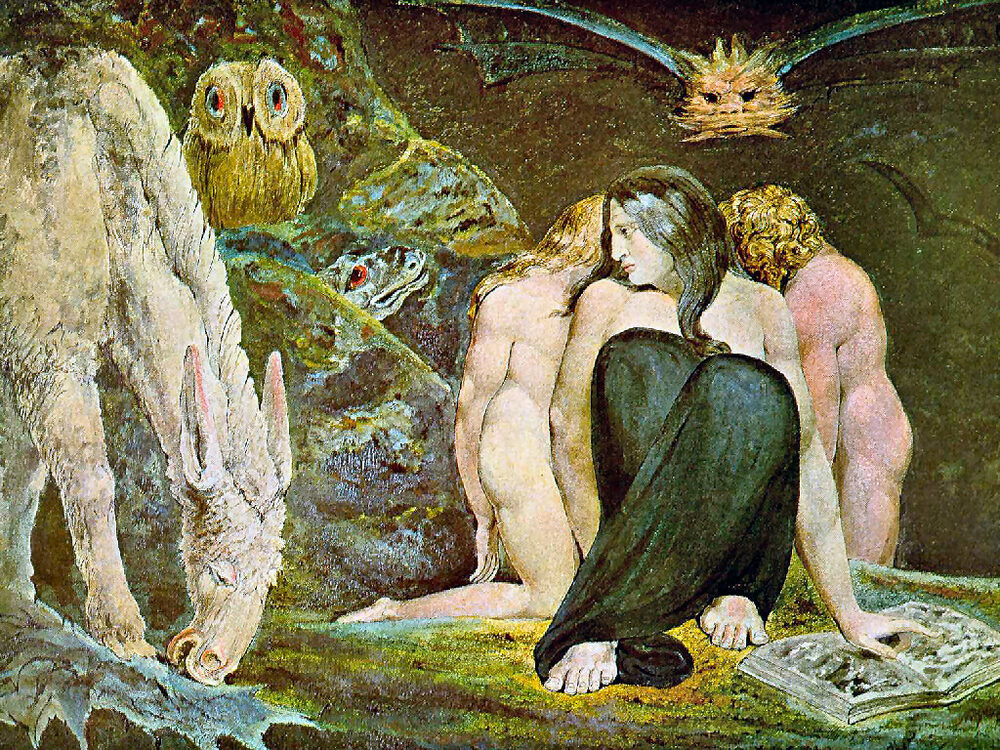
Hecate
First Appearance
Hecate's earliest and grandest appearance is the long passage in Hesiod's Theogony (411–452) that scholars call the "Hymn to Hecate" — the fullest praise the poem gives any single deity. Hesiod names her the daughter of the Titan Perses and of Asteria, and tells how Zeus honoured her above all others: she keeps her share of the earth, the sea, and the starry sky, the privilege she held from the first when the Titans were divided, and Zeus took nothing of it from her. She stands beside kings in judgment, gives victory in war and games, brings the fisherman his catch and the herdsman his increase, and nurses the young — a goddess who "reaches" (as her name suggests) into every part of life, and whom Hesiod plainly reveres.
— Hesiod, Theogony 411–452 (the 'Hymn to Hecate')
Who They Are
Hecate (HEK-uh-tee) is the great goddess of thresholds and things in between — the crossroads where three roads meet, the doorway between inside and out, the boundary between the living and the dead, the passage from one month to the next, and the deep magic that works across all of them. She is the one Olympian-era power the Greeks most consistently pictured facing three ways at once: torch in hand, keeper of the keys, standing at the fork in the road where a traveller must choose, watching down every path.
Her story is really the story of a transformation, and it is one of the most striking in all of Greek religion. In the oldest and highest telling — Hesiod's great "Hymn to Hecate" in the Theogony — she is not a witch at all but a cosmic goddess of enormous dignity, a Titan's daughter who kept her ancient share of earth, sea, and sky when the world was divided, and whom Zeus honoured above every other god. She gives kings their judgment, soldiers their victory, sailors their catch, and the young their nurture. Only in the centuries that followed did she gather to herself the darker robes she now wears in the popular imagination: mistress of ghosts and howling dogs, patron of sorceresses like Circe and Medea, queen of the crossroads at the dark of the moon. The Golden Thread tells her as both — the honoured cosmic power first, and the witch-queen she became, understood as an evolution across time rather than a contradiction.
Two images fix her in the mind. The first is the twin torches, which she carries through the dark and which she famously lit for the grieving Demeter, walking beside her as she searched the world for her stolen daughter Persephone — a scene that shows Hecate at her kindest and most helpful. The second is the triple form: three women standing back to back, or one figure with three faces, set up at the meeting of three roads so that no direction went unwatched. To follow her is to stand where the roads divide and feel her looking down all of them at once.
Mythology
Hesiod's honoured goddess: the great "Hymn to Hecate"
The oldest picture of Hecate is also the most surprising, because it is the least like the witch we expect. In Hesiod's Theogony (411–452) she appears not as a creature of the dark but as one of the most honoured powers in the whole cosmos. She is the daughter of the Titan Perses and of Asteria — "starry" Asteria, a goddess of the night sky and of falling stars, whose own story is told elsewhere — and so Hecate belongs to the older Titan generation by birth, not to the Olympians, though she keeps her honours under the new order of Zeus.
Hesiod says that when the gods and Titans divided the world, Hecate kept her ancient share of all three realms: earth, sea, and starry sky. And when Zeus came to power, far from stripping the older goddess of her rights, he honoured her above all others and left her every privilege she had held from the beginning. She sits beside kings as they give judgment; she gives victory to the soldier in battle and to the athlete in the games; she stands by horsemen and by sailors, and grants the fisherman his catch; she makes the herds increase or dwindle as she pleases; and she is a nurse of the young, a kourotrophos who tends children and brings them up. This is a goddess who "reaches" into every good thing a person might want — which is very likely what her name, tied to the word for "far off," was understood to mean: the far-reaching one, whose hand extends everywhere. Why Hesiod gives Hecate this uniquely lavish praise has puzzled readers since antiquity; whatever the reason, it preserves for us a Hecate of great dignity, entirely free of the sinister colouring that came later.
The kindness to Demeter: torches in the dark
The tenderest episode in Hecate's myth comes in the Homeric Hymn to Demeter, the early poem that tells how Hades carried off Persephone to be his queen and how her mother Demeter searched the world for her in grief. When Persephone was seized, only two of the gods heard her cry: Helios, the all-seeing Sun, and Hecate. Hecate, in her cave, heard the girl's voice but did not see who took her — and so, nine days later, when the desolate Demeter was wandering the earth with a torch in each hand, it was Hecate who came to her, bearing a light of her own, and told her the little she knew: that she had heard the cry but not seen the face of the one who did it. Then the two goddesses went together to Helios, who alone had seen everything, and learned the truth.
From that moment Hecate stays at Persephone's side. When at last the girl is allowed to return to the light for part of each year, the Hymn says Hecate went before and behind her as her guide and companion (propolos, the attendant who leads the way), and from then on she was the queen's close attendant, moving with her between the world above and the world below. It is a beautiful and gentle role — Hecate as the torch-bearer who lights the way through sorrow and who escorts the soul across the greatest of all boundaries — and it is entirely of a piece with the older Hecate of Hesiod: a helper, a guide, a friend to those in need. It also quietly explains much of what she later became. A goddess who moves freely between the living world and the dead, torch in hand, is already halfway to being the mistress of ghosts and the guide of souls.
The turn toward magic: crossroads, ghosts, and the dark moon
(Content note: this section touches on ghosts, sorcery, and the dead.) Somewhere after Hesiod, across the classical and Hellenistic centuries, Hecate's honours deepened and darkened. The threshold-goddess who guided souls between the worlds became, by natural extension, the goddess of everything that lives on a boundary: the crossroads where three roads meet and a choice must be made; the doorway of the house, which she guarded as a protector against evil (her small triple images, called hekataia, stood before Athenian doors); the dark of the moon, when the old month died before the new was born; and the restless dead, the ghosts who had not crossed over cleanly and who wandered the night in her train.
It is here that the popular Hecate takes shape — the one met at the crossroads at midnight with her pack of howling dogs, torches blazing, the ghosts and the empousai (shape-shifting phantoms) at her heels. At the dark moon, households set out the Deipnon, "Hecate's Supper," at the crossroads or the doorstep, both to honour her and to feed and appease the dead who travelled with her, carrying out the month's pollution to be left in her keeping. To hear dogs howling at night was to know the goddess was passing. None of this was in Hesiod; all of it grew from the seed he and the Homeric Hymn had planted — a powerful goddess who reached everywhere and who walked the border between life and death.
Queen of witches: Circe and Medea
By the classical period Hecate had become the divine patron of magic itself, and above all of its most famous practitioners. The great sorceresses of myth are her people. Circe, the enchantress of the island of Aeaea who turned Odysseus' men into swine, was called in some traditions Hecate's own kin and worked her spells under the goddess's power. Medea, the witch-princess of Colchis who helped Jason win the Golden Fleece and later took a terrible revenge on him, was Hecate's devoted priestess above all. In the tragedians, Medea swears by Hecate as the goddess she reveres most, "the mistress whom I chose to share my work," worshipped at a secret altar in the innermost room of the house. Where a woman worked drugs, spells, curses, and the darker arts, it was Hecate she called on — the goddess of the pharmaka, the potent herbs and poisons gathered by moonlight.
The triple form and the torches
Two things above all mark Hecate in ancient art. The first is her triple form. From at least the fifth century BC her image was made triplex — three complete female figures standing back to back around a central pillar, or a single body with three faces looking three ways at once — and set up at crossroads and before doors so that she could watch every direction at the same time. The sculptor Alcamenes was remembered for making the first such triple Hecate (the Hekate Epipyrgidia, "on the tower") on the Athenian Acropolis. The three forms suit her perfectly: the goddess of the three-way crossroads, looking down every road; the power that spans earth, sea, and sky; the deity who stands at once in the world of the living, the world of the dead, and the space between.
The second is her torches. In nearly every image she carries them — one or two blazing brands held high — the light she bore for Demeter, the light that leads souls through the dark, the light that a goddess of the night and the dark moon must carry to see her own way. Often she holds, besides the torches, a key (she is Kleidouchos, the key-bearer who locks and unlocks the gates between worlds), a dagger or a whip or cord, and she is attended by her dogs. Together the torch, the key, and the three watching faces make one of the most recognisable figures in all of Greek religion.
Worship — Ancient
The household door and the crossroads
For ordinary Greeks, Hecate was first of all a goddess of protection at the threshold. Small triple images of her, the hekataia, stood before the doors of Athenian houses and at the entrances to sanctuaries and city gates, set there to guard the boundary and turn away evil and the wandering dead. She was, in this everyday role, an apotropaic goddess — one who wards off harm — and her presence at the door was reassuring, not frightening: the keeper of the keys who decided what might cross the threshold and what might not.
Her other great place of cult was the crossroads, especially the fork where three roads met (the trihodos), which belonged to her as the three-way goddess Trioditis. There, at the dark of each month, families set out the Deipnon, "Hecate's Supper" — a meal of eggs, cakes, garlic, cheese, fish, and the swept-out remains of the household, left for the goddess and the hungry dead who followed her. It was both an offering and a cleansing: the pollution and bad luck of the closing month were carried out to the crossroads and given into Hecate's keeping, so the new month could begin clean. One left the food and walked away without looking back; only the truly destitute would stoop to eat "the supper of Hecate."
Offerings of the dark: dogs and the chthonic rite
Hecate's sacrifices were of the chthonic kind — the rites given to the powers of the earth and the underworld rather than to the bright Olympians. Offerings to her were poured or laid down at ground level and given wholly, not shared in a feast; libations went entirely onto the earth. Her most characteristic and distinctive sacrifice was the dog, above all the black she-dog — an animal offered to almost no other Greek deity, and a mark of how far outside the ordinary sunlit worship she stood. Puppies were used in purification rites under her name, and black lambs were offered to her as to a goddess of the night. Her sacred foods — garlic, red mullet, eggs, the strong-smelling and the liminal — belonged to the same dark and boundary-crossing register.
Lagina and the civic goddess
Alongside the crossroads-goddess of the night stood a very different Hecate: the great civic deity honoured with full public splendour, especially in Caria in Asia Minor. At Lagina she had the largest and most important temple of Hecate in the entire ancient world, a major sanctuary where she was the patron and protectress of the surrounding state, honoured with a grand annual procession that carried her sacred key (the Kleidophoria) and served by choirs and attendants. There was nothing sinister about the Lagina Hecate; she was a goddess of the first rank, guardian of the city's safety and prosperity. She was also central to the mysteries of the island of Samothrace and to those of Aegina, where she had an important mystery-cult said to grant her initiates protection. This public, honoured Hecate — closer to Hesiod's cosmic goddess than to the witch of the crossroads — is a vital corrective to the one-sided picture of her as merely a goddess of dread.
Worship — Modern
A living devotion
Hecate is among the most widely and warmly honoured of all the Greek deities in the modern world, both within reconstructed Hellenic polytheism (Hellenismos, the revival of the old Greek religion) and far beyond it, in the broader currents of contemporary Paganism and witchcraft, where she is one of the most beloved of all goddesses. Modern devotees are drawn to exactly the double nature the ancients knew: the cosmic goddess of enormous dignity that Hesiod praised, and the torch-bearing guide who stands with people at the hard crossroads and thresholds of a life.
Keeping the Deipnon
The single most widely practised modern rite is a faithful continuation of the ancient one: the Deipnon, "Hecate's Supper," kept at the dark of the moon at each month's end. A devotee prepares a plate of food traditional to her — eggs, garlic, bread or cakes, cheese, sometimes fish and honey — and sets it out at a crossroads, a doorway, or a household shrine, together with the symbolic sweeping-out of the month's stagnation and bad energy, so that the coming month may begin clean. As in antiquity, the offering is left and not eaten, and often not looked back at. Many keep it alongside a monthly cleansing of the home, exactly in the old spirit of Hecate as the goddess who takes away pollution at the threshold.
Shrine, torch, and key
A household shrine to Hecate typically gathers her ancient symbols: a key, one or two candles or torches for the light-bringer, an image of her triple form, and often something of the dog, her sacred animal. Devotees light her candles at nightfall, pour libations of wine or water wholly onto the earth (never sharing in them, in keeping with her chthonic character), and call on her by her old titles — Phosphoros the light-bearer, Propolos the guide, Kleidouchos the key-holder, Soteira the saviour. She is honoured particularly as a protector of the home and its threshold, a guide through times of transition, grief, and hard choice, and a guardian of women, of the dead, and of those who feel themselves to live at the edges. The gentle Hecate of the Homeric Hymn — the goddess who took up her torch and walked beside a grieving mother through the dark — is very much the Hecate her modern devotees love.
A note on the moon
Modern devotion very often links Hecate to the moon, and treats her, Artemis, and Selene as three faces of a single lunar goddess. This connection is real and old — but it is later syncretism, not part of her original nature, and it is worth knowing which layer of the tradition one is drawing on. The earliest Hecate of Hesiod is a goddess of earth, sea, and sky, not specifically of the moon; the lunar Hecate is a rich but secondary growth.
Epithets & Cult Titles
- Trioditis / Trivia (Τριοδῖτις) — She of the three ways — the goddess of the place where three roads meet, where her image stood facing all three directions at once; the Romans translated the title exactly as Trivia, 'of the three roads'
- Triformis / Trimorphos (Τρίμορφος) — Three-formed — the triple goddess shown as three women standing back to back, or one body with three faces, looking down every road at once
- Phosphoros / Dadophoros (Φωσφόρος) — Light-bringer / Torch-bearer — she who carries the twin blazing torches through the dark, lighting the way, and who lit Demeter's search for Persephone
- Propolos (Πρόπολος) — The guide and attendant — she who goes before and leads, the escort of souls and of Persephone between the world above and the world below
- Kleidouchos (Κλειδοῦχος) — Key-bearer / Key-holder — keeper of the keys that open and close the gates, whether the door of a house, the gate of a city, or the threshold between the living and the dead
- Chthonia (Χθονία) — Of the earth and the underworld — the goddess of the dark below, mistress of ghosts and of the powers under the ground
- Enodia (Ἐνοδία) — She of the road / in the way — an old Thessalian goddess of the roadside, widely identified with Hecate, watching over travellers and the paths between places
Sources & Variants
- Hesiod, Theogony 411–452 (the 'Hymn to Hecate': her parents Perses and Asteria, her share of earth, sea, and sky, and Zeus's exceptional honouring of her)
- Homeric Hymn to Demeter 2.24–27, 51–61, 438–440 (Hecate hears Persephone's cry, comes to Demeter with a torch, goes with her to Helios, and becomes Persephone's attendant and guide)
- Apollonius of Rhodes, Argonautica 3.478–480, 528–530, 1207–1224 (Medea as priestess of Hecate; the nocturnal chthonic sacrifice of a black she-lamb to the goddess, with her dogs and the ghosts of the dead)
- Euripides, Medea 395–398 (Medea swears by Hecate, 'the mistress I revere above all and have chosen to share my work,' at her hearth-altar)
- Sophocles, fragment (Rhizotomoi, 'The Root-Cutters') (Hecate invoked by the herb-gathering sorceresses; her wreath of oak and coiling serpents)
- Aristophanes, and the scholia on Wasps 804 and Plutus 594 (the Deipnon, Hecate's Supper set out at the crossroads and doorway at the month's end; only the destitute eat it)
- Pausanias, Description of Greece 2.30.2 (Alcamenes' triple Hecate, the Epipyrgidia, on the Athenian Acropolis; her cult on Aegina)
- Strabo, Geography 14.2.25 (the great sanctuary and civic cult of Hecate at Lagina in Caria)
- Orphic Hymn 1 (To Hecate) (Hecate of the roads, of the three ways, torch-bearing, of the earth, sea, and sky — a later devotional hymn preserving her cosmic range)
- Ovid, Metamorphoses 7.192–219, and 14.405 (Medea's invocation of triple Hecate; the moon-and-magic associations) — Roman retelling, and a source of the later lunar syncretism
Gallery