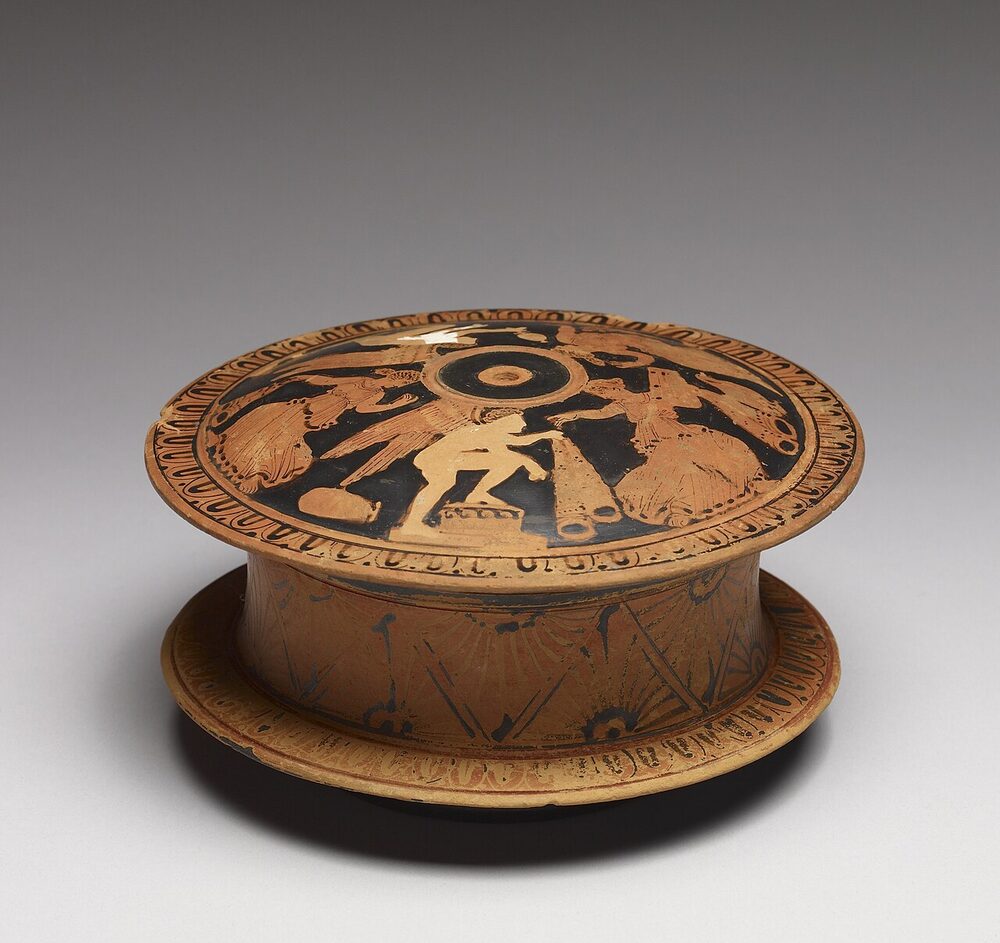
Erōtes / the Loves
First Appearance
The band of the Erotes begins where the single Eros first gathers a companion. Hesiod's Theogony opens with Eros alone among the first beings — "fairest among the deathless gods, who loosens the limbs, and overcomes the mind and the thoughtful counsel of all gods and all men" (116–122). But when golden Aphrodite rises from the sea-foam and first comes among the gods, she does not come alone: "Eros accompanied her, and fair Himeros (Desire) followed, at her birth and when she first went into the company of the gods" (Theogony 201–202). Here already, in the oldest theogony, the love-god has a second beside him — Eros and Himeros together — and from that pairing the later plural band of the Erotes grew.
— Hesiod, Theogony 201–202 (with 116–122 for the primordial Eros)
Who They Are
The Erotes (eh-ROH-teez), "the Loves," are the band of winged love-gods into which the single Eros of the earliest myth multiplied — a company of youthful, winged spirits who attend Aphrodite and carry, between them, the whole range of what it is to desire. Where the oldest Greek poetry knew one love-god — Hesiod's primordial Eros, "fairest among the deathless gods, who loosens the limbs" (Theogony 120–121) — later poets and, above all, later artists came to picture not one but many: a flock of small winged Loves fluttering about the goddess of love, each the sign of a different turn of the heart. The chief of them, besides Eros himself, are Anteros (love returned, and the avenger of love scorned), Himeros (desire, the wanting of the moment), and Pothos (yearning, the ache for what is absent or lost).
This multiplication is one of the quiet, telling movements in Greek religion: a single great force felt as so various that the Greeks gave its separate shades separate names and faces. Desire at first sight is not the same as the slow ache for someone far away; the love that is answered and grows is not the same as the love that is spurned and turns to grief. So the one Eros became the Erotes — Eros the archer at their head, Himeros the sudden heat of wanting, Pothos the longing for the absent, and Anteros the love that must be returned to live. In later lists Hymenaios, god of the wedding-song, and Hermaphroditus, the twy-formed child of Hermes and Aphrodite, were sometimes drawn into their company as well.
Eros himself keeps his own place in the Golden Thread — the primordial power of Hesiod and the arrow-shooting son of Aphrodite both. This page gathers the band he leads: the lesser-known Loves who share his wings and his work, and especially Anteros, whose strange and beautiful myth — of a love that thrives only when it is returned, and avenges itself when it is not — is one of the most humane things the Greeks ever said about the heart.
Mythology
From one Eros to many
In the beginning there was one. Hesiod's Theogony sets Eros among the very first beings to come into existence, a primordial force older than almost everything (116–122); and when Aphrodite is born from the sea, it is Eros and Himeros ("Desire") who attend her from the first (Theogony 201–202). Already, then, the love-god is not quite alone — he has a companion in Himeros, the rush of desire. From this seed the Greeks drew out, over the centuries, a whole plural band: the Erotes, "the Loves." The lyric poets began it, picturing love as a swarm rather than a single stroke — Sappho and Anacreon speak of Eros again and again as a power that strikes and flees and returns, and the later "Anacreontic" poems delight in a whole mischievous flock of little Loves. By the Hellenistic age, art had made the multiplication complete: vases, gems, wall-paintings and sculpture show not one Eros but many small winged Loves — erotes, the Romans' amores or cupids — fluttering about Aphrodite, drawing her chariot, riding dolphins and geese, teasing and tormenting gods and mortals alike. The single primordial force had become a company, each Love a separate shade of desire.
Himeros — the desire of the moment
Himeros (Ἵμερος, "Desire, Longing") is the eldest of the band after Eros, and the one Hesiod names: the hot, immediate wanting that strikes at the sight of the beloved. He is desire in the present tense — the pull felt now, toward the one who is here. In art he is often shown as one of a winged pair or trio with Eros and Pothos, attending Aphrodite; the three together map the geography of wanting. Himeros is the spark; where it lands on someone present and near, it is his.
Pothos — the ache for the absent
Pothos (Πόθος, "Yearning") is Himeros's darker, sweeter twin: not the desire for the one who is here, but the longing for the one who is absent, far off, or lost. The Greeks drew the distinction finely — himeros is the wanting of the present beloved, pothos the ache for the missing one — and they gave each its own god. Pothos is the love that grief is made of: the yearning that follows the departed, the lover gone to sea, the beloved dead. Because of this he keeps company not only with Aphrodite but with mourning, and the word pothos is carved on graves for the longing of the living after the dead. In the band of the Erotes he is the long reach of desire across distance and loss — love stretched thin by absence and all the keener for it.
Anteros — love returned, and love avenged
The most remarkable of the Loves is Anteros (Ἀντέρως), whose name means "love-in-return" or "counter-love." He is the god of reciprocity — of the love that is answered — and the Greeks understood him in two joined ways: as the power that makes a love flourish by being returned, and, where a true love is scorned, as its avenger. The deepest statement of the first idea is in Plato's Phaedrus (255d–e), where Socrates describes how the lover's passion, pouring into the beloved, overflows and streams back again into the lover's own eyes: the beloved "is in love, but with what he cannot tell… he has a counter-love (anteros), the image of love reflected back." Love, in Plato's picture, kindles its own answer; Anteros is that answering flame, the proof that true desire is not one-way but a thing passed back and forth between two.
The darker face of Anteros — love avenged — the Greeks told in a famous Athenian tale preserved by Pausanias (Description of Greece 1.30.1). In the grove of the Academy outside Athens stood an altar of Anteros, and Pausanias explains that the resident foreigners of the city (the metics) had raised it in memory of a youth named Timagoras. Timagoras, himself a metic, loved an Athenian boy named Meles; but Meles scorned him utterly, and at last, in cruelty or in sport, told Timagoras to climb to the top of a high rock and throw himself down. Timagoras, loving him, obeyed — and died. When Meles saw the body of the lover he had despised lying broken below, remorse seized him so terribly that he threw himself from the same rock and died too. From this the resident aliens honoured Anteros as the avenging spirit (alastōr) of Timagoras — the god who makes the scorner answer for the love he spurned, so that love refused does not go unpaid. It is a hard, unforgettable story, and it fixes the double nature of Anteros: love is meant to be returned, and where it is not, the debt still comes due.
Eros and Anteros, contending for the palm
The two ideas — love and love-returned — the Greeks also set side by side as an image. Pausanias (6.23.3–5) describes the gymnasium at Elis, where there was a relief of Eros and Anteros: Eros holds a palm-branch, the token of victory, and Anteros is trying to take it from him. The little scene is a riddle with a kind answer — love and counter-love wrestling for the prize, neither able to keep it alone, the victory belonging only to the love that is both given and returned. In some later tellings Anteros was even made the elder brother and guardian of Eros, who (said a story in the mythographers) remained a sickly child until Anteros was born, for love cannot grow until it is answered. Whether as rival, brother, or mirror, Anteros always carries the same truth: a love must be returned to thrive.
Hymenaios, Hermaphroditus, and the wider company
As the band of the Erotes grew, later writers and artists drew other figures into it. Hymenaios (Hymen), the god of the wedding-song and of marriage, was sometimes counted among the Loves, as the one who crowns desire with the married bond; and Hermaphroditus, the twy-formed child of Hermes and Aphrodite in whom the two sexes are joined in one body, was likewise sometimes grouped with them as a love-spirit of union. Both of these keep their own pages in the Golden Thread and belong fully to neither the Erotes alone nor to any single tale; they are named here only to show how open and various the company of the Loves became — a loose, expanding family of the gods of desire gathered about Aphrodite, into which the Greeks could fold whatever aspect of love they wished to give a face.
Worship — Ancient
The altar of Anteros in the Academy
The clearest cult of the band belonged to Anteros, and it stood in a famous place: the grove of the Academy outside Athens, where Plato taught. There, Pausanias reports (1.30.1), the resident foreigners of the city had raised an altar to Anteros, the god of love-returned and the avenger of love scorned, in memory of the dead lover Timagoras. It is a rare and moving thing — a shrine set up not by citizens but by the city's outsiders, to a god of the reciprocity they must have felt the lack of, honouring one of their own who had loved and died for it. The altar made Anteros not merely a poet's figure but a god with a place of worship, where the debt of love refused was remembered and, in some sense, paid.
The Erotes in the train of Aphrodite
Apart from Anteros's Athenian altar, the Erotes as a band had little cult of their own separate from Eros and Aphrodite, in whose worship they shared. Eros himself was anciently and seriously worshipped — most famously at Thespiae in Boeotia, where he was honoured from very early times under an unwrought stone and celebrated with the games called the Erotidia, and at Athens on the north slope of the Acropolis. The lesser Loves — Himeros, Pothos, Anteros — belonged to that worship as Aphrodite's attendants, present wherever the goddess of love was honoured. At the gymnasium at Elis the relief of Eros and Anteros contending for the palm (Pausanias 6.23.3–5) shows the Loves honoured in the places of youth and beauty, among the young men at their exercises — a fitting home for the gods of desire returned.
Himeros and Pothos as names of feeling
Himeros and Pothos were worshipped less as persons than as powers felt and named. Their names were the ordinary Greek words for two kinds of desire, and the Greeks moved easily between the word and the god: to feel pothos was, in a sense, to be touched by Pothos. So these two Loves lived most truly in the language and the poetry of desire — in Sappho's lines on longing, in Anacreon's on wanting, on the painted vases where they attend the goddess, and on the grave-markers where pothos, the yearning of the living for the dead, is carved as the truest name of grief. Their cult, such as it was, was the daily human experience of wanting itself.
Worship — Modern
Honouring the many Loves
To a modern devotee drawn to the gods of the Greek world, the Erotes offer something the single figure of Cupid, flattened by the centuries into a greetings-card cherub, has lost: the honest variety of love. Desire at first sight, the ache for someone far away, the love that grows when it is answered and curdles when it is spurned — the Greeks gave each its own god, and to name them is to name the real weather of the heart. One might honour Himeros in the first bright pull toward another, Pothos in the missing of someone absent or gone, and Anteros in gratitude for a love that is returned — or in the hard wisdom that a love not returned is a debt, both to the one who loved and to oneself. Garlands of roses and myrtle, the flowers of Aphrodite, suit the whole band, who stand always in her train.
Anteros and the ethics of love returned
Of all the Loves it is Anteros who speaks most directly to the present, for his is a moral idea as much as a god: that love is meant to be answered, and that to accept love and give nothing back — to scorn a true affection, to use it and discard it — is a wrong that carries its own punishment. The tale of Timagoras and Meles is terrible, but its lesson is gentle at the root: a love must be returned to thrive, and the one who despises another's true love does a harm that comes round, in the end, upon the scorner. In an age fluent in the careless wounding of hearts, Anteros is a surprisingly modern patron — the god of reciprocity, of love as a thing passed back and forth rather than taken, and of the simple, hard justice that what is given in love is owed an answer.
The little Loves in art
Above all the Erotes live on in art, where they never died. The flock of small winged Loves that the Hellenistic Greeks set fluttering about Aphrodite passed straight into the Roman amores and cupids, and from there into the putti and amorini of Renaissance and Baroque painting — the plump winged babies who crowd the skies of a thousand canvases, draw Venus's chariot, and aim their little bows at unsuspecting lovers. Every Valentine's cupid, every cherub trailing a ribbon, is a late and softened descendant of the Greek Erotes, the band of the Loves. Behind the sweetness, the old distinctions still wait to be recovered: that love is not one thing but many, and that the winged child with the bow was once a whole company of gods, each carrying a different piece of the human heart.
Epithets & Cult Titles
- οἱ Ἔρωτες (hoi Erōtes) — "the Loves" — The collective name of the band — the plural of Eros. Where early poetry knew one love-god, later poetry and art pictured a whole company of winged love-spirits attending Aphrodite, each embodying a different turn of desire; the name covers them all together
- Ἔρως (Erōs) — "Love, Desire" — The eldest and the source: in Hesiod the primordial Eros, "fairest among the deathless gods, who loosens the limbs and overcomes the mind" (Theogony 120–122), and in later myth the archer-child of Aphrodite. From this one figure the plural Erotes were drawn out. He keeps his own page; here he stands as the head of the band
- Ἀντέρως (Anterōs) — "Love-in-Return, Counter-Love" — From anti- ("in return, against") and eros: the god of love answered and returned, and — where love is spurned — its avenger. He is the brother who matches Eros, the power that makes a love thrive by being returned and punishes the one who scorns a true lover
- Ἵμερος (Himeros) — "Desire, the Longing of the Moment" — The personified rush of present desire, the hot immediate wanting. Already in Hesiod he walks beside Eros at the birth of Aphrodite (Theogony 201–202); in the band of the Erotes he is the desire that strikes at the sight of the beloved
- Πόθος (Pothos) — "Yearning, the Ache for the Absent" — The personified longing for what is far off or lost — the love that aches for the absent, the missed, the unattainable. Where Himeros is desire for the one present, Pothos is the yearning for the one who is gone
- Ὑμέναιος / Ἑρμαφρόδιτος (Hymenaios / Hermaphroditos) — Two figures sometimes counted among the Erotes in later tellings: Hymenaios, the god of the wedding-song and of marriage, and Hermaphroditus, the twy-formed child of Hermes and Aphrodite. Both keep their own pages; they are named here only as the wider company the love-gods were said to include
Sources & Variants
- Hesiod, Theogony 116–122 (Eros among the first beings, fairest of the gods, who loosens the limbs and overcomes the mind)
- Hesiod, Theogony 201–202 (Eros and Himeros attend Aphrodite at her birth and her first coming among the gods — the earliest pairing from which the band of the Erotes grew)
- Sappho and Anacreon (archaic lyric: Eros/the Loves as a striking, fleeing, returning power; the later 'Anacreontic' poems picture a whole flock of little Loves)
- Plato, Phaedrus 255d–e (Anteros as 'counter-love': the lover's passion reflected back into the beloved as an answering love)
- Pausanias, Description of Greece 1.30.1 (the altar of Anteros in the Academy at Athens, raised by the metics in memory of Timagoras, scorned by Meles — Anteros as avenger of love refused)
- Pausanias, Description of Greece 6.23.3–5 (the relief in the gymnasium at Elis of Eros and Anteros contending for the palm-branch)
- Pausanias, Description of Greece 9.27.1 (Eros most anciently worshipped at Thespiae under an unwrought stone; the games there in his honour) — for the cult-context of the Loves
- Hellenistic epigram and art (the plural winged Erotes attending Aphrodite — amores/cupids — on vases, gems, and wall-paintings, the source of the later putti)
- Cicero, De Natura Deorum 3.59–60 (the Romans' multiple Cupids/Amores and their genealogies) — Roman, for the later systematising of the band
Gallery