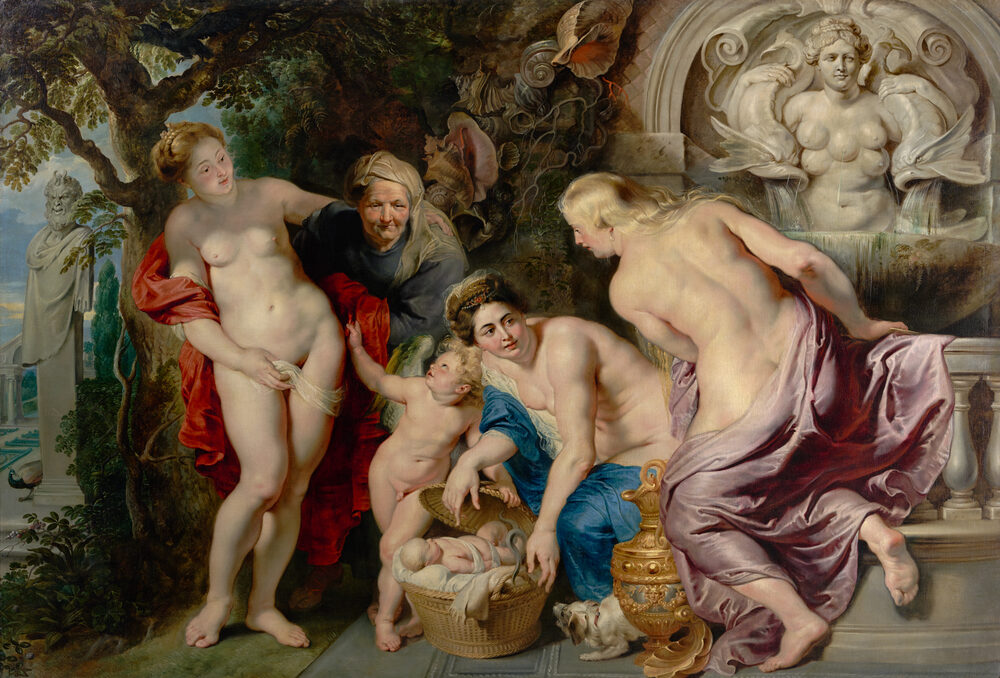
Erichthonios
First Appearance
The earliest glimpse comes in Homer's catalogue of the Greek forces (Iliad 2.546–551), where the men of Athens follow "great-hearted Erechtheus, whom once Athena reared, the son of the grain-giving earth" — set down by the goddess in her own rich temple, where the Athenian youths still honour him with bulls and rams. Homer calls this earth-born foster-child of Athena *Erechtheus*, and herein lies an old tangle, for later Athens remembered two kings — Erichthonius the serpent-child and Erechtheus the warrior-king — whom the oldest poetry does not yet distinguish. The birth itself, from the thwarted desire of Hephaestus and the earth, is told most fully by Apollodorus (Bibliotheca 3.14.6), and the whole myth stands behind the Athenian stage, above all Euripides' *Ion*.
— Homer, Iliad 2.546–551; Hesiod and the early Athenian tradition; fully in Apollodorus, Bibliotheca 3.14.6
Who They Are
Erichthonius (err-ick-THOH-nee-us) is the earth-born early king of Athens — the child who had no mother of flesh but was brought forth by the ground of Attica itself, reared in secret by the goddess Athena, and raised to the throne of the city he would teach to honour her. He is counted among the heroes because he was a king of men and the founder of a royal line; but he is a hero of a rare and uncanny kind, for he was never quite only a man. Part-serpent in body, or guarded always by serpents, he was the living sign of the Athenians' proudest claim — that they were autochthonous, sprung from their own soil, a people as old as the land they held.
His myth joins three things the Athenians most wanted to remember: where their kings came from, how their city's worship of Athena began, and why a sacred serpent was kept on the Acropolis to the end of their history. It is a strange and vivid story — a god's thwarted desire, a seed cast to the earth, a child grown from the ground, a forbidden chest and the maidens who could not keep from looking, and a king who gave Athens its great festival and its first chariot. Where the tale ends, it ends in the sky, among the stars as the Charioteer.
(A note on the two kings: ancient writers often ran together Erichthonius, the serpent-child and earth-born founder, with Erechtheus, a later warrior-king of Athens — Homer already uses the single name Erechtheus for the earth-born foster-child of Athena. This page keeps the two apart, as the fuller Athenian tradition did: Erichthonius the beginning of the line, Erechtheus his descendant and heir. A section below sets out the distinction plainly.)
Mythology
Born of the earth: the thwarted desire of Hephaestus
Erichthonius had no mother in the ordinary way; he was gēgenēs, earth-born. The story of his begetting is one of the strangest the Greeks told (Apollodorus, Bibliotheca 3.14.6). Athena had come to the forge of Hephaestus, the smith-god, to have arms made — and Hephaestus, seized by desire, tried to force himself upon the virgin goddess. Athena, fiercest guardian of her own chastity, fought free and fled; but in the struggle the god's seed fell upon her thigh. In disgust she wiped it away with a tuft of wool (Greek erion) and cast the wool to the ground — to Gaia, the Earth. From that the earth conceived, and in time Earth brought forth a child. The Greeks heard the whole tale folded into the name itself: Erichthonios, from the wool (erion) and the earth (chthōn) — the child the soil received and bore.
So the goddess who would raise and love him was in no sense his mother, nor Hephaestus in any true sense his father; he was the offspring of the ground of Attica, and that was the heart of the matter for the Athenians. Their first real king had come up out of their own land.
Athena's foster-child and the forbidden chest
Earth gave the infant up to Athena, who took him as her own foster-son and resolved to make him immortal and to rear him in secret, hidden even from the other gods (Apollodorus 3.14.6; and behind Euripides' Ion, where the tale is told as Athenian sacred history). She laid the child in a chest — a kistē, a lidded basket — and with it, in some tellings, set a serpent or two serpents to guard him; for the child himself was uncanny, part-serpent in body in the older picture, his lower half a snake's coil.
This chest Athena entrusted to the three daughters of Cecrops, the first king of Athens (himself half-serpent, earth-born like the child he was asked to keep): Aglauros, Herse, and Pandrosos. She laid on them one command — that they must not open it, nor look at what lay within. But the forbidden chest did what forbidden things do. Two of the sisters — Aglauros and Herse — could not master their curiosity and lifted the lid; Pandrosos alone, in the version Athens honoured, kept faith and did not look (it is she who had a shrine, the Pandroseion, beside Athena's on the Acropolis). What the sisters saw within — the serpent-child, or the infant wound about by the guardian snakes — struck them with a madness or a terror they could not bear, and in their frenzy they flung themselves from the height of the Acropolis to their deaths. So the first disobedience at Athens was punished, and the child passed back into the keeping of the goddess.
King of Athens and founder of the city's rites
Grown, Erichthonius took the kingship of Athens after Cecrops, and the Athenians credited him with the beginnings of their city's worship. He set up the ancient wooden image of Athena — the xoanon, the old olive-wood figure that was the holiest object on the Acropolis, said to have fallen from heaven or to be older than memory — and he founded the Panathenaia, the city's great festival in the goddess's honour, by whose procession the woven robe was carried up to her each year (Apollodorus 3.14.6; the Athenian tradition reflected in Pausanias). Through him Athens traced the origin of its chief cult: the earth-born king taught the earth-born people to honour the goddess who had reared him. He ruled long, and when he died he was buried, the Athenians said, within the sacred precinct of Athena herself; his son in the line of kings carried the royal house onward.
The invention of the chariot: Erichthonius in the stars
To Erichthonius the Greeks also gave a famous invention. Lame of foot in the old picture — the legacy of his serpent body or of his strange begetting — he was the first, they said, to yoke four horses to a chariot, so that he might ride where he could not easily walk; he built the first tethrippon, the four-horse team, in imitation (some said) of the sun-god's car (Eratosthenes, Catasterismi, on the Charioteer; the Roman astronomer Hyginus tells the same in his Astronomica, a later Latin source). For this he was set among the stars as the constellation Auriga, the Charioteer (Greek Hēniochos, "the rein-holder"), shown as a man holding the reins — the earth-born king lifted from the ground he was born of into the sky. Thus the tale that begins in the soil of Attica ends among the stars, and the lame king who could not walk rides forever across heaven.
Erichthonius and Erechtheus
Athens remembered two earth-associated kings whose names the ancient sources constantly ran together, and it is worth setting them clearly apart. Erichthonius is the serpent-child of this page: born of the earth from the thwarted desire of Hephaestus, reared by Athena, hidden in the chest, and raised to be the founder-king who established the Panathenaia and set up the goddess's image. Erechtheus is a later king of the same royal line — Erichthonius's descendant and heir, several generations on — a warrior-king chiefly remembered for the war between Athens and Eleusis, in which the Eleusinians were led by Eumolpus, a son of Poseidon. In that war Erechtheus killed Eumolpus; and for it Poseidon took his revenge, and Erechtheus was destroyed — struck down by Poseidon's trident or by the thunderbolt of Zeus at Poseidon's asking — a death bound up with the grim tale of his daughters' sacrifice for the city (the matter of Euripides' lost Erechtheus).
The tangle is old and honest: Homer already calls the earth-born foster-child of Athena Erechtheus (Iliad 2.546–551), using the single name for what the fuller Athenian tradition split in two, and the two kings share the Acropolis temple, the Erechtheion, that bears the later name. The two also gave the Athenians two faces of their kingship — Erichthonius the sacred, serpent-formed beginning out of the earth, and Erechtheus the mortal warrior-king who fell defending the city. This page keeps to the first; the second is a separate figure, for all that the sources blur them.
The sacred serpent of the Acropolis
Erichthonius never wholly left the Acropolis. The Athenians kept there a sacred serpent — the house-snake of the citadel, housed in the precinct of the Erechtheion, the temple that joined the worship of Athena and the old earth-born kings — and fed it each month with a honey-cake. This serpent they understood as the guardian of the Acropolis and the abiding presence of Erichthonius himself, the serpent-king still coiled in his city. In a famous moment before the Persian onslaught the priests reported that the honey-cake lay untouched — the sacred serpent had departed — and the Athenians read it as the sign that Athena herself had abandoned the citadel and that they should take to their ships (Herodotus 8.41 tells this of the guardian serpent of the Acropolis). So long as Athens stood, the earth-born king remained its protector in the body of a snake.
Worship — Ancient
A king remembered as sacred history
Erichthonius was honoured less as a separate god with his own cult than as the sacred foundation of Athens itself — the earth-born origin of its kings, its rites, and its claim to the land. His worship was woven into the worship of Athena on the Acropolis, whose image he set up and whose great festival he was said to have founded. To honour Athena of the city was, in a way, to honour the king who first taught Athens to do so.
The Erechtheion and the Acropolis serpent
His true shrine was the Acropolis and above all the Erechtheion, the strange and holy temple on its north side that gathered under one roof the oldest sacred things of Athens — the olive-wood image of Athena, the mark of Poseidon's trident and the salt spring, the tomb of the earth-born kings, and the den of the guardian serpent. There the sacred snake was kept and fed its monthly honey-cake (Herodotus 8.41), the living sign of Erichthonius present in his city. Pausanias, walking the Acropolis centuries later, still records these holy things and the memory of the earth-born child reared by the goddess (Pausanias 1.18.2 on the Erechtheion and its precinct; 1.24.7 on the sanctuary and the olive; 1.2.6 on the Athenian kings in the old tradition).
The Panathenaia and the Arrhephoria
Through the festivals he was credited with founding, Erichthonius stood behind the ritual year of Athens. The Panathenaia, the city's chief festival, carried Athena's robe up to the image he had raised; and in the secret night-rite of the Arrhephoria two girls bore hidden things, not to be looked upon, down a concealed stair — a ritual that Athenians felt as the long echo of the forbidden chest and the maidens of Cecrops who could not keep from looking. The myth was not merely told at Athens; it was enacted, year by year, in the rites of the Acropolis.
Worship — Modern
The earth-born king and the serpent
Erichthonius is remembered today chiefly as the great figure of Athenian autochthony — the myth by which a people claimed to be as old as their own soil — and as the serpent-king of the Acropolis. A modern honouring of him sits close to the earth he was born from and to the goddess who reared him: the olive, the ground of one's own place, the sense of a protecting presence kept at the hearth or the threshold in the old image of the house-snake. He belongs to those who care for a particular land and its continuity, the keeping-faith of a place with its own beginnings.
Faithfulness and the forbidden thing
His story carries a quiet moral the Greeks felt keenly: the chest that must not be opened, the two sisters who looked and were destroyed, and the one — Pandrosos — who kept faith and was honoured for it. Read today, the myth speaks of trust and of the things not meant to be pried into, and of the dignity of obedience to what is sacred. The madness that took the sisters is the oldest warning in the tale: some thresholds are not ours to cross.
The Charioteer in the winter sky
Above all Erichthonius endures where the Greeks last set him — overhead, as the constellation Auriga, the Charioteer, bright in the winter sky with the star Capella at its shoulder. The lame, earth-born king who first yoked four horses rides there still, and every chart of the northern heavens keeps his memory, the child of the Attic soil lifted at last into the stars.
Epithets & Cult Titles
- gēgenēs (γηγενής) — Earth-born — the word for one sprung from the ground itself, without human mother; Erichthonius is the great Athenian example, grown from the soil of Attica and so proof of the Athenians' claim to be autochthonous, 'sprung from their own land'
- autochthōn (αὐτόχθων) — Of the land itself, native-born — the title in which Athens took such pride, that its first kings came not as settlers from elsewhere but out of its own earth; Erichthonius embodied the claim
- basileus Athēnaiōn (βασιλεὺς Ἀθηναίων) — King of the Athenians — the early king who took the throne of Attica after Cecrops, founded the city's chief rites, and gave his line to the kings who followed
- the serpent-child — A name for his strange form: in the tellings he was part-serpent, his lower body a snake's coil, or else a human infant wound about and guarded by serpents — the shape that drove the daughters of Cecrops mad when they looked
Sources & Variants
- Homer, Iliad 2.546–551 (the Athenians under earth-born Erechtheus, 'son of the grain-giving earth,' reared by Athena and set in her temple — the oldest form, which uses the single name Erechtheus for the earth-born foster-child)
- Hesiod and the early Athenian tradition (Erichthonius among the earth-born first things of Attica)
- Apollodorus, Bibliotheca 3.14.6 (the fullest account: Hephaestus's attempt on Athena, the seed wiped with wool and cast to earth, Earth's child, the chest given to the daughters of Cecrops, their disobedience and death, Erichthonius as king, the xoanon and the Panathenaia)
- Euripides, Ion (the Athenian sacred history of the earth-born child, the chest, the guardian serpents, and the daughters of Aglauros on the Acropolis)
- Pausanias 1.2.6 (the old kings of Athens); 1.18.2 (the Erechtheion and its precinct); 1.24.7 (the Acropolis sanctuary, the image, and the olive)
- Herodotus 8.41 (the sacred guardian serpent of the Acropolis, fed a monthly honey-cake, whose departure signalled Athena's abandonment of the citadel)
- Eratosthenes, Catasterismi (Erichthonius, inventor of the four-horse chariot, set among the stars as Auriga the Charioteer / Hēniochos)
- Hyginus, Astronomica 2.13 (the chariot-inventor as Auriga) — a later Roman source, in agreement with the Greek
Gallery