Endymiōn
First Appearance
Endymion enters Greek poetry early and already double. The Hesiodic Catalogue of Women (fr. 10) places him in the heroic genealogies as a son of Aethlius and names him among the early kings, giving the Peloponnesian, Elean strand of his story. The amorous strand — the Moon in love with the sleeping youth — is among the oldest too: Sappho was remembered in antiquity for telling of Selene's love for Endymion, and Apollonius of Rhodes (Argonautica 4.57–58) has the Moon herself, rising over the Argo, remember "the Latmian cave and fair Endymion," confessing that she too has known the madness of love. From these beginnings the two traditions — the sleeping shepherd beloved of the Moon, and the king of Elis — run side by side through all of Greek myth.
— Ps.-Hesiod, Catalogue of Women fr. 10 (Merkelbach–West); Sappho (the love of Selene for Endymion); Apollonius of Rhodes, Argonautica 4.57–58
Who They Are
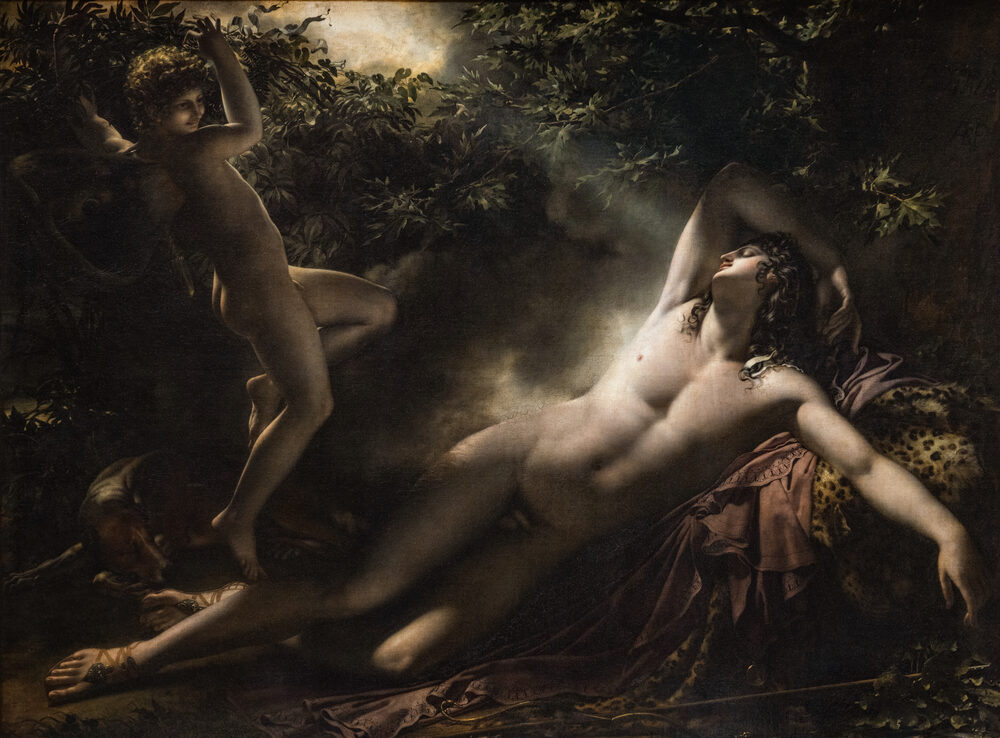
Endymion (en-DIM-ee-on) is the beautiful youth granted eternal sleep — the sleeper forever young, laid in a cave on a mountainside where the Moon herself comes down to him night after night. He is counted here among the heroes because he began as a mortal man; but like Ganymede his is a hero's tale unlike the others, for it holds no quest, no monster, and no war, only beauty, love, and a sleep that never ends. His story asks a single haunting question — what would it be to keep a loveliness from ever aging? — and answers it with an image the Greeks never forgot: a young man asleep under the open sky, undying and unchanging, visited each night by the light of the Moon.
Two great strands make up his myth, and the ancient sources never fully reconciled them. In the one best loved by the poets, Endymion is a shepherd of Mount Latmos in Caria (Karia), on the coast of Asia Minor, whom the Moon-goddess Selene sees as he sleeps and loves with all her heart, descending from the sky to kiss and embrace him; in some tellings she bears him fifty daughters. In the other, older and more sober, he is a king of Elis in the Peloponnese, son of Aethlius, founder of a royal house and ancestor of the Eleans, who showed his tomb at Olympia. The gift of eternal sleep binds the two together: Zeus grants Endymion his wish to stay forever young by sleeping forever, so that he never dies and never ages.
The sources disagree, too, on how the sleep came to be — whether Zeus offered him any wish he chose and he asked for undying sleep, whether it was Selene's own doing so that she might keep him unchanged, or whether it was a punishment for a trespass against the gods. This page follows the Greek sources through all these variants, keeping the image at the heart of them: the beautiful sleeper, forever young, and the Moon that will not let him go.
Mythology
The two Endymions: shepherd of Latmos, king of Elis
From the very beginning Greek myth told of Endymion in two ways, and did not trouble to make them one. In the strand the poets loved, he is a young shepherd keeping his flock on the high slopes of Mount Latmos (Latmian mountain) in Caria, on the western coast of Asia Minor — a youth of such beauty that the Moon came down out of the sky to him. In the other strand, older and set in mainland Greece, he is a king of Elis in the Peloponnese: the Hesiodic Catalogue of Women (fr. 10) names him a son of Aethlius (himself a son of Zeus, or of Aethlius' reputed father Aeolus), an early king who led his people into Elis and founded a royal line. Pausanias, travelling the Peloponnese, records this Elean Endymion fully (Pausanias 5.1.3–5): he reigned at Elis, set his sons to race for the throne at Olympia, and was buried there, his tomb still shown in Pausanias' own day. The ancients themselves noticed the doubling and tried in places to join the two — making the Elean king wander to Caria, or the Carian shepherd descend from Elean stock — but the sources never truly settled it, and both Endymions stand together in the tradition.
The Moon in love: Selene and the sleeper
The strand that made Endymion immortal in memory is the love of Selene, the Moon. Seeing the beautiful youth asleep on Mount Latmos, the Moon-goddess loved him, and night after night she left her course in the sky and came down to the cave where he lay to kiss and embrace him as he slept. This was among the oldest tellings of his story: Sappho was remembered in antiquity for singing of Selene's love for Endymion, and Apollonius of Rhodes (Argonautica 4.57–58) has the Moon herself, rising over the sea, recall with longing "the Latmian cave and fair Endymion," admitting that she too has suffered love's madness for a mortal. In some tellings the love was fruitful: Selene bore Endymion fifty daughters, understood as the fifty months of the Olympiad — the four-year span between the Olympic Games, counted by lunar months — so that the Moon's love for the sleeper was woven into the very reckoning of sacred time. It is one of the tenderest and strangest images in all Greek myth: the goddess of the Moon bending each night over a sleeping man who never wakes, loving a beauty held forever still.
The gift of eternal sleep
At the heart of the myth lies the gift for which Endymion's name became a byword: eternal sleep. The sources tell it more than one way. In the best-known version, Zeus granted Endymion a single wish — any thing he chose — and Endymion, so Apollodorus reports (Bibliotheca 1.7.5–6), "chose to sleep forever, remaining deathless and ageless": to be spared both death and the ruin of old age, at the price of never waking. In another telling it was the Moon's own wish, or her doing, that laid him in unending sleep so that she might keep his beauty unchanged and come to him forever as he was. Either way the result is the same haunting condition — a youth forever young because forever asleep, neither dying nor aging, laid in a cave on Latmos while the years pass over him and leave him untouched. The Greeks, who feared old age almost as they feared death, looked at this gift with a divided heart: it was deathlessness of a kind, yet a deathlessness without waking, without life lived — beauty preserved by being set outside of time altogether.
A variant: the sleep as punishment
Not every telling made the sleep a gift. In one strand of the tradition it was a punishment: Endymion, raised for a time among the gods (or granted their company), presumed too far — in the harshest version he cast his eyes upon Hera herself, the wife of Zeus, and desired her; and for this trespass Zeus cast him into unending sleep. In this reading the eternal sleep is not a mercy that spares him age but a sentence that removes him from the world, the price of a mortal's over-reaching love for a goddess who was not his to desire. The variant sits uneasily beside the tender Selene-strand, and the ancients did not reconcile them; but it preserves an older and sterner note — that to be loved by, or to love, the immortals is a perilous thing, and that Endymion's changeless sleep may be read as doom as readily as gift.
The king of Elis and his line
The Peloponnesian Endymion keeps a wholly different shape. Here he is no dreaming shepherd but a ruler: son of Aethlius, he led the Aeolians into the land of Elis and reigned there as king (Pausanias 5.1.3–5; Apollodorus 1.7.5–6). By his wife he had sons — among them Epeius, Aetolus, and Paeon — and, the story goes, he set them to run a footrace at Olympia for the kingship, the race by which Epeius won the throne; some counted this among the mythical origins of the Olympic contest itself. From Endymion's line the kings and peoples of the region traced their descent, and the Eleans honoured him as a founding ancestor, showing his tomb at Olympia. In this strand the gift of sleep, where it appears at all, is folded in only loosely — a far-off echo of the Carian story attached to the Elean king — and the weight falls instead on genealogy, kingship, and the founding of a people.
The haunting image: forever young
What held the Greeks, and has held every age since, is the picture itself: a beautiful young man asleep on a mountainside, undying and unaging, while the Moon comes down to him through the dark. In Endymion the myth gathers a cluster of deep human longings and fears — the wish to keep beauty from fading, the dread of growing old, the strange nearness of sleep to death, the ache of a love that cannot be fully answered because the beloved never wakes. The theme of the beautiful sleeper outside of time runs on long after antiquity, but it is already whole in the Greek sources: Endymion is the one on whom time has no hold, forever young because forever asleep, loved and watched over and never changed.
Worship — Ancient
A hero of Elis, honoured at the tomb
In the Peloponnesian tradition Endymion received the honours proper to a hero and founding king. Pausanias, describing Elis and Olympia (5.1.3–5), reports that the Eleans kept his memory as the ancestor of their royal line and showed his tomb — placing it, in the local telling, at Olympia itself, the great sanctuary over which his descendants were said to have contended. Hero-honours of this kind — offerings and libations at a reputed grave, the keeping of a founder's memory — were the natural form of Endymion's cult in mainland Greece, bound to place and lineage rather than to any Panhellenic festival.
The sleeper of Latmos
In Caria the memory ran differently, attached not to a tomb but to the mountain itself. The people of the region about Mount Latmos — and the nearby city of Heraclea under Latmos — kept the story of the sleeping shepherd and the Moon who loved him, and travellers in antiquity were shown the cave where Endymion was said to lie in his unending sleep. Here the devotion was less a formal cult than a landscape made holy by myth: a mountain, a cave, and the nightly return of the Moon, so that the place itself preserved the tale.
In poetry and reflection
Beyond any shrine, Endymion lived most fully in song and thought. From Sappho and the Hesiodic poets onward his name carried the whole weight of his myth, and to invoke "the sleep of Endymion" was to call up at once the ideas of changeless beauty, undying youth, and the strange blessing-or-curse of a life passed outside of time. Later Greek writers turned the figure over as the poets had the lovers — a byword for deep and happy sleep, and for the longing to keep what is beautiful from ever fading.
Worship — Modern
The patron of the changeless sleeper
Endymion is remembered today less through any formal cult than through the enduring power of his image — the beautiful youth asleep forever, watched over by the Moon. A modern devotee drawn to him might honour him in the places the ancients set him: in the quiet of night and under the light of the moon, in the hush of sleep and dream, and in the longing to hold fast what is beautiful against the wearing of time. He sits well as a patron of rest and of dreams, of youthful beauty, and of the tender, watchful love that keeps vigil over the sleeping.
Beauty held against time
His myth speaks directly to feelings every age knows — the wish that beauty and youth might not fade, the nearness of sleep to death and the hope that both might be gentle, the ache and the sweetness of loving one who cannot fully wake to answer. Read with care, Endymion's eternal sleep is neither simply blessing nor simply doom but both at once: a beauty preserved by being set outside the flow of life, a deathlessness bought at the price of living. That doubleness is what keeps the figure alive and worth returning to.
The Moon that still comes down
Above all Endymion survives through Selene and the Moon. Wherever the full moon rises over a sleeping world the old image waits to be felt again — the goddess of the Moon descending to the one she loves, the sleeper forever young in his cave on Latmos. To watch the moon rise with that story in mind is to keep a kind of devotion the Greeks would have understood: the beautiful sleeper, the watching light, and a love that time cannot alter.
Epithets & Cult Titles
- the sleeper of Latmos — His defining image — the beautiful youth laid in unending sleep in a cave on Mount Latmos in Caria (Karia), where the Moon-goddess comes down to him; the mountain gave its name to the whole tradition of the sleeping Endymion
- kallistos (κάλλιστος) — 'Most beautiful' — like Ganymede, Endymion is remembered above all for a loveliness so great that a deity desired to keep it from aging; his beauty is the hinge of the whole myth
- basileus Ēlidos (βασιλεὺς Ἤλιδος) — King of Elis — in the rival, non-amorous tradition (preserved by Pausanias) Endymion is no shepherd but a king of Elis in the Peloponnese, son of Aethlius, founder of a royal line and ancestor of the Eleans
- eudōn aiei (εὕδων αἰεί) — 'Forever sleeping' — the state Zeus granted him: eternal youth held fast in unending sleep, so that he neither dies nor ages, the haunting condition for which his name became a byword
Sources & Variants
- Ps.-Hesiod, Catalogue of Women fr. 10 (Merkelbach–West) (Endymion son of Aethlius; the Elean/Peloponnesian genealogy)
- Sappho (the love of Selene the Moon for Endymion, attested as among the oldest tellings)
- Apollonius of Rhodes, Argonautica 4.57–58 (the Moon recalls 'the Latmian cave and fair Endymion' and her own love-madness)
- Apollodorus, Bibliotheca 1.7.5–6 (Endymion king of Elis, son of Aethlius; Zeus grants his wish to sleep forever, deathless and ageless; his sons race at Olympia for the throne)
- Pausanias, Description of Greece 5.1.3–5 (the Elean tradition: Endymion as king of Elis, ancestor of the Eleans, his sons' footrace at Olympia, and his tomb shown there)
- Theocritus, Idyll 3.49–51 (Endymion's sleep invoked by the lovesick goatherd) and Idyll 20.37–39 (Selene and Endymion named among the gods' loves of mortals)
- Cicero, Tusculan Disputations 1.38 (Endymion's endless sleep on Latmos cited in the discussion of death and sleep) — later, Roman
Gallery