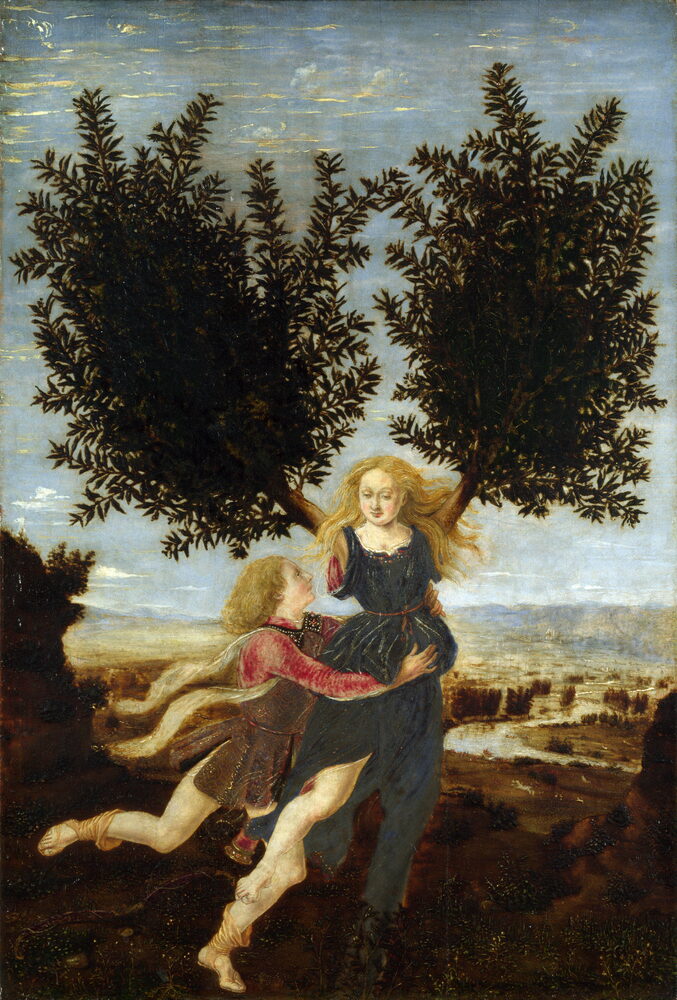
Daphnē
First Appearance
Daphne is a latecomer to the written record — she has no place in Homer or Hesiod — and her oldest connected tale is not the famous pursuit by Apollo but the darker story of Leucippus, preserved by Parthenius in his Sufferings in Love (Erōtika Pathēmata 15), who names the earlier Greek writers Diodoros and Phylarchus as his sources. There she is a huntress-maiden, a favourite of Artemis who shunned all men; a suitor named Leucippus disguised himself as a girl to be near her and was found out and killed, after which Apollo pursued her and she prayed to be taken out of mortal reach and became the laurel. Pausanias (8.20.1–4) tells the same Arcadian tale, making her the daughter of the river Ladon, and records (10.7.8) that it was from laurel, her tree, that the victor's crown at Apollo's Pythian games was woven. The pursuit-story in the shape the world best knows — with the arrows of love and her prayer to her river-father — is the later Roman telling of Ovid.
— Phylarchus (3rd c. BC), preserved by Parthenius, Erōtika Pathēmata 15; Pausanias 8.20.1–4 and 10.7.8
Who They Are
Daphne (DAF-nee) is the nymph who became the laurel tree. Her name is the Greek word for the laurel itself — daphnē, the bay — and her whole story is folded into that single fact: a maiden who would not be caught was changed, at the last moment of a desperate flight, into the evergreen tree that bears her name, and that tree became forever sacred to the very god she fled, Apollo. She is remembered as a daughter of a river-god and a companion of virgin Artemis, a huntress of the wild who wished for nothing but to remain unwed; and she is remembered, above all, for the instant of her transformation, when her running feet took root, her arms grew into branches, and her hair became leaves.
Her myth is one of pursuit and refusal. Apollo, greatest and most golden of the younger gods, burned with love for her; she fled from him through the woods, and when his speed was about to overtake her she cried out for rescue — to her father, to the Earth, to Zeus, according to which telling one follows — and was answered not by escape but by metamorphosis, hidden from the god inside the bark and leaves of a new-made tree. Apollo, finding he had embraced a tree where a girl had been, claimed the laurel as his own: its leaves would crown victors and poets, wreathe his lyre and his quiver, and stand green through every winter in sign of an honour that does not fade.
(Content note: Daphne's story is, at its core, one of unwanted pursuit and a woman's desperate flight from it. The ancient tellings do not shy from this, and neither does this page. Where the Romans and later art sometimes dwelt on Apollo's longing, the older Greek shape of the tale keeps its sympathy with the maiden — with her refusal, her prayer, and the strange mercy of a rescue that cost her her human life. That is the note kept here.)
Mythology
The maiden who would not be caught
Daphne was a nymph of the wild country, a daughter of a river — and the ancient sources do not agree which river. In the Arcadian telling recorded by Pausanias (8.20.1) she is the daughter of the river Ladon; the Roman handbook of Hyginus (Fabulae 203) makes her a daughter of the Earth (Gaia/Terra) and the Thessalian river Peneus, and the famous version of Ovid likewise makes her Peneus's daughter; while the oldest surviving narrative, that of Parthenius (Erōtika Pathēmata 15, drawing on Phylarchus), makes her a daughter of Amyklas. What every version agrees on is her nature: she was a huntress, a lover of the untamed hills and the chase, a companion and favourite of Artemis, the virgin goddess, and she wished above all things to remain unwed — a parthenos, a maiden, forever. She shunned the company of men and the thought of marriage, and asked of her father only that she be allowed to keep her maidenhood, as Artemis kept hers.
The pursuit of Apollo
The story the world knows best is of the pursuit by Apollo, and its most familiar form is the one fixed by the Roman poet Ovid (Metamorphoses 1.452–567), told here as the later shaping it is. In Ovid's telling the quarrel begins with Eros (Roman Cupid): Apollo, flushed with killing the great serpent Python, mocks the little love-god's archery, and Eros answers by drawing two arrows from his quiver — one of gold, tipped to kindle love, and one of lead, tipped to drive it away. The golden arrow he looses into Apollo, who at once burns with desire for Daphne; the leaden one he looses into Daphne, who at once loathes the very thought of a lover. So the god pursues and the maiden flees, each driven by an arrow, and Apollo calls after her as he runs — begging her to slow, protesting his love, naming his powers — while she, deaf with terror, runs the faster. This dueling-arrow device, and much of the breathless chase, is Ovid's own artistry; the older Greek tradition knew the pursuit but not the two arrows.
Her father the river, and the prayer
The flight could not last, for a god outruns a nymph. As Apollo's shadow fell across her and his breath stirred her hair, Daphne cried out for rescue — and here again the tellings part. In Ovid she prays to her father the river Peneus: "Help me, father! If your rivers hold divinity, destroy this beauty by which I please too well, and change it." in the Roman handbook of Hyginus (Fabulae 203) it is Gaia (Terra), the Earth, who opens and receives her and sets the laurel in her place; in Parthenius's oldest telling she prays to Zeus to be taken out of the reach of men. In every case the answer comes in the same instant and the same form: her limbs grow heavy, a thin bark closes over her soft skin, her hair springs into leaves, her arms lengthen into branches, her swift feet strike root into the ground, and where a running maiden had been there now stands a laurel tree — slender, evergreen, trembling still as if with the memory of flight. It is one of the most beloved of all Greek metamorphoses: not a punishment but a rescue, and yet a rescue that is also a loss, for the girl is saved only by ceasing to be a girl.
The laurel claimed: Apollo's tree
Apollo reached the tree and found, where the maiden had been, only bark and leaves; and in Ovid's telling he laid his hand against the trunk and felt the heart still beating beneath the new wood, and embraced the branches as he would have embraced her. Then, since he could not have her as a bride, he claimed her as his tree: "Since you cannot be my wife," he says, "you shall at least be my tree. My hair, my lyre, my quiver shall always wear you, laurel." From that day the laurel (daphnē) was sacred to Apollo above every other plant. Its leaves crowned the victors at his Pythian games at Delphi — Pausanias records (10.7.8) that the Pythian wreath was of laurel for this very reason — and wreathed the brows of poets, of triumphing generals, and of the god himself; its evergreen leaf, which does not fall in winter, stood as the sign of a glory that does not fade. The tree even entered the heart of Apollo's oracle, for laurel was burned and borne at Delphi and the prophetess was crowned with it. Thus the maiden who fled the god became, in the end, the one plant that could never be parted from him.
The older Greek tale: Leucippus
Before Ovid's chase there was an older and grimmer Greek story, the earliest that survives, told by Parthenius (Erōtika Pathēmata 15) from the earlier writers Phylarchus and Diodoros, and told again by Pausanias (8.20.2–4) as an Arcadian tale. In it Daphne is a huntress who will have nothing to do with men, and a mortal suitor, Leucippus, son of Oenomaus, falls in love with her. Knowing she will not admit a man to her company, he lets his hair grow long, dresses as a girl, and joins her band of huntress-maidens, winning her friendship as a companion of the chase. But Apollo, himself in love with Daphne and jealous of the disguised youth's nearness to her, puts it into the maidens' minds to bathe in the river. They strip to swim; Leucippus, trying to hold back, is forced, and his disguise is torn away — and the nymphs, seeing a man among them, fall on him with their javelins and hunting-knives and kill him. Only then does Apollo pursue Daphne openly, and she, fleeing, prays to be taken beyond his reach and is changed into the laurel. This is the pursuit-story in its oldest Greek bones: no golden arrow, but a rival destroyed, a jealous god, and a maiden who escapes marriage only by escaping her own body.
Why the laurel
To the Greeks the point of the tale lived in her name. Daphne is daphnē — the laurel — and the story is in part an aetion, an origin-tale, answering how the laurel came to be Apollo's and why it bears a girl's name. But it carries more than an etymology. It is a story about refusal honoured even by a god: the maiden who would not be caught is not punished for her refusal but saved in it, and the god who could not possess her must content himself with wearing her leaves. There is a hard mercy in it, and a hard irony too — that the sign of Apollo's triumphs, the victor's unfading crown, is made from the one victory he was denied.
Worship — Ancient
The laurel in Apollo's cult
Daphne had no temples or priesthood of her own in the manner of a goddess; her presence in Greek religion was the presence of her tree. But that presence was very great, for the laurel was among the most sacred of all plants, bound inseparably to Apollo and to his chief sanctuary at Delphi. Laurel grew beside the temple; branches of it were carried, burned, and strewn in his rites; and the Pythia, Apollo's prophetess, was crowned with laurel and (by some accounts) shook or chewed its leaves as she gave the god's oracles. The victor's wreath at the Pythian games, the great festival of Apollo, was woven of laurel — and Pausanias (10.7.8) records that this was so precisely because of the god's love for Daphne. Wherever a Greek cut a laurel branch for a crown, a doorway, or a purification, the nymph's transformed self was in his hand.
The laurel borne in procession
Two great rites in particular carried the laurel ceremonially. At Thebes the Daphnephoria, "the Laurel-Bearing," sent a noble boy as daphnēphoros ("laurel-bearer") at the head of a procession of laurel boughs to the temple of Apollo Ismenios. And at Delphi the Septeria (or Stepteria) re-enacted, every eighth year, Apollo's slaying of the serpent Python and his purification afterward — a rite in which a boy was sent to the vale of Tempe in Thessaly, Daphne's own country in the Thessalian telling, to fetch sacred laurel back to Delphi, from which the Pythian crowns were made. In these the tree that had been a maiden was honoured as the living emblem of the god, carried from the wild to the sanctuary and set upon the heads of the victorious.
A place-name and a memory
The name Daphne clung to places as well as to the tree. A famous grove and sanctuary of Apollo near Antioch in Syria bore the name Daphne, said to mark the spot of her transformation, and became a byword for a shaded, laurel-filled pleasure-ground sacred to the god. In such places the nymph's story was not so much worshipped as remembered — the landscape itself keeping her name, the laurels standing for the girl who had run there and been changed.
Worship — Modern
The laurel of victory and song
Daphne lives on most visibly in her leaves. The laurel wreath, won first at Apollo's Pythian games, passed down the centuries as the sign of victory and of excellence: the crown of the triumphant, the garland of the poet. The very word "laureate" — as in the poet laureate, or the Nobel laureate — descends from the Latin for the laurel-crowned, and so carries Daphne's name into every honour given for art and achievement. A modern reader who meets the laurel on a coat of arms, a coin, or a prize is meeting, without knowing it, the nymph who became the tree. To honour her today one might keep a living bay-laurel, or wear or give its leaves, remembering both the glory they signify and the maiden they once were.
A story of refusal and consent
Daphne's myth speaks with particular force to a modern conscience, for at its heart it is a story of a woman pursued against her will and of a refusal that she holds to even at the cost of her human form. Read this way she stands as a figure of autonomy and consent — of the right to say no, and to keep one's own self and body unclaimed. Her transformation is terrible and beautiful at once: a rescue that is also a loss, freedom bought with the end of her girlhood. Many who come to her now honour exactly this — the dignity of her refusal, and the ancient tellings' sympathy with the one who flees rather than with the god who pursues.
In art and imagination
Few myths have drawn artists more. The instant of transformation — fingers flowering into leaves, feet rooting, bark climbing a running body — has been painted and carved again and again, most famously in Bernini's marble Apollo and Daphne, where the marble itself seems to turn to leaf beneath the god's reaching hand. Through such works, and through poetry from the ancient world to the present, Daphne remains one of the most living of all the nymphs: the girl caught forever at the edge of flight, half-maiden and half-tree, the moment of her escape made permanent in stone and paint — and her name green on every laurel.
Epithets & Cult Titles
- Naïs (Ναΐς) — A Naiad, a nymph of fresh running water — the daughter of a river-god, belonging by birth to her father's stream before ever the laurel claimed her
- parthenos (παρθένος) — The maiden, the unwed girl — the heart of her story, for she is remembered above all as the one who would not be wed or caught, a companion of virgin Artemis who kept her maidenhood even at the cost of her human shape
- daphnē (δάφνη) — The laurel itself — her name became the common Greek noun for the bay-tree, so that every laurel branch cut for a crown or a doorway carried her name without a thought
Sources & Variants
- Parthenius, Erōtika Pathēmata 15 (On Daphne) — the oldest surviving narrative, from Phylarchus and Diodoros: Daphne the huntress-maiden, the disguise and killing of Leucippus, the jealous Apollo, her prayer and transformation into the laurel
- Pausanias 8.20.1–4 (the Arcadian tale: Daphne daughter of the river Ladon; the Leucippus story)
- Hyginus, Fabulae 203 (Terra et Peneus — Daphne as daughter of Earth and Peneus, received and hidden by the Earth, turned to laurel) — later Latin handbook
- Pausanias 10.7.8 (the victor's crown at Apollo's Pythian games woven of laurel, in memory of Daphne)
- Pausanias 9.10.4 and Proclus/Pindar's Partheneia (the Theban Daphnephoria, the laurel-bearing procession to Apollo Ismenios)
- Plutarch, On the Oracles at Delphi / Greek Questions and Aelian (the Septeria at Delphi and the fetching of sacred laurel from the vale of Tempe)
- Ovid, Metamorphoses 1.452–567 (Daphne daughter of Peneus; Eros's golden and leaden arrows; the pursuit; her prayer to her river-father; the transformation; Apollo's claiming of the laurel) — the later Roman retelling that fixed the popular version
- Hyginus, Fabulae 203 (Daphne daughter of the river Peneus; Apollo's pursuit and her change into the laurel) — Roman
Gallery