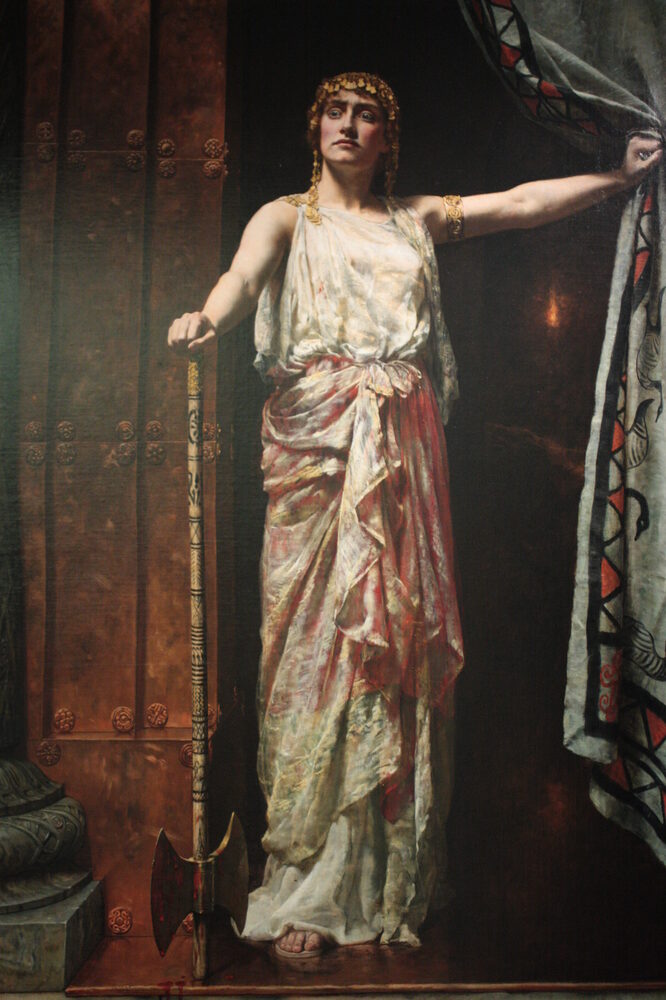
Klytaimnēstra
First Appearance
Clytemnestra enters surviving Greek poetry in the Odyssey, not as a heroine of her own epic but as a warning told and re-told along Odysseus's road home. Old Nestor remembers how, while Agamemnon fought at Troy, Aegisthus wooed the queen — and how at first "she would have none of it," for a loyal bard had been set to guard her, until Aegisthus marooned the singer on a desert island and led her, willing at last, to his own house (Odyssey 3.263–275). In the land of the dead Agamemnon's own ghost pours out the rest to Odysseus: how he came home and was cut down at the feast "as a man fells an ox at the manger," and how Cassandra was killed at his side by Clytemnestra's hand, the queen turning away so coldly she would not even close his eyes as he died (11.405–434). And at the very end of the poem her name is set against Penelope's: the one wife made a song of praise for her faith, the other "a hateful song" that would give all women an ill name forever (24.199–202). From her first appearance, then, she is already two things at once — the faithless, murdering wife of the epic's warning, and a woman whom even the warning admits had to be seduced, guarded against, and worn down before she turned.
— Homer, Odyssey 3.263–275; 11.405–434; 24.199–202
Who They Are
Clytemnestra (KLY-tem-NESS-truh) is the queen of Mycenae — of Argos in the tragic poets — the wife of Agamemnon, lord of the Greek host at Troy, and the woman who killed him on the day he came home. She is daughter of Tyndareus and Leda of Sparta, and sister (or half-sister) of Helen, whose flight to Troy began the war that would take Clytemnestra's own husband from her for ten years. When Agamemnon returned in triumph she met him with a welcome of spread purple and warm words, drew him into the bath, cast a robe or net over him so that his arms were bound, and struck him down with an axe — and killed beside him Cassandra, the captive Trojan prophetess he had brought home as his prize. For this her son Orestes, urged on by his sister Electra, would in turn kill her: the matricide that unleashed the Furies and could only be ended, in the oldest full telling, by the gods themselves.
She is among the most fiercely contested figures in all Greek story, and this page keeps both of the faces the Greeks gave her, with equal weight — for the tradition itself never settled on one. In the older strand, reaching back to the Odyssey, she is the monstrous wife: the adulteress who took Aegisthus to her bed while her husband bled for Greece, and butchered him at his own hearth; the pattern of the faithless woman, set against loyal Penelope as her dark opposite. In the strand the tragedians drew out, above all Aeschylus, she is the wronged mother: a woman whose husband, to get a fair wind for his war, cut the throat of their daughter Iphigenia on the altar at Aulis — and who waited ten years, nursing that grief into a cold and sovereign rage, to pay a death for a death.
Both readings are true to the sources, and each answers the other: she is a killer, and she was given a killer's reasons. The Greeks found her so unsettling precisely because they could not dismiss her — "a heart that counsels like a man's," the watchman says of her, half in awe and half in dread. She ruled a kingdom alone for ten years, met a conqueror's homecoming with a trap of her own devising, and stood over the body of the man who had killed her child and declared the deed just. She is queen, mother, adulteress, avenger, and murderess at once, and the power of her story is that it refuses to let any one of those names cancel the rest.
Mythology
Daughter of Sparta, bride of Mycenae
Clytemnestra was born into the royal house of Sparta, daughter of Tyndareus the king and his wife Leda — and sister to that house's more famous children, the beautiful Helen and the twin Dioscuri, Castor and Polydeuces. (The old tales tangled these births with the night Zeus came to Leda as a swan; in the usual reckoning Clytemnestra was the mortal daughter, Tyndareus's own, while Helen was the child of the god — so that the two sisters whose marriages would wreck two kingdoms were set apart from birth, one mortal and one half-divine.) She was given in marriage to Agamemnon, son of Atreus and king of Mycenae, greatest lord of the Peloponnese, while Helen went to his brother Menelaus of Sparta — two brothers wedding two sisters, binding the houses of Atreus and Tyndareus together. By Agamemnon she bore children who would carry the whole weight of the story to come: Iphigenia, Electra (called Laodice in the oldest lists), and the son Orestes.
Even in the marriage's beginning some tellers set a wound. In a darker tradition Agamemnon had won her by force — killing a first husband and an infant child of hers before taking her — so that from the first her bond to him carried the memory of a man who took what he wanted through blood. The tragedians do not always press this, but it lies in the tradition, a first death in the house long before the famous ones.
Aulis: the death of Iphigenia
The turning of her story is the sacrifice at Aulis. When the whole Greek fleet lay windbound at Aulis, unable to sail for Troy, the seer Calchas declared that the goddess Artemis was holding back the winds and would loose them only if Agamemnon gave her his daughter Iphigenia. By a lie — that the girl was to be married to Achilles — Clytemnestra's daughter was brought to the camp, and there, that his thousand ships might sail, Agamemnon let her throat be cut upon the altar. Euripides tells this with terrible fullness in the Iphigenia at Aulis, where Clytemnestra arrives joyful for a wedding and discovers a funeral, and turns on her husband with a grief that is already the first shape of her vengeance: she warns him, in effect, that he will not find her gentle when he comes home. (In one merciful variant, dramatized by Euripides, Artemis snatched Iphigenia away at the last instant and set a deer on the altar in her place, carrying the girl off to serve as her priestess among the Taurians — but Clytemnestra, left standing at the altar, believed her daughter dead, and it is that belief that moves her.) Aeschylus makes this the hinge of everything: his chorus sings of Iphigenia lifted "like a kid" above the altar, her robes falling, her eyes pleading, her mouth gagged lest she curse the house (Agamemnon 228–247) — and it is this image that the whole weight of the queen's later rage is built upon.
The queen who ruled, and the lover she took
For the ten years of the Trojan War Clytemnestra ruled Mycenae in her husband's place — and this, as much as any single act, is what the tradition cannot forgive and cannot forget: a woman holding a man's power, reasoning and resolving alone, "a heart that counsels like a man's" (Agamemnon 10–11). Into that long solitude came Aegisthus, Agamemnon's cousin and the son of Thyestes — himself an heir of the house of Atreus's old inner curse, the bloody feud between the brothers Atreus and Thyestes. In the Odyssey's telling Aegisthus courted her patiently, and she resisted at first, held to loyalty by a singer Agamemnon had left to guard her, until Aegisthus removed the bard and won her at last (Odyssey 3.263–275). In the tragic telling the emphasis shifts: she takes Aegisthus less as a seducer's conquest than as her own instrument and ally, a fellow-mourner of the house's wrongs, and the two of them rule and wait together. The sources thus hold two motives side by side and never fully choose — the adulteress drawn to a lover, and the avenger who has taken a confederate — and Pindar names this doubleness directly, asking whether it was Iphigenia's death at the Euripus that drove her, or whether "nights of a stolen bed" had led her astray (Pythian 11.22–37).
The homecoming and the killing
When Troy fell and Agamemnon came home in triumph, Clytemnestra met him with the most famous welcome in Greek tragedy. In Aeschylus's Agamemnon she greets her husband with praise heaped so high it is almost mockery, and spreads before him a path of precious purple cloth, daring him to tread like a conqueror upon the wealth of his own house — and he does. She has also marked, with cold courtesy, the captive at his side: Cassandra, daughter of Priam, the Trojan princess and prophetess Agamemnon has brought home as his war-prize and bedmate, who sits in the chariot seeing all that is about to come and unable to make anyone believe her (Agamemnon 1035–1330). Then the king goes within to bathe. There Clytemnestra throws over him a great woven robe or net — "an endless web, like a net for fish" — so that, tangled and bound, his arms cannot answer, and she strikes him down with an axe, two blows and then a third. She kills Cassandra beside him. And then she comes out before the elders of the city with the bodies and does the thing no other killer in tragedy quite does: she does not hide or flee, but stands over them and claims the deed aloud, exulting, naming it justice — a wife's payment for a daughter's blood, and for Cassandra, and for all his years away (Agamemnon 1372–1447). "I stand where I struck," she says in effect, "and I deny nothing." It is one of the most astonishing speeches given to any woman in the ancient world.
The avenger's case, and the adulteress's
Aeschylus lets her make her whole argument, and it is formidable: Agamemnon sacrificed their child without a tremor for a favouring wind, then sailed off for ten years and came home with a concubine on his arm; the law of blood-for-blood that governs this house falls on him as justly as on anyone. Against this the chorus — and the tradition behind them — set the other charge: that for all her reasons she is also the wife who took a lover and killed her lord, and that she now rules the city with that lover at her side, which is tyranny and adultery whatever else it is. The genius of the play is that it will not let either case silence the other. She is a mother avenging an unbearable wrong, and she is a queen who has murdered her husband and usurped his throne with the man in her bed, and both of these are shown to be true at once. The older Homeric strand leans hard toward the second reading, the tragic strand draws out the first; the figure who survives is the sum of both.
Orestes, Electra, and the matricide
The blood-law that justified her did not stop with her. Years later her son Orestes, who had been sent away as a child and raised in exile, returned to Mycenae, driven by Apollo's oracle to avenge his father — and met at the tomb his sister Electra, who had lived on in the house in grief and hatred of her mother, nursing the memory of the murdered king. Together they planned the return-blow. In Aeschylus's Libation Bearers (Choephoroi) Orestes kills Aegisthus first, then faces his mother — and here Clytemnestra makes her last, terrible plea, baring the breast that nursed him and begging her son to pity it (Libation Bearers 896–930). He falters; Apollo's command and his friend Pylades steady him; and he kills her. Euripides (Electra) and Sophocles (Electra) each retell this reckoning with their own emphasis — Euripides darkening it until the matricide looks like horror barely distinguishable from the crime it answers, and the children are left sickened by what they have done; Sophocles giving Electra a harder, more unwavering righteousness. In every version the deed is done, and it solves nothing, because a mother's blood cannot be shed clean.
The Furies and the end of the chain
With his mother's blood on his hands Orestes is set upon by the Erinyes, the Furies — the ancient powers who hound those who shed kindred blood, and a mother's blood above all. They drive him mad and pursue him across Greece, and here the chain of killing-for-killing that has run through the whole house of Atreus reaches the point where it can no longer be answered in kind: if Orestes is killed for killing Clytemnestra, who then avenges him, and where does it stop? In Aeschylus's Eumenides, the third play of the Oresteia, the question is taken out of the family's hands altogether and carried to Athens, where Athena founds a court of citizens — the Areopagus — to judge the matter by law rather than by blood. Clytemnestra's own ghost rises to rouse the Furies against her son, unwilling even in death to let her killing go unpaid; but the court acquits Orestes, the Furies are transformed into the kindly Eumenides and given honour in the city, and the long curse of the house is at last laid to rest — not by one more death, but by the passing of vengeance from the family to the law. Clytemnestra stands, in the end, as the figure on whom that whole terrible argument turns: the wronged woman whose just rage was itself a crime, whose crime demanded a vengeance that was itself a horror, until only something larger than vengeance could end it.
Worship — Ancient
A figure of poetry and the tragic stage, not of cult
Clytemnestra was not a goddess and had no temple, priesthood, or festival of her own; she belonged to story, not to cult. Her "worship," if the word fits at all, was the enduring hold she had on the Greek imagination — first through Homer and the old epic tradition, where her name was a watchword, and then, overwhelmingly, through the Athenian tragic theatre, where she was given some of the most powerful speeches ever written for a woman. To the Greeks who watched the Oresteia at the festival of Dionysus, she was not a distant myth but a living problem set before the whole city: what is justice, when every just act is also a crime, and where must vengeance end?
The house of Atreus and the dead
What ritual weight her story carried belonged to the cult of the dead and to the great cursed house she married into — the house of Atreus at Mycenae, whose buried kings and whose inherited guilt stand behind the whole tragedy. The Libation Bearers takes its very name from the offerings poured at Agamemnon's tomb, and turns on the rites owed to the murdered dead and the vengeance those rites demand. Clytemnestra belongs to that grim theology of blood: the conviction, older than the law-courts, that spilled kindred blood cries out from the ground and must be answered, and that the dead are not done with the living. It was against exactly this unending logic that Aeschylus imagined the founding of Athens's homicide court, so that her story became, for the Greeks, the mythical charter of the rule of law itself.
Worship — Modern
The first of the great tragic women
Clytemnestra is remembered today above all as one of the towering characters of world literature — the queen at the dark centre of Aeschylus's Oresteia, the most complete and formidable tragic woman the Greeks created, and the ancestor of a long line of avenging and ungovernable heroines after her. She is studied, staged, and argued over endlessly, and almost every modern reading turns on the same doubleness the ancients left in her: is she a monster, or is she the most wronged figure in the play? That the question cannot be closed is precisely why she endures.
The wronged mother reclaimed
Much modern retelling, and feminist reading in particular, has drawn out the strand the Odyssey buried — the mother whose child was sacrificed to a war begun over her own sister's marriage, who was left to rule alone and then expected to welcome home the man who had killed their daughter and brought a captive woman into her house. Read this way she becomes a figure of a woman's rage against a world that gave her every reason for fury and no sanctioned way to voice it; novels, plays, and poems have returned to her again and again to let her speak for herself. Held honestly, that reading does not erase the killing — she does murder her husband and his captive, and she does rule with her lover at her side — but it refuses to let the old verdict of "faithless wife" stand as the whole of her.
A mirror for justice and vengeance
Beyond the character, her story remains one of the deepest meditations the ancient world left on justice itself: the passage from blood-vengeance, where every wrong is answered by another killing in an endless chain, to the rule of law, where judgement is taken out of the hands of the wounded and given to the city. Anyone drawn to her today meets not a saint or a villain to be worshipped, but a question to be sat with — about wrongs that cannot be made right, about the cost of answering violence with violence, and about where, at last, the cycle has to be made to stop.
Epithets & Cult Titles
- dolomētis (δολόμητις) — Cunning-in-counsel, deviser of guile — the word Aeschylus and the tradition reach for again and again in her, the same quality of mind heard in the old spelling of her name; the queen who plans, waits, and strikes
- androboulon kear (ἀνδρόβουλον κέαρ) — 'A heart that counsels like a man's' — the watchman's phrase for her at the opening of Aeschylus's Agamemnon (10–11), naming the thing Argos found most unsettling: a woman who ruled, reasoned, and resolved as men did while her husband was away at war
- lioness of the house — Cassandra's image for her in the Agamemnon (1258–1260) — the she-lion who lay with the wolf (Aegisthus) while the true lion was away, and waited to kill; a byword for the deadly welcome hidden behind a wife's open door
Sources & Variants
- Homer, Odyssey 3.263–275 (Nestor: Aegisthus's long wooing of Clytemnestra, her early resistance, the guardian bard removed)
- Homer, Odyssey 11.405–434 (Agamemnon's ghost tells Odysseus of his murder at the feast, Cassandra killed at his side, the queen's coldness)
- Homer, Odyssey 24.199–202 (Clytemnestra set against Penelope — the faithful wife's song of praise and the faithless wife's 'hateful song')
- Aeschylus, Agamemnon (the beacon-fires, the purple cloth, Cassandra's foresight, the robe/net and the axe in the bath, the queen's exultant claiming of the deed; 'a heart that counsels like a man's,' 10–11; Iphigenia at the altar, 228–247)
- Aeschylus, Libation Bearers / Choephoroi (Orestes' and Electra's reunion at the tomb, the killing of Aegisthus, Clytemnestra's plea at the breast and the matricide, 896–930)
- Aeschylus, Eumenides (Clytemnestra's ghost rousing the Furies; Athena's founding of the Areopagus; Orestes acquitted and the Furies transformed)
- Euripides, Iphigenia at Aulis (the sacrifice of Iphigenia under cover of a false marriage to Achilles; Clytemnestra's grief turning toward vengeance)
- Euripides, Electra (the matricide retold with revulsion; the children undone by their own deed; the deer-substitution tradition for Iphigenia)
- Sophocles, Electra (Electra's unwavering grief and hatred; the vengeance seen chiefly through the daughter)
- Pindar, Pythian 11.17–37 (the doubled motive — whether Iphigenia's death at the Euripus or 'nights of a stolen bed' drove her to the deed)
Gallery