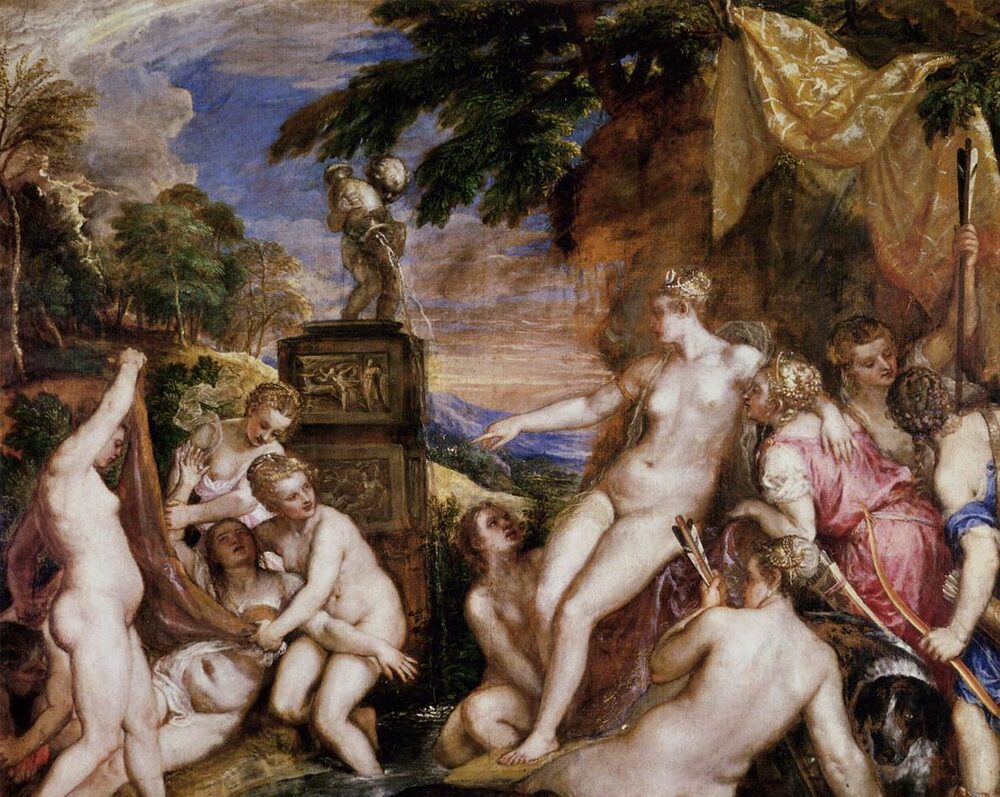
Kallistō
First Appearance
Callisto enters surviving Greek tradition already as a star-myth. Eratosthenes (Catasterismi 1) reports that the old Hesiodic Astronomy told how Callisto, a companion of Artemis in the hunt, was loved by Zeus, bore a son, was found out and turned into a bear, and was at last set among the stars as the Great Bear. Apollodorus (Bibliotheca 3.8.2) gives the fuller Arcadian story — her beauty, Zeus's deceit, Hera's or Artemis's anger, the bear, the son Arcas, and the rescue into the sky — and preserves the disagreement among the old poets over whose hand it was that transformed her.
— Hesiodic Astronomy (fr., preserved in Eratosthenes, Catasterismi 1); Apollodorus, Bibliotheca 3.8.2
Who They Are
Callisto (kuh-LIS-toh) is the Arcadian nymph and huntress, fairest of the company that followed Artemis through the mountain forests, who was loved against her will by Zeus, bore him a son, and was turned into a bear for it — and who, hunted years later by that very son, was caught up into the sky to become the Great Bear, the constellation that wheels forever about the pole and never sets. Her name means "most beautiful," and it is her beauty that destroys the quiet life she had chosen: a maiden sworn to the hunt and to chastity in Artemis's train, undone by a god's desire and a goddess's jealous rage.
Her story is one of the most sorrowful in Greek myth, and one of the most disputed — the ancient poets did not agree on whose anger turned her into a bear, and told the transformation three different ways. In the telling followed here as the lead, it is Hera, the jealous queen of the gods, who works the change: furious that Zeus has seduced the girl and that she has borne him a son, Hera lays her hand on Callisto and makes her a shaggy she-bear, driving beauty into beast. But other tellers gave the deed to Artemis herself — the betrayed mistress punishing a follower who broke her vow — and still others to Zeus, transforming his beloved to hide her from Hera's eyes. All three versions are old, and the page sets them out plainly below.
However she was changed, the ending is the same and it is a strange grace: her son Arcas, grown to a hunter, nearly kills the bear that was his mother, and Zeus in pity snatches them both into the heavens — Callisto as the Great Bear, Arcas beside her — where Hera's spite pursues her even among the stars.
Mythology
The huntress of Artemis
Callisto was a nymph of Arcadia, the wild mountain heart of the Peloponnese — in the Arcadian telling a daughter of the impious king Lycaon, though other writers made her simply one of the nymphs or a mortal girl of that land. What every account agrees on is her life: she was the fairest of the young women who ran with Artemis, the virgin goddess of the hunt, through the high forests, and she had bound herself to the goddess's own way — the bow, the chase, the open mountainside, and above all the vow of maidenhood, the sworn chastity that Artemis required of her close companions. Callisto loved that life and kept that vow, and it is the breaking of it, forced upon her, that sets the whole tragedy in motion.
Zeus's deceit
Zeus saw Callisto and desired her. Because she would never willingly break her vow, he came to her by a trick — and in one of the most striking and oldest versions of the story, he came to her disguised as Artemis herself, taking the shape of the very goddess Callisto trusted, so that she suspected nothing until it was too late (a deceit Apollodorus preserves, Bibliotheca 3.8.2). By this cruelty the maiden was overcome against her will, and in time she conceived and bore a son, Arcas. The pregnancy could not be hidden forever, and when it came to light the peace of her old life was shattered — for a sworn companion of Artemis to be found with child was, in the logic of the myth, a ruin past mending.
Hera's jealousy and the she-bear
In the telling followed here as the lead, the hand that falls on Callisto is Hera's. The queen of the gods, learning that her husband Zeus had seduced the girl and that she had now borne him a son, was seized with jealous fury — and in her rage she laid hold of Callisto and transformed her into a she-bear, driving the fair nymph down into a shaggy, speechless beast, her beauty (the very thing that had doomed her) torn away. So Callisto, who had been the loveliest of Artemis's maidens, was made to wander the forests she had hunted in, now as one of the wild things, fleeing the hounds and the hunters she had once run beside — a punishment aimed at Zeus's desire but falling wholly on the innocent girl, which is the bitter signature of Hera's jealousy throughout Greek myth.
The variant hands: Artemis, and Zeus
The ancient poets did not agree on who worked the transformation, and the differing versions are all genuinely old — this is one of the myths where the sources openly diverge, and honesty requires setting them side by side.
- In one strand it is Artemis herself who punishes Callisto — the betrayed goddess, discovering at the bath (or when the pregnancy showed) that her sworn companion was no longer a maiden, turning on her in anger. In some of these tellings Artemis does not transform her but shoots her down with an arrow for breaking the vow of chastity; in others the goddess is the one who makes her a bear. Apollodorus (3.8.2) records this version expressly, noting that "some say Artemis" worked the change, in wrath at the broken vow.
- In another strand it is Zeus who transforms Callisto — not in anger but to hide her, changing his beloved into a bear so that Hera's searching jealousy would pass over her. In these tellings Hera sees through the disguise even so, and it is she who then sets Artemis (or the hunt) against the bear.
The Hesiodic Astronomy, our earliest surviving thread (reported by Eratosthenes, Catasterismi 1), already knew the shape of the whole story; the disagreement is over the agent of the change, not the change itself. The lead telling — Hera transforming her in jealousy — is given first here because it carries the story's deepest logic: the wronged wife avenging herself on the girl her husband wronged.
Arcas and the near-kinslaying
Years passed, and the child Arcas grew to be a young hunter, knowing nothing of what his mother had become. The strands of the story bring mother and son together again in the forest: Arcas, out hunting, comes upon the great she-bear — in some tellings she moves toward him in a flicker of a mother's recognition, which to his eyes is only a beast closing in — and he levels his spear or draws his bow to kill her, not knowing he is about to slay his own mother. At this moment, with the near-kinslaying an instant away, Zeus intervenes.
Caught up into the sky: the Great Bear
To prevent the horror of a son killing his mother, Zeus snatched up both Callisto and Arcas out of the forest and set them in the heavens among the stars. Callisto became the Great Bear — the constellation Arktos Megale, the Big She-Bear, which we still call Ursa Major — the seven bright stars that wheel about the northern pole. Arcas was set beside her: the Greek tradition made him the neighbouring star-figure, named by some Arktophylax ("the Bear-watcher," the constellation Boötes) with his bright star Arcturus ("the Bear-guard"), and by others the Little Bear, Ursa Minor. So the mother and son who had almost met in blood were fixed together in the turning sky, the bear and her keeper, no longer able to harm one another.
Hera's further spite: the Bear that never bathes
Even in the heavens Hera's jealousy was not spent. Furious that the girl she had cursed should be granted so bright an honour — a place among the eternal stars — Hera went to the old sea-powers who had reared her, Tethys and Oceanus, and begged of them that the Bear should never be allowed to descend into their waters as the other constellations do. They granted her wish, and this, the Greeks said, is why the Great Bear alone among the figures of the sky never sets below the horizon to bathe in the sea, but circles always overhead — forbidden the rest of setting, kept wheeling about the pole forever by the queen's unforgiving spite (Eratosthenes, Catasterismi 1; the motif is told at length in the later Roman poets). It is a rare touch in star-myth, turning an observed fact of the northern sky — that the Bear is circumpolar and never dips below the horizon — into the last stroke of a goddess's vengeance.
Arcas, eponym of Arcadia
Callisto's son did not vanish into the sky alone as a mere star-figure; before his catasterism the tradition made him a king on earth. Arcas was held to be the ancestor and name-giver of the Arcadians, the mountain people of the central Peloponnese, and it was from him that Arcadia itself took its name — "the land of Arcas." Through her son, then, the ruined huntress stands at the root of a whole people's name, and the Arcadians honoured her memory in their own country (Pausanias 8.3.6–7), showing travellers the mound said to be her tomb.
Worship — Ancient
A memory kept in Arcadia
Callisto was not a goddess with temples and a priesthood of her own; she was a figure of myth, mourned and remembered rather than formally worshipped. Her cult, such as it was, belonged to Arcadia, the land her son was said to have named. There, on the way through the mountains, travellers in later centuries were still shown a high earthen tomb-mound held to be Callisto's grave — a mound crowned with trees, with a sanctuary of Artemis Kalliste ("Artemis the Fairest") standing upon it, so that the nymph's memory and the goddess she had followed were bound together even in her burial-place (Pausanias 8.35.8). The Arcadian traveller's record of Pausanias (8.3.6–7) preserves the local pride in Callisto as the mother of Arcas, the people's eponymous ancestor.
Artemis Kalliste and the shared name
The closeness of Callisto's name to the Arcadian cult-title Artemis Kalliste ("the fairest") led some ancient writers to suspect that the nymph was, in origin, a shadow or double of the goddess herself — that "Callisto" and "Artemis the Fairest" were once one figure, the bear-maiden of the Arcadian wild, later split into worshipped goddess and mortal victim. Whether or not that is so, the two were honoured on the same ground, and Callisto's story carries the old Arcadian link between Artemis, the she-bear, and the maiden — the same deep association that elsewhere in Greece gave the goddess girl-dancers called arktoi, "bears," in her service.
Written in the sky
Callisto's widest "cult" was simply the night sky. As the Great Bear (Ursa Major), the brightest and most recognisable of the northern constellations, she was before the eyes of every Greek — a figure by which sailors steered and farmers told the season. The star-catalogues of Eratosthenes (Catasterismi 1 and 8, treating the Bear and the Bear-watcher) set her story down as the explanation of what everyone could see overhead, and so her myth was carried, night after night, by the turning of the pole itself.
Worship — Modern
The bear in the sky, every night
Callisto is among the easiest of all the old figures to find again, for she is overhead on any clear night in the northern world: the Great Bear, Ursa Major, whose seven brightest stars form the shape most people know as the Plough or the Big Dipper. A modern honouring of her needs no altar — only a dark sky and the knowledge of whose grief is written there. To look up and name the Bear, and to remember the Arcadian maiden inside the beast, is to keep her story exactly where the ancients left it, in the one shrine that never closes.
A patron of the wronged and the transformed
Because her tragedy is one of innocence punished — a girl undone by a god's desire and a goddess's jealousy, made to bear in her own body the cost of another's wrong — Callisto speaks with unusual directness to anyone drawn to the figures who were harmed and then remembered. She sits well as a patron of the wronged, of those changed against their will or made to carry blame that was never theirs, and, through her son, of the bond between mother and child that even transformation and years of separation could not fully sever. Her lead story, in which it is Hera's jealousy that falls on her, makes her above all a figure of the injustice of displaced vengeance — the one who suffers for what was done to her, not by her.
The never-setting Bear
There is, finally, a strange consolation in the last turn of her myth. The spite that denied the Bear its rest in the sea is also what keeps Callisto always visible, never sinking below the horizon, circling the pole through every season — so that the very curse becomes the reason she can never be lost from sight. For a modern devotee she is the figure who endures in plain view, the wronged one who, whatever was done to her, still holds her place among the eternal things and turns steadily overhead when all the other stars go down.
Epithets & Cult Titles
- Kallistō (Καλλιστώ) — 'Most beautiful' — her name and her nature, the fairest of the nymphs who followed Artemis; the ancients linked the name to the goddess's own cult-title Kalliste ('the fairest'), and Pausanias reports an Arcadian shrine of Artemis Kalliste beside Callisto's tomb (Pausanias 8.35.8)
- Helikē (Ἑλίκη) — 'The Twister' or 'the one that turns' — a Greek name for the constellation of the Great Bear, which wheels about the pole and never sinks; some writers used it as a name for Callisto herself as the Bear set in the sky
- Arktos (Ἄρκτος) — 'The She-Bear' — both the beast she was turned into and the constellation she became, the Bear (Ursa Major) that circles the celestial pole; the Greeks steered their ships by it
Sources & Variants
- Hesiod (Hesiodic Astronomy), fragment preserved in Eratosthenes, Catasterismi 1 (the oldest surviving thread: Callisto, Artemis's companion, loved by Zeus, made a bear, set in the sky as the Great Bear)
- Eratosthenes, Catasterismi 1 (Ursa Major / the Great Bear as Callisto; Hera's plea to Tethys that the Bear never bathe in the sea, so it never sets) and 8 (Arktophylax / Boötes, the Bear-watcher, identified with Arcas)
- Apollodorus, Bibliotheca 3.8.2 (the full Arcadian story: Callisto daughter of Lycaon, Zeus's deceit — some say in Artemis's own shape; the disagreement over whose hand transformed her, Hera's or Artemis's or Zeus's; the birth of Arcas; the catasterism)
- Pausanias 8.3.6–7 (Callisto mother of Arcas, eponym of the Arcadians and of Arcadia) and 8.35.8 (her tomb-mound in Arcadia, crowned with trees, with a sanctuary of Artemis Kalliste upon it)
- Pausanias 1.25.1 (an image of Callisto at Athens, noted among the works seen on the Acropolis)
- Ovid, Metamorphoses 2.401–530 (the fullest narrative: Zeus disguised as Artemis; Artemis's discovery at the bath and banishment of Callisto; Hera's transformation of her into a bear; Arcas and the near-kinslaying; the catasterism; Juno's plea to Tethys and Oceanus that the Bear never set) — later Roman retelling
- Ovid, Fasti 2.153–192 (a second Roman telling of the same story, with the catasterism and the never-setting Bear) — later Roman
Gallery