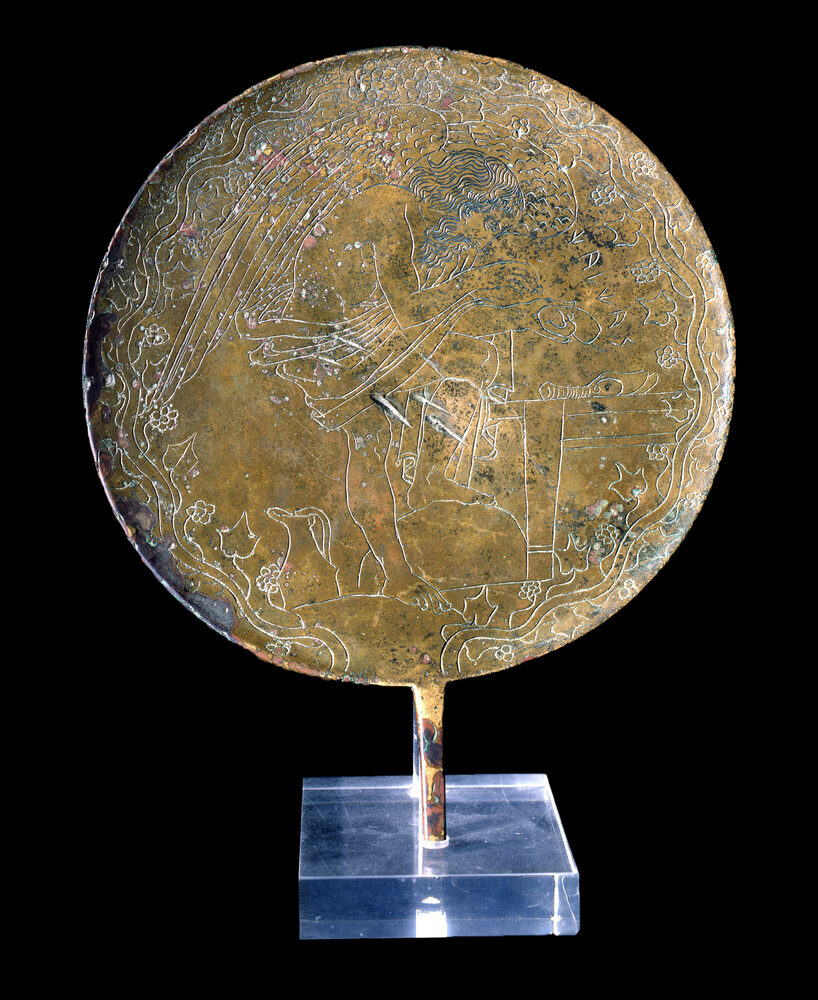
Kalchas
First Appearance
Calchas steps into Greek poetry at the very opening of the Iliad, when the plague is raging through the Achaean camp. "Then stood up Calchas son of Thestor, far the best of bird-interpreters (oiōnopolōn och' aristos), who knew the things that are, the things that shall be, and the things that were before" (Iliad 1.68–70). It is he who, under Achilles' protection, dares to name the cause: that Apollo is angered over the priest Chryses, whose daughter Agamemnon holds. From his first breath in the poem the seer is defined by the terrible accuracy of his sight — and by the danger of speaking it to a king.
— Homer, Iliad 1.68–72
Who They Are
Calchas (KAL-kas) is the chief seer of the Greeks in the Trojan War — "by far the best of bird-interpreters," in Homer's phrase, the augur who "knew what is, what will be, and what was before" (Iliad 1.69–70). He is not a warrior but the war's unseen engine: through his mouth the Greek host learns the will of the gods, and it is his readings of the signs that set the great wheels of the story turning. He reads the plague that opens the Iliad; at Aulis he reads the omen of the serpent and the sparrows, and (in the tradition of the Cypria and the tragedians) demands the sacrifice that lets the fleet sail; before Troy he names what the Greeks must do and get if the city is ever to fall. He belongs among the heroes as a mortal man of the war generation, but his heroism is of a rare kind — the heroism of sight, of being the one who must say aloud what the gods have decided, however hard.
His gift was said to come from Apollo, the god of prophecy, and with it came a shadow: it was foretold that Calchas would die when at last he met a seer greater than himself. That meeting came after the war, at the grove of Clarian Apollo, where he fell in with Mopsus — and lost. The seer who had read the fate of a whole army could not out-read the better seer set across from him, and he died of the grief of it. His life is thus a single long arc from the first page of the Iliad to that last contest: the man whose whole worth was his unmatched sight, undone at the end by a sight that matched and surpassed his own.
Calchas is remembered less as an object of worship than as a presence in the great story — the voice that speaks the gods' hard verdicts, and the measure against which all seercraft is set. To read him is to meet the Greek idea of prophecy itself: a true but costly knowledge, a burden laid on one man for the sake of the many, and in the end a gift that could be exceeded, and so could kill.
Mythology
The best of bird-interpreters
Calchas was the seer (mantis) of the Greek army in the war against Troy, and the sources are unanimous on the height of his gift. Homer introduces him as "far the best of bird-interpreters" (oiōnopolōn och' aristos), one "who knew the things that are, the things that shall be, and the things that were before" (Iliad 1.69–70) — the threefold reach of true prophecy, past and present and future all open to his sight. His art was above all augury, the reading of the flight and cries of birds, though he read sacrifices and portents too. The gift was held to come from Apollo, the god of prophecy; by it, the Greeks said, Calchas had even guided the fleet on its course to Troy in the first place (Homer, Iliad 1.71–72, where it is "by the gift of prophecy that Phoebus Apollo gave him" that he had led the Achaeans' ships to Ilios). Through the whole war he is the ear of the army turned toward heaven — the one man through whom the host learns what the gods have decided.
The plague and the wrath of Apollo
The Iliad opens on a disaster, and Calchas is the one who names its cause. Apollo has sent a plague raging through the Achaean camp, striking first the mules and dogs and then the men, the pyres burning night and day (Iliad 1.43–52). When Achilles calls an assembly to ask why the god is angry, it is Calchas who rises — but only after exacting a promise of protection from Achilles, for he knows his answer will enrage the most powerful man in the army (Iliad 1.74–83). Then he speaks it plainly: Apollo is wroth because Agamemnon dishonoured the god's priest Chryses and refused to give back his captive daughter Chryseis; the plague will not lift until she is returned, unransomed, with a sacrifice to the god (Iliad 1.93–100). The reading is true, and it is incendiary — it forces Agamemnon to give up his prize, which drives him to seize Achilles' prize Briseis in recompense, which kindles the wrath of Achilles that is the whole engine of the poem. The Iliad turns on Calchas's first words.
The omen at Aulis: the serpent and the sparrows
Long before Troy, the Greek fleet had gathered at Aulis in Boeotia, and there Calchas read the sign that told how long the war would be. As the army sacrificed beneath a plane-tree by a spring, a blood-red serpent darted out from under the altar, climbed the tree, and devoured a sparrow's nest — eight chicks and the mother that fluttered round them, nine birds in all — and was then turned to stone by the god that sent it. Odysseus recalls the portent and Calchas's reading of it in the Iliad (2.299–332): as the serpent ate eight young and the mother for the ninth, so the Greeks would fight nine years at Troy and take the city in the tenth. "As this serpent devoured the sparrow's eight little ones and the mother that bore them for the ninth, so shall we war there so many years, but in the tenth we shall take the wide-wayed city" (Iliad 2.326–329). It is the single most famous of Calchas's readings — a true prophecy of the war's whole length, given at its very outset, and proven exact.
The sacrifice of Iphigenia
The darkest of Calchas's readings belongs not to the Iliad but to the wider tradition of the war — the Cypria (known through the summary of Proclus) and, above all, the tragic stage. The fleet, gathered at Aulis, could not sail: either in punishment for a boast of Agamemnon's, or through the anger of Artemis, the winds failed or blew against them, and the ships lay trapped. It was Calchas who declared the terrible remedy — that the goddess would be appeased, and the winds would turn, only if Agamemnon sacrificed his own daughter Iphigenia upon the altar. In Aeschylus's Agamemnon the chorus remembers the moment: "the seer cried out, naming Artemis" and setting before the kings a cure "heavier than the storm" (Agamemnon 198–204), the child's blood the price of the wind. The sacrifice is carried through — or in some tellings the goddess snatches the girl away at the last and leaves a deer in her place — and it becomes the first wound of the house of Atreus, the deed for which Clytemnestra will one day kill her husband. Here Calchas's gift shows its cruelest face: he does not choose the gods' demand, but he is the one who must speak it, and the speaking of it sets a whole doom in motion.
The counsels before Troy: Achilles, Philoctetes, and the fall of the city
Through the years before Troy, Calchas remains the Greeks' guide to the gods' conditions — the seer who names what the army must do, and whom it must have, if the city is ever to fall. The tradition (gathered in Apollodorus, Epitome 3–5, and the lost epics of the Cycle) credits him with a chain of such pronouncements: that Troy could not be taken without Achilles, so that the young hero had to be found and brought to the war; and later, after Achilles' death, that the city would never fall without the bow of Heracles — and so the Greeks had to fetch the abandoned, festering archer Philoctetes back from the island of Lemnos where they had marooned him (a reading dramatized in Sophocles' Philoctetes). To Calchas the sources also give a part in the counsels of the end — among the conditions and signs read as Troy's doom drew near. In every case the pattern holds: Calchas does not win the war, but no step of it is taken until he has read what the gods require.
The death of the seer: the contest with Mopsus
It had been foretold that Calchas would die when he met a seer greater than himself — and after the fall of Troy, that meeting came. Making his way home by land, he reached the grove of Clarian Apollo near Colophon in Asia Minor, and there he fell in with Mopsus, a seer of that country and himself a grandson, it was said, of the prophet Tiresias through his daughter Manto. The two matched their arts in a contest of divination. In the oldest version, from the Melampodia ascribed to Hesiod, Calchas challenges Mopsus to say how many figs a certain wild fig-tree bore; Mopsus names the exact number — ten thousand, and a measure over, with one fig left out — and is proven right. Then Mopsus sets Calchas a riddle of his own: how many piglets a pregnant sow carried, and when she would farrow. Calchas guesses; Mopsus answers to the number and the very hour — and the birth proves him exact. Calchas had met his better. Overcome with grief and chagrin at being surpassed, the great seer of the Greeks died there in the grove (Hesiod, Melampodia, in Strabo 14.1.27; the contest also at Apollodorus, Epitome 6.2–4, and Strabo 14.5.16). So ended the man who had read the fate of a whole army: not in war, not by any sword, but undone by a sight keener than his own — the seer defeated by a better seer, exactly as the gods had said.
Worship — Ancient
A seer remembered more than worshipped
Calchas was a figure of the heroic age rather than a god, and for the most part he was honoured as heroes were — at a tomb and an oracle-site tied to his name — rather than through any wide public cult. His true presence in Greek life was literary and oracular: he lived in the great story of the war, as the archetype of the army-seer, and in a handful of local shrines that claimed him.
The oracle of Calchas in Daunia
The most striking cult attached to him lay far from Greece, in Daunia in southeastern Italy (Apulia), where ancient writers place a tomb and a dream-oracle of Calchas on a hill — Mount Drion or thereabouts. Strabo records the site (Geography 6.3.9): those who wished to consult the dead seer sacrificed a black ram to him and lay down to sleep in its fleece, receiving their answers in dreams. It is a classic hero-oracle of the incubation kind, in which the inquirer sleeps at the shrine to be met by the hero in a vision — fitting for a figure whose whole art had been the reading of what is hidden. This, more than any temple in Greece, was where Calchas was actually sought out and "worshipped" in the centuries after Homer.
The measure of all seercraft
Beyond any shrine, Calchas's largest place in Greek religious imagination was as the standard of divination. To call someone a Calchas was to call him a true seer; his readings — the plague, the serpent of Aulis, the demand at the altar — were cited again and again as the pattern of how prophecy works and what it costs. And the story of his death carried its own grave lesson for a people who set great weight on seercraft: that even the best of seers could be surpassed, that the gift was not absolute, and that to be matched in it could be fatal. The seer who read the war's whole length was held up, in the end, as proof that no mortal sight is the last word.
Worship — Modern
Patron of the hard true word
Calchas has no living cult today, but he remains one of the most vivid figures of the Trojan story, and a modern reader drawn to him tends to be drawn by the thing he stands for: the duty of speaking a true but costly word. He is, in a sense, a patron of the unwelcome truth — of the one who must tell the powerful what they do not wish to hear, under their anger, because it is so. A thoughtful honouring of Calchas is less a matter of libation than of attention: to sit with the burden his myth describes, the knowledge that must be spoken even when it wounds, and the courage it takes (as he took a promise of protection from Achilles before he dared) to say it at all.
The seer who could be surpassed
His death gives him a second, quieter meaning that speaks across the ages — the humbling of the expert by a greater one. The man whose entire worth was his unmatched sight died of the grief of being out-seen. Read with sympathy rather than mockery, it is a story about the limits of any gift, about the danger of resting one's whole self on being the best at a single thing, and about the day a better one arrives. It sits well as a meditation for anyone whose identity is bound up in mastery.
A presence in the enduring story
Above all Calchas lives on wherever the tale of Troy is told. In every retelling of the Iliad he is there at the opening, rising in the plague-struck camp to name Apollo's wrath; at Aulis he reads the serpent and the sparrows and speaks the dreadful demand at the altar; through the war he names the conditions of the city's fall. He has walked into later literature too, carrying that office with him — the war-prophet of Troy's great story, the voice of the gods' hard verdicts. To keep his name is to keep alive the Greek idea that true sight is a burden as much as a power, and that the one who carries it serves the many at his own cost.
Epithets & Cult Titles
- oiōnopolōn och' aristos (οἰωνοπόλων ὄχ' ἄριστος) — By far the best of bird-interpreters — Homer's own verdict on him at his first appearance (Iliad 1.69), the augur without equal among the Greeks
- ho ta eonta ta t' essomena pro t' eonta (ὃς ᾔδη τά τ' ἐόντα τά τ' ἐσσόμενα πρό τ' ἐόντα) — He who knew what is, what will be, and what was before — Homer's description of the reach of his sight (Iliad 1.70), the threefold knowledge of past, present, and things to come
- Thestorides (Θεστορίδης) — Son of Thestor — his patronymic in Homer (Iliad 1.69), the name by which the seer is formally called in the assembly of the Greeks
- mantis of the Achaeans — The seer (mantis) of the Greek host — his office through the whole war at Aulis and before Troy, the one through whom the army learned the will of the gods
Sources & Variants
- Homer, Iliad 1.68–100 (Calchas son of Thestor, 'far the best of bird-interpreters,' who knew what is, will be, and was before; he reads the plague as Apollo's wrath over Chryses and Chryseis, under Achilles' protection)
- Homer, Iliad 1.71–72 (it was by the gift of prophecy from Apollo that Calchas had guided the Achaean ships to Troy)
- Homer, Iliad 2.299–332 (Odysseus recalls the omen at Aulis — the serpent devouring eight sparrow-chicks and the mother — and Calchas's reading that the Greeks would war nine years and take Troy in the tenth)
- The Cypria (summary of Proclus, Chrestomathy) (the gathering at Aulis; Calchas declares that Artemis must be appeased by the sacrifice of Iphigenia so the fleet may sail; and other of his prophecies of the war)
- Aeschylus, Agamemnon 104–159, 198–204 (the chorus's memory of the seer at Aulis crying out the name of Artemis and the demand for Iphigenia's blood as the price of the wind)
- Sophocles, Philoctetes (the prophecy that Troy cannot fall without the bow of Heracles, requiring the fetching of Philoctetes from Lemnos — attributed in the tradition to Calchas and Helenus)
- Hesiod (attributed), Melampodia, quoted in Strabo 14.1.27 (the contest of divination with Mopsus — the figs on the wild fig-tree and the pregnant sow — in which Calchas is surpassed and dies of grief)
- Apollodorus, Epitome 3.15–3.22 and 5–6 (Calchas's wartime prophecies; the need for Achilles and for Philoctetes' bow); Epitome 6.2–4 (the meeting with Mopsus at the grove of Clarian Apollo, the contest, and Calchas's death)
- Strabo, Geography 14.1.27 (the contest with Mopsus near Colophon and the Clarian grove) and 14.5.16 (Calchas and Mopsus in Cilicia / the seercraft of the region)
- Strabo, Geography 6.3.9 (the tomb and dream-oracle of Calchas in Daunia in Italy — consulted by sacrificing a black ram and sleeping in its fleece)
Gallery