Askalaphos
First Appearance
Ascalaphus first stands out in the mythographers as the lone witness of the underworld: Apollodorus (Bibliotheca 1.5.3) records that when Persephone ate of the pomegranate in the house of Hades, Ascalaphus, son of Acheron, alone saw her do it and told of it — and for this testimony he was punished, pinned beneath a great stone, until Heracles in his descent rolled the stone away.
— Apollodorus, Bibliotheca 1.5.3
Who They Are
Ascalaphus (as-KAL-uh-fus) is a small but pivotal spirit of the underworld — the orchard-keeper of Hades' realm and the single witness whose word doomed Persephone to the land of the dead for part of every year. He was a son of Acheron, the river of woe that runs through the underworld, and of a nymph of the dark places below, named as Orphne ("gloom") or Gorgyra. His whole story turns on one act of seeing and one act of speaking: he alone saw Persephone eat the pomegranate seeds in the house of Hades, and he told of it, so binding her to the underworld and wrecking her full return to her mother Demeter.
For that testimony he was harshly punished — pinned beneath a great rock in the underworld, and later, after Heracles freed him on his descent, transformed into a screech-owl, the bird of ill omen whose cry heralds grief. He is a figure of the fateful witness: the one whose truthful word cannot be unsaid, and who pays for it forever.
(He should not be confused with the other Ascalaphus, a son of the war-god Ares who sailed as an Argonaut and led the men of Orchomenus to Troy — an entirely separate mortal hero who shares only the name.)
Mythology
The witness in the orchard
Ascalaphus belonged wholly to the underworld. He was a son of Acheron, the river of woe, by an underworld nymph — Orphne ("gloom") in the fullest telling, or Gorgyra in another — and he kept the orchard of Hades' dark realm, among the fruit that grows below the earth. When Persephone, carried off to be the queen of the dead, was at last to be released and returned to her mother Demeter, everything turned on whether she had tasted the food of the underworld. The condition was ancient and absolute: whoever ate in the house of Hades belonged, in part, to Hades. And Persephone had eaten — she had broken a pomegranate and swallowed its seeds (some say a few, some say seven). Of all the realm, only Ascalaphus saw her do it.
The word that could not be unsaid
When the question was raised and Persephone's full return hung in the balance, Ascalaphus bore witness: he alone had seen, and he told of it (Apollodorus, Bibliotheca 1.5.3). His testimony settled the matter. Because she had eaten of the pomegranate, Persephone could not be wholly restored to the upper world; she was bound to spend a portion of each year below with Hades, and only the rest above with her mother. So the great compromise of the seasons — the queen of the dead dividing the year between the underworld and the light — rests in part on the word of this one small witness, whose truth wrecked the full reunion of mother and daughter and is woven into the cross-referenced story of Persephone and Demeter's grief.
Pinned beneath the stone
For betraying what he had seen, Ascalaphus was punished. Demeter — or in some tellings Persephone herself — pinned him beneath a great rock in the underworld, where he lay crushed and helpless (Apollodorus, Bibliotheca 1.5.3). There he remained through long ages, until Heracles came down into the realm of the dead on his labour to fetch the hound Cerberus. In the course of that descent Heracles rolled the heavy stone away and freed Ascalaphus from beneath it (Apollodorus, Bibliotheca 2.5.12). But release from the stone was not the end of his punishment.
Turned into the screech-owl
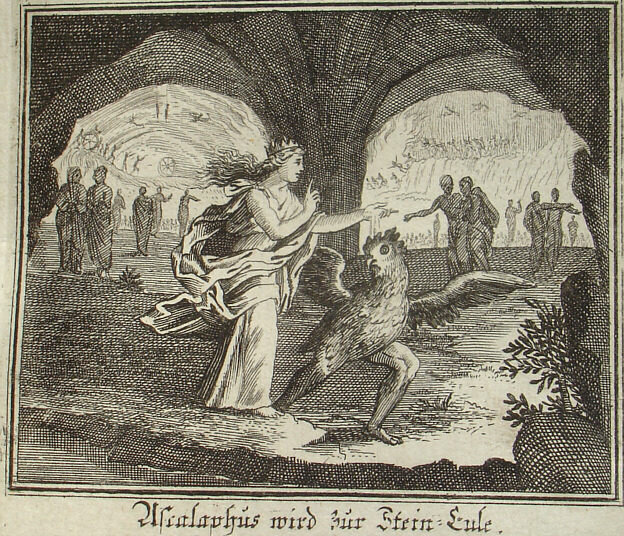
Once he was uncovered, the wronged goddess completed his sentence by changing his shape: Persephone (or Demeter) transformed Ascalaphus into a screech-owl — the ōtos, the eared owl the Greeks counted a bird of ill omen, whose cry in the night was taken as a herald of grief and coming sorrow. This transformation is told most fully and vividly by the later Roman poet Ovid (Metamorphoses 5.533–550), who describes Persephone sprinkling him with the water of Phlegethon so that his head swelled into a beak, his arms spread into wings, and he became "the sluggish screech-owl, a loathsome bird, a herald of mourning to mortals." The core of the story — the betrayal, and the pinning beneath the rock — is already firmly Greek in Apollodorus; the owl-ending as we know it in such detail is the Roman telling. So the witness of the underworld became a creature of the night, and his voice, once a single fateful word, became a cry that men still heard as an omen of grief.
Worship — Ancient
A figure of myth, not of cult
Ascalaphus had no temple, priesthood, or festival of his own. He was a figure of story and of the underworld's machinery rather than an object of worship — remembered not for favours he might grant but for the fate that overtook him. What devotion touches him is indirect: it belongs to the quiet observances of the dead and to the old dread of the screech-owl's cry. The Greeks (and after them the Romans) heard in the night-call of the ōtos the voice of ill omen, and Ascalaphus is the myth that explains why that bird carries grief in its voice.
The owl of ill omen
Through his transformation Ascalaphus entered the long tradition of the owl as a bird of foreboding. Where the little owl of Athena stood for wisdom, the screech-owl he became stood for mourning and the nearness of death — a creature of the dark whose cry made the hearer flinch. To know the myth was to know why: the bird was once the witness who doomed Persephone, and its cry still carries the grief of that story.
Worship — Modern
The fateful witness
Ascalaphus is a minor figure, but a resonant one for anyone drawn to the moral weight of his story. He is the witness whose truthful word cannot be called back — the one who sees what others miss and speaks it, and so sets the course of events and pays the price. A modern reader may honour him as a patron of hard testimony and of the burden of seeing clearly, remembering that in his myth the truth was both unwelcome and unalterable.
When the owl calls
His other inheritance is the screech-owl itself. Where his cry is heard in the night, the old stories remembered him — the orchard-keeper of the dead, pinned beneath the stone and raised again only to be changed into a bird of grief. To hear the owl and recall Ascalaphus is to keep a small, ancient habit alive: reading an omen in a voice out of the dark, and remembering the witness behind it.
Epithets & Cult Titles
- the orchard-keeper of Hades — A spirit of the underworld who tended the fruit of Hades' realm — it was in that dark orchard that he saw Persephone taste the pomegranate
- ōtos (ὦτος) — The eared or screech-owl into which he was transformed — a bird the Greeks heard as a herald of grief and ill omen, its cry carrying through the night
- dirum mortalibus omen (bubo) — 'A dire omen to mortals' — the Latin tradition's naming of him (Ovid, Metamorphoses 5.549–550), which makes the transformed Ascalaphus the ignavus bubo, the sluggish eagle-owl whose very appearance forebodes coming grief
Sources & Variants
- Apollodorus, Bibliotheca 1.5.3 (Ascalaphus, son of Acheron, alone sees Persephone eat the pomegranate and tells of it; is punished by being pinned beneath a rock; his mother named as the nymph Orphne or Gorgyra)
- Apollodorus, Bibliotheca 2.5.12 (Heracles, in his descent for Cerberus, rolls away the stone and frees Ascalaphus)
- Ovid, Metamorphoses 5.533–550 (the pomegranate seeds; Persephone transforms Ascalaphus into the screech-owl, a herald of mourning) — later Roman retelling; the betrayal and pinning are already Greek in Apollodorus
Gallery