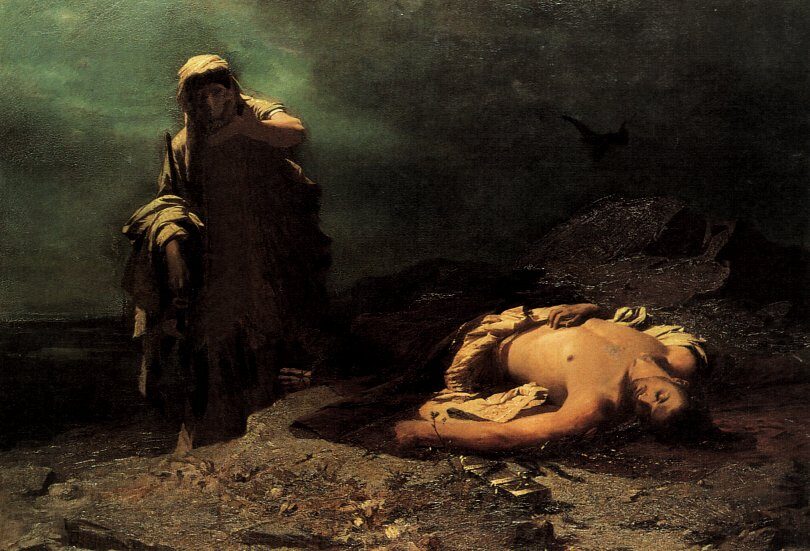
Antigonē
First Appearance
Antigone's defiance first reaches the stage at the close of Aeschylus's Seven Against Thebes (1005–1053), where a herald proclaims that Polynices, who marched against his own city, shall lie unburied, and Antigone answers at once that she will bury him herself whatever the city decrees — though the authenticity of this ending is debated, since it seems to look forward to Sophocles' later and far fuller treatment. It is in Sophocles' Antigone (produced around 441 BC) that she becomes one of the great figures of Greek tragedy: the daughter of Oedipus who sets the eternal laws of the gods against the edict of King Creon, buries her brother, and goes to her death unbowed.
— Aeschylus, Seven Against Thebes 1005–1053; Sophocles, Antigone (produced c. 441 BC)
Who They Are
Antigone (an-TIG-oh-nee) is the daughter of Oedipus, the doomed king of Thebes, and the heroine of principled defiance — the young woman who defied a king's command to honour the higher, unwritten laws of the gods, and died for it. She is counted among the heroes not for feats of arms or monsters slain, but for a courage of conscience: she buried a brother the state had condemned to rot unburied, and when she was caught she did not flinch or deny it, but claimed the deed and its penalty together. For more than two thousand years she has stood as the archetype of the individual conscience set against the power of the state — the one who obeys a law older and higher than any king's.
Her story has two great movements, both drawn chiefly from Sophocles, who shaped her into the figure the world remembers. In the first she is the loving daughter who alone stays by her blind, accursed father Oedipus after Thebes casts him out, guiding him by the hand through long years of wandering to his strange and holy death at Colonus near Athens (Sophocles' Oedipus at Colonus). In the second — the more famous — her two brothers Eteocles and Polynices kill each other in the war of the Seven against Thebes; the new king Creon decrees that Polynices, who attacked the city, be left unburied on pain of death; and Antigone defies him, buries her brother, and is sealed alive in a rock tomb, where she takes her own life. Her death pulls down the whole house of Creon after her.
Antigone was born into a family already crushed by fate — the child of Oedipus and his own mother Jocasta, sister to Ismene, Eteocles, and Polynices — and her greatness lies in how she bore that inheritance of ruin: not by fleeing it, but by meeting it with an unbending fidelity to the dead and to the gods. (The reader will find her family's larger tragedy told on the page for Oedipus.)
Mythology
Daughter of a cursed house
Antigone belonged to the most ill-fated family in all Greek story. She was the daughter of Oedipus, king of Thebes, by Jocasta — who was, unknown to either at the time, Oedipus's own mother; so that Antigone was at once the daughter and the half-sister of her father, a child of the incest that lay at the heart of the Theban curse. Her sister was Ismene, gentler and more yielding than she; her brothers were Eteocles and Polynices, whose quarrel would destroy them both. The genealogy is given plainly by Apollodorus (Bibliotheca 3.5.8), who names the four children of Oedipus and Jocasta. From her first breath Antigone carried the weight of a doom older than herself — and the glory of her story is that she bore it not as a victim but as a woman who chose, again and again, to do right within it. (The full tragedy of Oedipus — the killing of his father, the marriage to his mother, the self-blinding — is told on his own page.)
The guide of her blind father
When the truth of Oedipus's birth and marriage came to light and Thebes cast him out, blind and polluted, it was Antigone who went with him. In Sophocles' Oedipus at Colonus — the poet's last play, composed in his old age and produced after his death (401 BC) — she is the exiled king's eyes and his staff, leading him by the hand through years of beggarly wandering until they come at last to the grove of the dread goddesses, the Eumenides, at Colonus just outside Athens. There the aged, outcast Oedipus, received in mercy by Theseus of Athens, is granted a mysterious and holy end: he vanishes into the earth, his grave a secret blessing to the land that sheltered him. Antigone's devotion in this play — patient, tender, unwearied — is the counterweight to her later defiance: the same fidelity to kin and to the dignity of the suffering, shown first in love and then in resistance. At the play's close she begs to return to Thebes, hoping still to reconcile her warring brothers, and so the poet turns her toward the doom that waits for her there.
The war of the Seven and the brothers' mutual slaughter
The quarrel that breaks the house was between her brothers. Eteocles and Polynices had agreed to share the kingship of Thebes, ruling in alternate years; but when his turn ended Eteocles refused to yield the throne, and Polynices, driven into exile, went to Argos, married the daughter of King Adrastus, and raised a great army — the Seven against Thebes — to take the city by force. Aeschylus's Seven Against Thebes and Euripides' Phoenician Women tell the war: seven champions against the seven gates, the assault beaten back, and at the last the two brothers meeting in single combat at the gate and killing each other with their own hands, each dying by the other's spear (Apollodorus, Bibliotheca 3.6.8). So the curse of Oedipus came home: the sons who had wronged their blind father destroyed one another, and the kingship of Thebes fell to their uncle Creon, the brother of Jocasta.
Creon's edict: the unburied brother
Now came the test that made Antigone immortal. Creon, taking power, decreed that Eteocles, who had died defending Thebes, should be buried with full honours — but that Polynices, who had led a foreign army against his own city, should be left where he fell, unburied and unmourned, his body given to the dogs and the birds, and that anyone who tried to bury him should be put to death (Sophocles, Antigone 192–206). To the Greek mind this was a terrible thing: the dead had a sacred right to burial, and the duty of giving it fell above all on the kin; to leave a body unburied was to leave the soul unable to pass into the house of the dead, and to defile the living with the pollution of the exposed corpse. Creon set the law of the state — the welfare of the city, the punishment of the traitor — against the oldest law of the gods and the family. Antigone, hearing the edict, resolved at once to defy it.
"The unwritten laws of the gods": the defiance
In the great opening of Sophocles' play Antigone tells her sister Ismene what she means to do and asks her help. Ismene, frightened, refuses — they are only women, she says, and cannot fight the men who rule; better to yield than to die. Antigone goes alone. She scatters dust upon the body of Polynices — the symbolic burial that the rite required — and when the guards, having uncovered the corpse, catch her returning to tend it a second time, she does not deny the deed but claims it proudly before the king. In the heart of the play she answers Creon to his face: his edict, she says, was the proclamation of a mortal man, and no mortal proclamation can override the "unwritten and unfailing laws of the gods" (agrapta kasphalē theōn nomima) — laws that are not of today or yesterday but live forever, and whose origin no one knows (Sophocles, Antigone 450–457). She chose, she says, to obey these; and if she must die for it, she will die having done what is holy. It is one of the most famous speeches in all of Greek literature — the first clear voice in the Western tradition of conscience set above the command of the state.
Sealed in the rock tomb
Creon, enraged and unyielding, condemns her — not to open execution, but to be walled up alive in a rock-cut tomb with a little food, so that the city may claim no direct guilt for her death and leave her fate to the gods. Antigone goes to her living grave lamenting, in one of tragedy's most moving laments, that she will die unwed and childless, never to know marriage or the bearing of children, a bride only of Death (Sophocles, Antigone 806–882). The blind seer Tiresias comes then to warn Creon that he has sinned against the gods — keeping a living woman in the grave and a dead man above the earth — and that the gods will exact a price from his own house. Too late, Creon relents and hurries to free her. But he comes too late: Antigone has already hanged herself in the tomb, choosing her own death rather than the slow dying the king decreed.
The ruin of Creon's house
Her death drags down the house of the king who killed her. Haemon, Creon's son and Antigone's betrothed, is found in the tomb clinging to her body; when his father approaches he draws his sword — in his grief and fury first upon Creon, then, missing, upon himself — and dies embracing the dead girl (Sophocles, Antigone 1175–1243). When word of Haemon's death reaches his mother, Creon's wife Eurydice, she too takes her own life, cursing her husband as she dies for the loss of her son. Creon is left alive amid the wreckage of his family — son and wife and niece all dead — a broken man who learns, when learning can no longer save him, that his rigid will has destroyed everything he had. So Sophocles' Antigone (produced around 441 BC) ends not in the triumph of either law but in universal ruin, with the Chorus's warning that pride and hard words bring down great blows upon the proud, and teach wisdom only in old age. Antigone, dead, is vindicated; but the vindication is bought with the destruction of a whole house.
Worship — Ancient
A heroine of the stage, not of the altar
Antigone was not, so far as the record shows, the object of an organized hero-cult with temple, priesthood, and festival in the way many Greek heroes were. Her immortality was won on the stage and in the memory of the Greeks rather than at an altar. She belonged above all to the great cycle of Theban tragedy — the house of Oedipus and the war of the Seven — which the Athenian tragedians made into one of the central stories of their art, performed before the whole city at the festivals of Dionysus. Through Sophocles' Antigone and Oedipus at Colonus, through Aeschylus's Seven Against Thebes and Euripides' Phoenician Women, her figure was set before the Greeks year by year as a pattern of fidelity, of courage, and of the terrible collision between the law of the city and the law of the gods.
The question she was made to ask
To the Greeks who watched her, Antigone posed a question that lay at the heart of their own civic life: what does a citizen owe to the state, and what to the gods and the family, when the two commands conflict? The Athenians held burial of the dead to be a sacred and inviolable duty — the exposure of a corpse was among the gravest of pollutions — and they honoured, too, the authority of law and the good of the city. Sophocles set these two goods against each other and gave neither an easy victory: Creon is not simply a tyrant, nor Antigone simply right, for her defiance destroys her and those she loves. The play was remembered and quoted in antiquity precisely for this unresolved weight; Aristotle and later writers cite it, and her appeal to the "unwritten laws" became a touchstone in Greek thought about justice higher than written statute.
Variant endings
The tradition was not wholly uniform. Beyond the Sophoclean story, a different and happier strand survived — best known from a lost play of Euripides (also titled Antigone) and reported by later mythographers — in which Haemon does not die but hides Antigone, who bears him a son; the boy, grown, is later recognized by a birthmark of the Theban royal line, and the story turns on that recognition rather than on death in the tomb. Apollodorus (Bibliotheca 3.7.1) preserves yet another version in which Antigone is caught burying Polynices and handed by Creon to Haemon to be killed, and Haemon instead kills her and then himself. These variants are a reminder that the Greeks told the story more than one way; but it is Sophocles' telling — the defiance, the rock tomb, the chain of deaths — that became canonical and that the world has kept.
Worship — Modern
The archetype of conscience against power
Antigone is remembered today less as a figure of cult than as one of the enduring symbols of the human conscience set against unjust power. Her stand — that there is a law higher than the decree of any ruler, and that one must obey it even at the cost of one's life — has made her a touchstone for every age that has had to weigh obedience against conscience. She has been read as the patron figure of civil disobedience and of resistance to tyranny; her name is invoked wherever an individual defies an unjust command in the name of a higher duty, and her great speech on the "unwritten laws" is cited in the long argument over whether justice stands above the written law of states.
The reach of her story
Few figures of Greek myth have had so long an afterlife in art and thought. Sophocles' Antigone has been retold, translated, and restaged in every century, and made new in times of crisis — most famously in the twentieth century as a drama of resistance under occupation and dictatorship. Philosophers from the age of Hegel onward have returned to her as the very type of a tragic conflict between two goods, the family and the state, each with its own right. For a modern reader drawn to her, Antigone stands for the dignity of the dead and the duty of the living to honour them; for fidelity to kin; and above all for the courage to say, before a power that can kill her, that some laws are not a king's to make or unmake.
How she might be honoured
One who wished to keep her memory might do so exactly where her story places it: in the care of the dead and in the keeping of conscience. To pour a libation for the unmourned and the unburied, to honour those whom the powerful would leave without rites, to stand by kin in their worst hour, and to hold fast to what one believes is right against the pressure to yield — these are the devotions her story teaches. She is a fitting patron of the loyal, of the grieving, and of all who must choose between obedience and the deeper law.
Epithets & Cult Titles
- The burier of her brother — Her defining act — the one who gave funeral rites to Polynices against the edict of Creon, scattering dust upon his unburied corpse so that his shade might pass to the dead; the deed for which she died
- Keeper of the unwritten laws (agrapta nomima) — From her own great speech in Sophocles (Antigone 450–457), where she sets the 'unwritten and unfailing laws of the gods' — eternal, of no man's making — above the proclamation of a mortal king
- Guide of the blind exile — Her devotion in Oedipus at Colonus, where she leads her blind, outcast father Oedipus by the hand through his wandering to his mysterious end at Colonus near Athens
- autonomos (αὐτόνομος) — 'A law to herself' — the word the Chorus uses of Antigone as she goes to her death (Antigone 821), going down to Hades alive, self-willed and ruled by no law but her own conscience
Sources & Variants
- Sophocles, Antigone (produced c. 441 BC) — the central source: Creon's edict, Antigone's defiance and the 'unwritten laws' speech (450–457), the rock tomb, her suicide, and the deaths of Haemon and Eurydice
- Sophocles, Oedipus at Colonus (produced posthumously 401 BC) — Antigone as the guide of her blind, exiled father Oedipus to his end at Colonus
- Aeschylus, Seven Against Thebes 1005–1053 — the proclamation against burying Polynices and Antigone's resolve to bury him (closing scene of disputed authenticity)
- Euripides, Phoenician Women — the war of the Seven, the mutual slaughter of Eteocles and Polynices, and Antigone within the fall of the house
- Euripides, Antigone (lost play) — the variant tradition in which Haemon saves Antigone and she bears him a son, known from fragments and later summaries
- Apollodorus, Bibliotheca 3.5.8 (the children of Oedipus and Jocasta: Eteocles, Polynices, Antigone, Ismene)
- Apollodorus, Bibliotheca 3.6.8 (Eteocles and Polynices kill each other in single combat)
- Apollodorus, Bibliotheca 3.7.1 (Antigone caught burying Polynices; a variant of her death at Haemon's hand)
Gallery