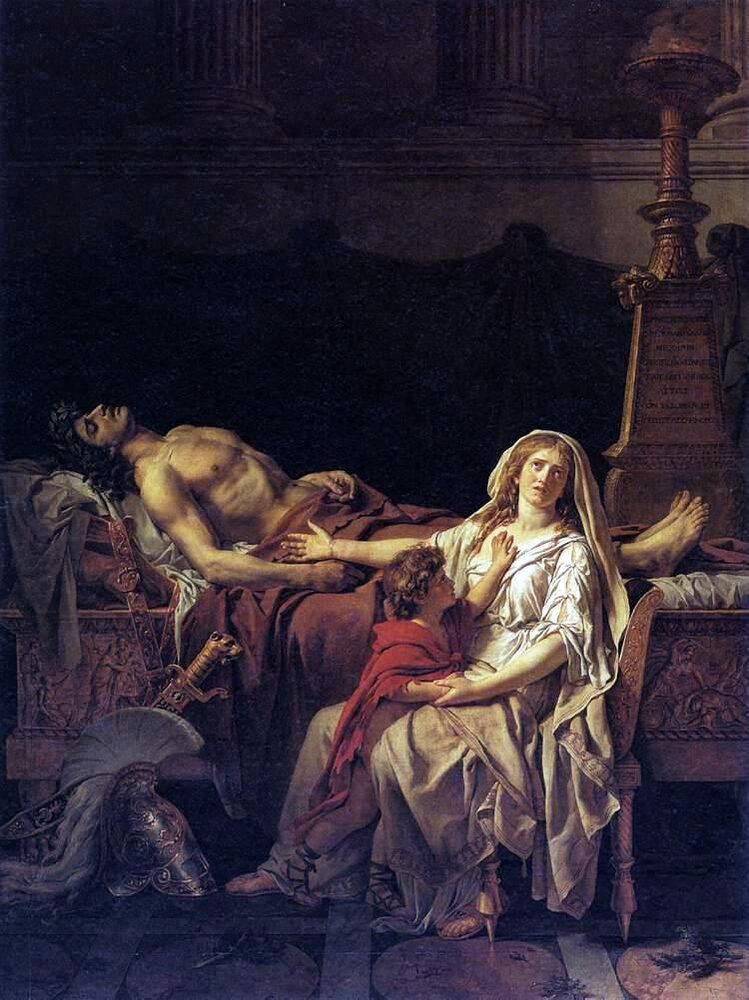
Andromachē
First Appearance
Andromache enters Greek poetry in one of its most tender and famous scenes — the meeting of Hector and Andromache at the Scaean Gate (Iliad 6.390–502). Searching for her husband, Hector finds her not at home but on the tower of the wall, where she has run in dread, "like one gone mad," the nurse beside her carrying their infant son. She takes his hand and weeps, and begs him not to go back to the fighting and make her a widow and their child an orphan — reminding him that she has no one left in the world but him, for Achilles has already killed her father and her seven brothers. Hector answers that he cannot hide from the battle and keep his honour, yet the thought that wounds him most is of her led away a slave. Then he reaches for his son — and the baby shrinks back crying, frightened by the horsehair crest nodding on his father's helmet; Hector laughs, lifts off the helmet, takes up the boy and prays over him, and gives him back to Andromache, who takes him to her fragrant breast "smiling through her tears." It is the one moment of ordinary human love set against the whole doom of the war, and it has never been forgotten.
— Homer, Iliad 6.390–502
Who They Are
Andromache (an-DROM-uh-kee) is the faithful wife of Hector, the great prince and defender of Troy, and in the whole sweep of Greek epic and tragedy she is the supreme image of the devoted wife and the grieving war-widow. She is counted here among the heroes because she stands at the human centre of the Trojan War — not a warrior, though her name means "battle of men," but the woman on whom the war's grief falls most completely: she loses her father, her seven brothers, her husband, her infant son, her city, and her freedom, and lives on through all of it. If Hector is the measure of what Troy loses in its men, Andromache is the measure of what it loses in its women and children.
She was a princess in her own right, daughter of King Eëtion of Thebe-under-Placus, a city near Troy, before Achilles sacked it and killed her father and all seven of her brothers in a single day. Married to Hector, she bore him a son, Astyanax, and her few scenes in Homer's Iliad — the farewell at the Scaean Gate, the moment she learns of Hector's death while drawing his bath, her lament over his body — are among the most moving in all of Greek literature. After Troy falls, the sorrows only deepen: the Greeks kill her little son, and she is carried off as a war-slave and concubine to Neoptolemus, the son of the very Achilles who destroyed her family.
Yet her story does not end in annihilation. In the later tradition she endures the jealousy of Neoptolemus's wife Hermione, survives, bears children in captivity, and at last marries Helenus, Hector's brother the seer, and lives out her days as a queen in Epirus — the surviving matriarch of the Trojan royal line, the one who carries what remains of Troy into a new country. The Greek tragedians, above all Euripides in his Andromache and his Trojan Women, made her the enduring archetype of the woman whom war widows and enslaves, and whose dignity and faithfulness survive even that.
Mythology
The princess of Thebe
Before she was Hector's wife, Andromache was a princess of her own house: the daughter of Eëtion, king of Thebe-under-Placus (Thebe Hypoplakia), a Cilician city near the wooded slopes of Mount Placus, not far from Troy. Homer gives her this lineage in her own words at the Scaean Gate (Iliad 6.414–428), and it is the ground of all her later grief. For when Achilles sacked Thebe early in the war, he killed Eëtion — yet, Homer says, out of a strange reverence he did not strip the king's armour but burned him in it with his own weapons and raised a barrow over him, and the mountain-nymphs planted elms around the grave. In that same assault Achilles killed Andromache's seven brothers all in one day, cutting down the whole generation of her father's house; her mother he took captive and ransomed, only for her to die soon after. So before the Iliad even opens, Andromache has already lost her father, her brothers, and her first home to the hand of Achilles — and it is because she has no kin left that her whole world has narrowed to Hector alone. "Hector," she tells him, "you are father to me now, and honoured mother, and brother, and you are my strong husband" (Iliad 6.429–430).
The farewell at the Scaean Gate
The scene that fixes Andromache forever in memory is her parting from Hector in the sixth book of the Iliad (6.390–502). Hector, come back into the city, looks for her at home, but she is not there; a servant tells him she has rushed to the great tower of the wall in dread at the news that the Trojans are being pressed, and he finds her there at the Scaean Gate with the nurse, who carries their baby son on her breast — a child "like a beautiful star," whom Hector calls Scamandrius but the Trojans call Astyanax, "lord of the city," for his father's sake. Andromache takes Hector's hand, weeps, and pours out her plea: do not go back to the fighting; have pity on your infant son and on me, who will be a widow; you are everything I have, for Achilles took all the rest. She even counsels him where the wall is weakest and begs him to hold there rather than charge out. Hector answers gently but immovably — he cannot skulk from battle and keep his honour before the Trojans, and in his heart he knows Troy will fall; yet nothing grieves him so much, he says, as the thought of her led away weeping into slavery, forced to weave at another woman's loom and fetch water in a strange land, while men say "there goes the wife of Hector."
Then comes the most human moment in the poem. Hector reaches out for his boy — and the baby shrinks screaming into the nurse's bosom, terrified by the bronze helmet and the horsehair crest nodding terribly from its peak. Both parents laugh aloud; Hector lifts the helmet from his head and lays it gleaming on the ground, takes up his son, kisses him, dandles him, and prays to Zeus that the boy may grow to be a better man than his father, a joy to his mother's heart. He gives the child back to Andromache, who receives him to her fragrant breast "smiling through her tears" (dakruoen gelasasa) — and Hector pities her, strokes her with his hand, bids her go home to her loom and leave war to men, and takes up his helmet again. She goes, "turning back again and again," weeping; and once home, she and her maids raise the lament for Hector while he yet lives, "for they thought he would never again come back from the battle." It is the whole tragedy of the war compressed into one doorway: the tenderness of an ordinary family, and the certainty that it is already lost.
The bath and the news of Hector's death
Homer keeps Andromache off the page through the long central battles, and brings her back with devastating force at the climax. In the twenty-second book, while Achilles kills Hector beneath the walls and drags his body behind his chariot, Andromache knows nothing of it. She sits deep within the house at her loom, weaving a great purple web with a pattern of flowers, and has just called to her maids to set a cauldron over the fire and heat a warm bath for Hector against his return from the fighting — "poor fool," Homer says, "she did not know that far from all baths grey-eyed Athena had brought him down at Achilles' hands" (Iliad 22.437–446). Then she hears the shrieking and wailing rise from the tower; the shuttle drops from her hand; her heart leaps; she runs through the hall "like a madwoman," and climbs to the wall. There she sees Hector's body being dragged in the dust toward the ships — and night covers her eyes, and she faints clean away, flinging from her head the bright headdress and veil that golden Aphrodite had given her on her wedding day. Revived in the arms of her husband's sisters, she pours out her first great lament (22.477–514): Hector is dead, and she and the child are doomed; the boy Astyanax, orphaned, will be pushed from feast and friendship, his cheeks wet, reduced to begging — and Hector's body will lie by the ships, naked, to be eaten by dogs, far from the fine garments she wove, which she now will burn, since they are no use to him. The ancient scene makes her grief the true measure of Hector's worth.
The lament over Hector's body
At the very close of the Iliad, when old King Priam has ransomed Hector's body back from Achilles and borne it home, Andromache leads the formal mourning of the three women who loved him most (Iliad 24.723–746). Cradling his head in her hands, she sings the first of the three great dirges over him: he has died young and left her a widow in his halls, and their son is still only an infant; the city will now surely fall, for its guardian is gone, and the Trojan wives and children will be carried off in the hollow ships — she among them, and the boy with her, to labour at shameful tasks, unless some Greek seizes him and dashes him from the tower in revenge for the kin Hector killed. She grieves most of all, she says, that Hector did not die in his bed and stretch his arms to her and speak some last close word she could have kept and wept over all her days. Her lament is answered by Hecuba's and then by Helen's, the three voices closing the poem — and of them Andromache's is the wife's, the most intimate and the most desolate.
The fall of Troy and the death of Astyanax
What Andromache foresaw came to pass. When Troy fell, the Greeks were not willing to let Hector's line survive, lest the son grow up to avenge the city; and so — in the tradition the tragedians and later writers tell (Euripides, Trojan Women; Apollodorus, Epitome 5.23) — the infant Astyanax was taken from his mother and hurled to his death from the walls of Troy, the very towers from which his father had defended the city. In Euripides' Trojan Women the scene is almost unbearable: Andromache must give up the child, and later his small broken body is brought back to her on Hector's own great shield to be washed and buried, while she herself is already being driven down to the Greek ships. With husband, son, father, brothers, and city all destroyed, she is now wholly alone — and still she is not permitted to die, but must go on living as another's property.
War-slave of Neoptolemus
In the division of the Trojan spoils, Andromache was allotted as war-slave and concubine to Neoptolemus (also called Pyrrhus), the son of Achilles — a cruelty the Greeks themselves felt as such, that the wife of Hector should be handed to the son of the man who had destroyed her whole family. He carried her across the sea to his kingdom in Phthia or Epirus in the north of Greece, and there she bore him sons in captivity — the tradition names Molossus (ancestor of the Molossian kings of Epirus), and sometimes Pielus and Pergamus. Her endurance in this bondage is the subject of Euripides' tragedy Andromache, where she appears years on, still a slave, clinging to the altar of Thetis for refuge and defending her child against those who would destroy him. She has become the very thing Hector dreaded at the Scaean Gate — the captive woman weaving at a stranger's loom in a foreign land — and she bears it with a grave dignity that the play sets against the pettier cruelties around her.
The jealousy of Hermione
In Euripides' Andromache, the sharpest danger comes not from men but from Hermione, the daughter of Menelaus and Helen and the wedded wife of Neoptolemus. Childless and bitterly jealous of the captive who has borne her husband sons, Hermione — with her father Menelaus — plots to kill Andromache and her boy while Neoptolemus is away at Delphi. Andromache takes sanctuary at the altar and pleads for the child's life; the play turns on the contrast between the enslaved Trojan's steadfastness and the free Spartan queen's spiteful fear. The murderous scheme is undone, and old Peleus, Achilles' father, intervenes to save Andromache and her son; Hermione, terrified of her husband's return, flees with Orestes, who contrives the death of Neoptolemus at Delphi. Through all of it Andromache survives — the pattern of the woman who outlasts those who would destroy her.
Marriage to Helenus and the matriarch of Epirus
Andromache's long story ends, against all expectation, not in death but in a kind of restoration. After Neoptolemus is killed, she is joined to Helenus — Hector's own brother, the Trojan prince and prophet (seer) who had also been brought captive to Epirus — and the two Trojan survivors, widow and brother-in-law, marry and reign together in that northern land. In the famous passage of Virgil's Aeneid (3.294–505) — a Roman telling — Aeneas, wandering after the fall of Troy, comes to Epirus and finds Andromache there, pouring libations at an empty tomb she has raised to Hector's memory beside a little model of Troy that she and Helenus have built to comfort their exile; she weeps to see Astyanax's living likeness in Aeneas's companion. So the martial name "battle of men" resolves at last into something like survival: Andromache becomes the enduring matriarch of the scattered Trojan line, the one who keeps the memory of Hector and of Troy alive in a strange country, and through her son Molossus is counted an ancestress of the kings of Epirus. Of all the royal house of Troy, it is the faithful wife who carries its remnant into the future.
Worship — Ancient
Not a goddess, but a pattern held sacred
Andromache was a mortal woman of myth, not a deity, and she had no temple, altar, priesthood, or festival anywhere in the Greek world. What she had instead was something the Greeks valued almost as highly as cult — a place in the great shared poems and plays by which they understood themselves. From Homer onward she was the acknowledged pattern of the faithful wife (the ideal of wifely devotion, the companion who weaves at home and runs to the wall in dread for her husband) and, still more, of the grieving war-widow, the woman on whom the costs of war fall after the fighting is done. Her devotion lived not in rites performed for her, but in the honour Greek culture gave to the figure she embodied.
The voice of the lament
Andromache's deepest connection to Greek religious life is through the lament — the formal mourning-song (goos, thrēnos) raised by women over the honoured dead, one of the oldest and most sacred of Greek observances. Her three great laments in the Iliad — foreseeing Hector's death at the Scaean Gate, collapsing at the sight of his dragged body (22.477–514), and leading the dirge over his corpse at the poem's close (24.723–746) — became the classic literary models of the form. In a culture where the proper mourning of the dead was a solemn duty and the women's lament a recognised rite, Andromache stood as the very type of the wife performing that rite: her grief gave the dead their due honour, and her figure sanctified the act of mourning itself.
The Athenian tragic stage
It was on the tragic stage of fifth-century Athens that Andromache received something closest to devotion — the sustained attention of the city's great public religious festivals, where tragedy was performed in honour of Dionysus. Euripides made her the title figure of his Andromache, the captive clinging to the altar and defending her child, and one of the central voices of his Trojan Women, where she must surrender Astyanax to his death. These plays, watched by the whole Athenian citizenry, fixed her forever as the supreme image of the woman unmade by war — the widow, the slave, the mother robbed of her child — and used her suffering to hold up a mirror to the city's own conduct in war. Pausanias, travelling Greece in the second century AD, still records her painted among the captive Trojan women in the great lost mural of the sack of Troy by Polygnotus (Pausanias 1.11 and 10.25), proof of how enduring her image remained.
Worship — Modern
The archetype of the grieving war-widow
Andromache endures today less as a figure of devotion than as one of literature's most enduring and sympathetic archetypes — the faithful wife and the grieving war-widow, the human face of war's cost to those who do not fight it. A modern reader or devotee drawn to her meets, in her few scenes, almost the whole emotional weight of the Iliad: the tenderness of the farewell at the gate, the horror of the dropped shuttle and the unneeded bath, the dignity of the lament over the body. She speaks for every wife and mother who has waited for a soldier who did not return, and for every civilian carried off when a city falls. In an age that still fills with the widows and refugees of war, her figure has lost none of its force.
A patron of faithfulness and of those war unmakes
Honoured today, Andromache sits well as a patron of wifely faithfulness and devotion, of the love that holds to one person through everything; and, more broadly, of the women and children whom war destroys — the widowed, the orphaned, the enslaved and displaced, the survivors who must carry a ruined past into an uncertain future. Her story insists that their grief be seen and named, not passed over in the counting of heroes and victories. To remember Andromache is to remember that every fallen defender leaves an Andromache behind, and that the measure of what war costs is taken as truly in the woman at the loom as in the warrior on the field.
The one who survives
Above all, Andromache is the figure who endures. Stripped of father, brothers, husband, son, city, and freedom, she does not die; she goes on, bears children in captivity, outlasts her persecutors, and at the last becomes a queen and matriarch in a new land, keeping the memory of Hector and of Troy alive among strangers. Read this way her story is not only one of loss but of survival and faithfulness beyond catastrophe — the keeping-alive of what is loved even when everything that held it is gone. It is why, of all the royal house of Troy, it is the faithful wife whom the tradition carries furthest into the future, the surviving heart of a fallen world.
Epithets & Cult Titles
- the wife of Hector (Ἕκτορος ἄλοχος) — Her defining name in Homer — Hector's wife, the devoted companion of the greatest defender of Troy, whose whole dignity and whole grief flow from that bond
- leukōlenos (λευκώλενος) — White-armed — a formulaic epithet of beauty and nobility Homer gives her (Iliad 6.371, 377), the same honour-word used of Hera and Helen, marking her as a woman of the highest rank
- daughter of great-hearted Eëtion (Ἠετίωνος θυγάτηρ) — Her father's name clung to her as a title of her lost first home — princess of Thebe-under-Placus in Cilicia, whose father and seven brothers Achilles killed in one day
- dystēnos (δύστηνος) — Wretched, ill-fated, star-crossed — the word the tragedians and Homer alike reach for to name the sheer weight of sorrow heaped on her: father, brothers, husband, and child all torn away
Sources & Variants
- Homer, Iliad 6.390–502 (the farewell of Hector and Andromache at the Scaean Gate; her lineage as daughter of Eëtion of Thebe; Achilles' killing of her father and seven brothers; the infant Astyanax frightened by the helmet-crest; 'smiling through her tears')
- Homer, Iliad 22.437–515 (Andromache at her loom drawing a warm bath for Hector; the shuttle falling as she hears the wailing; her collapse and first lament at the sight of his dragged body; her fear for the orphaned Astyanax)
- Homer, Iliad 24.723–746 (Andromache leads the women's lament over Hector's ransomed body, the first of the three dirges that close the poem)
- Euripides, Andromache (the captive years in Epirus as slave-concubine of Neoptolemus; the jealousy and murderous plot of Hermione; her defence of her child; rescue by Peleus; the death of Neoptolemus)
- Euripides, Trojan Women (Andromache among the captive women after Troy's fall; the taking and killing of Astyanax, thrown from the walls; his burial on Hector's shield)
- Apollodorus, Bibliotheca Epitome 5.23 (the death of Astyanax, hurled from the walls at Troy's fall)
- Apollodorus, Bibliotheca Epitome 6.12 (Andromache allotted to Neoptolemus; her later union with Helenus and the Trojan line in Epirus; her son Molossus)
- Pausanias 1.11 (Andromache and the Epirote/Molossian royal line descended through her son by Neoptolemus); cf. Pausanias 10.25 (Andromache depicted among the captive Trojan women in Polygnotus's painting of the sack of Troy at Delphi)
- Virgil, Aeneid 3.294–505 (Aeneas finds Andromache married to Helenus in Epirus, tending an empty tomb raised to Hector beside a 'little Troy') — Roman
Gallery