Amphiaraos
First Appearance
Amphiaraus steps into Greek poetry already whole, in the Odyssey's telling of the seer's doomed house (15.244–247): a man "whom Zeus the aegis-bearer and Apollo loved with all manner of love; yet he did not reach the threshold of old age, but perished at Thebes because of a woman's gifts." In the same poem Odysseus, among the dead, names Eriphyle (11.326–327), "hateful," who "took precious gold as the price of her own husband" — the bribe by which the seer who could read all fates was betrayed to the one fate he could not escape.
— Homer, Odyssey 15.244–247; 11.326–327
Who They Are
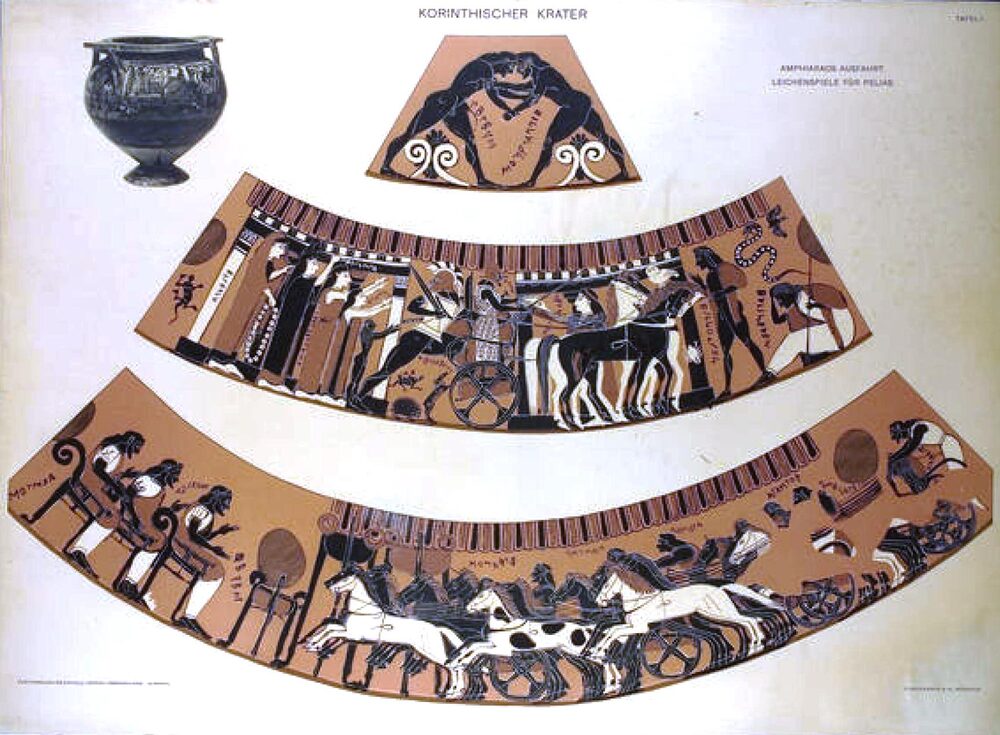
Amphiaraus (am-fee-AH-ray-us) is the seer-warrior of Argos — the greatest prophet of his age, a king and hero of the generation before the Trojan War, and one of the Seven champions who marched against the city of Thebes. He is remembered for a terrible knot of fate that no cleverness could cut: a man who could read the future plainly, who foresaw his own death in the expedition against Thebes and tried to escape it by hiding, only to be betrayed by his own wife and bound by a sworn oath to march to the doom he had seen coming.
His story turns on that betrayal. Eriphyle, his wife, had been made the arbiter of a standing quarrel between her husband and her brother Adrastus, king of Argos; whatever she decided, both men had sworn to abide by. When the exiled Theban prince Polynices needed Amphiaraus for his war, he bribed Eriphyle with the cursed necklace of Harmonia — the heirloom that brought ruin to all who wore it — and she revealed her husband's hiding-place and ruled that he must go. Amphiaraus went, knowing he went to die, and before leaving charged his sons, above all Alcmaeon, to avenge him one day by killing their mother.
He did not die as other men. As the expedition broke in rout before the walls of Thebes and Amphiaraus fled in his chariot along the river, Zeus split the earth open with a thunderbolt, and the seer was swallowed whole — chariot, horses, and charioteer — into the ground, taken alive rather than slain, and made immortal below. From that swallowing grew his cult: at Oropus, on the border of Attica and Boeotia, his great oracle drew suppliants for centuries, who slept in his precinct to receive healing and answers in dreams.
Mythology
The seer of Argos
Amphiaraus was a prince and prophet of Argos, counted among the Argonauts in some tellings and famed above all men for the seer's art — the reading of the gods' will in the flight of birds, in the marks of sacrifice, and in dreams. Homer says plainly that Zeus the aegis-bearer and Apollo, the two great gods of sky and prophecy, "loved him with all manner of love" (Odyssey 15.244–246), and it is through that love that his gift of foresight was understood: he saw truly because the gods who send the signs favoured him. He was bound by marriage and kinship into the royal house of Argos, for he had married Eriphyle, sister of Adrastus the king — a marriage that would prove the hinge of his ruin.
The oath and the arbiter
Between Amphiaraus and his brother-in-law Adrastus there had once been a bitter quarrel, settled at last by a reconciliation whose terms held the seed of the tragedy: the two men agreed that any future dispute between them should be submitted to Eriphyle — wife to the one, sister to the other — and that both would abide by whatever she judged. Each swore to it. The device was meant to keep peace in the house; instead it put the seer's life in the hands of a woman who could be bought.
The necklace of Harmonia and the betrayal
When Polynices, the exiled son of Oedipus, came to Argos seeking champions to win back his share of Thebes from his brother Eteocles, Adrastus took up the cause and gathered the expedition that would be called the Seven against Thebes. But Amphiaraus, reading the future, saw that the war was doomed — that of all the leaders only Adrastus would come home alive, and that he himself would die at Thebes. He refused to go, and did his utmost to keep the others back; then, to escape being forced, he hid himself away where he could not be found. Polynices, knowing the one weakness in the house, turned to Eriphyle. He offered her the necklace of Harmonia — the wedding-gift of the first queen of Thebes, a thing of surpassing beauty and a curse upon every woman who possessed it (the same heirloom whose dark history runs through the house of Thebes). Overcome by the gift, Eriphyle betrayed her husband's hiding-place and, as the sworn arbiter, ruled that he must march. Bound by his own oath, Amphiaraus could not refuse.
The charge to his sons
Knowing now that he went to certain death, Amphiaraus set his house in order with a bitter command. He charged his sons — above all Alcmaeon, with his brother Amphilochus — that when they came of age they should avenge their father: they were to kill Eriphyle, the mother who had sold him, and then to lead a second expedition against Thebes to finish what the first could not. He went to war, the sources say, in grief and anger but without flinching, a seer marching open-eyed into the fate he had foretold — the image, for the Greeks, of a man who keeps his oath though it costs him everything.
The expedition of the Seven
At Thebes the war went as Amphiaraus had foreseen. The seven champions assaulted the seven gates of the city; Aeschylus's Seven Against Thebes sets each hero against a gate, and gives Amphiaraus the noblest portrait of them all — the just man among the violent, who rebukes the boastful Tydeus and the blasphemous Capaneus, and who bears on his shield no proud device but a plain field, "for he does not wish to seem the best but to be it" (Aeschylus, Seven 592–594). One by one the attackers fell; the brothers Eteocles and Polynices killed each other at the gate; the expedition broke and fled.
Swallowed alive by the earth
As the rout scattered the Argives, Amphiaraus fled in his chariot along the bank of the river Ismenus, a Theban spearman close behind. He was about to be struck down from behind when Zeus, to spare his beloved seer the shame of such a death, hurled his thunderbolt and split the earth wide open before the fleeing chariot. The ground swallowed Amphiaraus whole — horses, chariot, charioteer (Baton, in some tellings), and the seer himself — and closed again over him. He did not die: he was taken down living into the earth and there made immortal, a prophet-hero dwelling beneath the ground (Pindar, Nemean 9.24–27; Olympian 6.12–14, which calls him "both a good seer and a good fighter with the spear"; Apollodorus 3.6.8). Thus alone of the Seven he escaped an ordinary death — not by living, but by being taken whole into the keeping of the earth.
Alcmaeon and the vengeance
The charge Amphiaraus laid on his sons was fulfilled. When they were grown, Alcmaeon led the sons of the fallen Seven — the Epigoni, the "after-born" — in a second war against Thebes, and this time the city fell. Then, in obedience to his father and (in some tellings) to the oracle of Apollo, Alcmaeon killed his mother Eriphyle for her betrayal. For that matricide he was pursued by the Erinyes, the avenging Furies, and driven mad and wandering, as those who shed a parent's blood always were — so that the curse of the necklace, passed from hand to hand, went on dealing ruin even after the seer it first destroyed had been taken into the earth.
Worship — Ancient
The oracle born from the swallowing
Where Amphiaraus was taken into the earth, the Greeks believed, he remained — a living presence beneath the ground, and therefore a power that could be approached. From this grew one of the most important oracles of the Greek world. Herodotus already treats it as venerable and renowned: he tells how Croesus, king of Lydia, tested the oracles of Greece and judged that of Amphiaraus (with Delphi) to have answered truly, and sent it rich offerings of gold (Herodotus 1.46–49); and he notes that the Thebans themselves were barred from consulting it by a standing rule, for Amphiaraus had been their enemy (8.134). The oracle was consulted not by spoken response but through dreams.
The Amphiareion of Oropus
The great seat of the cult was the Amphiareion at Oropus, in the contested borderland between Attica and Boeotia, a sanctuary set in a wooded valley by a sacred spring. Pausanias describes it in detail (1.34): the suppliant who came for a cure or an answer first purified himself and sacrificed a ram to Amphiaraus and to the other powers of the place; then he spread the ram's fleece on the ground and lay down to sleep upon it within the precinct, waiting for the hero to send, in a dream, the healing or the counsel he sought. This practice — sleeping in a holy place to receive a divine dream — is called incubation (Greek enkoimēsis), and the Amphiareion was among its most famous homes, alongside the healing-shrines of Asclepius.
Healing, dreams, and the sacred spring
At Oropus Amphiaraus was honoured above all as a healer (hērōs iatros, "the hero-physician") as well as a giver of oracles — the two offices joined, for the dream that cured and the dream that foretold came from the same power below. Pausanias records that those who were healed by the oracle gave thanks by throwing gold and silver coins into the sacred spring from which, the people of Oropus said, Amphiaraus had risen when he became a god. The sanctuary grew into a considerable establishment, with a temple, a long colonnade (stoa) where the suppliants slept, a theatre, and the apparatus of its four-yearly festival, the Amphiareia. Many inscriptions survive from the site, recording cures, dedications, boundary-rules, and the regulations of the cult.
A hero reckoned among the gods
Because he had been taken alive into the earth and made immortal, Amphiaraus occupied an unusual place — more than an ordinary hero, something close to a god of the underworld's healing powers. The Oropians, Pausanias notes, held that he was the first to be regarded as a god, though other cities had their own claims; and the richness of the offerings made to him, from Croesus's Lydian gold onward, shows the standing his oracle held among Greeks and foreigners alike. His was a cult of the threshold between the living and the dead — a seer who had crossed over without dying, and who answered, from the far side, those who slept at his door.
Worship — Modern
The seer who kept his oath
For a modern devotee, Amphiaraus is the patron of those who must do a hard thing with open eyes. His story is not one of ignorance stumbling into ruin but of clear sight bound by obligation: he saw his death coming and went anyway, because he had sworn, and because betrayal left him no honourable way out. He stands therefore for the keeping of one's word under the worst of terms, for courage that is not blindness but the choice to meet a foreseen fate without flinching — "a good seer and a good fighter with the spear," as Pindar praised him. Those drawn to the virtue of integrity under pressure, or burdened with a duty they would rather refuse, may find in him a fitting elder.
Dreams, divination, and healing
His ancient office makes him a natural patron of the inner arts — of divination, of attention to dreams, and of the healing that comes through rest and the quieting of the mind. The practice of his oracle, incubation, honoured sleep itself as a channel through which guidance and cure could come; a modern honouring of Amphiaraus might take the form of bringing a question into sleep with deliberate intent, and of attending carefully to the dreams that answer, as his suppliants once did on the ram's fleece at Oropus. He sits well, too, as a figure for those who work with prophecy, interpretation, or the care of the sick.
The dignity of the doomed
There is a further note in his story that a thoughtful devotee may hold to: Amphiaraus was wronged — sold by his wife for a cursed ornament — and yet the gods did not abandon him. Zeus spared him the shame of a fleeing man's death and took him whole into the earth, immortal, honoured ever after with an oracle of his own. Read this way his myth speaks of grace answering injustice, of a death transformed into a lasting presence, and of the one betrayed being raised higher than those who betrayed him. He is the hero who was swallowed by the earth and rose from it a god of healing dreams.
Epithets & Cult Titles
- mantis (μάντις) — Seer, diviner — his defining nature: Amphiaraus was the great prophet of Argos, who read the will of the gods in bird-flight, sacrifice, and dream, and who foresaw clearly the ruin of the expedition he was bound to join
- beloved of Zeus and Apollo — Homer's own account of him (Odyssey 15.244–246) says Zeus the aegis-bearer and Apollo loved him 'with all manner of love' — the two gods of prophecy and sky honouring the seer above other men
- the swallowed one — He who was taken alive into the earth — at Thebes, as he fled the rout, Zeus split the ground with a thunderbolt and Amphiaraus was engulfed, chariot and charioteer and all, and made deathless below rather than dying as men die
- hērōs iatros (ἥρως ἰατρός) — The healing hero — the title under which he was worshipped at his great oracle, a giver of cures and of answers through dreams to those who slept in his precinct
Sources & Variants
- Homer, Odyssey 15.244–247 (Amphiaraus loved by Zeus and Apollo, yet perished at Thebes 'because of a woman's gifts')
- Homer, Odyssey 11.326–327 (Eriphyle 'hateful, who took precious gold as the price of her own husband')
- Pindar, Nemean 9.13–27 (the expedition of the Seven; Zeus cleaves the earth with the thunderbolt and hides Amphiaraus with his horses)
- Pindar, Olympian 6.12–17 (Amphiaraus 'a good seer and a good fighter with the spear'; the earth swallows him and his horses at Thebes)
- Aeschylus, Seven Against Thebes 568–625 (Amphiaraus the just seer among the attackers, who rebukes Tydeus and Capaneus and bears a plain shield, wishing 'to be the best, not to seem it')
- Apollodorus, Bibliotheca 3.6.2–8 (the oath to abide by Eriphyle's judgement; the bribe of Harmonia's necklace by Polynices; the betrayal; the charge to Alcmaeon; the swallowing by the earth and Amphiaraus made immortal)
- Herodotus 1.46–49 (Croesus tests the oracles and judges that of Amphiaraus true, sending it offerings of gold)
- Herodotus 8.134 (the oracle of Amphiaraus consulted; the Thebans barred by rule from using it, he having been their enemy)
- Pausanias 1.34 (the Amphiareion at Oropus: the ram-sacrifice and incubation on the fleece, the dream-oracle and healing, the sacred spring and the thrown coins, Amphiaraus reckoned the first hero held a god)
Gallery