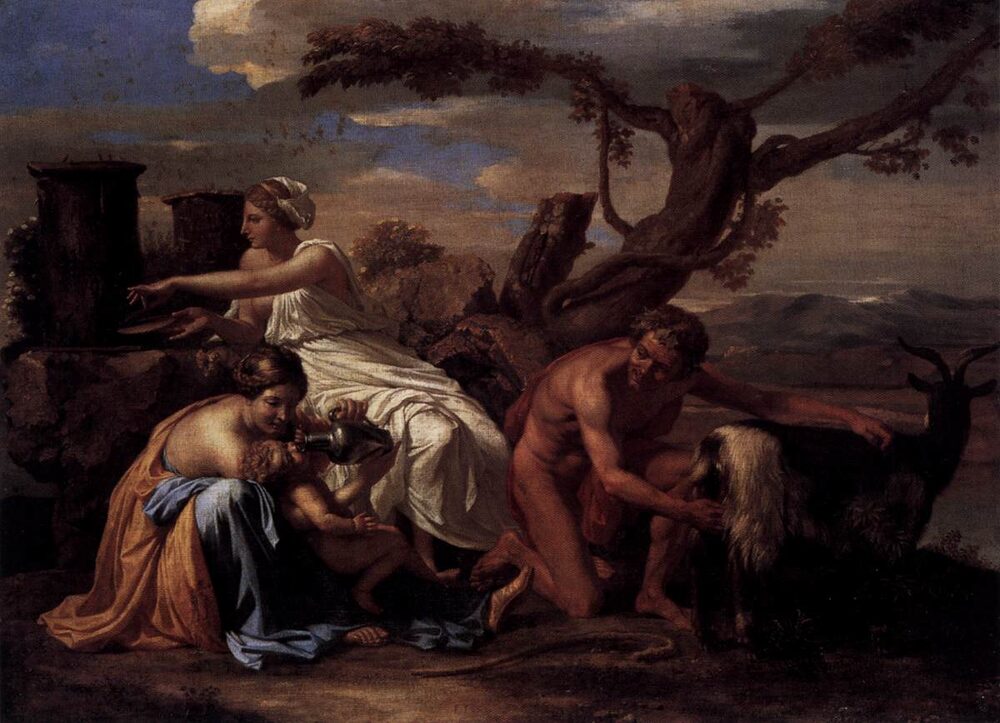
Amáltheia
First Appearance
The frame of Amalthea's story stands already in Hesiod (Theogony 477–484): when Rhea was about to bear Zeus, she was sent by Gaia and Ouranos to Crete, and there, in a cave beneath a wooded hill, she hid the new-born child away, giving Cronus a stone wrapped in swaddling-clothes to swallow in the baby's place. Hesiod does not yet name who nursed the hidden god; that the nourisher was the goat Amaltheia — or the nymph who kept her — is told by later Greek writers, above all Callimachus in the Hymn to Zeus (46–54), who sings of the infant sucking "the rich udder of the she-goat Amaltheia" and eating the sweet honeycomb while the Kouretes danced in arms about him, and Apollodorus (Bibliotheca 1.1.6–7), who has the nymphs feed the child "on the milk of Amaltheia."
— Hesiod, Theogony 477–484 (the hiding of the infant Zeus in a Cretan cave); the nurse and her goat named by Callimachus, Hymn to Zeus (1) 46–54, and Apollodorus, Bibliotheca 1.1.6–7
Who They Are
Amalthea (am-al-THEE-uh) is the nurse of the infant Zeus — the one who kept the hidden god alive in the Cretan cave while his father Cronus, who devoured his children, searched the world for the son fated to overthrow him. Hers is one of the gentlest and most important small myths in all Greek story, for without the nurse there is no Zeus, and without Zeus none of the order of the gods that follows. She is honoured here among the nymphs, the tender powers of the wild places, though the ancient sources themselves could not quite agree on what she was.
For the Greeks told her in two ways, and told both without embarrassment. In the older and more vivid telling, Amalthea is the she-goat herself — the animal whose milk suckled the baby Zeus, whose broken horn became the ever-filled horn of plenty (the cornucopia, in Greek keras Amaltheias, "the horn of Amaltheia"), whose tough hide, when she died, became the aegis, the storm-shield of Zeus, and who was lifted in the end into the sky as a star. In the other telling she is a nymph of Crete who owned and tended that wonderful goat, filling its horn with fruit for the child. The two traditions run side by side through the whole of Greek and Roman literature, and this page keeps them both, as the ancients did.
Whatever her form, her name outlived her story. "The horn of Amaltheia" became the common Greek phrase for abundance without end, so that long after the particulars of the myth had blurred, a Greek who spoke of plenty was still, without quite knowing it, invoking the nurse of the hidden god.
Mythology
The goat or the nymph
The ancient sources give Amalthea in two forms, and both are genuinely old. In the first, she is the she-goat — the animal, named Amaltheia, that gave the infant Zeus her milk in the Cretan cave. This is the form in which the earliest namings tend to run: Callimachus has the baby suck "the rich udder of the she-goat Amaltheia" (Hymn to Zeus 48–49), and Apollodorus says the nurse-nymphs fed the child "on the milk of Amalthea" (Bibliotheca 1.1.6), the goat plainly meant. From this animal-Amalthea come the three famous relics of her body — the horn that became the cornucopia, the hide that became the aegis, and the star into which she was set.
In the second form, Amalthea is a nymph — a daughter of the Cretan wild who owned and kept the marvellous goat, and who used its milk (and the honey of the Cretan bees) to nourish the hidden god. In this telling the goat is her creature, not herself, and it is the nymph who breaks and fills the horn. The Roman poet Ovid gives this version most fully (Fasti 5.111–128), naming "the Naiad Amalthea, famous in the Cretan woods," who hid the goat and its two kids in the forest and tended them — a telling flagged here as later and Roman, though the idea of a nymph-nurse behind the goat is already implicit in the Greek sources, where unnamed Cretan nymphs (Adrasteia and Ida, daughters of Melisseus) share the nursing with the animal.
The Greeks felt no need to choose. A nurse who was a goat, a nymph who kept the goat, a nymph remembered through her goat — the tradition held all of these at once, and the name Amalthea could mean any of them. What never varied was the office: she is the one who fed the baby Zeus.
The hiding of the infant Zeus
Amalthea's story belongs to the great crisis at the root of the divine order. Cronus, the Titan king, had learned that one of his own children was fated to overthrow him, and so he swallowed each as it was born. When Rhea was about to bear her sixth child, Zeus, she begged Gaia and Ouranos for help, and was sent to Crete to bear him in secret (Hesiod, Theogony 468–484). There, in a cave — the sources name the Dictaean cave on Mount Dikte, or the Idaean cave on Mount Ida — she hid the new-born god away, and gave Cronus a stone wrapped in swaddling-clothes to swallow in the baby's place, which he gulped down unknowing.
In the cave the child had to be fed and kept from crying, for any infant wail might carry to the ears of his listening father. It is here that Amalthea does her work: the goat gives her milk, and (in Callimachus and Diodorus) the bees of Crete add their honey, so that the hidden god is reared on milk and honey in the dark. And around the cradle leap the Kouretes (or Curetes), the armed guardian-spirits of Crete, who perform a clashing war-dance, beating their spears upon their shields, so that — as Callimachus puts it (Hymn to Zeus 52–54) — "Cronus might hear with his ears the din of the shield, and not the infant's crying." Apollodorus gives the same picture: the nymphs feed the child on Amalthea's milk while "the armed Kouretes guarded the babe in the cave, clashing their spears upon their shields that Cronus might not hear the child's voice" (Bibliotheca 1.1.7). Between the goat's milk and the warriors' din, the fated son grew up unheard, and came at last to his reckoning with his father.
The cornucopia — the horn of Amaltheia
The most lasting gift of the nurse is the horn of plenty. In the story, one of the goat's horns is broken off — in some tellings the infant Zeus himself, playing, snaps it loose — and the horn is found to have a wonderful power: it pours out an endless stream of whatever food and drink its holder desires, and is never emptied. This is the cornucopia, which the Greeks called simply keras Amaltheias (κέρας Ἀμαλθείας), "the horn of Amaltheia."
The phrase was proverbial in Greek long before its origin was fixed in detail: the early lyric poet Anacreon already uses "the horn of Amaltheia" as a byword for riches beyond measure (fr. 361), and the horn's magical plenty is told by the Greek mythographers (Pherecydes among the early ones is cited for it). In gratitude, or in memory, Zeus is said to have given the ever-filling horn to those who had cared for him — to the nymphs who nursed him, in one telling — so that its abundance passed into the world as a blessing. (A separate strand attaches the same name to a different horn — the horn torn from the river-god Achelous by Heracles, which the Naiads filled with fruit and also called the horn of Amaltheia, Apollodorus 2.7.5 — a sign of how firmly the nurse's name had fused with the very idea of the overflowing horn.) To this day the cornucopia, heaped with fruit and grain, remains the common image of plenty, and it is Amalthea's horn.
The aegis — the goat's hide
A darker and grander tradition makes the goat's body serve Zeus a second time, in war. When the goat Amaltheia died, Zeus is said to have taken her tough hide and made of it the aegis — the fearsome goat-skin shield or breastplate that he bears in battle and that scatters his enemies with terror. The Greeks heard the kinship of the words themselves, for aigis ("aegis") and aix ("goat") stand close together, and later writers drew the two into one story: in the war of the gods against the Titans, Zeus armed himself with the hide of his own nurse, the goat who had saved him, and so the creature that had kept the infant alive helped the grown god win his kingdom. This connection of the aegis with Amalthea's hide is drawn out especially in the astronomical tradition — Eratosthenes among the Greek writers on the constellations, and, later and in Latin, Hyginus (Astronomica 2.13, Roman) — which has Zeus use the goat's skin in the Titanomachy and then set her image among the stars in recompense.
Set among the stars — Capella and the Aix
In the end the goat received the honour the Greeks gave to so many of their creatures and heroes: a place in the sky. She was set among the stars as the Goat — in Greek hē Aix (ἡ Αἴξ), "the she-goat" — carried on the arm or shoulder of the constellation of the Charioteer (Auriga), where she still shines as the bright star we now call Capella ("the little she-goat," the Latin diminutive of the same idea), one of the most brilliant stars of the winter sky, with the fainter "Kids" beside her. The poet Aratus names her in his star-poem (Phaenomena 156–166), telling how the holy Goat "is said to have given the breast to Zeus," and the Greek mythographer Eratosthenes sets down the full account in his catalogue of the constellations (Catasterismi 13). So the nurse's story, which began in the dark of a hidden cave, ends in the brightest light: the goat that fed the god in secret now burns openly overhead, where anyone may find her on a clear winter night.
Worship — Ancient
The nurse within the Cretan cult of Zeus
Amalthea had no temples or priesthood of her own in the ordinary sense; she lived within the great Cretan tradition of the birth and rearing of Zeus. Crete claimed the god's infancy as its own, and showed the caves — the Dictaean on Mount Dikte, the Idaean on Mount Ida — where he had been hidden and fed. In that cult the nurse and her goat, together with the leaping Kouretes and the nymphs Adrasteia and Ida, were the honoured figures of the god's survival, remembered wherever the Cretan story of the new-born Zeus was told. Diodorus Siculus, drawing on Cretan lore, records the whole scene — the cave, the goat's milk, the honey of the sacred bees, the guardian Kouretes (Library of History 5.70) — as living local tradition rather than mere poetry.
The horn that carried her name into the harvest
Where Amalthea truly lived in the common life of the Greeks was in the horn of plenty. The cornucopia was among the most familiar of all Greek emblems of blessing, carried by gods and powers of abundance — by Plouton and Ploutos (wealth), by Tyche (fortune), by Gaia and the harvest-powers — and heaped on altars and household shrines with the first-fruits of the field. Every such horn was, by its very name, the horn of Amaltheia; and so the nurse of Zeus was present, unnamed but invoked, at every offering of plenty and every prayer for a full harvest. Her name had become the word for abundance itself.
Worship — Modern
Patron of the hidden, the nourished, and the overflowing horn
Amalthea is remembered today chiefly through the two things that outlived her story — the cornucopia and the star. A modern devotee drawn to her might honour her as the power of nourishment and safe-keeping: the one who feeds and shelters the small and the hidden until they are strong enough to meet their fate. She sits naturally as a patron of nurses and foster-mothers, of those who raise children not their own, and of the quiet, unseen care that makes everything later possible — for the whole order of the gods, in the Greek telling, rests on a goat's milk given in a cave.
The horn of plenty and the harvest
Her clearest living symbol is the horn of plenty, the cornucopia, still heaped with fruit and grain as the common image of abundance and thanksgiving. To honour Amalthea at the table of a harvest, or to keep her name over a gift of food freely given, is to stand in the oldest meaning of her horn: plenty that pours out and is never emptied, the nurse's blessing passed on. First-fruits, a share of the harvest set aside, a libation of milk and honey such as fed the infant god — these suit her well.
The Goat in the winter sky
And she may be found overhead. On any clear winter night the bright star Capella — "the little she-goat" — rides high in the constellation of the Charioteer, with the faint Kids near her. It is the goat Amalthea, set among the stars for the milk she gave in the dark; and to look up and know her there is itself a kind of remembrance, the hidden nurse of the hidden god shining now in the open for all to see.
Epithets & Cult Titles
- trophos Dios (τροφὸς Διός) — Nurse of Zeus — her defining office, the one who suckled and reared the hidden infant god in the Cretan cave while his father Cronus searched the world for him
- keras Amaltheias (κέρας Ἀμαλθείας) — The horn of Amaltheia — the proverbial Greek name for the horn of plenty, the cornucopia, the ever-filled horn broken from the goat; already a byword for boundless abundance in early Greek verse
- hē Aix (ἡ Αἴξ) — The Goat — the she-goat of the Cretan cave, set in the end among the stars as the bright star the Greeks called the Goat (Aix) and we call Capella, on the shoulder of the Charioteer
Sources & Variants
- Hesiod, Theogony 468–484 (Rhea bears Zeus in secret in Crete, hides him in a cave, and gives Cronus a stone to swallow; the frame of the nursing, though the nurse is not yet named)
- Callimachus, Hymn to Zeus (1) 46–54 (the infant sucks the udder of the she-goat Amaltheia and eats the honeycomb; the Kouretes dance in arms so Cronus will not hear the child's cry)
- Apollodorus, Bibliotheca 1.1.6–7 (Rhea bears Zeus in the Dictaean cave; the nymphs Adrasteia and Ida, daughters of Melisseus, nurse him on the milk of Amalthea while the armed Kouretes clash their spears on their shields)
- Apollodorus, Bibliotheca 2.7.5 (the horn torn from Achelous by Heracles, filled with fruit by the Naiads and called the horn of Amaltheia — the name fused with the idea of the overflowing horn)
- Anacreon, fragment 361 (PMG) (the horn of Amaltheia named as a proverb for riches beyond measure)
- Pherecydes of Athens (cited by the mythographers for the horn of Amaltheia and its power of endless plenty)
- Aratus, Phaenomena 156–166 (the Goat, Aix, on the arm of the Charioteer; the holy goat said to have given the breast to Zeus, with the Kids beside her)
- Eratosthenes, Catasterismi 13 (the goat Amaltheia set among the stars as the Goat of Auriga; her hide used by Zeus as the aegis in the war against the Titans)
- Diodorus Siculus, Library of History 5.70 (the Cretan tradition of the infant Zeus reared in the cave on the milk of the goat and the honey of the bees, guarded by the Kouretes)
- Hyginus, Astronomica 2.13 (the she-goat Amalthea; the aegis made from her hide; her setting in the sky as Capella) — later, Roman/Latin
- Ovid, Fasti 5.111–128 (Amalthea as a Naiad nymph of the Cretan woods who kept the goat and its kids; the broken horn filled with fruit; goat and horn set among the stars) — later, Roman
Gallery