Alkēstis
First Appearance
Alcestis enters Greek poetry in Homer's Catalogue of Ships (Iliad 2.714–715), where the forces of Pherae are led by Eumelus, "whom Alcestis bore to Admetus, shining among women, the fairest of the daughters of Pelias." The one line fixes her lineage and her beauty; the whole weight of her story — the death she dies for her husband and the return Heracles wins her — comes down to us above all in Euripides' tragedy Alcestis (438 BC), the earliest of his surviving plays and the fullest telling of her sacrifice.
— Homer, Iliad 2.714–715; Euripides, Alcestis (438 BC)
Who They Are
Alcestis (al-SESS-tiss) is the wife who died in her husband's place — the paragon of conjugal love, the woman who gave her own life so that her husband might live, and who was then wrestled back from Death itself and restored to him. She is counted among the heroes not for quest or battle but for a courage the Greeks ranked with any: the courage to die freely for another when no one else would.
Her story belongs to the royal house of Pherae in Thessaly. Alcestis was the fairest of the daughters of King Pelias of Iolcus, and she was won in marriage by Admetus, king of Pherae — a man beloved of the god Apollo, who had served him for a year as his herdsman. By Apollo's favour Admetus was granted a strange mercy: that when his death came, he might escape it if another would consent to die in his stead. But when the day arrived, no one would — not his father, not his mother, not any friend or servant — no one except his wife. Alcestis alone offered her life for his, and died in his place.
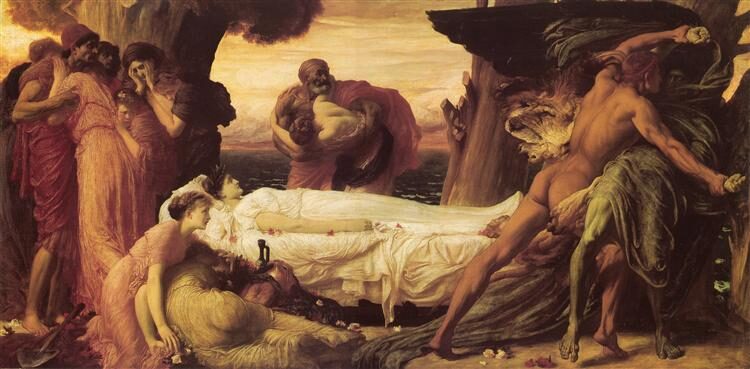
The turn of her tale is its glory. Heracles, passing through Pherae as a guest of the grieving house, learns too late of the death — and goes to the tomb, lies in wait for Thanatos (Death) himself, seizes and wrestles him, and forces him to give up his prize. He brings Alcestis back from the dead and leads her, veiled and silent, home to her husband. The woman who went down into death for love is returned alive to the light.
Mythology
The fairest daughter of Pelias
Alcestis was a daughter of Pelias, the king of Iolcus in Thessaly (the same Pelias who sent Jason after the Golden Fleece), and of his wife; of all his daughters she was, Homer says, the most beautiful (Iliad 2.714–715). Her sisters are the Peliades, the daughters who were later tricked by Medea into the killing of their own father — but Alcestis stands apart from that dark tale, remembered instead for her marriage and her sacrifice. From her union with Admetus came a son, Eumelus, who would lead the men of Pherae to Troy (Homer, Iliad 2.711–715), and a daughter.
The winning of Alcestis: the lion and the boar
Pelias would not give his daughter to any ordinary suitor. He set a bride-contest of a kind only a god's favour could meet: the man who would marry Alcestis must yoke a lion and a boar (in some tellings a lion and a bear) to a single chariot and drive the mismatched beasts. Admetus, king of Pherae, accomplished the impossible task — but not alone. He had in his household, at that time, the god Apollo himself.
Apollo the herdsman: why a god served a mortal
Apollo came to serve Admetus as a penance. When Apollo's son Asclepius was struck down by Zeus's thunderbolt (for raising the dead), Apollo in his grief killed the Cyclopes who had forged the bolt; and for that killing Zeus condemned him to serve a mortal man for a year (Apollodorus, Bibliotheca 1.9.15; 3.10.4). The master he was given was Admetus of Pherae — and Admetus treated the god so justly and so kindly that Apollo came to love him. Through the year Apollo herded the king's cattle, and under the god's tending every cow bore twins and the herds multiplied. It was Apollo who yoked the lion and the boar for Admetus and so won him his bride; and it was Apollo who, loving him still, would win him the greater mercy to come.
The bargain with the Fates: a death that may be deferred
Apollo's final gift to Admetus was the strangest. In Euripides' telling the god, by a cunning won from the Moirai (the Fates) — Apollo made them drunk, and so drew from them the concession — arranged that when the appointed day of Admetus's death arrived, he need not die, if only he could find another willing to go down to Hades in his place. Apollo, bound by his year's service to depart, could do no more; the rest lay with the house of Pherae. And so the fatal day came, and Admetus went seeking someone — anyone — to die for him.
No one will die for him — except Alcestis
Here the story turns on its cruelty and its grace. Admetus asked, and was refused. His aged father, Pheres, with little life left to him, would not give up what little remained; his mother would not; no friend, no servant, no one in all the house would consent to die so that the king might live. One soul alone offered: his wife. Alcestis, young and in the fullness of her life, with children still to raise, freely took her husband's death upon herself and prepared to die in his place. In Euripides' play she bids farewell to the marriage-bed, commends her children to Admetus, and binds him by oath never to take another wife to be their stepmother — and then, as the day declines, she fades and dies, the household filled with lamentation. Plato in the Symposium (179b–d) names her the great proof that only lovers will die for one another: the gods so honoured her deed, he says, that they granted the rare grace of sending her soul back up from Hades.
Heracles at the tomb: the wrestling of Death
Into this house of grief comes Heracles, journeying on one of his labours, and Admetus — host to the last, unwilling to turn a guest from his door even in his mourning — hides the death and receives him, giving no sign that the woman just carried out to burial is his own wife. Heracles feasts, not knowing; then a servant's grief betrays the truth, and the hero, ashamed to have revelled in a house of death and moved by his host's terrible courtesy, resolves to repay it. He goes out to the tomb, lies in ambush, and when Thanatos (Death) comes to take his portion of the offerings and claim the dead, Heracles springs upon him and seizes him in his arms. He wrestles Death body to body and will not loose his grip until Thanatos yields up his prize. Alcestis is given back.
The veiled woman restored
Heracles leads a veiled woman back to the mourning Admetus and, at first, does not say who she is — he asks the grieving king to keep her, to guard her for him until he returns from his labour. Admetus, faithful to his dead wife, refuses to take any woman into his house; only when pressed does he yield, and when the veil is lifted it is Alcestis herself, alive, brought back from the dead. In Euripides' play she stands silent — for, Heracles explains, she may not speak until the third day has purified her of her consecration to the gods below. So the play ends: the wife returned, the husband's death deferred, and a death undone by the strength of a friend and the love of a wife — one of the very few Greek tales in which the grave gives back what it has taken.
Worship — Ancient
The paragon of the faithful wife
Alcestis was honoured less as a goddess with cult than as the supreme example — the pattern of wifely love and self-sacrifice held up before all Greece. Her name became a byword: to call a woman "an Alcestis" was to name her the best and most devoted of wives. The chorus of Euripides' play prays that she be honoured even in death, a blessed spirit, and foretells that her tomb will be revered by travellers who turn aside to it as to a holy thing and say, "This woman died once for her husband, and now she is a blessed power; hail, lady, and be gracious" (Alcestis 995–1005). Whether or not a real hero-cult grew at any tomb called hers, the poetry imagines exactly the honours a heroized mortal received: offerings, salutation, and the name of a blessed one.
The story on the Greek stage
Alcestis belonged, above all, to the theatre. Euripides' Alcestis (438 BC) is her central and fullest source — produced as the fourth play of his tetralogy, in the slot a satyr-play usually held, so that it mingles grief and rescue, solemnity and a near-comic Heracles, in a way all its own. Before Euripides the poet Phrynichus had written an Alcestis, now lost, from which Euripides seems to have drawn the figure of Death coming in person for the queen. The tale was known too in the old epic and genealogical poetry — in the tradition of Hesiod and of Eumelus of Corinth, who sang of the house of Pherae — and the bare facts of her lineage stood already in Homer (Iliad 2.714–715).
In the philosophers
The thinkers took her as their proof. Plato, in the Symposium (179b–d), puts her forward through the mouth of Phaedrus as the great example that love alone will make a mortal die for another: her parents were alive, he notes, yet it was she, the wife, who died — and for that the gods gave her the almost unheard-of gift of a soul sent back from the dead. Hers was, to the Greek moral imagination, the clearest case of a love stronger than death.
Worship — Modern
A patron of faithful and sacrificial love
Alcestis is remembered today not through temple or festival but as the enduring image of love that gives itself wholly. A modern devotee drawn to her honours the virtues her story carries: fidelity between partners, the courage to put another's life before one's own, and the steady, undramatic devotion that is willing to pay the last price without being asked twice. She sits well as a patron of marriage and of the bonds of the household, and of any love measured not by feeling but by what it will give up.
Grief answered, death undone
Her tale is one of the rare Greek stories that ends in resurrection — the grave made to give back its dead — and so it speaks of hope against loss as few others do. To honour Alcestis is to hold to the thought that love can reach even into death and that devotion may be answered, past all expectation, by return. Hers is the comfort of the undone ending: the mourned one restored, the farewell unmade, the veiled figure led back into the light of home.
The veiled woman in art and letters
Alcestis has never left the Western imagination. Euripides' play has been staged and reworked for two and a half thousand years; the scene of Heracles leading the silent, veiled woman back to her husband has drawn painters and poets again and again, and writers from Milton (who dreamed of his dead wife as "my late espoused saint … like Alcestis from the grave") to Rilke, Eliot, and beyond have taken her as the figure of the beloved returned from death. She endures as the great myth of a devotion that death could not keep.
Epithets & Cult Titles
- aristē gunaikōn (ἀρίστη γυναικῶν) — Best of wives / noblest of women — the praise the chorus gives her in Euripides' play, and the name under which later Greece remembered her: the paragon against whom all wifely devotion was measured
- hē hyper andros thanousa (ἡ ὑπὲρ ἀνδρὸς θανοῦσα) — She who died in her husband's place — her defining act, named as the one thing no other soul in the house, not even his aged parents, would do for Admetus
- kallistē thugatēr Peliou — Fairest daughter of Pelias — Homer's note (Iliad 2.714–715) that of all the daughters of King Pelias, Alcestis was the most beautiful
Sources & Variants
- Homer, Iliad 2.711–715 (Alcestis, fairest of the daughters of Pelias, wife of Admetus and mother of Eumelus of Pherae)
- Euripides, Alcestis (438 BC) — the central and fullest source: the deferred death, Alcestis's sacrifice, Admetus's refused appeals to his parents, Heracles' wrestling of Thanatos at the tomb, and the veiled wife restored
- Plato, Symposium 179b–d (Phaedrus's praise: Alcestis alone would die for her husband, and the gods sent her soul back from Hades for it)
- Apollodorus, Bibliotheca 1.9.14–15 (the winning of Alcestis by the yoked lion and boar; Apollo's year of service to Admetus and the bargain with the Fates that another might die in his place; Heracles' rescue)
- Apollodorus, Bibliotheca 3.10.4 (Apollo's killing of the Cyclopes and his servitude to Admetus as penance)
- Hesiod / the Hesiodic tradition and Eumelus of Corinth (the genealogical poetry of the house of Pherae and the daughters of Pelias)
- Phrynichus, Alcestis (lost tragedy, earlier than Euripides; source of the figure of Death coming in person for the queen)
Gallery