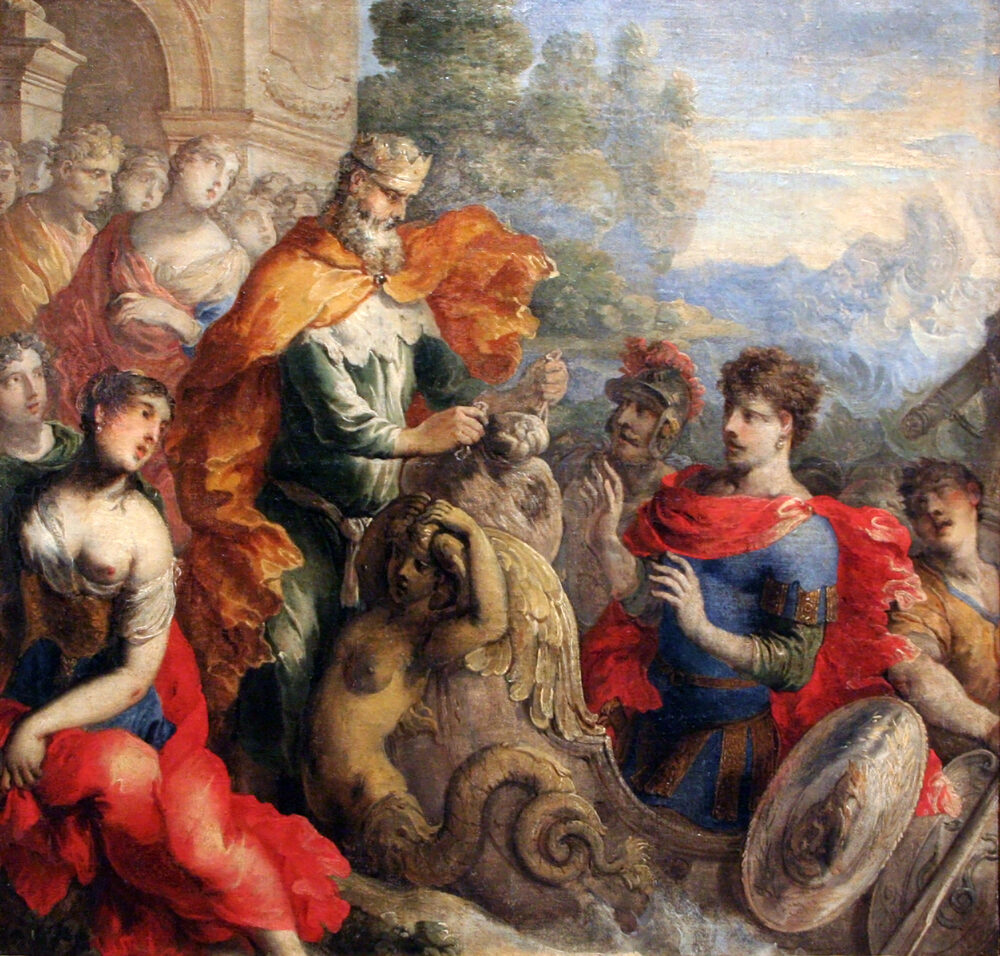
Aiolos
First Appearance
Aeolus enters Greek poetry in the Odyssey (10.1–79), where Odysseus and his men come to the floating island of Aeolia, "girt round with a wall of unbreakable bronze," home of Aeolus son of Hippotes, "dear to the immortal gods," whom Zeus has made steward of the winds, "to still them or to rouse them as he will." For a month Aeolus feasts his guest, and at parting gives Odysseus a bag made of the hide of a nine-year ox, binding within it all the blustering winds but one — leaving free only the gentle West Wind to carry the ships home to Ithaca.
— Homer, Odyssey 10.1–79
Who They Are
Aeolus (EE-oh-lus) is the keeper of the winds — the man whom Zeus appointed steward of the gales, to bind them or set them loose as he pleases, and who dwells with his great family on the floating island of Aeolia. He is best known from the tenth book of Homer's Odyssey, where he gives the wandering Odysseus the most famous gift in all of seafaring myth: an ox-hide bag with every contrary wind tied up inside it, so that only the fair West Wind is left free to blow the ships home. It is a gift of almost godlike generosity — and the occasion of one of the bitterest disasters in the whole of Odysseus's long return.
The wind-keeper is not quite a god and not quite an ordinary man. Homer calls him simply "dear to the immortal gods," a mortal (or something very near one) to whom Zeus has entrusted a power that belongs by right to heaven: the governance of the winds. He lives in a kind of blessed, enclosed happiness on his bronze-walled island, feasting endlessly with his six sons and six daughters, far from the troubles of the world — a figure of hospitality and of the sudden, chancy power of the weather, which can carry a ship home in a day or fling it to the ends of the earth.
A word of caution belongs at the start, for the ancients themselves were confused: there were three different men named Aeolus in Greek story, and the old writers tangled them together. The one who leads this page is the wind-keeper of the Odyssey. The other two — an ancestor of a Greek people, and a son of Poseidon — are untangled below, so that the keeper of the winds may be met clearly, as his own man.
Mythology
The island of Aeolia and its bronze wall
When Odysseus and his weary men sailed on from the land of the Cyclopes, they came (Homer, Odyssey 10.1–12) to Aeolia, a floating island that drifted upon the sea, "girt all about with a wall of unbreakable bronze, and the rock runs up sheer." There dwelt Aeolus son of Hippotes, dear to the immortal gods, with his household about him in unbroken feasting. It is one of the strangest and most vivid places in the whole poem — an island that does not stay still, walled in bronze, where the smoke of the feast never dies and the halls ring day and night with the sound of flutes and song.
The twelve children and the endless feast
Aeolus had twelve children — six sons and six daughters — and, in a detail the Greeks found startling, he had given his daughters to his sons as wives, so that the whole family lived together, feasting beside their father and honoured mother, with "food beyond counting" before them (Odyssey 10.5–12). By day the house was loud with banqueting; by night each son slept beside his wedded sister-bride on a corded bed. The picture is of a sealed, self-contained happiness — a family that needs nothing and no one from outside, shut away on its drifting island behind its wall of bronze.
The steward of the winds
The source of Aeolus's fame is the office Zeus gave him: he is the tamiēs anemōn, the "steward of the winds" (Odyssey 10.21), the one "whom the son of Cronos made keeper of the winds, to still them or to rouse them, whichever he will." This is a remarkable trust — the control of the gales, which even the gods treat as a force to be reckoned with, placed in the hands of a man on an island. Aeolus does not command the winds as their maker, but keeps them, as a steward keeps a storehouse: binding them up, letting them out, holding the power of fair passage and foul over every ship upon the sea.
The gift of the bag of winds
For a whole month Aeolus received Odysseus as his guest and questioned him closely about Troy and the homeward voyage of the Greeks; and when Odysseus asked leave to depart, Aeolus sped him on his way with an extraordinary parting-gift (Odyssey 10.19–27). He took the hide of a nine-year-old ox, and in this bag he bound fast "the blustering winds," for Zeus had made him their keeper; and he tied the bag inside Odysseus's hollow ship with a bright silver cord, "that not even a little should escape." Then he sent forth only the West Wind (Zephyros) to blow, to carry the ships and their men home. It was a gift of almost impossible generosity — safe passage itself, handed over in a sack.
The opening of the bag, and the ruin
For nine days and nights they sailed, and on the tenth the fields of Ithaca rose into view, so near that they could see the watch-fires burning on the shore (Odyssey 10.28–55). Then Odysseus, who had held the sheet himself the whole way and never slept, at last gave in to weariness and slept — and his men, who had watched him, began to murmur. They supposed the bag held silver and gold, a rich treasure that Aeolus had given their captain and that he meant to keep for himself while they came home empty-handed. "Let us see," they said, "how much gold and silver is in the bag" — and they loosed the silver cord. At once all the winds rushed out together, and the storm seized the ships and swept them, wailing, back out to sea, far from their own country. Odysseus woke to find Ithaca gone from sight. In his grief he debated whether to fling himself from the deck and drown, but endured, and lay covered on the deck while the gale drove the ships back the whole long way to Aeolia.
Turned away from the door
So they came a second time to the floating island, and Odysseus went up to the hall where Aeolus sat at meat with his wife and children, and sat down, a suppliant, on the threshold (Odyssey 10.56–76). Astonished, they asked what evil power had wrecked his careful sending-home; and Odysseus confessed the truth — that his own men and a wretched sleep had undone him — and begged for help a second time. But Aeolus would not give it. "Begone from this island at once," he cried, "most contemptible of living things! It is not lawful for me to help or to send on his way a man hated by the blessed gods — and hated you surely are, to come here so." And he drove Odysseus from his door. It is a chilling moment: the most generous host in the Odyssey turns, in an instant, into a man who will not risk the anger of heaven for a guest the gods have cursed. The wind-keeper's hospitality, so lavish while fortune smiled, has a hard and prudent limit.
Three men named Aeolus
The ancients themselves confused three different men named Aeolus, and it helps to set them plainly apart:
(1) Aeolus the wind-keeper — the one of this page, son of Hippotes (hence his title Hippotadēs), the steward of the winds on the floating island of Aeolia in the Odyssey (Homer, Odyssey 10). He is a figure of the sea and the weather, not of any genealogy of nations. Later Greek and Roman writers sometimes located his island among the volcanic Aeolian Islands off Sicily (named for him), and tried to tidy the confusion by making him a descendant of one of the other two Aeoli — but Homer, the oldest source, gives him no such pedigree; he is simply the man whom Zeus made keeper of the winds.
(2) Aeolus son of Hellen — a wholly separate figure, the mythical ancestor of the Aeolian Greeks. In the standard genealogy (Apollodorus, Bibliotheca 1.7.3) Hellen, son of Deucalion, had three sons — Dorus, Xuthus, and Aeolus — from whom the great divisions of the Greek people descended; this Aeolus became king of Thessaly and father of a large brood of sons and daughters (Sisyphus, Athamas, Cretheus, Salmoneus, and others) who founded many ruling houses. He is an eponym, a name coined to explain the Aeolians and their dialect, and has nothing to do with the winds.
(3) Aeolus son of Poseidon — a third man, son of the sea-god Poseidon and the mortal Arne (or Melanippe), twin brother of Boeotus (Diodorus Siculus 4.67; Apollodorus is likewise aware of the tangle). This Aeolus ruled in the regions about the Tyrrhenian Sea and, in some accounts, in the islands off Sicily. Because his realm lay in the same western waters later poets assigned to the wind-keeper, ancient writers increasingly merged him with figure (1) — and so by the Hellenistic and Roman periods the three Aeoli were often melted down into a single composite "Aeolus," ruler of the Aeolian Islands and master of the winds. The oldest and clearest sources keep them apart; it is the later synthesizers who blurred them.
In later and Roman poetry
The wind-keeper's later fame owes much to Roman poetry, which should be flagged as later and Roman, not early Greek. In Virgil's Aeneid (1.50–80) — Roman — Aeolus is no longer a mortal host on a floating island but a king set by Jupiter over the winds, which he keeps imprisoned in a vast mountain cavern, holding them down "with sovereignty and chains," and loosing or curbing them at command. There the goddess Juno (the Roman Hera), hating the Trojans, comes to bribe Aeolus to raise a storm against Aeneas's fleet — promising him a nymph, Deiopea, as wife — and Aeolus obliges, striking the hollow mountain with his spear so that the winds burst out and the great tempest falls upon the Trojans. This cavern-king who answers to the gods' bidding is largely a Roman development of Homer's older, stranger figure, the private steward on his drifting bronze-walled isle.
Worship — Ancient
A figure of the sea, not the temple
Aeolus was not, in the ordinary sense, a god with temples, priesthood, and festivals; he was a figure of myth and of the seafarer's imagination rather than an object of civic cult. His presence was felt wherever the Greeks, a people of ships, reckoned with the winds — in the prayer for a fair breeze at the launching of a voyage, in the dread of the sudden gale, in the sailor's sense that the weather was governed by a power that could be kind or cruel. To hold the winds was to hold the lives of seamen, and the figure of the man who kept them spoke directly to that daily peril.
The Aeolian Islands
Aeolus left his clearest mark on the map. The volcanic archipelago off the north coast of Sicily — the Aeolian Islands (among them Lipari and Stromboli, with their smoking vents and sudden squalls) — was named for him in antiquity, for later Greeks and Romans placed his wind-keeping realm among them. Ancient writers reasoned that a people living among islands of such changeable and violent weather, where a watcher could read the coming winds from the smoke of the vents, would naturally be ruled by the keeper of the winds; and so geography and myth were fitted together, the restless isles given the restless god.
Reading the winds
The historian and others of a rationalizing turn liked to explain Aeolus as a real early king of those islands — a shrewd observer of weather who, from the smoke and flame of the volcanoes and the look of the sea, learned to foretell the winds so well that sailors said he "kept" them and could grant a fair passage. In this reading the "steward of the winds" was simply the first great weather-prophet, whose skill at prediction hardened, in the telling, into a mastery over the gales themselves. Whether taken as god, king, or canny forecaster, Aeolus stood always for the one thing the seafaring Greeks most needed and least controlled: the wind.
Worship — Modern
Patron of winds and wanderers
Aeolus is remembered today less through formal cult than through the enduring image the Odyssey gave him — the keeper of the winds and the giver of the fatal bag. A modern devotee drawn to him might honour him at the edge of a journey, in the old sailor's way: a prayer or libation for a fair wind and safe passage, an acknowledgement of the great chancy powers of weather and sea that no care can wholly master. He sits well as a patron of travellers and voyagers, of the hospitality owed to the stranger, and of the hard lesson that even the most generous gift can be undone by a moment's mistrust.
The bag of winds as a byword
The gift of the bag has long outlived its myth. The ox-hide sack with the gales tied up inside — safe passage handed over, and then thrown away by his own men's greed and suspicion on the very threshold of home — has become one of the great images of self-inflicted ruin, of a prize lost through folly at the last moment. To "open the bag of winds" is to undo one's own good fortune by prying where trust was asked. Whoever has watched a hard-won success wrecked by distrust or carelessness within reach of the goal has met the story of Aeolus's bag, which keeps its force wherever the tale of Odysseus is read.
A name on the wind
Aeolus lives on, too, in the very language of the winds. The word aeolian means "of the wind, wind-borne," and an aeolian harp is an instrument sounded not by hands but by the breeze passing over its strings — the wind itself made music, and named for the keeper of the winds. Geologists speak of aeolian deposits, the sand and dust laid down by wind; and the Aeolian Islands still bear his name on the map. So the steward of the gales, who in the old poem could tie every wind in a bag, is remembered wherever the wind is named for him — in the harp that sings in the draught, and in the restless, smoking isles that carry his name across the sea.
Epithets & Cult Titles
- tamiēs anemōn (ταμίης ἀνέμων) — Steward / keeper of the winds — Homer's own title for him (Odyssey 10.21), the office on which his whole fame rests: the man appointed by Zeus to restrain and release the gales as he pleases
- Hippotadēs (Ἱπποτάδης) — Son of Hippotes — Homer's patronymic for the wind-keeper (Odyssey 10.2), the name that keeps him distinct from the other men called Aeolus
- philos athanatoisi theoisin (φίλος ἀθανάτοισι θεοῖσιν) — Dear to the immortal gods — Homer's phrase for him (Odyssey 10.2), marking that the winds were his to govern by the gods' own favour and appointment
Sources & Variants
- Homer, Odyssey 10.1–79 (Aeolus son of Hippotes on the floating bronze-walled island of Aeolia; the twelve children and the endless feast; steward of the winds by Zeus's appointment; the gift of the ox-hide bag of winds; the opening of the bag and the ruin; the suppliant turned from the door)
- Apollodorus, Bibliotheca 1.7.3 (Aeolus son of Hellen, eponymous ancestor of the Aeolians, king of Thessaly, and his many children)
- Diodorus Siculus, Library of History 4.67 (the genealogical Aeoli and the confusion among the three; Aeolus son of Poseidon and Arne in the western islands)
- Virgil, Aeneid 1.50–80 (Aeolus as king of the winds imprisoned in a mountain cavern; Juno bribes him to raise the storm against the Trojan fleet) — later, Roman
Gallery