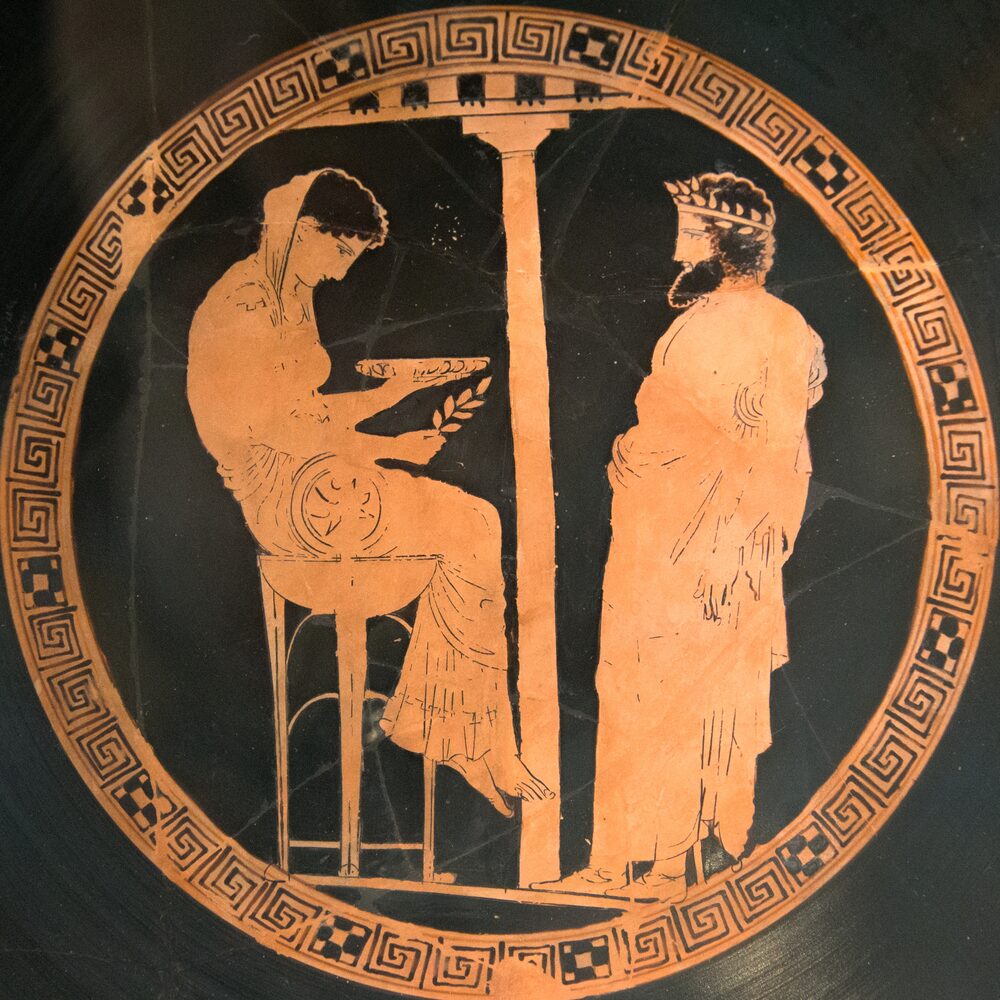
Aigeus
First Appearance
Aegeus enters the fullest surviving tellings as the childless king of Athens who goes to Delphi to ask the god how he may get a son (Apollodorus, Bibliotheca 3.15.6). The oracle answers in a riddle he cannot read — that he must not loose the jutting neck of the wineskin until he comes again to Athens — and on his way home he stops at Troezen with Pittheus, who understands the god's meaning, makes Aegeus drunk, and lays him with his daughter Aethra; so Theseus is conceived. Plutarch's Life of Theseus (3-6) tells the same beginning and adds the tokens Aegeus hides beneath a great rock — his sword and his sandals — the signs by which, years later, the grown son will be known to his father.
— Apollodorus, Bibliotheca 3.15.6-3.16.1; Plutarch, Life of Theseus 3-6
Who They Are
Aegeus (EE-jee-us) is the king of Athens whose name the sea itself still carries — the long-childless ruler who became, late and by a strange road, the father of Theseus, the hero who would unite Attica. He is counted here among the heroes, though he is a king rather than a monster-slayer, because his life is one of the great tragic patterns of Athenian myth: a man who longed for a son, begot one in secret and at a distance, found him again at the very edge of losing him to poison, and then — through a single forgotten promise — lost his own life believing that son was dead. Out of that death the Greeks named their sea.
His story is told in three movements. First, the childless king goes to Delphi and is given an oracle he cannot interpret — "loose not the wineskin's neck until you reach Athens" — and on the road home is received at Troezen by Pittheus, who reads the riddle, and contrives that Aegeus lie with his daughter Aethra; Theseus is conceived, and Aegeus hides his sword and sandals under a great rock as tokens for the boy to lift when grown. Second, back in Athens, Aegeus marries the sorceress Medea, who — knowing the arriving youth for his unrecognised son — nearly persuades the king to poison him, until Aegeus sees his own sword at the young man's side and dashes the cup away in time. Third and last, Theseus sails against the Minotaur of Crete, promising to change his black sail to white if he returns alive; he forgets; and Aegeus, watching from the headland, sees the black sail, believes his son dead, and throws himself into the sea.
He is thus a figure of fatherhood and of grief — of a joy found late and lost through a small forgetting — and the Athenians, who loved him as one of their ancient kings, kept his memory in the name of the water that took him: the Aegean.
Mythology
The childless king and the oracle at Delphi
Aegeus was king of Athens, a ruler of the old Erechtheid line — son of Pandion (himself a son of the royal house driven out and restored), and heir to the kingship of Attica. But he had no child, and the want of an heir weighed on him; his two marriages had given him no son. So, as Apollodorus tells (Bibliotheca 3.15.6), he went to Delphi, to the oracle of Apollo, to ask the god how he might at last beget a child.
The answer came, as Delphic answers so often did, in words he could not read. In Plutarch's rendering (Life of Theseus 3) the god said: "Loose not the jutting neck of the wineskin, O best of men, until thou art come again to the height of Athens." It was a riddle — the "wineskin" and its "neck" a figure the king could not untangle — and Aegeus turned homeward no wiser than he had come, carrying an oracle he did not understand.
Troezen: Pittheus, Aethra, and the begetting of Theseus
On the road home Aegeus broke his journey at Troezen, across the Saronic Gulf, at the house of Pittheus, its king — a man famed in the old stories for his wisdom and his skill with words. Pittheus heard the oracle and understood at once what the god had meant: that Aegeus should not lie with a woman — not "loose the wineskin" — until he was home, for the son so begotten would be great. Wanting that greatness for his own house, Pittheus made Aegeus drunk and brought him that night to his daughter Aethra (Apollodorus, Bibliotheca 3.15.7; Plutarch, Life of Theseus 3-4). So Theseus was conceived at Troezen, far from Athens — the oracle fulfilled against its own warning, the son got in the very loosing the god had forbidden until home.
Before he left, Aegeus did a thing that would shape his son's whole beginning. He took his sword and his sandals and hid them beneath a great rock, and told Aethra that if she bore a son, she should rear him without telling whose he was; and when the boy was grown and strong enough to roll aside the rock and take up the tokens beneath it, she should send him to Athens with sword and sandals, by which his father would know him (Plutarch, Life of Theseus 3-4, 6). Then Aegeus returned alone to Athens. The sword under the stone is one of the memorable images of Greek myth — the father's recognition-token waiting in the earth for the strength of a son not yet born.
Athens and Medea: the poisoned cup
Back in Athens, Aegeus took into his household the sorceress Medea, who had fled there after the horrors of Corinth; by her he had a son, Medus, and she promised with her arts to cure his childlessness (Apollodorus, Epitome 1.5-6; Plutarch, Life of Theseus 12). It is this moment of Aegeus's life that the Athenian stage knew best: in Euripides' Medea (663-758) the king appears on his way back from consulting an oracle about his lack of children, meets Medea at Corinth, and swears to give her refuge in Athens — the scene that binds the sorceress to his house. Euripides treated the aftermath — the poisoning — in a separate play, his lost Aegeus.
When Theseus, grown, had made his way to Athens overland, clearing the road of its bandits, he came to his father's court still unrecognised — for Aegeus did not know the stranger for his son. Medea knew. Fearing that this youth would displace her own child, she persuaded the aging king that the newcomer was a danger and must be put out of the way, and prepared a cup of poison (in the usual telling, aconite) for Theseus at the feast. But as the young man drew his sword — in some tellings to carve the meat, in others as Aegeus caught sight of the blade at his side — the king recognised his own hidden sword, the token from beneath the Troezen rock, and knew the stranger for his son. He struck the poisoned cup from Theseus's hand, dashing it to the ground before it reached his lips (Plutarch, Life of Theseus 12; Apollodorus, Epitome 1.5-6). Medea, exposed, fled Athens with her son Medus. So Aegeus found the heir he had crossed the sea to Delphi for — recovered at the very edge of murdering him unknowing.
The black sail: Aegeus and the Aegean Sea
The last movement of Aegeus's story is its most famous, and it gave a sea its name. Athens at this time lay under a cruel tribute to Minos of Crete: every ninth year (or yearly, in some accounts) the city had to send seven youths and seven maidens to be devoured by the Minotaur in the Labyrinth. Theseus resolved to go among them and kill the monster, to free the city from the tribute. As the black-sailed ship of the tribute put out, Aegeus gave his son a white sail (or, in some tellings, a scarlet one) to carry with him, and made him promise: if he came home alive, he was to hoist the white sail in place of the black, so that his father, watching from afar, might know from the colour of the sail — before the ship even reached the shore — whether his son lived or had died (Plutarch, Life of Theseus 17; Apollodorus, Epitome 1.7-11).
Theseus killed the Minotaur, and with the help of Minos's daughter Ariadne won free of the Labyrinth and sailed for home. But — whether for grief at the loss of Ariadne, left on Naxos, or simply because the joy and sorrow of all that had happened drove it from his mind — he forgot the signal, and the ship came on toward Attica still flying its black sail (Plutarch, Life of Theseus 22; Apollodorus, Epitome 1.10). Aegeus was keeping watch for it. Pausanias (1.22.4-5) places him on the Acropolis itself, near the sanctuary of Athena Nike, straining to see the returning ship; a later and popular tradition sets his watch on the cliffs of Cape Sounion, the southern headland of Attica above the sea. From his height he saw the black sail far out on the water, and believed his son dead. In his grief the old king cast himself down — from the rock of the Acropolis in Pausanias's account, from the headland into the water in the other — and died. And because, in the version the Athenians loved best, he fell into the sea, the water was ever after called the Aegean (Aigaion pelagos), named for Aegeus who drowned in it. His son came home victorious to find his father dead, and the city's joy at the Minotaur's end turned to mourning for the king — grief and triumph arriving on the same black-sailed ship.
Worship — Ancient
A hero-king of Athens
Aegeus was honoured not as a god with temples of his own but as one of the ancient hero-kings of Athens — a figure of the city's own royal past, of the Erechtheid line through which the Athenians traced their kings back to the earth-born rulers of Attica. His memory lived in the places Athens kept for him and in the festival-cycle of his son Theseus, whose cult the city tended with great devotion. The city that called itself the home of Theseus could not forget the father who begot and lost him.
The places of his story
Several spots in and around Athens held his memory. The Delphinion, the sanctuary of Apollo Delphinios, was linked in local tradition to the moment Theseus came to his father's city. On the Acropolis, near the little temple of Athena Nike at its western edge, the Athenians remembered the place from which Aegeus was said to have watched for the ship and fallen — so that the very approach to the citadel carried the story of the watching king (Pausanias, Description of Greece 1.22.4-5). Across the gulf at Troezen, where Theseus was conceived and reared, local cult kept alive the tale of the sword and sandals hidden beneath the rock, and the Troezenians showed the stone to visitors as a relic of the myth.
The sea that bears his name
The greatest and strangest of his memorials needed no temple at all: the Aegean Sea. In the account the Athenians favoured, the sea took its name from Aegeus, who drowned in it believing his son dead. Thus the whole breadth of water between Greece and Asia carried, in its very name, the memory of an Athenian king's grief — a monument no building could rival, renewed every time a sailor named the sea he crossed.
Worship — Modern
The father in the story of the son
Aegeus is remembered today chiefly as the father of Theseus, and his myth is read most often for what it says about fathers and sons, about longing for a child and losing one, and about the terrible weight of a small forgetting. A modern reader drawn to him meets a figure very human beneath the crown: a man who wanted an heir so badly he crossed the sea to ask a god; who nearly killed his own son without knowing him, and was saved from it by a sword hidden years before; and who died of grief at a signal his living son forgot to give. His is one of the most quietly devastating of the Greek stories — not a hero cut down in battle, but a father undone by hope and a mistaken glance at a sail.
The Aegean, still named for him
Above all, Aegeus survives in the name of the sea. Every map of Greece, every account of the islands, every ship's course between the mainland and the coast of Asia carries his name in the word Aegean — and the old Athenian story that the sea was named for a king who threw himself into it is still told to explain it. To speak the name of that bright, island-scattered water is, in the Greek understanding, to keep the memory of Aegeus: the childless king who found a son and lost him, and whose grief became a sea.
A patron of fatherhood and of the kept promise
Read for devotion rather than only for tragedy, Aegeus stands well as a figure of fatherhood long awaited and dearly held, and — by the dark example of the forgotten sail — of the promise that must be kept, the signal that must be remembered, the small faithfulness on which great outcomes turn. His story asks its reader to remember the white sail: to do the small remembered thing that spares those who watch for us from needless grief.
Epithets & Cult Titles
- basileus Athēnaiōn (βασιλεὺς Ἀθηναίων) — King of the Athenians — his defining title, the ruler of Athens in the generation before the city's great hero Theseus, and the last king of the old line before his son's reign
- father of Theseus — The office by which he is best remembered — the long-childless king who begot, lost, and found again the hero who would unify Attica; his whole story turns on this fatherhood
- the eponym of the Aegean — He who gave his name to the sea — the Aigaion pelagos (Αἰγαῖον πέλαγος), the Aegean, was said by the Athenians to be named for Aegeus, who cast himself into it; the water keeps his name to this day
Sources & Variants
- Apollodorus, Bibliotheca 3.15.6-3.16.1 (Aegeus childless, the Delphic oracle of the wineskin, Pittheus and Aethra at Troezen, the conception of Theseus, the sword and sandals hidden beneath the rock)
- Apollodorus, Epitome 1.5-6 (Medea in Aegeus's house; her plot against the unrecognised Theseus and the poisoned cup; Aegeus recognises his sword)
- Apollodorus, Epitome 1.7-11 (the Cretan tribute and the Minotaur; the sail-signal; Theseus forgets and Aegeus's death)
- Plutarch, Life of Theseus 3-6 (the oracle 'loose not the wineskin's neck'; Pittheus, Aethra, and the begetting; the tokens under the rock and Aegeus's charge to Aethra)
- Plutarch, Life of Theseus 12 (Medea and the poisoned cup; Aegeus recognises the sword and strikes the cup away)
- Plutarch, Life of Theseus 17 and 22 (the black and white sails; Theseus forgets to change the sail; Aegeus sees the black sail and dies)
- Euripides, Medea 663-758 (the Aegeus scene: the childless king returning from the oracle meets Medea and swears to shelter her at Athens)
- Euripides, Aegeus (lost play; treated the poisoning of Theseus — known from fragments and later summaries)
- Pausanias, Description of Greece 1.22.4-5 (Aegeus watches from the Acropolis near the sanctuary of Athena Nike and casts himself down at the sight of the black sail)
- Pausanias, Description of Greece 1.27-28 and 2.31-33 (Athenian and Troezenian memorials of Aegeus and the sword-and-sandals tokens)
- Catullus 64.212-248 (the sails and Aegeus's death from the headland) — Roman retelling
Gallery